BIRM-166’s Pollen Census31405 BCE
31,405 BCE cannot denote a precisely dated Irish event, but falls within Marine Isotope Stage 3. At Derryvree, County Fermanagh, freshwater sediments between glacial tills, dated broadly to 34,950–29,750 BCE, preserve pollen, plants, mosses and beetles from an ice-free, treeless periglacial wetland. Comparable deposits confirm episodic cold open habitats, while Crag Cave records warmer interstadials. Castlepook Cave, County Cork, yielded cold-adapted fauna and a reindeer femur possibly bearing butchery marks, suggesting, but not proving, brief human presence. Later glaciation damaged evidence. No settlements, polities, trade or sustained occupation can be demonstrated; the period is reconstructed from environmental and faunal archives.

Dateline
A modern label such as 31,405 BCE suggests a precision that the evidence cannot sustain. No community in Ireland recorded a year in this manner, and neither archaeology nor palaeoclimate science can isolate an event to this particular calendar year. The date corresponds approximately to 33,355 calendar years before 1950, within Marine Isotope Stage 3, a volatile interval of the last Ice Age. The most useful Irish evidence belongs to broad calibrated ranges, not annual entries. In particular, an organic deposit at Derryvree, near Maguiresbridge in County Fermanagh, has been placed at about 36,900–31,700 calibrated years BP, or roughly 34,950–29,750 BCE. Thus 31,405 BCE falls within the span in which its evidence may be relevant, but it cannot be identified as a discrete moment within it.
A Wetland Between Ice Advances
Derryvree is the essential Irish archive for this horizon. Road-cutting through a drumlin in 1969 exposed freshwater silts and fine sands trapped between two thick tills: sediments left by separate incursions of glacier ice. The intervening layers preserved organic material dated to 30,500 radiocarbon years BP, with a substantial laboratory uncertainty. Calibration converts that measurement into a much wider calendar range. The result establishes an important point of geography rather than a dated historical episode: during part of this interval, north-central Ireland contained ice-free ground, freshwater and living vegetation before later ice overran and sealed the deposit.
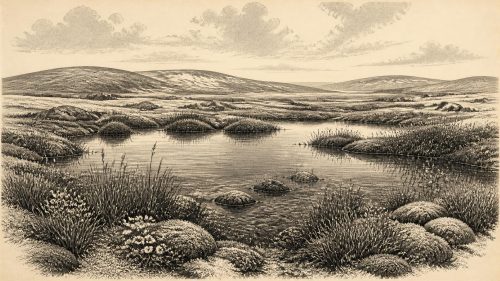
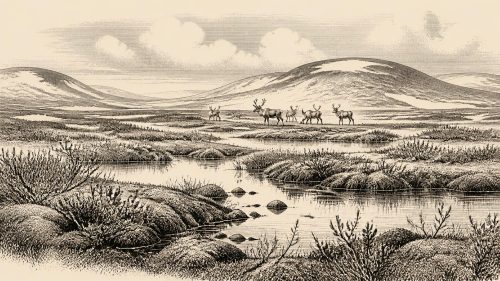
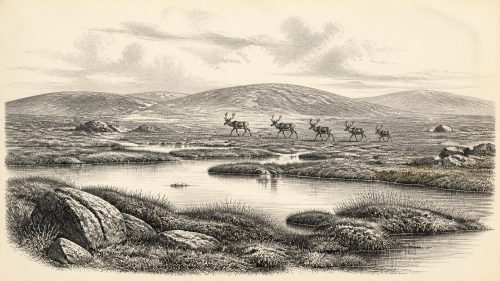
The fossils make the scene unusually tangible. Plant remains, pollen, mosses and beetles indicate an open, treeless, periglacial landscape, often described as tundra or muskeg. Muskeg here means waterlogged, peaty ground with mossy surfaces, sedge-rich margins and shallow pools. It was neither a modern Irish bog nor an unbroken frozen desert. Small bodies of standing water supported aquatic plants; wet ground accumulated organic matter; beyond them lay sparse, low-growing vegetation exposed to cold winds. The insects and plants are direct evidence of habitat. Reconstructing how the whole countryside looked beyond the sampled basin is an informed interpretation, albeit a strong one.
Comparable Middle Midlandian deposits at Greenagho, also in Fermanagh, and earlier work at Hollymount and Aghnadarragh reinforce the picture of cold, open landscapes in the north. They do not prove that every valley was identical at the same time. Local shelter, drainage, altitude and the shifting edge of ice would have mattered greatly. But together they disprove an older, simple image of an Ireland wholly entombed beneath ice throughout the final glacial cycle. The island’s Ice Age history was episodic: phases of severe cold, restricted ice-free refuges or expanses, and ultimately the major expansion of the last Irish Ice Sheet.
Climate Without a Single Season
The Derryvree material points to harsh winters and short productive summers. Arctic-alpine plants could grow in the brief thaw season, while persistent frost and seasonal freezing shaped soils and restricted trees. Yet the wider climate was not static. A study of calcite formations in Crag Cave, County Kerry, shows that cave-water conditions in south-west Ireland repeatedly became suitable for speleothem growth during warmer Greenland interstadials of Marine Isotope Stages 3 and 2. Because calcite deposition requires liquid water moving through the cave, these episodes register meaningful environmental shifts, although they do not provide a local weather diary for Fermanagh.
For 31,405 BCE, therefore, the responsible description is of a changing cold-stage Ireland, not a single fixed climate. Derryvree’s date range overlaps several millennial-scale North Atlantic fluctuations. Its sediment sequence records a cold, open wetland under periglacial conditions; it cannot establish the temperature, snowfall or duration of a particular year. The approaching expansion of the British–Irish Ice Sheet was a long geological process rather than an invasion on a known date. Modern reconstructions show ice growth and maximum positions differed between sectors, while much of the decisive advance around Ireland came later, especially from the late twenties into the low twenties thousands of years ago.
Animals in the Open Country
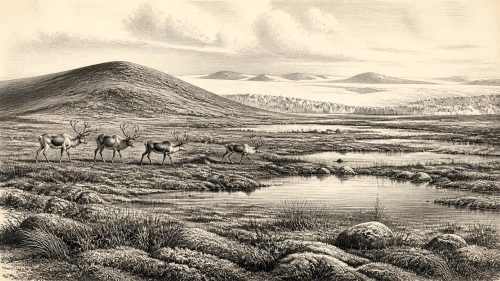
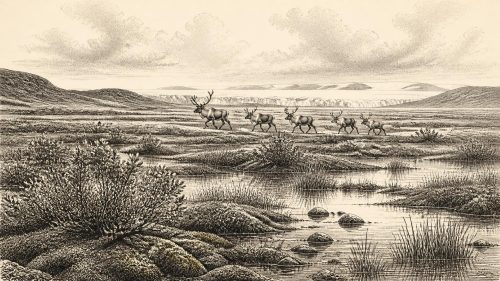
The best evidence for larger animals comes chiefly from Castlepook Cave, near Doneraile in north County Cork, rather than from Derryvree. Its deposits and old bone collections have produced an Ice Age fauna including reindeer, woolly mammoth, spotted hyaena, brown bear, fox, hare and lemming. Such an assemblage belongs to open country capable of sustaining grazing animals and their predators or scavengers. It makes reindeer a plausible part of Irish landscapes in the broader period, but it would be wrong to place a herd at Derryvree in 31,405 BCE as though an observer had seen it.
Castlepook also teaches caution. A cave bone is not necessarily evidence from the place where an animal died. Carnivores can drag carcass parts into caves; water and slope processes can move material; repeated use over millennia creates mixed deposits; and early twentieth-century excavations did not preserve the contextual detail expected today. Improved radiocarbon pretreatment and redating have revised the ages of Castlepook fauna markedly, showing both how valuable the collection is and why older chronologies must be handled critically. The evidence securely demonstrates that cold-adapted animals reached Ireland during Marine Isotope Stage 3. It does not provide a complete census, a population estimate or a continuous sequence of occupation.
The Narrow Human Question
One reindeer femur from Castlepook has made this period especially significant for Irish prehistory. It has been reported as approximately 33,000 years old and bears a deep mark interpreted as possible evidence of stone-tool butchery. If that interpretation is confirmed, it would indicate that people handled a reindeer in Ireland during the later part of Marine Isotope Stage 3, enormously earlier than the long-established record of post-glacial settlement. It is relevant to the broad timeframe around 31,405 BCE, but cannot be assigned to that numbered year.
Its limits matter as much as its promise. The date is that of the animal bone, not an exact time stamp for the incision; the specimen was not recovered as part of a modern, securely excavated living floor; and there is no associated house, hearth, stone-tool scatter, human burial or storage feature of comparable age. Accordingly, the femur may record a brief visit by mobile hunter-gatherers and the processing of a carcass, not a settled population. Recent controlled excavation at Castlepook has located further stratified Pleistocene deposits, offering the prospect of firmer evidence, but it has not transformed this single find into proof of enduring habitation.
No Polities, No Proven Trade
There is no responsible basis for describing Irish kingdoms, leaders, wars, alliances or diplomacy at this date. Nor is there evidence for villages, farming, domestic animals, pottery, metalworking, monuments, formal burial or organised religion. Any people represented by the Castlepook bone would have belonged to Upper Palaeolithic hunter-gatherer worlds known elsewhere in north-west Europe, but Ireland has not yielded enough securely contextualised material to identify their language, kinship system, beliefs, artistic practices or route of travel.
The same restraint applies to economy and trade. Reindeer meat, marrow, hide, sinew and bone would have been valuable resources to hunter-gatherers who obtained a carcass, but the Irish record cannot demonstrate regular hunting territories or exchange networks. A possible human visit must not be inflated into a trading community. Even the question of access is complex: lower sea levels altered the geography of the Irish Sea, while ice extent, coastlines, water barriers and temporary land connections varied. Whether a passable terrestrial route existed at a particular point depended on several interacting conditions, and cannot be assumed merely because sea level was lower.
An Island’s Fragile Archive
What can be said is consequential. Around the broad interval represented by 31,405 BCE, parts of Ireland were capable of supporting cold-stage wetland vegetation and Ice Age animals. Fermanagh’s buried silts preserve the biological record of an ice-free periglacial basin; Cork’s caves preserve a fragmentary faunal record and a possible sign of human butchery. Later glaciation eroded, buried and rearranged much of the landscape, so the scarcity of evidence is not proof that nothing happened. It is, however, a reason to distinguish possibility from demonstration.
This is a prehistory of pollen grains, seeds, beetle fragments, cave bones and sediment layers rather than named people or narrated events. BIRM-166, the laboratory number attached to Derryvree’s radiocarbon determination, is a fitting emblem for it: an apparently technical label that opens a narrow window on an Irish landscape of pools, sedges, mosses, frost and animal movement before the greatest ice advance of the last glaciation reshaped the island again.
Primary Sources
- A Middle Midlandian Freshwater Series at Derryvree, Maguiresbridge, County Fermanagh, Northern Ireland
- Early Midlandian–Middle Midlandian, Pleistocene, Northern Ireland
- Middle Midlandian Interstadial Deposits at Greenagho, Near Belcoo, County Fermanagh, Northern Ireland
- Quaternary Deposits and Glacial Stratigraphy in Ireland
- Irish Pleistocene Biostratigraphy
- Episodic Speleothem Deposition Tracks the Terrestrial Impact of Millennial-Scale Last Glacial Climate Variability in SW Ireland
- A Reconsideration of the Radiocarbon Dating of the Marine Isotope Stage 3 Fauna from Southern Ireland
- The Irish Quaternary Fauna Project
- 2022:564 – Castlepook Cave, Castlepook South, Cork
- Archaeological Heritage of County Cork
- Trimlines, Blockfields and the Vertical Extent of the Last Ice Sheet in Southern Ireland
- Late Pleistocene Chronostratigraphy and Ice Sheet Limits, Southern Ireland
- Last Glacial Maximum Cirque Glaciation in Ireland and Implications for Reconstructions of the Irish Ice Sheet
- Growth and Retreat of the Last British–Irish Ice Sheet, 31,000 to 15,000 Years Ago: the BRITICE-CHRONO Reconstruction
- The IntCal20 Northern Hemisphere Radiocarbon Age Calibration Curve (0–55 cal kBP)
- The Greenland Ice Core Chronology 2005, 15–42 ka
- Deglaciation, Earth Crustal Behaviour and Sea-Level Changes in the Determination of Insularity: A Perspective from Ireland
- The Problem of a Late Quaternary Landbridge Between Britain and Ireland
- Advances in Irish Quaternary Studies
- New Insights on the Fauna of Ireland’s Younger Dryas and Early Holocene from Alice & Gwendoline Cave