
Derryvree’s Freshwater Window
About 31,843 BCE, Ireland lay within the climatically unstable Late Pleistocene, before the last British–Irish Ice Sheet reached its maximum. Freshwater sediments at Derryvree, County Fermanagh, dated broadly to this period, preserve evidence of ice-free wet tundra, mosses, sedges and herbaceous vegetation between glacial advances. Cave records and faunal collections indicate fluctuating milder phases and varied mammals, including reindeer, mammoth and hyaena, although deposits cannot reconstruct single communities. Possible cut marks on a Castlepook reindeer bone suggest a human visit, not settlement. Subsequent ice expansion destroyed or buried much evidence, leaving fragmentary environmental archives rather than a documented human society.
View Record
Derryvree’s Frostbound Pool
At 31,844 BCE, Ireland lacks a recoverable annual history; evidence instead describes a changing Late Pleistocene environment. Derryvree, County Fermanagh, preserves freshwater silts between glacial tills, radiocarbon-dated broadly to a range encompassing this period. Plant remains indicate cold, open tundra with wetland niches, rather than continuous ice cover. Castlepook Cave fauna demonstrate cold-stage mammals, including mammoth, reindeer and predators, although disturbed contexts limit conclusions. A possibly tool-marked reindeer bone suggests brief human presence, but remains unconfirmed. Lower sea levels and shifting ice shaped uncertain routes. Approaching later maximum glaciation erased much evidence, leaving deposits and bones as crucial scientific archives.
View Record
Castlepook’s Open Season
At the notional date of 31,845 BCE, Ireland lay within the climatically unstable MIS 3 phase of the last Ice Age, approaching wider glaciation but retaining varied ice-free environments. Fermanagh sediments demonstrate freshwater habitats during broad calibrated ranges encompassing this period. Castlepook Cave in County Cork preserves Ireland’s richest Ice Age vertebrate collection, including mammoth, reindeer, giant deer, bears and hyaenas, deposited over millennia. A reportedly cut-marked reindeer femur, about 33,000 years old, may indicate brief Upper Palaeolithic butchery. However, it cannot prove permanent settlement or society. Glacial erosion, complex cave deposits and uncertain dating require caution; animals certainly ranged.
View Record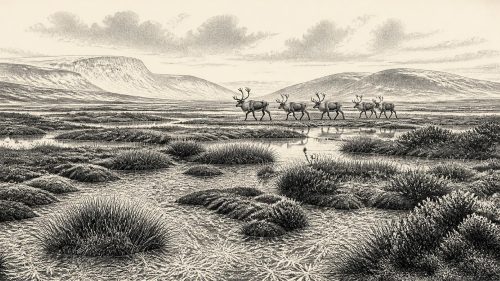
Derryvree’s Moss and Silt
The modern label 31,846 BCE denotes a broad MIS 3 Ice Age interval, not a datable Irish event. At Derryvree, County Fermanagh, buried organic silts, pollen, plants and insects record cold, treeless tundra wetlands, indicating that parts of Ireland supported freshwater habitats before major ice-sheet expansion. Castlepook Cave, County Cork, preserves disturbed but important remains of reindeer, mammoth, bears, wolves, lemmings and other fauna, though species were not necessarily contemporaneous. A cut-marked reindeer femur may indicate Upper Palaeolithic butchery around 31,000 BCE, yet cannot prove settlement. No secure tools, hearths, dwellings or human remains exist. Possible human presence remains unconfirmed.
View Record
Doneraile’s Reindeer Landscape
Around 31,847 BCE, Ireland lay within the climatically unstable MIS 3 interval, not a precisely datable historical year. Cold, varied landscapes included periglacial tundra wetlands, documented at Derryvree, while later glaciation erased much evidence. Castlepook Cave, County Cork, preserves mixed remains of reindeer, mammoth, giant deer, hyaena, wolves, lemmings and other fauna, indicating periodically open, treeless habitats. A reindeer femur reportedly bears a stone-tool cut mark, suggesting possible human carcass processing around 31,000 BCE. However, no associated tools, hearths or settlement evidence confirm occupation. Changing sea levels, ice and lost coastal deposits obscure access routes. Perhaps transient human visits occurred.
View Record
Maguirebridge’s Buried Freshwater
Around 31,848 BCE, Ireland experienced the unstable cold conditions of Marine Isotope Stage 3, rather than a datable historical event. Landscapes varied between ice, periglacial ground, wetlands and exposed shelves, preceding the Last Glacial Maximum. At Derryvree, County Fermanagh, freshwater sediments enclosed by glacial tills preserve evidence of treeless tundra, mosses, sedges, pools and frost-affected terrain. Castlepook Cave, County Cork, contains a fauna including reindeer and Ice Age animals. A possibly tool-marked reindeer bone may indicate human presence, but no settlement, tools or occupation surface survives. The evidence documents environmental change and shifting animal communities, not prehistoric society or politics.
View Record
Maguirebridge’s Interstadial Waters
Around 31,849 BCE, Ireland lay in the climatically unstable Marine Isotope Stage 3, not a date archaeology can resolve precisely. Freshwater silts at Derryvree, County Fermanagh, dated broadly to 36,900–31,700 cal BP, indicate a locally ice-free interstadial landscape of open vegetation, wetlands and cold conditions. Castlepook Cave, County Cork, preserves remains of reindeer, deer, bear, fox, hare, lemming, wolf, hyaena and mammoth, showing varied Pleistocene fauna. A cut-marked reindeer bone may indicate Upper Palaeolithic butchery, but cannot demonstrate settlement. Subsequent ice-sheet expansion then profoundly transformed Ireland. Evidence supports only cautious reconstruction of transient habitats, animals and possible brief human visits.
View Record
Doneraile’s Cave Archive
31,850 BCE is a modern label, not a recoverable Irish historical year, within the unstable later Ice Age. Ireland’s shifting climate, ice margins and lowered seas created changing connections with Britain and continental Europe, though routes remain uncertain. Castlepook Cave near Doneraile preserves Ireland’s richest pre-Last Glacial Maximum fauna, including mammoth, reindeer, giant deer, hyaena, wolves and lemmings, indicating recurring cold open habitats. Cave deposits and revised dating caution against treating these animals as contemporaries. A possibly tool-marked reindeer bone suggests, but cannot prove, temporary human activity. No settlement, tools or surface confirms habitation. Research may refine this environmental archive.
View Record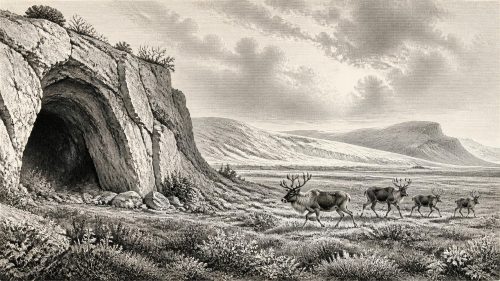
The Doneraile Bone Puzzle
Around 31,851 BCE, Ireland lay within the climatically unstable MIS 3, before the Last Glacial Maximum. Evidence is environmental and archaeological, not historical: cave bones, sediments, pollen and glacial deposits indicate a cold, open, intermittently accessible landscape. Castlepook Cave, County Cork, preserves remains of mammoth, reindeer, giant deer, hyaena and other fauna, although re-dating shows not all overlapped. Derryvree, County Fermanagh, records tundra vegetation and freshwater habitats later buried by ice. A possibly cut-marked Castlepook reindeer bone suggests a brief human visit, but lacks secure context or associated artefacts. Ireland’s human presence then remains unproven; environmental change dominates the record.
View Record
Castlepook’s Open Tundra
31,852 BCE is a modern chronological label rather than a recoverable Irish historical year. During volatile MIS 3, Ireland was intermittently ice-free, with open periglacial tundra, freshwater hollows, sparse vegetation and changing climates before later ice-sheet expansion reworked much evidence. Deposits at Derryvree, Greenagho and Hollymount, alongside Kerry speleothems, indicate non-glacial episodes but cannot define conditions everywhere. Cave faunas, notably at Castlepook, include reindeer, mammoth, bear, hare, fox and hyaena, demonstrating ecological links with north-west Europe. A possibly cut-marked reindeer bone suggests human activity around 33,000 years ago but proves neither settlement nor culture. The record is fragmentary and environmental.
View Record