
Castlepook’s Reindeer Claim31432 BCE
Dateline
31,432 BCE is a modern calendar label applied to a time far beyond written records, named places or annual chronologies. It cannot responsibly be treated as a year in which a dated Irish event occurred. In archaeological terms, it falls at roughly 33.4 thousand calibrated years before present, within Marine Isotope Stage 3, a long and unstable phase of the last Ice Age. The evidence for Ireland is exceptionally fragmentary: sediments sealed beneath later ice, cave bones with complicated histories, radiocarbon measurements with wide margins, and climate records that work on scales of centuries or millennia. They can illuminate a broad setting around this point, but not a day, season or individual year.
An Interval Rather Than a Date
The nearest useful Irish environmental archive is at Derryvree, near Maguiresbridge in County Fermanagh. Roadworks exposed organic silts and fine sands between two separate beds of glacial till. Their order is crucial. An earlier glacier deposited the lower till; during a subsequent ice-free interval, freshwater sediments, plants and small animals accumulated; then another advance buried the deposit beneath fresh glacial debris. A conventional radiocarbon result of 30,500 years before present, with a substantial uncertainty, has been recalibrated in later discussion to a broad range of about 36,900–31,700 calibrated years before present, or approximately 34,950–29,750 BCE.
The nominal year 31,432 BCE lies within that large range. Yet this does not mean that a Derryvree pool can be assigned to that year, or that all the fossils in its sediments lived together. Radiocarbon ages require calibration because atmospheric carbon-14 has varied through time; at this depth of time, a single measurement produces a probability range rather than a precise calendar answer. The Derryvree series is therefore evidence for an interval of cold-stage freshwater conditions in north-central Ireland, not an annual diary.
Cold Ground and Fresh Water
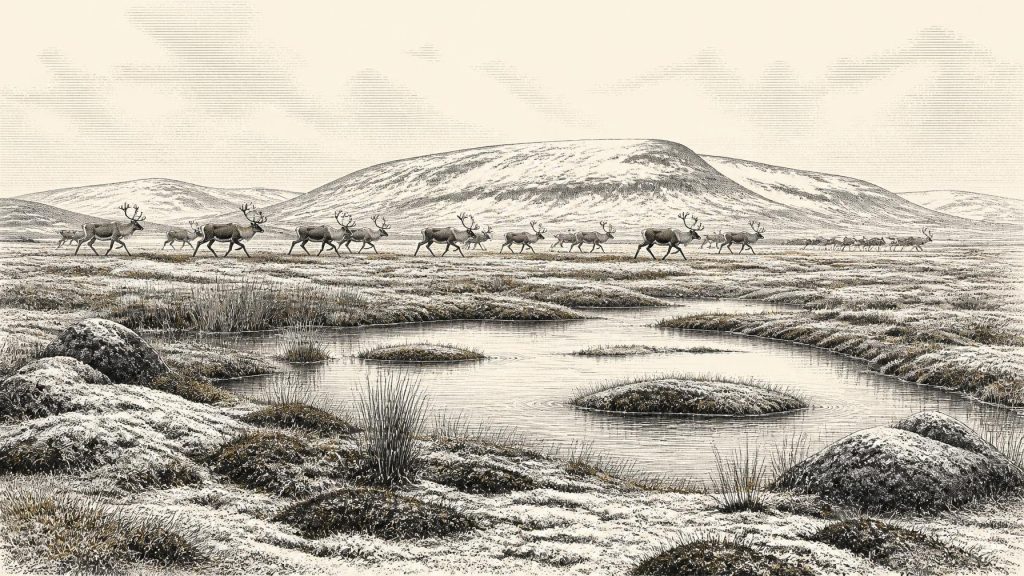
Derryvree’s plant remains, pollen and insect evidence indicate a largely open, treeless landscape. Sedges, grasses, herbs, mosses and low-growing plants could occupy wet ground, shallow pools and stream margins. Such evidence has often been described as tundra or muskeg-like: damp, frost-affected terrain with patches of standing water rather than the dense woodland that later became characteristic of much of Ireland. Local shelter, drainage and season mattered. A valley floor with freshwater and vegetation could be more productive than exposed upland, while frozen or wind-scoured ground nearby might offer little cover.
This was not necessarily an unbroken white wilderness. Even during an ice age, north Atlantic climates altered sharply between colder stadials and relatively milder interstadials. Speleothems from Crag Cave in County Kerry show that liquid water periodically reached caves during Marine Isotope Stage 3, implying episodes when local mean annual conditions rose above freezing. Their growth phases broadly correspond with the abrupt warmer episodes recorded in Greenland ice cores. That evidence does not supply a weather report for Fermanagh or Cork in 31,432 BCE, but it demonstrates that Ireland’s climate could change markedly over relatively short geological intervals.
Approaching Glaciation
Ireland was heading towards the much more extensive glaciation of the Last Glacial Maximum, but the transition was neither instantaneous nor uniform. Syntheses of sub-till deposits suggest that substantial areas remained ice-free until around 32,000 years ago, while modern reconstructions of the British–Irish Ice Sheet stress regional variation, changing margins and significant uncertainty. The date considered here sits close to that threshold. It is unsafe to draw a confident island-wide ice boundary for one numbered BCE year. The secure conclusion is that glaciers, perennial snow and severe cold were increasingly important, and that later ice would erode, redistribute and bury earlier evidence.
That destruction helps explain the unusual importance of sheltered caves and sealed sediments. Ireland’s familiar topography of drumlins, lakes, bogs and broad river valleys owes much to later glacial action, but it should not be projected unchanged backwards. At this earlier time rivers carried sediment through a shifting cold-climate landscape; coastlines were very different because sea level was lower; and the land and shallow seas around Ireland formed a changing north-west European frontier. Whether a straightforward dry route connected Ireland to Britain at any particular moment remains uncertain. Animal movement is clear; the precise route is not.
The Castlepook Fauna
Castlepook Cave, also known as Mammoth Cave, near Doneraile in north County Cork, provides the strongest Irish evidence for large mammals before the Last Glacial Maximum. Its deposits have yielded remains attributed to woolly mammoth, reindeer, giant deer, brown bear, wolf, Arctic fox, mountain hare, lemmings and spotted hyena. This combination supports the picture of cold, open country capable at intervals of sustaining, or being reached by, animals familiar from the mammoth-steppe and tundra environments of northern Europe.
However, Castlepook is not a single, neatly dated animal community. Many bones were recovered during early twentieth-century excavations, before modern recording standards, from cave deposits disturbed by water, carnivores and later activity. Improved radiocarbon pretreatment has shown that some older Irish cave dates were too young, and re-dating has placed important elements of the Castlepook fauna firmly within Marine Isotope Stage 3. Individual bones nevertheless belong to different phases over many thousands of years. A list of species from the cave must not be converted into a claim that every animal stood together outside the entrance in 31,432 BCE.
Spotted hyena is especially revealing. Bone accumulations and chewing traces indicate that carnivores could drag or scavenge carcass parts into caves, turning these spaces into repositories rather than ordinary living sites. Mammoth and reindeer remains show access to large herbivores, while lemmings and Arctic fox point towards cold conditions. The cave record demonstrates ecological connection with wider Europe, but it also preserves the biases of a carnivore-affected archive: what entered the cave, survived, and was collected is not a complete census of Ireland.
A Single Mark and Human Possibility
One Castlepook reindeer femur has transformed discussion of Ireland’s earliest possible human presence. County Cork’s published heritage account identifies the bone as approximately 31,000 BCE and describes a deep incision interpreted by the palaeozoologist Ruth Carden as a cut made by a sharp stone tool during butchery. If that assessment is upheld, it would be evidence that people handled a reindeer in Ireland during the Upper Palaeolithic, far earlier than the long-established post-glacial record.
Its limitations must be stated plainly. The date concerns the age of the animal bone, not a securely observed moment of cutting. The femur came from an old cave collection, not from a modernly excavated occupation floor. No associated hearth, stone-tool assemblage, shelter, human remains, food store or concentration of butchered bones has yet demonstrated a camp of this age in Ireland. Nor can one incision establish whether people killed the animal, scavenged it, removed hide or sinew, extracted marrow, or processed it somewhere else before carnivores carried the bone into the cave.
No Polities, No Proven Settlement
There is no evidence for political communities, leaders, warfare, diplomacy, territorial boundaries or institutions in Ireland at this date. Nor is there evidence for a settled village, farming, herding, pottery, metalworking, monuments, writing or a calendar. Religion, language, kinship rules and ritual are likewise beyond recovery from the available Irish material. It would be misleading to import famous Upper Palaeolithic cave art, burials or ornaments from continental Europe and present them as Irish culture.
If the Castlepook mark does record human work, the most restrained interpretation is a brief visit by one or more highly mobile hunter-gatherers equipped with a sharp stone edge and able to exploit a large animal. Such people would have depended on close knowledge of weather, animal movement, shelter, fuel, clothing and co-operation. These are reasonable inferences from Upper Palaeolithic lifeways elsewhere, not direct discoveries from an Irish camp. No Irish evidence currently permits a responsible reconstruction of households, trade partnerships or social identities around 31,432 BCE.
What Can Be Said
The history of Ireland at this depth of time is principally environmental, though not empty of human significance. Around the broad interval containing 31,432 BCE, parts of the island supported open, cold and locally wet habitats; large mammals and predators moved through a landscape connected intermittently to wider European ecosystems; and glaciation was intensifying towards a phase that would profoundly alter the land. Castlepook’s marked reindeer bone offers an important but still limited possibility of human activity. Derryvree’s sediments provide the firmer foundation: not a dated event, but a rare survival of Ice-Age Ireland before later ice sealed much of its past.
Primary Sources
- A Middle Midlandian Freshwater Series at Derryvree, Maguiresbridge, County Fermanagh, Northern Ireland
- A Reconsideration of the Radiocarbon Dating of the Marine Isotope Stage 3 Fauna from Southern Ireland
- The Irish Quaternary Fauna Project
- The Last Irish Ice Sheet: Extent and Chronology
- Episodic Speleothem Deposition Tracks the Terrestrial Impact of Millennial-Scale Last Glacial Climate Variability in SW Ireland
- Growth and Retreat of the Last British–Irish Ice Sheet, 31,000 to 15,000 Years Ago: the BRITICE-CHRONO Reconstruction
- BRITICE-CHRONO Maps and GIS Data of the Last British-Irish Ice Sheet 31 to 15 ka
- BRITICE Glacial Map, Version 2: A Map and GIS Database of Glacial Landforms of the Last British–Irish Ice Sheet
- Spatio-Temporal Dynamics of Speleothem Growth and Glaciation in the British Isles
- The IntCal20 Northern Hemisphere Radiocarbon Age Calibration Curve (0–55 cal kBP)
- A Stratigraphic Framework for Abrupt Climatic Changes During the Last Glacial Period Based on Three Synchronized Greenland Ice-Core Records
- A Stratigraphical Basis for the Last Glacial Maximum (LGM)
- New Data for the Last Glacial Maximum in Great Britain and Ireland
- Reconstruction and 36Cl Based Geochronology of the Deglaciation of Central Ireland
- Castlepook Cave
- Spotted Hyena Skull
- Heritage Artefacts of County Cork
- Archaeological Heritage of County Cork
- The Subdivision of the Quaternary Period in Ireland
- Mammoth Cave (Castlepook Cave)
- Pleistocene Vertebrates in the British Isles