
Elephant Hall’s Tundra Fauna
Around 31,855 BCE, Ireland formed a variable Late Pleistocene, Marine Isotope Stage 3 landscape rather than a uniformly ice-covered island. Derryvree sediments in Fermanagh record an ice-free, treeless, wet tundra of grasses, sedges, herbs, juniper, mosses and beetles, later overridden by glaciers. Castlepook Cave in Cork preserves bones accumulated over long periods, including mammoth, giant deer, reindeer, bear, wolf and hyaena, demonstrating wider European faunal connections but not coexisting assemblages. A possibly cut-marked reindeer bone suggests early human activity, yet settlement remains unproven. Lower sea levels aided animal dispersal, while evidence for trade, agriculture, politics, ritual or continuous occupation absent.
View Record
Derryvree Between Two Tills
At 31,856 BCE, Ireland was in Marine Isotope Stage 3, a climatically unstable later Pleistocene phase rather than a precisely recoverable year. Derryvree, County Fermanagh, preserves freshwater organic sediments between tills, demonstrating locally ice-free conditions before renewed glaciation. Its mosses, sedges, insects and other remains indicate treeless, wet tundra with shallow water, seasonal growth and severe winters. Cave and fossil evidence shows diverse cold-stage animals reached Ireland, although local dates and species distributions remain uncertain. No secure archaeological evidence proves resident humans. Lower sea levels altered landscapes, but expanding Irish ice later transformed habitats, drainage and shorelines across the island.
View Record
Derryvree’s Silted Tundra
31,857 BCE is a reference, not a datable Irish year. Derryvree, County Fermanagh, preserves organic silts beneath glacial till, radiocarbon-dated broadly to 36,900–31,700 calendar years ago, indicating cold, open tundra and freshwater habitats during an unstable pre-glacial period. Ice expansion was uneven and later reached its maximum around 26,000 years ago; land connections remain uncertain. Castlepook Cave, County Cork, records Ice Age fauna, but not a single contemporaneous community. A possibly cut-marked reindeer bone suggests a human visit, yet lacks settlement context. No evidence supports claims about society, culture or permanent settlement. These deposits reveal changing habitats at ice’s edge.
View Record
Doneraile’s Butchery Debate
Around 34,000 years ago, Ireland was a climatically unstable late-Pleistocene landscape supporting diverse mammals, including mammoth, reindeer, giant deer, hyaena and bear. Castlepook Cave near Doneraile, County Cork, preserves important but disturbed faunal remains. A reindeer femur, tentatively dated around 31,000 BC, bears a mark interpreted as possible stone-tool butchery, raising the prospect of an exceptionally early human visit. However, the bone does not prove settlement, hunting, cultural affiliation or a permanent population. Cave deposits may reflect predators, natural processes and antiquarian excavation. Renewed research seeks intact stratigraphy, reliable dating and associated artefacts to clarify Ireland’s earliest possible human presence.
View Record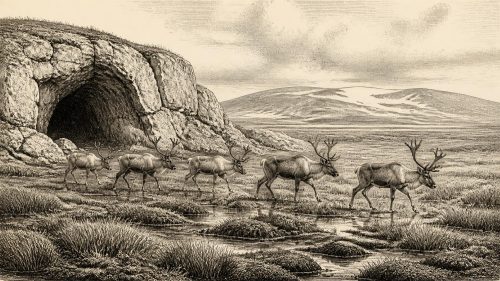
Doneraile’s Reindeer Trace
Around 31,859 BCE, Ireland lay within the climatically unstable Marine Isotope Stage 3 of the last Ice Age, although conditions and ice extent varied regionally. Freshwater deposits at Derryvree, County Fermanagh, preserve evidence of cold, open, wet tundra-like terrain, while other deposits remain fragmentary and difficult to date. Castlepook Cave, County Cork, yielded reindeer, mammoth, giant deer, bear and hyaena remains, demonstrating intermittent animal use of southern Ireland. Re-dating has complicated their chronology. A marked reindeer femur may indicate human butchery about 33,000 years ago, but lacks excavation context. No established Palaeolithic settlement, tools, hearths or social history is known.
View Record
Derryvree’s Tundra Sedgebeds
Around 31,860 BCE, Ireland cannot be described through a precise annual chronology, but through uncertain environmental evidence from Marine Isotope Stage 3. At Derryvree, County Fermanagh, organic silts beneath later till record an ice-free, cold landscape of sedges, mosses, wet basins and open tundra-like vegetation. Ice-sheet advance and retreat varied regionally, altering drainage and relative sea levels. Revised cave-bone dates from southern Ireland show brown bears, giant deer, hyaenas and mammoths during broad MIS 3 phases. No accepted evidence demonstrates human settlement then. Later glaciation destroyed much evidence, leaving a fragmentary prehistory interpreted through calibrated ranges, sediments, fossils and probabilities.
View Record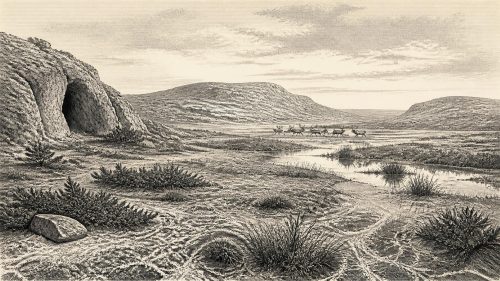
Juniper Beneath the Drumlins
Around 31,861 BCE, Ireland was a climatically unstable Late Pleistocene landscape approaching more extensive glaciation, not a historically documented society. Derryvree sediments in Fermanagh indicate open, treeless tundra or wet muskeg, with grasses, sedges, juniper, herbs and cold-adapted mosses. Castlepook Cave in Cork preserves remains of reindeer, mammoth, giant deer, bears, wolves, hyaenas, Arctic foxes and lemmings, demonstrating a diverse cold-stage fauna. Possible cut marks on a reindeer bone may indicate Upper Palaeolithic human activity, but remain unconfirmed and cannot prove settlement. Later ice reshaped and obscured older landscapes, leaving fragmentary evidence of Ireland’s ecological connection with Ice Age Europe.
View Record
Mammoth Cave, Derryvree Silts
About 31,862 BCE, Ireland lay within the volatile MIS 3 phase of the Late Pleistocene, before the Last Glacial Maximum. Derryvree sediments in Fermanagh indicate an ice-free but severe tundra wetland, supporting mosses, insects and freshwater life between roughly 36,900 and 31,700 years ago. Castlepook Cave in Cork preserves bones of mammoth, reindeer, giant deer, hyaena and other cold-adapted animals, although its deposits span millennia and do not represent one community. A possibly cut-marked reindeer bone suggests brief human activity, not settlement. Ireland was a changing landscape of wetlands, grazing animals, predators, caves and fluctuating ice during this remote period.
View Record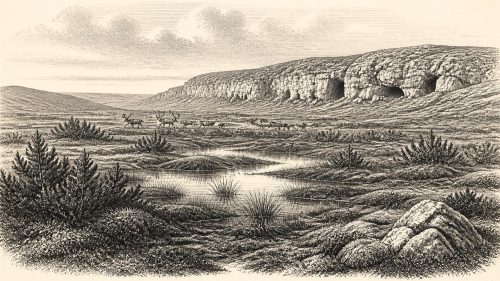
Reindeer by the Awbeg
At roughly 31,863 BCE, Ireland experienced an unstable MIS 3 cold phase, with open, wet, treeless tundra recorded at Derryvree and intermittent milder conditions indicated by Crag Cave calcite. The Last Glacial Maximum was approaching, but Ireland was not uniformly ice-covered. Castlepook Cave in County Cork preserves diverse cold-stage fauna, including reindeer, mammoth and hyaena, accumulated over extended periods. A reindeer femur, dated broadly around 33,000 years ago, bears a possible cut mark suggesting human carcass processing. Without secure context, tools or campsites, this indicates only tentative, mobile Upper Palaeolithic visits. Ongoing investigation may clarify Ireland’s fragmentary pre-glacial human record.
View Record
Maguirebridge’s Arctic Silts
At the notional date of 31,864 BCE, Ireland lay in the unstable MIS 3 phase before the Last Glacial Maximum, not beneath uniform ice. Lower seas altered coasts, while glaciers advanced unevenly. Derryvree deposits near Maguiresbridge preserve evidence of open, treeless tundra, wet hollows and severe periglacial conditions; other records show intermittent climatic amelioration. Castlepook Cave documents diverse cold-adapted fauna, including mammoth, reindeer, giant deer and hyaena, accumulated over extended periods. A cut-mark-like incision on a dated reindeer bone may indicate Upper Palaeolithic visitors, but disturbed contexts preclude certainty. No contemporary settlement exists; later glaciation and early excavation obscured traces.
View Record