Castlepook Dating31424 BCE
Around 31,424 BCE, Ireland lay within the unstable cold conditions of Marine Isotope Stage 3, before the Last Glacial Maximum. Lower sea levels and fluctuating ice created changing connections with Britain and continental Europe. Castlepook Cave, County Cork, preserves a complex, re-dated assemblage including mammoth, giant deer, reindeer, hyena, wolves and lemmings, demonstrating a rich, intermittent cold-stage fauna. Improved radiocarbon methods placed some remains far earlier than formerly believed, though dates remain ranges, not precise anniversaries. A cut-marked reindeer femur may indicate Upper Palaeolithic butchery, yet cannot prove settlement. Evidence depicts shifting Ice Age ecosystem; future research may clarify presence.
Dateline
Modern calendar-year precision is not available for prehistoric Ireland at this depth of time. “31,424 BCE” is a convenient retrospective label, roughly 33,373 years before the conventional radiocarbon baseline of 1950, not a date that any person then could have recognised or recorded. The responsible frame is therefore a span of millennia: this point falls in Marine Isotope Stage 3 (MIS 3), before the Last Glacial Maximum, within an era of sharp North Atlantic climatic fluctuations and major uncertainty about the exact extent of ice in particular Irish regions. Evidence can illuminate the kind of Ireland that existed around this time; it cannot identify an event, a ruler, a battle, or a particular day.
A Landscape Before the Maximum Cold
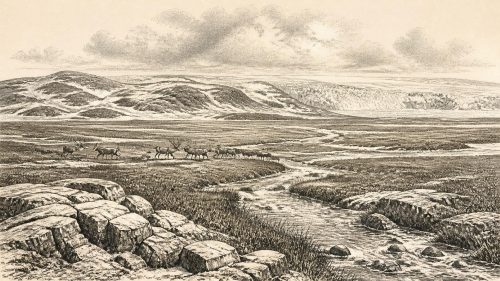
Ireland was not yet the familiar island of wooded valleys, farms and coasts. Sea level was far lower than today because vast quantities of water were held in northern ice sheets. The Irish Sea basin and surrounding shelves were correspondingly altered, creating changing expanses of exposed land, shallow water and glacial terrain. This did not make movement simple or automatic: the routes between Ireland, Britain and continental Europe varied with ice, rivers, wetlands and sea incursions. Yet the island’s later isolation had not taken its final form. The archaeological question is not whether a modern ferry crossing could have been made, but whether people and animals could intermittently move through a difficult north-west European frontier.
The climatic setting was cold, but not uniformly so. MIS 3 included abrupt warmer interstadials and colder stadials, registered especially clearly in Greenland ice cores and North Atlantic sediments. Irish deposits do not yield a weather report for 31,424 BCE itself. They do show that, before the fullest growth of the last British–Irish Ice Sheet, parts of Ireland could support open, cold-adapted landscapes and substantial mammals. The maximum extent of the ice sheet was attained much later, around 27,000 years before present in major reconstructions; its growth and margins were dynamic rather than a single, island-wide instant of freezing. It would be misleading to picture all Ireland at this date as either wholly ice-covered or wholly hospitable grassland.
The Cave Near Doneraile
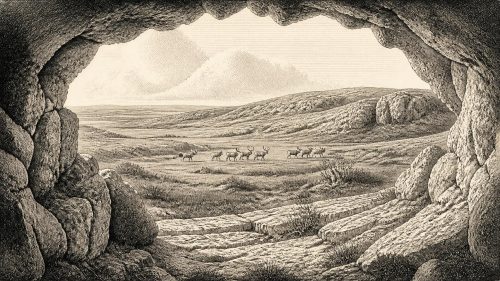
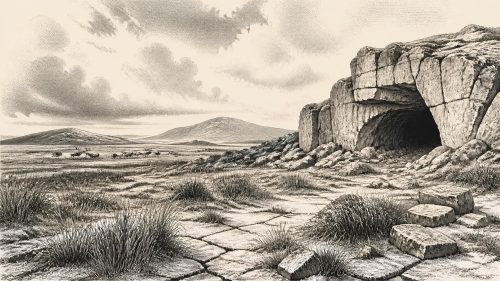
The principal Irish archive relevant to this broad horizon lies at Castlepook Cave, also known as Mammoth Cave, near Doneraile in north County Cork. Excavated principally in the early twentieth century, its passages acquired vivid names including Hyenahall and Elephant Hall. More than 2,000 bones have been recovered, but their abundance is not a simple census of one moment. Water disturbance, antiquarian excavation methods, later contamination and the cave’s long use as a repository all complicate the record. Some remains accumulated because carnivores dragged or scavenged carcasses; others may have been moved by sediment and water. A cave deposit is evidence, but its formation must be interpreted rather than assumed.
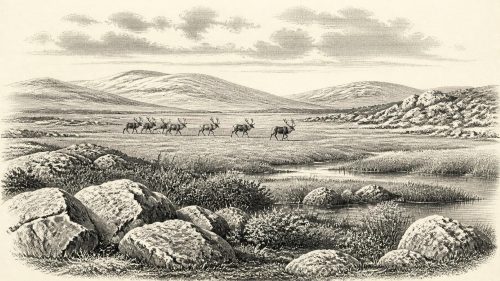
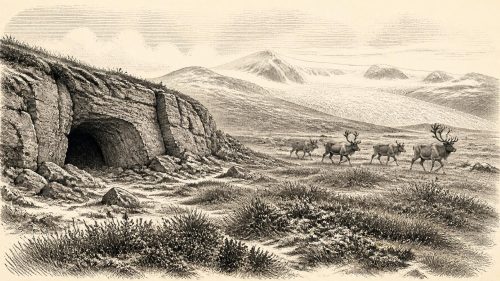
Even with those cautions, Castlepook establishes an extraordinary Ice Age fauna in southern Ireland. Woolly mammoth, giant deer, reindeer, brown bear, wolf, Arctic fox, mountain hare, stoat, collared lemming, Norwegian lemming and spotted hyena are represented in the broader cave assemblage. This was not a tranquil woodland community. Reindeer and lemmings indicate open, cold-country habitats; mammoth and giant deer point to extensive productive grazing or browsing grounds; large carnivores reveal a food web capable of sustaining scavengers and hunters. The coexistence of species need not mean that every individual was alive in the same season or century, but it demonstrates that Ice Age Ireland had, at intervals, a far richer mammalian community than the later island would possess.
What Re-Dating Changed
Older radiocarbon determinations once offered a tempting but unstable chronology for Irish cave bones. Modern accelerator mass spectrometry and improved chemical pretreatment have transformed the picture. Ruth F. Carden’s reassessment of specimens from Castlepook, Foley and Shandon caves found that some Castlepook samples returned ages between about 5,000 and 12,000 radiocarbon years older than their earlier determinations. The result was not merely a technical correction. It shifted parts of the fauna securely into MIS 3 and suggested that giant deer and spotted hyena may have disappeared locally before the Last Glacial Maximum, around 40,000 calibrated years before present.
This also explains why exact conversion into a BCE year is hazardous. A radiocarbon measurement is not identical to a calendar age: atmospheric carbon-14 changed through time, and calibration produces probability ranges rather than a single incontrovertible year. A bone dated to a particular radiocarbon age may calibrate across a broad and sometimes irregular span. Moreover, one dated bone dates the death of that animal, not necessarily every bone in the same cave level, nor the precise moment at which a carnivore or person modified it. Around 31,424 BCE, calibrated ranges and stratigraphic relationships are more meaningful than an apparently exact numerical anniversary.
The Reindeer Femur Question
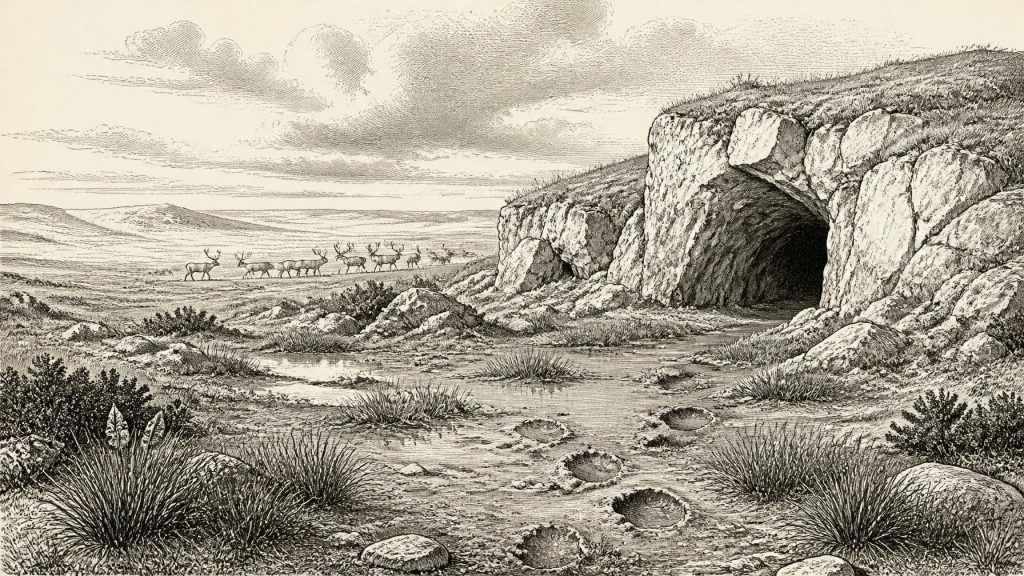
One Castlepook object gives this period special historical interest: a reindeer femur bearing a deep linear mark that has been interpreted as damage made with a sharp stone implement while the bone was fresh. County Cork’s heritage publication has presented the specimen as Palaeolithic and approximately 31,000 BC. If the mark is indeed anthropogenic and contemporary with the animal’s death, it would indicate that somebody processed a reindeer in Ireland during the Upper Palaeolithic, vastly earlier than the island’s long-established terminal-Pleistocene evidence for human activity.
The conditional language matters. The femur is not a hearth, a stone-tool assemblage, a dwelling surface, a burial or a repeated pattern of butchered animals from a sealed layer. It cannot reveal the visitors’ names, language, kinship, route, season of arrival or length of stay. Nor does it prove permanent occupation. Its scientific value lies precisely in being a sharply limited clue: a potentially human alteration on a dated animal bone from a site whose complex deposits demand further excavation and analysis. Recent fieldwork has sought surviving undisturbed Pleistocene sediment in both the old cave system and lower passages discovered in the 1970s.
People at the Western Edge
If people did reach Ireland around this broader interval, they would have belonged to Upper Palaeolithic hunter-gatherer worlds known elsewhere in north-west Europe. Such communities were highly mobile, organised around family and wider social networks, and equipped with perishable clothing, shelters and wooden objects as well as stone tools. They could track seasonal resources and share information over long distances. But those are comparisons, not discoveries from Castlepook. Ireland has not produced a securely associated camp of this age from which one may responsibly reconstruct local houses, toolkits, food stores, artistic traditions or population size.
The most defensible picture is therefore one of possibility rather than a settled Ice Age society. A small visiting party might have exploited an animal carcass, sheltered briefly, or travelled through a landscape also frequented by hyenas, wolves and bears. Equally, the cave’s faunal richness may chiefly record non-human processes. No evidence supports kingdoms, chiefs, territorial boundaries, diplomacy, organised warfare, formal religion, shrines, farming, metalworking, pottery, trade goods or sea-going commerce in Ireland at this date. Their absence from the record is not proof that every human thought or social custom was absent; it is a limit on what archaeological material can demonstrate.
Everyday Ecology, Not Irish Politics
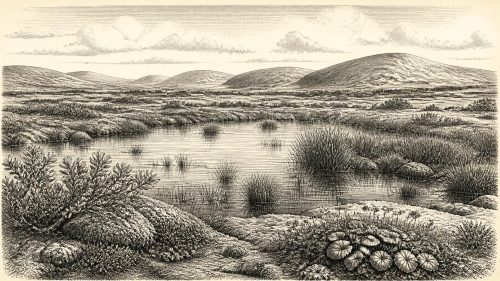
For the animals represented at Castlepook, daily life was structured by cold, exposure and seasonal food. Reindeer moved through open terrain; hares and lemmings occupied low vegetation; carnivores competed for carcasses; large herbivores depended on enough plant productivity to survive severe winters. Vegetation in comparable Irish interstadial deposits includes tundra and wetland indicators rather than closed forest. Organic silts between tills at Derryvree and Maguiresbridge in Fermanagh preserve evidence for treeless, waterlogged muskeg-like environments during an earlier or broadly comparable cold-stage sequence. These sites do not date a particular Cork season, but they show why pollen, seeds, mosses, insects and sediments are essential companions to bones when reconstructing Ice Age Ireland.
Regional change was already the great political force, in the widest non-human sense. Advancing ice could erase habitats and routes; a warmer pulse could open them; lowered seas could join landscapes that later became separated by water. This volatility helps explain the fragmentary record. Animals and perhaps people may have entered during favourable windows, only for later ice advance, erosion and rising seas to destroy camps and obscure pathways. It also cautions against treating Ireland as a passive edge of Britain: southern caves, northern inter-till deposits and offshore glacial records each preserve different parts of a changing system.
A Record Still Being Made
The most important development around 31,424 BCE is thus not a named historical event but the existence of a potentially habitable, ecologically connected Ice Age Ireland before the last great glacial maximum. Castlepook’s re-dated animal archive demonstrates that mammoths, reindeer, hyenas and other cold-stage mammals reached the island during MIS 3. The marked reindeer femur raises, but does not settle, the prospect of an exceptionally early human visit. Future work on intact sediments, microscopic bone damage, ancient biomolecules and improved radiocarbon methods may revise the story again.
That uncertainty is not a weakness to be hidden. It is the central historical fact. At this distance, Ireland’s past survives not as chronicles of people and polities but as a cave’s bones, a drumlin’s buried organic silt, an ice-scoured landscape and a series of calibrated ranges. They allow a vivid but disciplined conclusion: around this broad date, Ireland was part of a severe, shifting Ice Age world, inhabited at least intermittently by remarkable animals and perhaps touched briefly by human hands.
Source References
Hover over a number to see the source. Select it to open the source.

- [1] A reconsideration of the radiocarbon dating of the Marine Isotope Stage 3 fauna from southern Ireland
- [2] The Irish quaternary fauna project
- [3] Castlepook Cave, County Geological Site report
- [4] Spotted Hyena Skull
- [5] The Exploration of Castlepook Cave, County Cork
- [6] Holdings: The exploration of Castlepook Cave, Co. Cork
- [7] Occurrence of mammalia relicts at site Castlepook Cave
- [8] Excavations.ie Report 2022: Castlepook Cave, Cork
- [9] Heritage Artefacts of County Cork
- [10] Europe and the County of Cork: A Heritage Perspective
- [11] New insights on the fauna of Ireland's Younger Dryas and Early Holocene from Alice & Gwendoline Cave
- [12] New insights on the fauna of Ireland's Younger Dryas and Early Holocene from Alice & Gwendoline Cave (open PDF)
- [13] Timing and pace of ice-sheet withdrawal across the marine–terrestrial transition west of Ireland during the last glaciation
- [14] Pattern and timing of retreat of the last British-Irish Ice Sheet
- [15] Growth and retreat of the last British–Irish Ice Sheet, 31,000 to 15,000 years ago: the BRITICE-CHRONO reconstruction
- [16] Late Pleistocene chronostratigraphy and ice sheet limits, southern Ireland
- [17] Oscillating retreat of the last British-Irish Ice Sheet on the continental shelf offshore Galway Bay, western Ireland
- [18] Figure 6: The subdivision of the Quaternary Period in Ireland
- [19] The Quaternary of Fermanagh and Tyrone
- [20] Quaternary Site Descriptions
- [21] Outreach and Education Resources
- [22] Dublin Radiocarbon Dates II
- [23] Dimensions and chronology of the last ice sheet in Western Ireland
- [24] Geology of Ireland, second edition: pre-publication information
Primary Sources
- A reconsideration of the radiocarbon dating of the Marine Isotope Stage 3 fauna from southern Ireland
- The Irish quaternary fauna project
- Castlepook Cave, County Geological Site report
- Spotted Hyena Skull
- The Exploration of Castlepook Cave, County Cork
- Holdings: The exploration of Castlepook Cave, Co. Cork
- Occurrence of mammalia relicts at site Castlepook Cave
- Excavations.ie Report 2022: Castlepook Cave, Cork
- Heritage Artefacts of County Cork
- Europe and the County of Cork: A Heritage Perspective
- New insights on the fauna of Ireland's Younger Dryas and Early Holocene from Alice & Gwendoline Cave
- New insights on the fauna of Ireland's Younger Dryas and Early Holocene from Alice & Gwendoline Cave (open PDF)
- Timing and pace of ice-sheet withdrawal across the marine–terrestrial transition west of Ireland during the last glaciation
- Pattern and timing of retreat of the last British-Irish Ice Sheet
- Growth and retreat of the last British–Irish Ice Sheet, 31,000 to 15,000 years ago: the BRITICE-CHRONO reconstruction
- Late Pleistocene chronostratigraphy and ice sheet limits, southern Ireland
- Oscillating retreat of the last British-Irish Ice Sheet on the continental shelf offshore Galway Bay, western Ireland
- Figure 6: The subdivision of the Quaternary Period in Ireland
- The Quaternary of Fermanagh and Tyrone
- Quaternary Site Descriptions
- Outreach and Education Resources
- Dublin Radiocarbon Dates II
- Dimensions and chronology of the last ice sheet in Western Ireland
- Geology of Ireland, second edition: pre-publication information