Awbeg’s Cave-Bone Archive31431 BCE
Around 33,000–34,000 calibrated years before present, Ireland lay in climatically unstable Marine Isotope Stage 3, with changing ice, coastlines and open habitats. Castlepook Cave, County Cork, preserves Ireland’s richest pre-Last Glacial Maximum vertebrate fauna, accumulated over millennia rather than representing one moment. Bones of mammoth, giant deer, reindeer, bear, wolf, hyaena, Arctic fox and lemmings demonstrate periodically viable cold-climate ecosystems. Radiocarbon dates require caution, especially for old collections. A modified reindeer bone may indicate human carcass processing about 33,000 years ago, but remains unconfirmed and cannot prove permanent settlement. No evidence establishes contemporary institutions, rituals, language, or sustained occupation there.

Dateline
A Date Beyond Calendar History
“31,431 BCE” is a modern numerical label, not a year that anyone living in Ice Age Ireland could have recognised or recorded. No written calendar, named ruler, settlement chronicle or event sequence exists for this depth of time. The number falls approximately 33,380 years before AD 1950, the conventional reference point used in much Quaternary science, but it should not be mistaken for a precise archaeological date. For a period so remote, chronology depends chiefly on radiocarbon determinations from animal bone and on comparison with climatic archives. Those results carry statistical uncertainty; radiocarbon years must also be calibrated against changing atmospheric carbon levels. The responsible historical setting is therefore a broad interval around 33,000–34,000 calibrated years before present, within the later Pleistocene, rather than a claim about one identifiable Irish day or year.
Ireland at this point belonged to Marine Isotope Stage 3, a long and climatically unstable portion of the last glacial cycle. It preceded the cold maximum of the Last Glacial Maximum, when the British–Irish Ice Sheet expanded much more extensively, broadly after 35–32 thousand years ago and reached its greatest late-glacial extent around 27–21 thousand years ago. The island’s land, coastlines, vegetation and animal communities were consequently not fixed. They altered in response to sharp climatic oscillations, advancing ice and changing sea levels. It is misleading to picture the familiar green, wooded island simply transplanted into a colder age. Equally, it is unsafe to imagine every part of Ireland buried continuously beneath ice at the moment represented by this modern date.
An Unsettled Ice-Age Island
The best evidence indicates a landscape undergoing repeated environmental change. During milder episodes, ice-free ground in parts of Ireland could sustain mammals and plants adapted to open, cold climates. During harsher phases, expanding ice, permafrost, sparse vegetation and severe seasonal conditions would have greatly narrowed those possibilities. Greenland ice-core records demonstrate that abrupt warming and cooling were characteristic of the North Atlantic world during this period. They offer an essential regional framework, but they are not local Irish weather diaries: an event registered in Greenland cannot tell us the temperature beside an Irish cave on a particular day.
Nor did the modern island necessarily possess its modern shores. Global sea level was lower because immense quantities of water were held in continental ice sheets. Yet lower sea level did not automatically make Ireland a walkable extension of Britain or continental Europe. Ice, sea channels, shifting coastlines and terrain all mattered. For animals or people, movement into Ireland may at different times have involved exposed coastal plains, narrow maritime crossings, temporary ice-linked routes or a combination of these. The exact route remains unresolved. The faunal record proves that large mammals reached Ireland in the broader period; it does not reveal a single uninterrupted corridor, a permanent land bridge, or a regular route followed by human communities.
Castlepook’s Evidence
The most important Irish archive for this broad era lies at Castlepook Cave, near Doneraile in north County Cork, overlooking the Awbeg valley and close to the Ballyhoura uplands. Its limestone passages acquired evocative early names such as Hyenahall and Elephant Hall. Excavations undertaken principally between 1904 and 1918 recovered more than 2,000 animal bones. The material is exceptionally significant because Castlepook is Ireland’s richest known vertebrate-fauna site for the long period before the Last Glacial Maximum.
Radiocarbon results from individual Castlepook bones span an immense range, roughly 45,700 to 19,950 radiocarbon years before present. The cave therefore does not preserve one instant of life, nor a neatly sealed hunting camp. It is an archive accumulated across many millennia. Re-dating with improved bone-preparation techniques has shown that some earlier determinations were too young by several thousand radiocarbon years. That revision is a reminder that Pleistocene chronology advances with laboratory methods as well as excavation. At the far end of radiocarbon’s practical range, even apparently simple dates deserve caution.
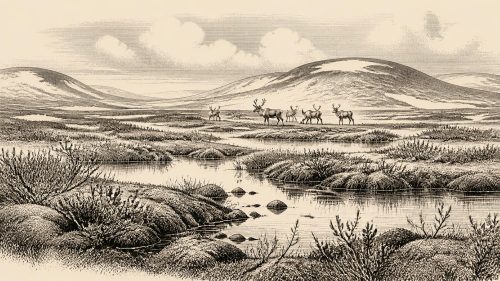
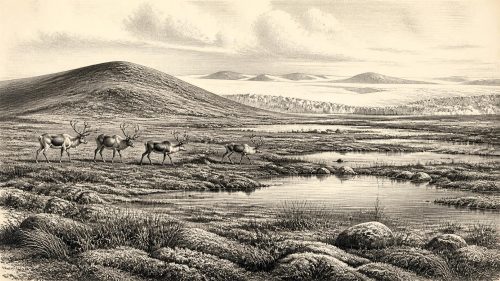
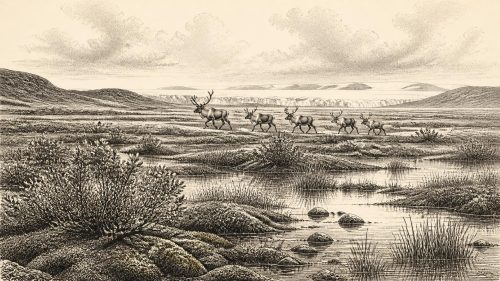
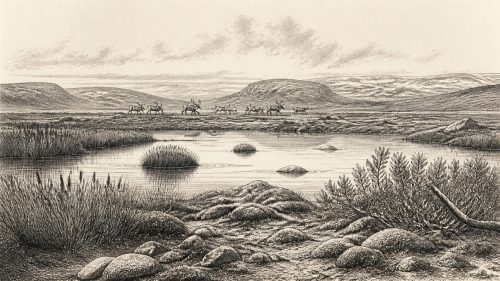
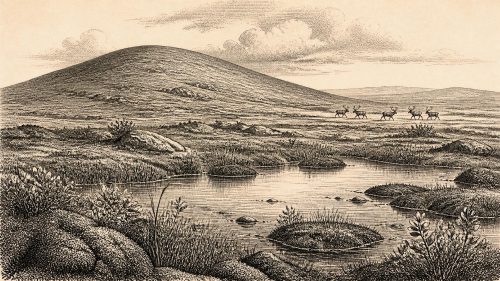
Among the animals represented at Castlepook are woolly mammoth, giant deer, reindeer, brown bear, wolf and spotted hyaena; Arctic fox and lemmings occur in other parts of the cave sequence. These finds establish a remarkable point: Ice Age Ireland was not biologically empty. At various times, parts of the island supported a food web involving large grazers and browsers, carnivores, scavengers and smaller cold-adapted mammals. They cannot, however, be treated as a single living herd photographed in the year 31,431 BCE. Some species may have occupied Ireland at different points within the cave’s lengthy chronology, and individual bones may have entered the passages by different processes.
Open Ground and Animal Lives
The Castlepook fauna supports a picture of largely open country rather than dense temperate woodland. Reindeer are well suited to cold, open habitats; mammoth and giant deer indicate that sizeable herbivores could use parts of the wider landscape; hyaenas, wolves and bears show that animal carcasses entered more complicated ecological relationships than simple hunting scenes suggest. Pollen, plant macrofossils and other environmental archives from Irish interstadial deposits demonstrate that vegetation could change rapidly with climate, producing mosaics of tundra, grassland, sedge-rich wet places, dwarf shrubs and scattered woody growth where conditions allowed.
This is evidence for environmental potential, not a complete reconstruction. The density of vegetation, the duration of snow cover, the seasonality of animal movement and the precise location of ice margins near Castlepook cannot be read directly from a mixed cave collection. Mammoth was not necessarily a common resident of every Irish valley, nor does one reindeer bone establish an annual migration route. The more modest conclusion is also the more valuable: Ireland’s pre-Last Glacial Maximum environments periodically supported animals that later disappeared from the island, and those animals inhabited a changing north-west European ecological zone.
Caves complicate the story. A cave can be a carnivore den, a shelter, a natural trap, a drainage route or a place into which bones are washed from above. Teeth marks, breakage, sediment position and the anatomical pattern of a collection help specialists distinguish these possibilities, but old excavations often removed deposits before modern recording standards existed. Castlepook’s animal bones are direct witnesses to former species, but not automatically to where each animal died or how it reached the cave.
The Human Question
The question of people in Ireland around this date is important precisely because the evidence is so slight. A reindeer femur from the old Castlepook collection has been publicised as approximately 33,000 years old and as bearing a deep modification interpreted by zooarchaeologist Ruth Carden as damage made with a sharp stone tool during carcass processing. If that interpretation and its chronological association are confirmed by further analysis, it would be evidence that people handled a reindeer in Ireland during the later Pleistocene, dramatically earlier than the long-established record of post-glacial settlement.
It would not demonstrate a permanent population. There is no securely excavated Castlepook hearth, stone-tool assemblage, dwelling floor, burial, food-waste deposit or settlement site of comparable age. The bone comes from a cave collection formed through antiquarian excavation and complex depositional processes. The date of an animal’s death is not, by itself, proof of the date or human origin of a mark on its bone. The cautious historical conclusion is thus that a possible, highly consequential trace of human activity has been identified, while convincing evidence for sustained occupation of Ireland at this time remains absent.
The distinction matters for everyday life. If visitors did reach Ireland, they were almost certainly mobile Upper Palaeolithic hunter-gatherers rather than farmers or town-dwellers. Inference from better documented communities in Britain and continental Europe suggests that such groups could have relied on close knowledge of animals, stone raw materials, shelter and seasonal opportunities. Reindeer could provide meat, marrow, hide, sinew, antler and bone. But Castlepook cannot establish that any particular resource was taken, whether a group camped beside the Awbeg, how many people travelled together, or whether a visit lasted hours, weeks or generations.
No Kingdoms, No Known Rituals
There were no Irish kingdoms, chiefs, diplomatic missions, borders or political institutions that archaeology can identify around this date. There is likewise no direct Irish evidence for language, ethnic names, kinship rules, art, ritual practice or formal religion. Cave art and sophisticated symbolic objects are known from Upper Palaeolithic Europe, but their existence elsewhere cannot be transferred automatically to Castlepook. A cave containing Ice Age bones is not proof of an Irish sanctuary, a painted chamber or a ceremonial gathering place.
What can be said is narrower. The presence of a diverse fauna made the wider region ecologically connected to north-west Europe, despite the barriers and uncertainties imposed by sea and ice. Any humans who reached Ireland would have done so within that wider world of movement, adaptation and changing resource zones. Their possible arrival would have been an episode of exploration or short-lived use of an unstable landscape, not the beginning of a continuous national story. The later ice advance may have erased or buried much of the evidence needed to judge this question.
What This Moment Means
For Ireland around 31,431 BCE, the principal story is not an event but an evidential frontier. Castlepook shows that the island could host an unexpectedly rich Ice Age fauna before the Last Glacial Maximum. Its deposits also reveal why the earliest human history of Ireland is difficult to write: caves preserve bones, but often mix times and processes; glaciers reshape landscapes; and the surviving record is sparse. The strongest facts concern animal presence and environmental change. The most intriguing interpretation concerns an early human encounter with reindeer. Between them lies the necessary discipline of prehistoric history: to make the past vivid without pretending that the evidence is more precise, complete or certain than it is.
Primary Sources
- Castlepook Cave, County Geological Site Report
- A Reconsideration of the Radiocarbon Dating of the Marine Isotope Stage 3 Fauna from Southern Ireland
- The Irish Quaternary Fauna Project
- First Evidence of a Late Upper Palaeolithic Human Presence in Ireland
- First Evidence of a Late Upper Palaeolithic Human Presence in Ireland
- New Insights on the Fauna of Ireland's Younger Dryas and Early Holocene from Alice & Gwendoline Cave
- New Insights on the Fauna of Ireland's Younger Dryas and Early Holocene from Alice & Gwendoline Cave
- Preliminary Assessment of the Archive of Faunal Remains from Excavated Irish Cave Sites
- Prehistoric Details: Stone Age Collections
- The Mesolithic in Ireland: When Was It?
- Castlepook Cave, Co. Cork, 2022 Excavation Report
- IQUA Newsletter 58
- Outreach and Education Resources
- Extent and Timing of the Last Glacial Maximum in Britain and Ireland: A Review
- The Timing and Magnitude of the British–Irish Ice Sheet Between Marine Isotope Stages 5d and 2
- The Last Glacial Maximum British-Irish Ice Sheet: A Reconstruction Using Digital Terrain Mapping
- Pattern and Timing of Retreat of the Last British-Irish Ice Sheet
- The IntCal20 Northern Hemisphere Radiocarbon Age Calibration Curve (0–55 cal kBP)
- A Stratigraphic Framework for Abrupt Climatic Changes During the Last Glacial Period Based on Three Synchronized Greenland Ice-Core Records
- A 60,000 Year Greenland Stratigraphic Ice Core Chronology
- European Vegetation During Marine Oxygen Isotope Stage 3
- The Archaeology of Caves in Ireland
- What Was on the Menu in Prehistoric Ireland?