BIRM-166 Before the Ice30426 BCE
Around 32,375 calibrated years before present, Ireland lay within climatically unstable Marine Isotope Stage 3, not a precisely dated historical year. At Derryvree, County Fermanagh, freshwater silts between glacial tills demonstrate an ice-free interval with tundra vegetation, wet hollows and severe periglacial conditions. Castlepook Cave, County Cork, preserves remains of reindeer, mammoth, giant deer, predators and other cold-adapted fauna, indicating intermittent links with Eurasia, though not a single community. A marked reindeer femur may represent early human butchery, but remains inconclusive. Subsequent ice advances reshaped landscapes and destroyed evidence, leaving silt, seeds and bones as Ireland’s fragmentary earliest surviving record.
Dateline
Modern calendar-year precision is not available for Ireland at this depth of time. “30,426 BCE” is a retrospective label, not a date known to any community then living in, visiting or passing near the island. Arithmetically it corresponds to about 32,375 calibrated years before present, where “present” is conventionally AD 1950. Yet the evidence is not fine-grained enough to identify a particular season, event or generation. Ireland can instead be approached through the broader Late Pleistocene setting: Marine Isotope Stage 3, a climatically unstable part of the last Ice Age, and through rare deposits whose dates carry uncertainties measured in centuries or millennia.
A Date Between Evidence
The most instructive Irish environmental archive for this long interval is BIRM-166, a radiocarbon determination from Derryvree townland, near Maguiresbridge in County Fermanagh. Roadworks in 1969 cut through a drumlin and exposed a remarkable sequence: glacial till below, freshwater silts and fine sands containing organic material in the middle, and another thick till above. The order of the layers is crucial. Glacier ice had occupied the locality; an interval of ice-free ground and standing or slow-moving fresh water followed; then a later ice advance sealed the wetland beneath fresh debris.
The original determination was 30,500 radiocarbon years BP, with an uncertainty of +1,170/−1,030 years. Radiocarbon years are not calendar years. One later compilation gives the deposit an approximate calibrated age of 35.9 ± 1.1 thousand calendar years BP, while calibration methods and the large original uncertainty make any single conversion provisional. That range probably predates the modern label 30,426 BCE rather than documenting the island in that exact year. It remains highly relevant because it preserves the kind of cold-stage Irish landscape from which little evidence survives: later ice eroded, displaced or buried many older surfaces.
For that reason, BIRM-166 must not be treated as a diary entry. It does not prove that every part of Ireland was ice-free, nor that the same plants grew throughout the island at one time. Its value is more precise and more modest: during a broad middle part of the last glacial cycle, freshwater habitat existed in north-central Ireland between episodes of glaciation. Around the requested date, therefore, the responsible picture is one of a changing island at the north-western edge of Europe, shaped above all by climatic oscillation, shifting ice margins and fragmented habitats.
Wet Ground in a Treeless Land
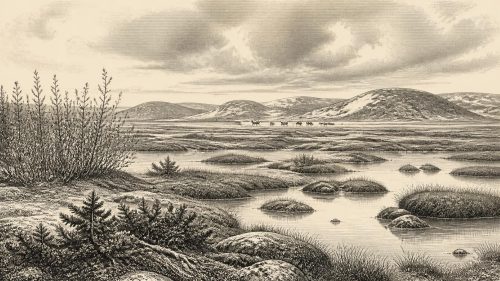
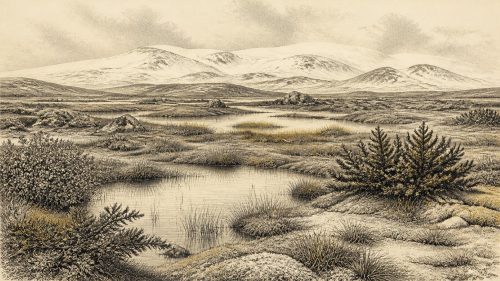
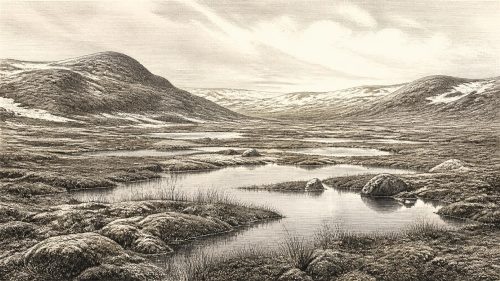
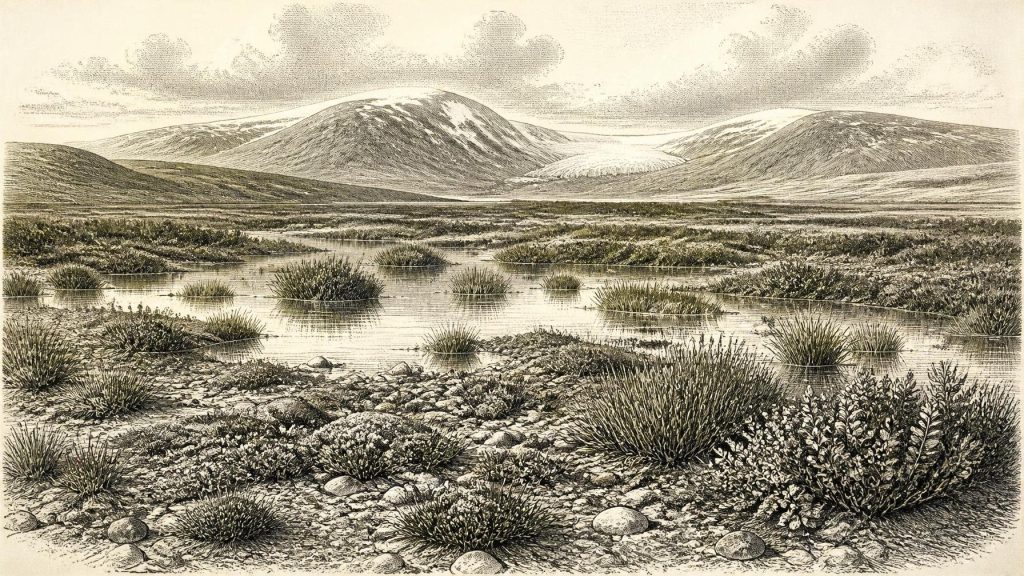
The Derryvree silts contained plant and animal remains that point to open tundra and a periglacial regime. Periglacial does not mean wholly buried under ice. It describes land subject to severe cold, repeated freezing and thawing, sparse plant cover and short growing seasons, often close to glaciers or ice sheets. Mosses, sedges and other cold-tolerant plants grew beside shallow water. A fossil seed of bogbean, Menyanthes trifoliata, is especially evocative: it is a wetland plant, and its presence confirms that pools or waterlogged margins could sustain life even in an austere climate.
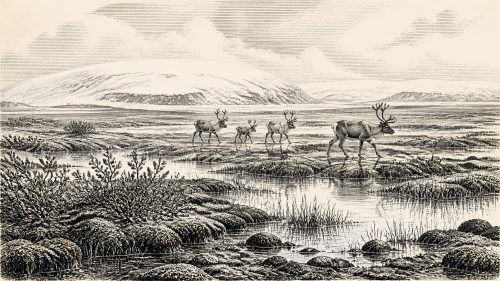
This was not a modern Irish bogland transported unchanged into the past. The wider plant and insect evidence indicates an exposed, treeless environment, with low vegetation, wet hollows and poorly developed soils. Dwarf shrubs and herbs could exploit brief summers, while strong winds and winter frost restricted taller growth. The landscape would have been heterogeneous rather than uniformly blank: freshwater pockets, sedge-rich margins, bare mineral ground and patches of moss could occur within a broader cold, open terrain. Plants were the primary producers on which the food web depended, and their limited seasonal productivity set hard constraints on every animal that used the land.
Ice was an equally active agent. Ireland’s glacial history before the Last Glacial Maximum remains more difficult to reconstruct than its later retreat, and modern research stresses advance-and-retreat phases during Marine Isotope Stage 3 rather than a simple story of uninterrupted ice cover. There is evidence that the British–Irish Ice Sheet had developed earlier in the last cold stage and behaved dynamically. At approximately 32,375 calendar years BP, shortly before the better-constrained growth phase after 31,000 BP, no responsible reconstruction can assign a single ice edge across the whole island. Local ice-free ground, ice masses and changing drainage systems may all have existed in different districts and at different times.
Caves and the Animal Record
County Cork provides a contrasting archive. Castlepook Cave, near Doneraile, has yielded remains of an Ice Age fauna that included reindeer, woolly mammoth, giant deer, brown bear, Arctic fox, lemmings, mountain hare, wolf and spotted hyaena. These bones were accumulated across long spans of time rather than in one moment. Caves may be dens, traps, shelters, water conduits and repositories into which scavengers, flowing sediment and people move material. Moreover, much of Castlepook was excavated in the early twentieth century, before modern standards of stratigraphic recovery. Its assemblage is therefore strong evidence that such animals reached Ireland during the Late Pleistocene, but weak evidence for a single, complete living community.
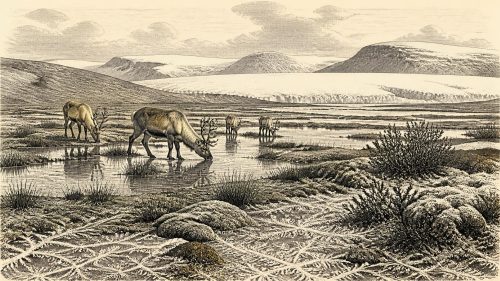
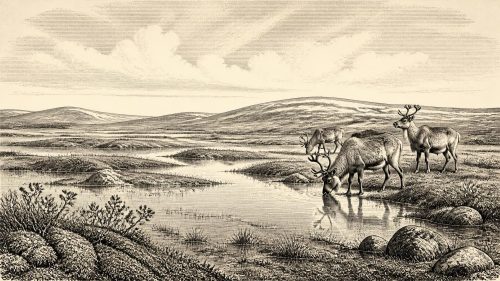
Improved radiocarbon pretreatment has transformed the chronology of the Castlepook material. Re-dating has shown that several bones are substantially older than determinations obtained in the 1990s, placing important parts of the fauna within Marine Isotope Stage 3. The revision matters because it shows that Ireland intermittently supported a richer mammal fauna before the Last Glacial Maximum than later, more familiar landscapes suggest. Reindeer and mammoth indicate cold, open-country conditions; hyaena and wolf point to predator–scavenger networks; lemmings and Arctic fox further underline the northern character of the environment. But their presence at the cave should not be converted into a map of where every species ranged in 30,426 BCE.
The animal record also illuminates regional connection. Lower global sea levels and changing ice conditions altered coastlines and routes across the wider Irish Sea world. Recent sedimentary ancient-DNA research from Castlepook supports the conclusion that Irish Late Pleistocene megafauna were connected biologically with populations elsewhere in Eurasia before the Last Glacial Maximum. That does not demonstrate a permanent dry land bridge at this particular date, nor does it establish a route used by people. It does show that Ireland was not ecologically sealed off: animals arrived, disappeared locally and, in some cases, left traces in cave sediment and bone.
The Reindeer Femur Question
One Castlepook object gives this period its sharpest human question. A fragment of reindeer femur, recovered from the old cave collection, has been reported as about 33,000 radiocarbon years old and bears a deep mark interpreted by zooarchaeologist Ruth Carden as having been made by a sharp stone tool while fresh bone was being processed. If that interpretation is confirmed, it is potentially the earliest known indication of human activity in Ireland, vastly earlier than the long-established evidence for post-glacial occupation.
Its limitations are as significant as its promise. The dated bone establishes when the animal died, not the precise time or place at which a mark was made. The specimen did not come from a modernly excavated camp floor with associated tools, hearths, food waste, dwellings or human remains. Carnivore damage, sediment abrasion, breakage, old excavation methods and the complexity of cave deposits all demand scrutiny when interpreting a single incision. Nor does a processed limb establish whether people hunted the reindeer, scavenged it, visited for hours or days, or returned at all. The prudent conclusion is that Castlepook preserves an important possible trace of Upper Palaeolithic butchery, not proof of a settled or continuous Irish population.
No Kingdoms, No Recorded Beliefs
There is no evidence from Ireland at this date for political institutions, named groups, diplomacy, warfare, language, formal religion, monuments, art or learning in the sense later historical periods reveal. Nor is there secure evidence for settlements, households, trade networks or a social order that can be described in detail. Absence from the record is not certainty that no people ever entered the island; it is a warning against inventing a society from environmental deposits and one contested humanly modified bone.
If people did reach Ireland during this wider period, the feasible interpretation is of highly mobile hunter-gatherers operating within a wider north-west European world, not of farmers, towns or tribal states. Reindeer could have offered meat, marrow, hide, sinew, antler and bone, but Castlepook does not demonstrate which of these resources were taken or how labour was organised. Exchange, diplomacy and conflict cannot be inferred from the available evidence. The most consequential development was ecological: survival depended on movement through a cold, seasonal landscape in which usable water, animal migrations, shelter and safe routes were continually being reshaped.
An Island on the Threshold
The history of Ireland around this notional year is therefore chiefly a history of thresholds. Derryvree preserves freshwater life between two glacial advances; Castlepook preserves animals from an Ice Age world later diminished or erased; the reindeer femur poses, but does not finally answer, the question of an unexpectedly early human presence. During the millennia that followed, expanding ice profoundly altered terrain, drainage and the chances that archaeological evidence would survive. The island’s oldest story cannot be told year by year. It must be read patiently from silt, seed, bone and ice—evidence of a cold but living landscape before the great transformations of the Last Glacial Maximum.
Primary Sources
- A Middle Midlandian Freshwater Series at Derryvree, Maguiresbridge, County Fermanagh, Northern Ireland
- A Middle Midlandian Freshwater Series at Derryvree, Maguiresbridge, County Fermanagh, Northern Ireland
- Irish Pleistocene Biostratigraphy
- The Irish Quaternary Fauna Project
- A Reconsideration of the Radiocarbon Dating of the Marine Isotope Stage 3 Fauna from Southern Ireland
- Growth and Retreat of the Last British–Irish Ice Sheet, 31,000 to 15,000 Years Ago: The BRITICE-CHRONO Reconstruction
- The Timing and Magnitude of the British–Irish Ice Sheet Between Marine Isotope Stages 5d and 2: Implications for Glacio-Isostatic Adjustment, High Relative Sea Levels and ‘Giant Erratic’ Emplacement
- Pattern and Timing of Retreat of the Last British-Irish Ice Sheet
- Pleistocene Glaciations in Ireland
- Cenozoic: Tertiary and Quaternary
- BSBI: Menyanthes trifoliata
- Heritage Artefacts of County Cork 2021
- Castlepook Cave, Co. Cork, 2022 Excavation Report
- New Insights on the Fauna of Ireland’s Younger Dryas and Early Holocene from Alice & Gwendoline Cave
- The Colonization of Ireland: A Human Ecology Perspective
- Prehistoric Details: Stone Age
- Ice Age Ireland
- IntCal20 Radiocarbon Age Calibration Curve
- IntCal: RadioCarbon Dating Research
- Sedimentary Ancient DNA Reveals Late Pleistocene Faunal Connectivity Between Ireland and Eurasia
- BRITICE Glacial Map, Version 2: A Map and GIS Database of Glacial Landforms of the Last British–Irish Ice Sheet