BIRM-166’s Coldwater World30212 BCE
30,212 BCE cannot describe a specific Irish event, as Late Pleistocene evidence provides only broad, calibrated ranges. At Derryvree, County Fermanagh, freshwater organic deposits between glacial tills record a temporary cold wetland of mosses, sedges, aquatic plants and northern insects, demonstrating local environmental change amid uneven ice-sheet growth. Castlepook Cave, County Cork, preserves an accumulated fauna including mammoth, reindeer, horse, predators and small cold-climate animals, showing intermittent habitable open country. A cut-marked reindeer femur may indicate Upper Palaeolithic butchery, but cannot securely establish settlement or social organisation. Ireland was climatically volatile, ecologically varied and perhaps briefly visited by mobile people.

Dateline
30,212 BCE is a modern calendar label, not a recoverable year in Irish prehistory. No written record, annual chronology or securely dated event allows historians to say what happened in Ireland in that particular year. The responsible frame is the later part of the Late Pleistocene, during Marine Isotope Stage 3, when climate across the north Atlantic was highly unstable and the British–Irish Ice Sheet was developing unevenly. The nearest useful evidence consists of broad calibrated ranges, sediment sequences and animal remains. These can illuminate landscapes and ecological possibilities around this point, but not a named community, ruler, battle, treaty or seasonal occurrence.
A Date Within Wide Ranges
The date 30,212 BCE is roughly 32,160 years before the radiocarbon convention of “present” in 1950. That apparent precision is misleading. Radiocarbon results of this antiquity must be calibrated because atmospheric carbon-14 levels have varied over time; their calendar equivalents can span centuries or millennia. The most relevant Irish measurement is BIRM-166, obtained from organic deposits at Derryvree near Maguiresbridge, County Fermanagh. It produced an age of 30,500 radiocarbon years before present, with an uncertainty of about 1,100 years. Modern calibration makes clear that this is a wide chronological window, rather than a date for one moment. It is therefore reasonable to discuss Derryvree as evidence relevant to the early thirty-second millennium BCE, but not to assign its plants, insects or waters to 30,212 BCE precisely.
Fresh Water Between the Tills
Derryvree is important because of its stratigraphy: a lower glacial till was followed by freshwater silts, sands and organic muds, and these deposits were capped by another till. Till is the unsorted material laid down directly by glacier ice. The sequence demonstrates that ice occupied this Fermanagh locality, that an interval then allowed open water, sediment and vegetation to develop, and that glacier ice subsequently returned. It does not show that all Ireland was ice-free simultaneously. Rather, it overturns any simple image of a uniformly ice-covered island throughout the last glacial period. Ireland contained changing local environments: ice masses, ice margins, periglacial ground and, at least at intervals, sheltered freshwater basins.
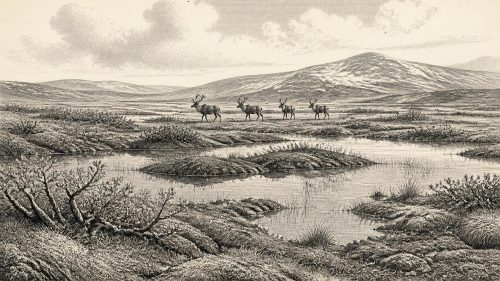
The organic layers preserve a rare local environmental archive. Fossil mosses, sedges, aquatic plants and insects indicate standing or slow-moving fresh water bordered by wet ground. The flora included cold-tolerant species, and the insect evidence has a northern, cold-climate character. Archaeologists and Quaternary scientists have described this setting with terms such as tundra, muskeg or periglacial wetland. These are useful comparisons, not exact replicas of any modern habitat. The important point is that Derryvree was not a familiar wooded Irish landscape. It was an open, cold and waterlogged mosaic, with a short growing season, exposed ground and pools in which plant material could accumulate before later ice sealed the evidence away.
An Island in Climatic Transition
At this date Ireland lay within a north-west European world increasingly affected by expanding ice, but it was not yet at the best-established maximum of the last glaciation. Major reconstructions place the greatest extent and volume of the British–Irish Ice Sheet later, broadly during the period after about 27,000 years ago, with maximum ice volume around 23,000 years before present. The approach to that maximum was not a single, steady advance. Different sectors grew, flowed and retreated at different times. Around 30,212 BCE, local conditions in Ireland could therefore vary sharply according to altitude, proximity to ice and drainage. The Derryvree sequence gives direct evidence for one such changing northern landscape.
This environmental volatility shaped every possibility for life. Winter cold, frost action and snow cover would have constrained vegetation and travel; thaw seasons would have changed streams, pools and animal forage. The preservation of freshwater deposits suggests that meltwater, groundwater or seasonal runoff mattered as much as ice itself. The later glacier advance erased, reworked or buried many older surfaces. That destructive history helps explain why Ireland has so little surviving evidence for the period compared with some continental regions: campsites, hearths, wooden objects and tracks would have been exceptionally vulnerable to glacial erosion and subsequent landscape change.
Castlepook’s Animal Archive
County Cork provides the principal faunal counterpart to Derryvree. Castlepook Cave, near Doneraile and sometimes called Mammoth Cave, produced one of Ireland’s most striking collections of Ice Age animal remains. Its wider Late Pleistocene fauna has included woolly mammoth, reindeer, giant deer, horse, brown bear, wolf, spotted hyaena, arctic fox, mountain hare and lemmings. Not every species need have lived there at the same time, and the cave deposits were excavated before modern standards of recording. Carnivores could carry bones into a cave, water could move sediments, and antiquarian excavation could mix material. The assemblage must therefore be treated as an accumulated archive, not as a single frozen scene.
Nevertheless, the fauna establishes a vital point: pre-maximum Ireland was not biologically empty. Open-country grazers and browsers, together with predators and scavengers, could occupy parts of the island during suitable phases. Mammoth and reindeer evoke an exposed grassland-and-herb landscape rather than dense forest; hyaena and wolf indicate a functioning food web in which carcasses were contested, moved and consumed. Such animals also imply seasonal movement across wider territories. They cannot tell us that a particular herd passed through Cork in 30,212 BCE, but they make an Irish landscape capable of supporting large mammals around this broad interval historically credible.
The Reindeer Femur Question
The strongest possible evidence for people in this earlier Ice Age Ireland is also the most limited. A reindeer femur from Castlepook bears a deep mark interpreted by zooarchaeologist Ruth Carden as having been made by a sharp stone tool during carcass processing. The bone has been publicly dated to roughly 33,000 years ago, making it closely relevant to the period considered here. If the interpretation is upheld, it shows that people handled a reindeer carcass in Ireland during the Upper Palaeolithic. It would be evidence for an encounter, hunt or butchery episode—not proof of a permanent settlement.
Several limits must remain explicit. The radiocarbon date concerns the animal’s death, not the exact time at which the mark was made. No securely associated stone-tool assemblage, hearth, dwelling floor, burial, art or human skeleton of comparable age has been published from Ireland. The Castlepook collection also came from complex, early excavations rather than a modern, tightly recorded trench. There is consequently no sound basis for naming an Irish Upper Palaeolithic people, identifying their language, assigning them a continental archaeological culture, or treating them as ancestors of later inhabitants. The bone is a compelling clue, not a population history.
No Politics, But Possible Mobility
There is no evidence for political institutions, diplomacy, organised warfare, religion or formal learning in Ireland at this date. Nor can trade be demonstrated. If people were present, they were probably highly mobile foragers operating in a landscape where animal movements, weather and access to unfrozen ground determined opportunity. That is an inference from the ecological setting and the wider European Upper Palaeolithic, not a fact directly observed in Irish deposits. The absence of houses, fields, pottery, metalwork and cemeteries means that everyday social arrangements remain unknown. Even the number of visits, people involved and length of occupation cannot be estimated responsibly.
Sea level was lower than today because large quantities of water were locked in northern ice sheets, altering coasts and the geography of the Irish Sea region. Yet it would be unsafe to turn this into a claim of an easy or continuous land route to Ireland. Connections between Ireland, Britain and continental Europe changed with ice extent, sea level, marine channels and local topography. For any humans or animals reaching Ireland, access was a geographical problem that changed through time rather than a permanent bridge. The fossil record confirms movement was possible; it does not reveal the exact route.
What This Year Can Mean
The best historical picture for Ireland around 30,212 BCE is thus ecological and geological. In Fermanagh, a cold freshwater wetland existed during an interval between glacier advances, preserving plants and insects that later ice protected beneath till. In southern Ireland, Castlepook’s accumulated bones show that large mammals and carnivores inhabited the island during overlapping parts of Marine Isotope Stage 3. A marked reindeer bone raises the serious possibility of human activity, while falling far short of demonstrating settlement. The major development was not state formation or cultural florescence, but the creation—and later destruction—of habitable patches within an increasingly glacial world.
This sparse evidence has unusual value precisely because it is so easily overstated. Derryvree and Castlepook do not supply a year-by-year Irish history; they reveal the fragments from which one must be built. Their lesson is that Late Pleistocene Ireland was dynamic, locally varied and intermittently alive with wetland plants, insects and large animals, perhaps briefly with people as well. The archaeological task is to preserve that distinction between direct evidence and interpretation, while recognising that beneath Ireland’s later landscapes lies the record of a far older, colder and largely vanished world.
Primary Sources
- A Middle Midlandian Freshwater Series at Derryvree, Maguiresbridge, County Fermanagh, Northern Ireland
- Early Midlandian–Middle Midlandian, Pleistocene, Northern Ireland
- A Reconsideration of the Radiocarbon Dating of the Marine Isotope Stage 3 Fauna from Southern Ireland
- The Irish Quaternary Fauna Project
- Exploring the Last British-Irish Ice Sheet: The BRITICE-CHRONO Project
- Growth and Retreat of the Last British–Irish Ice Sheet, 31,000 to 15,000 Years Ago: the BRITICE-CHRONO Reconstruction
- Deglaciation Chronology of the Donegal Ice Centre, North-West Ireland
- Stratigraphic and Palaeo-Geomorphological Evidence for the Glacial-Deglacial History of the Last British-Irish Ice Sheet in the North-Western Irish Sea
- The IntCal20 Northern Hemisphere Radiocarbon Age Calibration Curve (0–55 cal kBP)
- IntCal Publications
- The IntCal20 Northern Hemisphere Radiocarbon Age Calibration Curve (0–55 cal kBP)
- Heinrich Events: Massive Late Pleistocene Detritus Layers of the North Atlantic and Their Global Climate Imprint
- Figure 6.—The Subdivision of the Quaternary Period in Ireland
- References and Recommended Reading
- Introduction to the Late Quaternary and Holocene of Northern Ireland
- Heritage Artefacts of County Cork
- Castlepook Cave Excavation Report 2022
- Reindeer Bone Found in Cork Cave Shows Human Activity in Ireland 33,000 Years Ago
- Middle Midlandian Interstadial Deposits at Greenagho, Near Belcoo, County Fermanagh, Northern Ireland
- New Insights on the Fauna of Ireland's Younger Dryas and Early Holocene from Alice & Gwendoline Cave