Derryvree’s Juniper Pools30412 BCE
Modern label 30,412 BCE cannot identify a recoverable Irish historical moment. Derryvree, County Fermanagh, preserves freshwater silts between glacial tills, radiocarbon dated broadly to 36,900–31,700 calibrated years before present. Its juniper, sedges, mosses and insects indicate an open, treeless wet-tundra of pools and periglacial conditions, later overridden by ice. Castlepook Cave, County Cork, contains mixed remains of reindeer, mammoth, predators and other cold-climate fauna, accumulated across extended periods. A possibly cut-marked reindeer femur may indicate human activity, but proves neither settlement nor occupation. Evidence supports a changing Late Pleistocene environment, while political, social and cultural histories remain unknowable in Ireland.
Dateline
“30,412 BCE” is a modern chronological label, not a year that can be recovered from Ireland’s prehistoric record. No Irish community used a calendar of this kind, and there is no written testimony, named person, settlement, artefact assemblage or event that can responsibly be fixed to this point. In calendar terms, the label lies roughly 32,360 years before AD 1950, the reference point conventionally used for radiocarbon dating. The appropriate subject is therefore not a dated episode but a broad Late Pleistocene landscape: Ireland during Marine Isotope Stage 3, as climates fluctuated sharply and the last British–Irish Ice Sheet was beginning a major phase of growth.
The closest illuminating evidence comes from deposits and bones whose dates are ranges with substantial uncertainty. They show that parts of the landmass now called Ireland could, at intervals, support a cold-adapted flora and fauna. They do not demonstrate an Irish population, a political community or a continuous human occupation. The distinction is central: fossils can establish that an animal was present; sediment can preserve a local wetland; an apparently modified bone may suggest human contact. None of these, by itself, supplies the ordinary detail of history.
A Date Range, Not a Moment
The key environmental archive is Derryvree, near Maguiresbridge in County Fermanagh. Roadworks in 1969 cut through a drumlin and exposed organic silts and fine sands trapped between two thick sheets of glacial till. The lower and upper tills record separate episodes of ice overriding the district; between them, the sediments preserve a freshwater environment. The deposit produced the radiocarbon determination BIRM-166: 30,500 radiocarbon years before present, with an uncertainty of +1,170 and −1,030 years.
That figure must not be converted mechanically into a single BCE year. Radiocarbon years are not calendar years, because atmospheric carbon-14 has varied through time. Later calibrations and regional syntheses place the Derryvree determination within a broad calendar range of approximately 36,900–31,700 calibrated years before present. The modern date-label 30,412 BCE falls near the younger end of that wide window, rather than marking a detectable day, season or generation in the deposit. BIRM-166 is a chronological anchor, not a timestamp for a particular pool or plant.
Nor should the bed be treated as a complete picture of all Ireland. It records one surviving locality in Fermanagh. Subsequent ice eroded, redeposited or buried much of the older landscape, leaving a fragmentary record. Yet its position between tills is exceptionally valuable: it proves that, before the later ice advance sealed the sediments, open ground and freshwater conditions existed at Derryvree. It also demonstrates why confidence must be graded. The plants and insects are evidence; the wider reconstruction of climate and ice extent is interpretation drawn from their combination with other sites and models.
Open Ground and Fresh Water
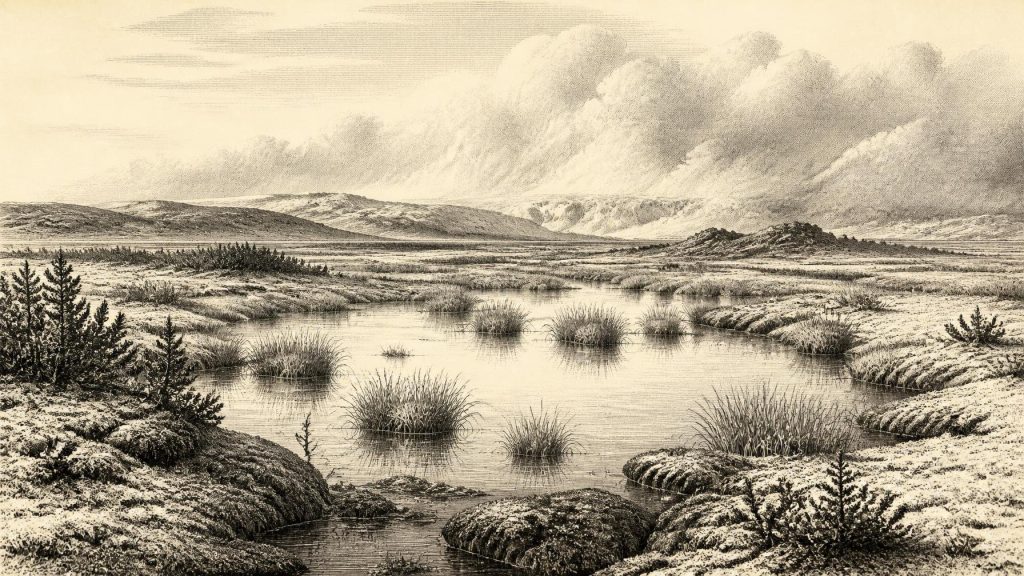
Derryvree was no forested version of modern Fermanagh. Its fossil evidence has been interpreted as an open, treeless muskeg or wet-tundra setting under a periglacial climate. Grasses and sedges were important, accompanied by herbs, mosses and juniper. Insect remains indicate plant-rich shallow water and open pools bordered by mossy ground. The scene was likely a patchwork rather than a uniform plain: saturated hollows, sedge margins, small pools, frost-disturbed mineral soil and drier exposed ground, all shaped by a short growing season and severe winters.
Such evidence supports a landscape with vegetation, not a barren white wilderness. It does not allow a precise reconstruction of temperature for this exact notional year. The point is climatic character: conditions were markedly colder and more seasonal than those of the modern Atlantic island. Tree cover was absent locally, while low vegetation could take advantage of summer light and wet ground. Juniper is especially evocative because it signals that some woody plants survived close to the surface, but it should not be expanded into a dense scrubland without evidence.
Water was a decisive part of this environment. The Derryvree silts accumulated in freshwater, and the organic material survived because it was rapidly buried and later protected beneath glacial deposits. Pools and wet margins would have concentrated vegetation and invertebrate life within an otherwise exposed country. They were ecological refuges on a small scale, but not evidence for lakeside villages or a settled economy. No hearth, hut floor, tool scatter, fishing equipment or food waste has been securely associated with this deposit.
Ice in a Changing Island
This was before the Last Glacial Maximum, when ice later became far more extensive across Ireland and adjacent seas. It was nevertheless a period of profound instability. Modern reconstructions of the British–Irish Ice Sheet identify rapid early growth around 32,000–31,000 years ago, followed by further expansion over many millennia. At the broad time represented by 30,412 BCE, the precise position of an ice margin in each Irish region cannot be stated with confidence. The evidence instead shows an island entering an era in which local environments were increasingly vulnerable to glacial advance.
Derryvree’s two tills make that sequence tangible. An earlier ice episode had laid down the lower till; freshwater life returned or persisted during the interval represented by the organic bed; later ice deposited the upper till and incorporated the wetland into a drumlin. The landscape visible in the silts was therefore temporary on geological timescales. It was eventually erased from the surface, although its buried remains became an archive.
Lower sea levels altered coastlines and exposed areas now submerged, but this should not be simplified into a guaranteed walkable route to Ireland. Palaeogeographic connections varied with sea level, topography and ice, and the evidence for any particular crossing at this date is inadequate. Ireland’s later separation from Britain is well established in post-glacial research, while the routes taken by earlier animals or any people remain much less certain. Ice, water and changing shorelines were all barriers as well as possible corridors.
Animals in the Cave Record
County Cork provides the other major window. Castlepook Cave, near Doneraile and long known as Mammoth Cave, yielded a remarkable Pleistocene bone assemblage during antiquarian excavation. Reindeer, woolly mammoth, giant deer, brown bear, wolf, Arctic fox, lemmings and spotted hyaena are among the animals identified from the wider cave record. Together they establish that Ireland, during portions of the pre-maximum glacial period, hosted or received a fauna very different from today’s.
Cave collections need cautious handling. Bones from Castlepook accumulated over a long period, rather than during one occupation or one climatic season. Some were moved or re-sorted by water; others may have been brought in by predators, scavengers or natural deaths. Old excavation practices also removed much of their original spatial and stratigraphic context. A list of species is therefore not a census of animals alive together in 30,412 BCE, nor proof that each inhabited every Irish region simultaneously.
Even so, the fauna makes the Derryvree landscape more intelligible. Reindeer and Arctic fox fit a cold, open environment; lemmings indicate severe climatic conditions; hyaenas and wolves remind us that large herbivores existed within predator-rich food webs. Mammoth remains reveal that very large grazers reached Ireland at some point in this extended period. Their bones are powerful evidence for vanished ecosystems, but not for a stable, plentiful game reserve accessible to human hunters.
The Castlepook Human Question
The most consequential possible trace of people is a reindeer femur from Castlepook. Zooarchaeologist Ruth Carden identified a deep mark interpreted as a stone-tool incision made while the bone was fresh, and public reporting has associated the bone with an age of roughly 33,000 years. If that interpretation is confirmed, it would be exceptionally early evidence that people processed a reindeer in Ireland, broadly near the period under discussion.
Its implications must remain narrow. The date is for the animal bone, not automatically for the cutting episode; the cave’s deposits are complex; and one marked specimen does not establish whether people killed the animal, scavenged it, took meat or hide, remained overnight, or returned repeatedly. Crucially, Ireland has no securely associated stone-tool assemblage, hearth, built shelter, burial, human skeletal remains, artwork or occupation surface of comparable age from Castlepook. The femur is a promising and important clue, not a foundation for a populated Ice Age Ireland.
Research into the cave is consequently more valuable than dramatic certainty. Renewed examination, direct dating, microscopic study of bone-surface damage and excavation of undisturbed deposits may test the claim. The history of Irish cave finds shows why this matters: improved pretreatment and dating have revised earlier chronologies, sometimes substantially. Responsible interpretation changes when better evidence appears.
What Cannot Be Written
There is no evidence for political affairs, diplomacy, warfare, kingship, law, trade networks, religion, formal learning or named cultural identities in Ireland at this depth of time. Nor can archaeologists infer a household routine, clothing, language, kinship system or belief from the Derryvree wetland. If visitors briefly handled a reindeer at Castlepook, they may have possessed knowledge and social relationships comparable in complexity to other Upper Palaeolithic peoples elsewhere in Europe, but that is an analogy, not an Irish fact.
The most defensible account is environmental and evidential. Around the modern label 30,412 BCE, the Irish landmass belonged to a cold Late Pleistocene world of open vegetation, freshwater hollows, periglacial processes and shifting ice. Fermanagh’s buried silts preserve juniper, sedges, mosses, insects and pools; Cork’s caves preserve a long, mixed record of animals, and perhaps one humanly modified reindeer bone. These sparse survivals do not yield a conventional national history. They show instead how Ireland’s deepest past must be read: patiently, locally and with uncertainty made visible.
Primary Sources
- Middle Midlandian Freshwater Series at Derryvree, Maguiresbridge, County Fermanagh, Northern Ireland
- The Irish Quaternary Fauna Project
- Landscapes and Environments of the Last Glacial-Interglacial Transition: A Time of Amazingly Rapid Change in Ireland
- Figure 6.— The Subdivision of the Quaternary Period in Ireland
- References and Recommended Reading
- Introduction to the Late Quaternary and Holocene of Northern Ireland
- Pleistocene Glaciations in Ireland
- Trimlines, Blockfields and the Vertical Extent of the Last Ice Sheet in Southern Ireland
- Growth and Retreat of the Last British–Irish Ice Sheet, 31,000 to 15,000 Years Ago: The BRITICE-CHRONO Reconstruction
- The Timing and Magnitude of the British–Irish Ice Sheet Between Marine Isotope Stages 5d and 2
- BRITICE-CHRONO Maps and GIS Data of the Last British-Irish Ice Sheet 31 to 15 ka
- BRITICE-CHRONO: Introduction
- Data – Ice Samples – Software
- The WAIS Divide Deep Ice Core WD2014 Chronology – Part 2: Annual-Layer Counting (0–31 ka BP)
- The Island of Ireland: Drowning the Myth of an Irish Land-Bridge?
- Ireland: Submerged Prehistoric Sites and Landscapes
- The Mesolithic in Ireland: When Was It?
- New Insights on the Fauna of Ireland's Younger Dryas and Early Holocene from Alice & Gwendoline Cave
- First Evidence of a Late Upper Palaeolithic Human Presence in Ireland
- The Archaeology of Caves in Ireland
- Heritage Artefacts of County Cork
- Ireland's Palaeolithic Archaeology – Fleeting Footprints in a Frozen Land