Cork’s Marked Reindeer30413 BCE
Around 30,413 BCE, Ireland lay within a fluctuating late-Pleistocene environment, approaching major glaciation but not necessarily wholly ice-covered. Climate, sea level and routes to Britain and Europe changed rapidly, allowing intermittent animal movement. Castlepook Cave in County Cork preserves remains of reindeer, mammoth, hyaena and other fauna, demonstrating episodic ecological connections. A reindeer femur bearing a possible stone-tool cut mark may indicate Upper Palaeolithic carcass processing about 30,000 years ago. However, uncertain dating, disturbed cave context and absence of associated artefacts or settlement evidence preclude claims for permanent occupation, named communities or continuous ancestry. Interpretation therefore remains calibrated and cautious.
Dateline
30,413 BCE is a modern chronological label, not a date that people in Ice Age Ireland could have recognised. No writing, calendar, named community or year-specific event survives from this depth of time. Archaeology cannot responsibly describe what happened on a particular day, season or year. It can place the notional date within a broad late-Pleistocene setting: roughly 32,400 years before AD 2000, during Marine Isotope Stage 3 and shortly before the most extensive phase of the last British–Irish Ice Sheet. The evidence is necessarily uneven. It comes from cave bones, buried sediments, ice-sheet reconstructions, radiocarbon measurements and climate archives, each with its own uncertainties.
A Date of Ranges, Not Annals
At this age, even apparently precise numbers require care. A radiocarbon age is not the same as a calendar age: atmospheric carbon-14 changed over time, so measurements must be calibrated against curves such as IntCal20. Nor should a date expressed in BCE be mechanically equated with a result in years “before present”, conventionally before AD 1950. The sensible historical frame is therefore a range of centuries or millennia, not the illusion of exact annual precision.
The wider North Atlantic record gives an important, though indirect, context. Greenland ice cores register abrupt shifts between cold stadials and relatively milder interstadials. Around this notional date, the GICC05 chronology places the onset of Greenland Interstadial 5 at about 32,500 years before AD 2000, with an uncertainty of several centuries. This does not prove that Ireland experienced exactly the same temperature, rainfall or seasonality at the same moment. It does show that Ireland lay within a North Atlantic world capable of rapid climatic reorganisation. Caves, vegetation and animal ranges on the western edge of Europe were shaped by those shifts.
An Island on the Edge of Growing Ice
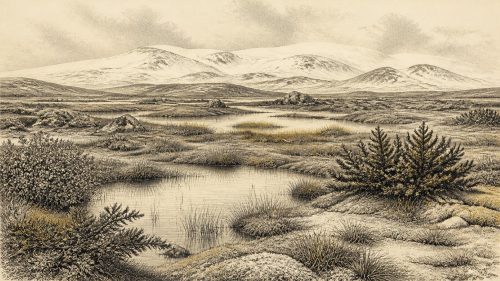
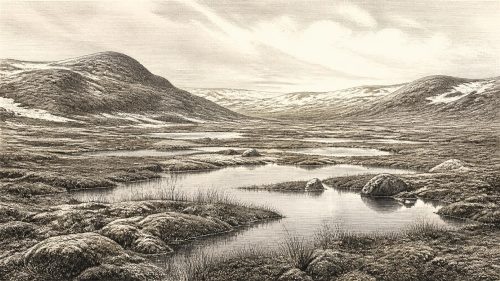
Ireland was not yet simply a white, lifeless ice sheet. The best recent reconstruction of the British–Irish Ice Sheet begins at 31,000 years ago and depicts broad growth of ice between 31,000 and 26,000 years ago, but it also stresses that constraints before 31,000 years ago are sparse. That warning matters for 30,413 BCE. The state of every valley, coast and upland cannot be mapped with confidence for this particular point. What can be said is that the island was entering a severe glacial phase in which ice accumulation and changing sea levels would increasingly transform routes, habitats and the survival of exposed ground.
Later in the glacial cycle, ice reached far across the Irish continental shelf and the Irish Sea system became a major conduit for fast-moving ice. Those later limits should not be projected unchanged backwards onto this date. Around 30,413 BCE, the landscape was dynamic rather than uniform: some areas may have supported open ground and animal movement, while others were dominated by cold-climate processes, local ice or increasingly inhospitable terrain. The modern coastline was not a reliable boundary either. Lower global sea levels altered the extent of surrounding shelves and the distances between Ireland, Britain and the continent, although land connections and crossings changed through time and cannot be assumed for every episode.
For people, if any were present, this was a landscape in which mobility would have mattered more than territorial possession. There were no states, kings, borders, diplomatic institutions or political communities visible in the evidence. It would be misleading to invent them. The meaningful regional story is environmental: the advance or retreat of ice, the availability of grazing and carrion, and the shifting practicality of movement through the Irish Sea basin.
Castlepook and the Animal Evidence
The principal Irish evidence relevant to this deep period comes from caves, especially Castlepook Cave, also known as Mammoth Cave, near Doneraile in north County Cork. Excavated chiefly in the early twentieth century, it produced an exceptional collection of Pleistocene animal remains. The National Museum of Ireland preserves material from the site, including spotted-hyaena remains. Castlepook is important because its fauna demonstrates that Ireland was inhabited, during parts of the later Ice Age, by mammals now absent from the island: reindeer, woolly mammoth, spotted hyaena, brown bear, wolf, hare and deer among them.
The Irish Quaternary Fauna Project showed that a range of mammals reached Ireland between at least about 45,000 and 20,000 years ago. That is powerful evidence for repeated ecological connections with Britain and mainland Europe during favourable windows. It is not, however, a single assemblage frozen in one moment. Cave collections may combine remains accumulated over long periods; bones can be moved by water, scavengers, excavation practices or later disturbance. An animal dated from Castlepook establishes that its species occurred in Ireland at or near the age of that bone. It does not automatically establish a stable population, a precise local environment, or the simultaneous presence of every other species found in the cave.
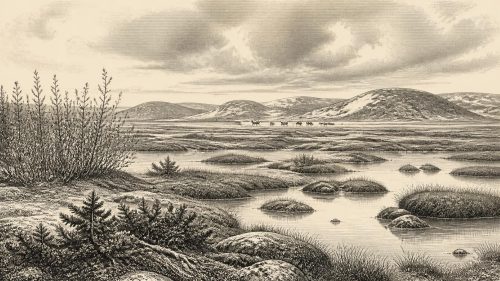
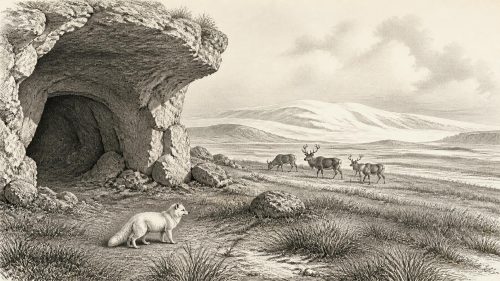
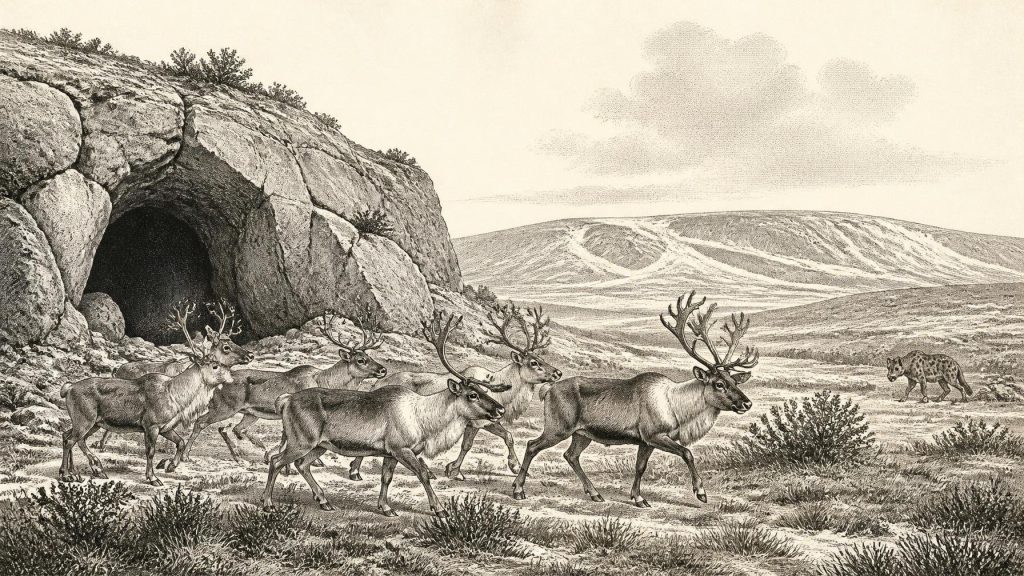
Reindeer are especially relevant to the image of Ireland at this time. Their presence is consistent with open, cold landscapes offering seasonal grazing, but it does not require a featureless polar desert. Hyaenas complicate any romantic picture of a harmless herd-land: they were formidable predators and scavengers, and caves could be dens or places where carnivores accumulated bones. Mammoths, too, belong to the wider Castlepook faunal record, but their remains should not be used to claim that every Cork valley around 30,413 BCE contained mammoth herds. The responsible conclusion is more modest: changing Irish habitats could, at different times within this broad interval, sustain a surprisingly varied cold-stage fauna.
The Marked Femur
A reindeer femur from Castlepook has made this period especially significant for Irish prehistory. Zooarchaeologist Ruth Carden has identified a deep linear mark on the bone and interpreted it as damage from a sharp stone tool during the processing of a carcass. County Cork heritage material presents the find as evidence that Stone Age hunters may have been stalking reindeer in Ireland about 30,000 years ago. If that interpretation is upheld by continuing specialist analysis, it would be an extraordinarily early indication that people handled animal remains in Ireland during the Upper Palaeolithic.
Yet the qualification is essential. The femur is not a settlement. No securely associated hearth, stone-tool assemblage, dwelling floor, burial, human skeleton, art panel or food store has been published from Ireland for this age. Nor does the age of an animal bone identify the exact instant at which a mark was made. Castlepook’s old collection also lacks the tightly controlled stratigraphic context expected from a modern excavation. A single possible cut mark may signal butchery, but it cannot reveal whether people killed the animal, found it dead, processed it at the cave, stayed nearby overnight, revisited the district, or belonged to a population living permanently on the island.
That distinction affects every social inference. Small Upper Palaeolithic groups elsewhere in north-west Europe possessed considerable knowledge of animals, stone, weather and seasonal movement; they could cooperate in hunting and carcass processing, share food and teach practical skills. These are reasonable comparative possibilities, not demonstrated facts about Ireland in 30,413 BCE. There is no evidence here for a named culture, language, kin group or lineage. Equally, there is no basis for treating a possible visit as the uninterrupted beginning of later Irish population history. Subsequent glacial conditions may have erased or prevented any continuity.
Food, Movement and Material Life
If humans did process reindeer in Cork during this broad period, meat, marrow, hide, sinew and bone would all have been valuable resources. A large carcass could feed a small travelling group and furnish raw materials for clothing, bindings or tools. But such statements describe the known practical potential of reindeer rather than artefacts recovered from Castlepook. No Irish toolkit of this date has been securely linked to the marked femur. There is therefore no responsible way to describe local tool types, house forms, cooking methods, clothing or hunting tactics as though they were excavated facts.
Trade is even less visible. There is no evidence for exchange networks, imported goods or regular seaborne traffic in Ireland at this point. Movement across the wider region remains a more defensible concept than trade: animals and, potentially, small human groups could exploit temporary environmental corridors as sea level, ice and vegetation changed. The island’s position did not make it permanently isolated, but neither does it prove that every route was easy or continuously open. Ireland’s prehistoric geography must be understood as fluctuating opportunity constrained by climate.
Silence on Belief and Power
Religion, art, formal learning and conflict cannot be recovered from the Irish evidence for this date. A cut-marked animal bone is not proof of a ritual, a shrine, an emblem or a ceremonial hunt. The presence of hyaena and other carnivores documents competition and danger within an ecosystem, not warfare between human groups. Likewise, there is no archaeological basis for diplomacy, leadership, political authority or territorial boundaries. These absences are not failures of imagination; they are the limits that keep a prehistoric account honest.
There was, nonetheless, a kind of learning embedded in survival. Any people who entered this northern Atlantic landscape would have needed acute observation: where animals fed, when weather changed, which rock could make cutting edges, where caves offered shelter and which routes became blocked by ice or water. That knowledge was probably social and cumulative, passed through demonstration and memory rather than writing. It remains an inference from human lifeways elsewhere, not a direct record of an Irish community.
A Precarious Irish Window
The most important development around 30,413 BCE was not a recorded event but a precarious environmental window. Ireland formed part of a late-Pleistocene world in which large mammals could reach and occupy the island during certain intervals, while glaciers were gathering strength for a much harsher transformation. Castlepook’s fauna preserves the outcome of those openings. The marked reindeer femur raises the possibility that humans also used one of them.
For now, Cork’s marked reindeer should be treated as a question of great consequence rather than a finished origin story. It may record a brief act of carcass processing by Upper Palaeolithic people. It does not demonstrate a village, a permanent colony or a continuous ancestry leading to later inhabitants. Future excavation of undisturbed deposits, direct dating, microscopic analysis of surface modifications and recovery of securely associated artefacts may sharpen the picture. Until then, the history of Ireland at this depth is best told through calibrated ranges, environmental change and carefully bounded possibilities.
Primary Sources
- The Irish Quaternary Fauna Project
- New Insights on the Fauna of Ireland’s Younger Dryas and Early Holocene from Alice & Gwendoline Cave
- Growth and Retreat of the Last British–Irish Ice Sheet, 31,000 to 15,000 Years Ago: The BRITICE-CHRONO Reconstruction
- BRITICE-CHRONO Maps and GIS Data of the Last British-Irish Ice Sheet 31 to 15 ka
- Timing and Pace of Ice-Sheet Withdrawal Across the Marine–Terrestrial Transition West of Ireland During the Last Glaciation
- A 60,000 Year Greenland Stratigraphic Ice Core Chronology
- The IntCal20 Northern Hemisphere Radiocarbon Age Calibration Curve (0–55 cal kBP)
- NGRIP/GRIP: GICC05 Time Scale and δ18O Values
- Spotted Hyena Skull
- Ice Age Ireland: Cool Fossils!
- Heritage Artefacts of County Cork
- Ireland’s Palaeolithic Archaeology – Fleeting Footprints in a Frozen Land
- Outreach and Education Resources
- Late Quaternary Stratigraphy and Glacial History of Southern Ireland
- Phylogeographic, Ancient DNA, Fossil and Morphometric Analyses Reveal Ancient and Modern Introductions of a Large Mammal: The Complex Case of Red Deer (Cervus elaphus) in Ireland
- Prehistoric Details: Mell Flint Flake
- Learn About: The Ice Age
- Dimensions and Chronology of the Last Ice Sheet in Western Ireland
- Episodic Speleothem Deposition Tracks the Terrestrial Impact of Millennial-Scale Last Glacial Climate Variability in SW Ireland
- Late Pleistocene Chronostratigraphy and Ice Sheet Limits, Southern Ireland
- The Mesolithic in Ireland: When Was It?