A Drumlin’s Ancient Seed30353 BCE
Around 30,353 BCE, Ireland’s history is environmental rather than political. At Derryvree, County Fermanagh, organic-rich freshwater sediments between glacial tills date broadly to this period, demonstrating an ice-free interval with cold, wet, treeless tundra, pools and hardy vegetation. The sequence records shifting ice conditions, not uniform glaciation. Cave faunas, particularly at Castlepook, indicate changing Late Pleistocene animal communities, though deposits are disturbed and time-averaged. A possibly cut-marked reindeer bone raises the prospect of human presence, but provides no evidence for settlement. No societies, politics or cultures can be reconstructed. The evidence instead reveals life persisting in refuges between ice advances.
Dateline
Modern calendar precision cannot be carried back to 30,353 BCE. No Irish document, settlement layer or dated event records a single year so remote. The label is nevertheless useful as a point within the later Pleistocene: approximately 32,303 years before AD 1950, the conventional starting point for “before present” dating. The responsible historical question is therefore not what happened in Ireland in that year, but what dated evidence can illuminate the wider interval containing it.
The strongest evidence comes from Derryvree townland near Maguiresbridge, County Fermanagh. There, roadworks in February and March 1969 exposed a drumlin cut through by a remarkable sequence: a lower deposit of glacial till, freshwater silts and fine sands rich in organic material, and then a second thick till above. The order is decisive. Glacier ice had crossed the site; subsequently, water, plants and small animals occupied an ice-free locality long enough for sediment to build up; later ice advanced over it and sealed the deposit. This is not a written history, but it is a securely observed environmental sequence.
A Broad Dating Window
Organic material from the Derryvree freshwater bed produced the radiocarbon determination BIRM-166: 30,500 radiocarbon years before present, with a large laboratory uncertainty of +1,170 and −1,030 years. Radiocarbon years are not identical to calendar years. When calibrated against changing atmospheric carbon-14 levels, the result has commonly been expressed as a broad range of roughly 36,900 to 31,700 calibrated years before present, or approximately 34,950 to 29,750 BCE. Different calibration curves and modelling choices can alter the precise conversion, but the essential point remains: 30,353 BCE lies within the wide interval represented by these sediments, not at a pinpointed horizon within them.
That distinction matters. Derryvree does not show the weather on a particular day, nor prove that every part of Ireland was ice-free at the same moment. It records a local landscape over an interval of accumulation. Yet its place between two tills is especially valuable in a country where later glaciation repeatedly eroded, mixed and buried older deposits. It rules out any simple picture of an Ireland continuously entombed beneath ice throughout the whole late Pleistocene.
Fresh Water Between Ice Advances
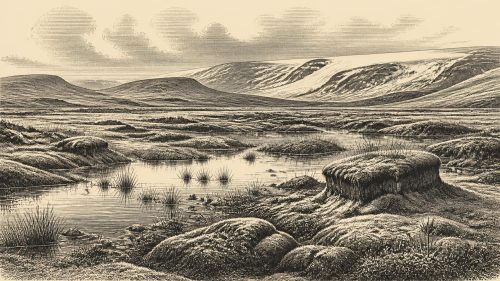
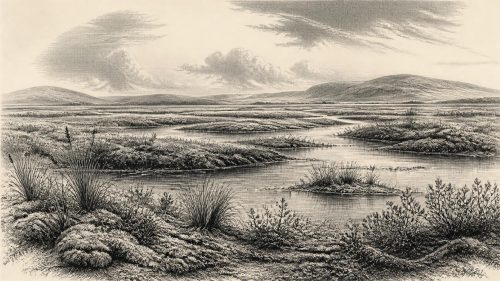
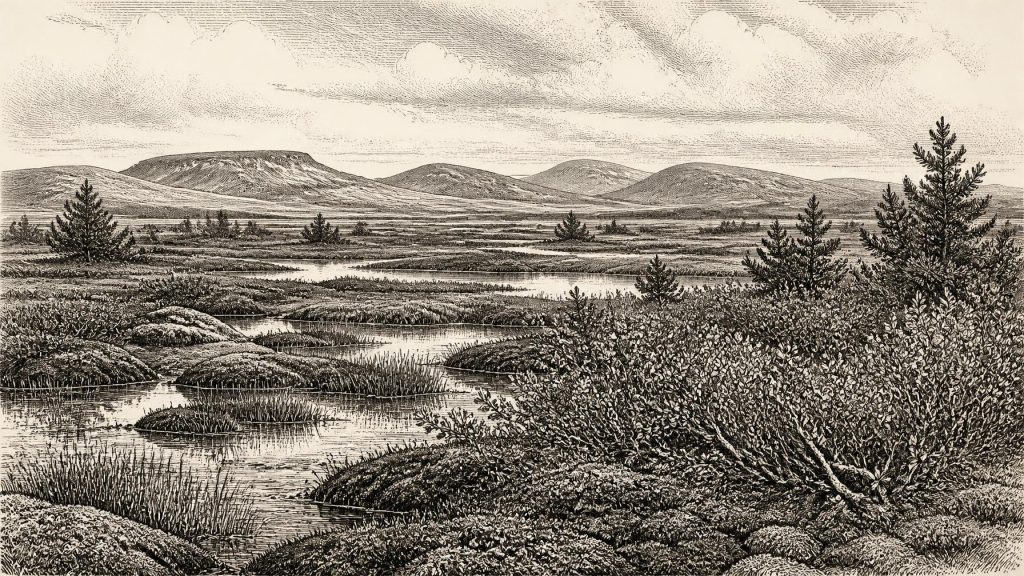
The Derryvree fossils describe a cold, open and wet environment. Pollen, plant macrofossils, moss remains and insects indicated treeless tundra or muskeg: waterlogged ground with mossy margins, shallow pools and low vegetation rather than forest. Grasses and sedges formed part of the cover. Juniper, dwarf willow and hardy herbs occurred, while aquatic and wetland plants included water-milfoil and bogbean. Mountain-avens and clubmoss were among the plants used to reconstruct a severe, periglacial setting.
Such a place should not be imagined as barren white ice. During the growing season, sedges, mosses and flowering herbs could occupy sheltered wet hollows, pool edges and better-drained patches. Freshwater supported aquatic plants, while saturated ground preserved organic debris. But the same evidence points to short summers, long winters and intense frost action. The soil would often have been frozen or unstable; wind exposure and snow cover varied from one hollow or slope to another. Derryvree was a living landscape, but one in which biological productivity was constrained by cold.
This local wetland also reveals regional change. The lower till shows that ice had previously occupied the district. The upper till records a later return or advance of ice. Around the broad Derryvree interval, therefore, Ireland was neither a stable temperate island nor uniformly glaciated. Its northern landscapes could include ice-free basins and freshwater habitats while ice masses developed, shifted or survived elsewhere. The later Last Glacial Maximum, when the British–Irish Ice Sheet reached its greatest extent, belongs mainly to a subsequent phase, conventionally placed around 27,000–21,000 years ago. The precise route from the Derryvree interval to that maximum remains a subject of glacial research.
Animals in a Fragmentary Record
Ireland’s cave deposits supply a second, complementary line of evidence. At Castlepook Cave near Doneraile in north Cork, collections accumulated through carnivore activity, natural deaths, water movement and early excavation preserve part of a much broader late-Pleistocene fauna. Reassessment and improved radiocarbon treatment have shown that some bones previously assigned to later periods are substantially older, belonging to Marine Isotope Stage 3, the long, climatically variable interval in which 30,353 BCE falls.
These faunal records demonstrate that Ireland was, at various points before the Last Glacial Maximum, accessible to cold-adapted and large mammals. Reindeer are especially important to the later-Pleistocene story, and Castlepook also produced remains attributed to species including mammoth, wolf, Arctic fox, bear, giant deer and spotted hyaena. It would be irresponsible, however, to turn this list into a census for 30,353 BCE. Cave assemblages are time-averaged and often disturbed; each species has its own date, context and degree of confidence. Recent work suggests that giant deer and spotted hyaena may have disappeared locally by about 40,000 calibrated years ago, well before the date considered here.
What can safely be said is that the island’s ecological opportunities were changing sharply. A low, open mosaic of wetland, grass-herb tundra and exposed ground could support grazing animals in some places, predators and scavengers where prey occurred, and seasonal movements across a landscape unlike modern Ireland. Sea level was much lower than today, but lower sea level did not automatically provide a simple, dry land route from every direction: the geography of coasts, channels, ice and sea ice was variable, and the Irish Sea region was itself being reshaped by glaciation.
The Human Question
The possibility of people in Ireland at this deep date is important precisely because it remains uncertain. A reindeer femur from Castlepook has been presented as bearing a deep mark made by a stone tool during butchery, and its reported age has been publicised as about 33,000 years ago. If both the dating and cut-mark interpretation withstand further scrutiny, it may indicate a brief episode of human handling of an animal in Ireland during the broader period under discussion.
That is not the same as evidence for a settled population. No securely associated hearth, dwelling, stone-tool assemblage, burial, repeatedly used camp surface or food-processing area has been demonstrated at Castlepook for this time. The date obtained from a bone measures the age of the animal’s death, not a named expedition or a precise year of butchery. A single marked bone, even if ultimately accepted, would demonstrate an action rather than a village. The clearer, long-established archaeological evidence for humans in Ireland belongs much later, after the great ice retreat, and should not be projected backwards without qualification.
No Politics, No Kingdoms
Accordingly, there are no recoverable political affairs for Ireland in 30,353 BCE: no rulers, peoples, frontiers, diplomatic relationships, conflicts or institutions can be named. There is likewise no evidence for organised religion, formal learning, trade networks or cultural traditions specific to the island at this date. Terms such as “Ireland” and “Irish society” are geographic conveniences here, not ethnic or political identities. Gaelic language, kingdoms, farming communities, monuments and metalworking lay many millennia in the future.
If humans did intermittently reach the island, their economy would have depended on mobile hunter-gatherer practices: knowledge of animal movements, workable stone, shelter, fuel, weather and safe routes. This is a cautious inference from Upper Palaeolithic lifeways elsewhere in north-west Europe, not a demonstrated reconstruction of a Derryvree community. There is no basis for assigning permanent houses, kin groups, rituals or exchange partnerships to the evidence from Ireland itself.
What the Buried Landscape Means
The most significant development around this date was environmental, not political. Derryvree’s freshwater bed preserves a rare phase when plant-rich water and tundra vegetation existed between episodes of glaciation. Castlepook and other fossil sites show that Ireland’s pre-maximum Ice Age world included animals whose remains later became scattered, redeposited and difficult to date. Crag Cave in County Kerry adds another perspective: phases of speleothem growth during Marine Isotope Stage 3 show that liquid water could periodically circulate through shallow cave systems during climatic ameliorations, although such evidence cannot be translated directly into conditions across the entire island.
For this date, then, the responsible history is one of limits as well as discoveries. The record supports an open, cold freshwater landscape in Fermanagh, regional climatic instability, and a changing Irish fauna before the ice sheet’s later maximum. It permits a carefully qualified human question, but not a human narrative. The tiny bogbean seed and organic silt sealed beneath a drumlin are more historically secure than any imagined chieftain, campfire or migration. Their importance lies in proving that, long before recorded Ireland, life endured in pockets of ground between advancing ice.
Primary Sources
- Middle Midlandian Freshwater Series at Derryvree, Maguiresbridge, County Fermanagh, Northern Ireland
- Exploring Controls of the Early and Stepped Deglaciation on the Western Margin of the British-Irish Ice Sheet
- A Reconsideration of the Radiocarbon Dating of the Marine Isotope Stage 3 Fauna from Southern Ireland
- New Insights on the Fauna of Ireland's Younger Dryas and Early Holocene from Alice & Gwendoline Cave
- Episodic Speleothem Deposition Tracks the Terrestrial Impact of Millennial-Scale Last Glacial Climate Variability in SW Ireland
- The Irish Quaternary Fauna Project
- Pleistocene Glaciations in Ireland
- Dimensions and Chronology of the Last Ice Sheet in Western Ireland
- Late Pleistocene Chronostratigraphy and Ice Sheet Limits, Southern Ireland
- Radiocarbon Constraints on the Age of the Maximum Advance of the British–Irish Ice Sheet in the Celtic Sea
- Trimlines, Blockfields and the Vertical Extent of the Last Ice Sheet in Southern Ireland
- Stratigraphic and Palaeo-Geomorphological Evidence for the Glacial-Deglacial History of the Last British-Irish Ice Sheet in the North-Western Irish Sea
- Oscillating Retreat of the Last British-Irish Ice Sheet on the Continental Shelf Offshore Galway Bay, Western Ireland
- The Deglaciation of the Western Sector of the Irish Ice Sheet from the Inner Continental Shelf to its Terrestrial Margin
- Figure 6.— The Subdivision of the Quaternary Period in Ireland
- The Geological Heritage of County Leitrim
- Archaeological Heritage of County Cork
- Our Ancient Landscapes: Hunter-Gatherers in Ireland
- Occurrence of Mammalia Relicts at Site Castlepook Cave
- BSBI: Menyanthes trifoliata
- IntCal20 Northern Hemisphere Radiocarbon Age Calibration Curve (0–55 cal kBP)