Castlepook’s Incised Reindeer Femur30352 BCE
30,352 BCE is a modern label, not a recoverable Irish date. Derryvree sediments in County Fermanagh, radiocarbon dated broadly to this period, record cold, treeless freshwater wetland between glacial advances, demonstrating regional environmental change rather than island-wide conditions. Castlepook Cave in County Cork preserves a diverse cold-climate fauna, including reindeer and mammoth. An incised reindeer femur may indicate stone-tool carcass processing around 33,000 years ago, but its old, poorly documented context prevents firm conclusions. No securely dated settlement, hearth, burial or continuous population is known. Evidence instead indicates volatile Late Pleistocene habitats, shifting ice margins and possible, unconfirmed human visitation.

Dateline
The label 30,352 BCE is a modern device, not a recoverable Irish calendar year. No community in Ireland then used writing, a numbered era or a calendar whose dates can be translated into ours. In radiocarbon convention this point lies roughly 32,300 years before AD 1950, during the Late Pleistocene and broadly within Marine Isotope Stage 3. Yet neither archaeology nor palaeoenvironmental science can resolve Ireland’s history at this depth to one year, a season or an individual lifetime. The responsible evidence consists instead of calibrated ranges, deposits laid down over time, animal bones from imperfectly recorded excavations and reconstructions of expanding ice. They illuminate a changing island-world, not an annal.
A Date Without an Event
The nearest useful Irish evidence is not precisely contemporary with the modern year-label. At Derryvree, near Maguiresbridge in County Fermanagh, roadworks in 1969 exposed a remarkable sequence within a drumlin: a freshwater bed of fine sands and organic silts lay between two thick layers of glacial till. The order of deposits is secure. Ice had previously crossed the site and laid down the lower till; subsequently, open water and wet ground existed long enough for sediment, plants and small animals to accumulate; later glacier ice overrode the locality and sealed the deposit beneath a new till.
Organic material from this freshwater horizon produced the radiocarbon determination Birm-166, 30,500 radiocarbon years before present, with a substantial quoted uncertainty of +1,170/−1,030 years. “Present” in this system means AD 1950, and a radiocarbon age is not a calendar age. Atmospheric radiocarbon varied greatly through the Ice Age, especially at such antiquity; calibration against the IntCal20 curve produces a broad range rather than a pinpoint. The Derryvree horizon is therefore a valuable regional guide to conditions in the wider middle part of the last glacial cycle, but it cannot certify what happened at 30,352 BCE. Its principal lesson is chronological humility.
That humility matters particularly because Irish glacial history remains spatially complicated. The Last Glacial Maximum, when the British–Irish Ice Sheet reached its greatest overall extent, lay later, largely after about 27,000 calibrated years ago, though advances and retreats varied markedly by sector. Around the date represented here, ice, sea, climate and exposed land were changing on different timetables across and around Ireland. It is not sound to portray the entire island either as a single unbroken ice sheet or as a wholly open country. Local evidence and regional ice-sheet models must be kept distinct.
Derryvree’s Cold Wetland
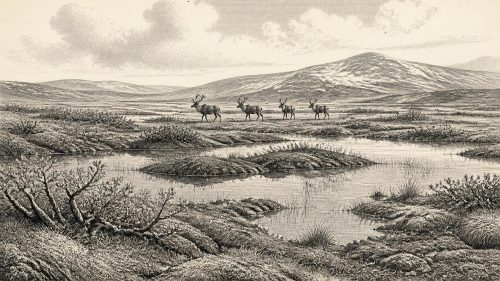
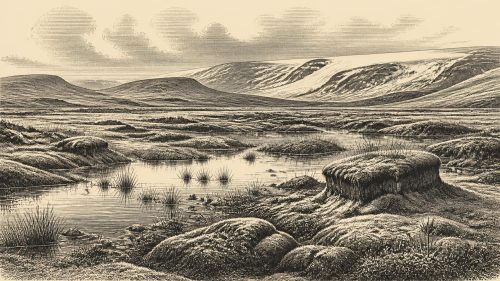
What Derryvree does show is unusually vivid. Its plant and animal remains indicate an open, treeless tundra and a severe periglacial regime: ground subject to intense freezing and thawing, with short productive summers rather than forested countryside. Mosses, sedges and other wet-ground plants accumulated beside freshwater. The original investigators described a full-glacial flora and fauna; later Irish Quaternary syntheses have aptly characterised the setting as muskeg or cold wetland. Such a landscape could include shallow pools, saturated margins and low vegetation, while frost-shaped ground and sparse cover made it exposed to wind.
This is evidence for a habitat, not a panoramic photograph of all Ireland. A buried basin near Maguiresbridge recorded its own drainage, soils and microclimate. Still, it establishes beyond reasonable doubt that there were intervals before the maximum glaciation when at least part of north-central Ireland supported freshwater life and tundra vegetation rather than lying permanently beneath moving glacier ice. It also demonstrates why later ice was so destructive of earlier landscapes: the same process that preserved the organic bed by burial erased or rearranged much of the surface from which a more conventional archaeological record might have survived.
For everyday animal life, caves in southern Ireland add another, differently formed archive. Castlepook Cave, also known as Mammoth Cave, near Doneraile in north County Cork has yielded remains attributed to reindeer, woolly mammoth, giant deer, brown bear, wolf, Arctic fox, hare, lemmings and spotted hyaena. Taken together, the finds establish that pre-maximum Ireland could sustain a much richer cold-climate mammal fauna than later historic Ireland. They do not prove that all these species grazed, hunted or scavenged together at the same moment. Cave bone assemblages commonly mix material deposited over long periods, and carnivores, water movement, natural deaths and excavation history all affect what entered and remained in a cave.
The Castlepook Question
Castlepook is directly relevant to 30,352 BCE because it has become central to the question of whether people reached Ireland far earlier than the firmly documented terminal-Pleistocene visitors. A reindeer femur in the National Museum of Ireland’s natural-history collection has a deep linear mark interpreted as having been made by a sharp stone tool during carcass processing. County Cork heritage material has presented it as a potentially very early indication of human activity, associated broadly with an animal living around 33,000 years ago. If that interpretation is confirmed through continuing study, it would be an important sign that a person handled a reindeer in Ireland during the wider period discussed here.
But the conditional wording is essential. The bone is not from a newly excavated, sealed camp floor. It came from an old cave collection, formed through early twentieth-century investigations whose contexts cannot meet modern recording standards. The date establishes the age of the animal’s remains, not the exact moment a surface incision was made; and a single possible cut mark cannot identify who made it, whether the animal was hunted or scavenged, or whether the work occurred inside the cave. Recent work at Castlepook has sought surviving deposits, new samples and improved chronological control precisely because the older assemblage is so significant yet so difficult to interpret.
Accordingly, there is no securely dated house, hearth, stone-tool workshop, burial, food store or settlement in Ireland assignable to around 30,352 BCE. There is also no demonstrated continuous population. This absence does not prove that no human being ever entered the island during a milder or more accessible interval: later glaciation, erosion, sea-level change and antiquarian collecting have narrowed the record drastically. It does mean that a settled Upper Palaeolithic Ireland cannot responsibly be written into this date.
People, Politics and Belief
There is no evidence from which to reconstruct political affairs, diplomacy, named groups, leadership, warfare or territorial boundaries. No artefact assemblage can be tied to a social group at this time; no human skeleton, dwelling or grave allows an account of kinship, gender, language, dress or ritual. Nor can religion or learning be inferred from the Derryvree wetland or Castlepook fauna. It would be tempting to import the richly documented Upper Palaeolithic cultures of continental Europe or Britain into Ireland, but resemblance in broad environment is not proof of the same traditions, beliefs or population movements.
Even the word “economy” must be used carefully. Reindeer and other large mammals were potential resources for any people who might have visited, providing meat, hide, sinew, antler and bone. That is a general archaeological possibility, not evidence for a local hunting economy. The proposed Castlepook modification, at most, concerns one episode of carcass processing. It does not demonstrate a seasonal round, exchange network, repeated hunting route or trade across the Irish Sea. Lower global sea levels altered coastlines, but the relationship between land, sea and ice around Ireland was governed as well by local crustal depression and glacier dynamics. A simple land-bridge story is not supported for this specific moment.
An Unsettled Threshold
The most important development around this nominal date was environmental rather than political: Ireland stood on an unstable threshold before the much more extensive ice cover of the Last Glacial Maximum. Freshwater sediments at Derryvree preserve one interval of cold, open wetland; the Castlepook cave record preserves traces of a diverse mammal world in the south; regional ice-sheet research shows that glaciation developed asynchronously rather than in one island-wide instant. These archives describe a place with seasonal life and ecological opportunity, but also with profound climatic volatility and an increasingly hostile future.
For Ireland Year by Year, 30,352 BCE must therefore remain a carefully bounded window. The evidence supports Late Pleistocene tundra, wetlands, large mammals, changing ice margins and a provocative but unproven possibility of very early human carcass processing. It does not support an Irish tribe, a battle, a migration narrative, a religious practice or a settlement in this year. The history is real, but it is written in silt, bone, pollen, stratigraphy and calibrated probability—not in dates that can be read as an event diary.
Primary Sources
- Middle Midlandian Freshwater Series at Derryvree, Maguiresbridge, County Fermanagh, Northern Ireland
- Middle Midlandian Freshwater Series at Derryvree, Maguiresbridge, County Fermanagh, Northern Ireland
- A Reconsideration of the Radiocarbon Dating of the Marine Isotope Stage 3 Fauna from Southern Ireland
- The Irish Quaternary Fauna Project
- Heritage Artefacts of County Cork
- 2022:564 – Castlepook Cave, Castlepook South, Cork
- Mammoth Cave
- Figure 6: The Subdivision of the Quaternary Period in Ireland
- The IntCal20 Northern Hemisphere Radiocarbon Age Calibration Curve (0–55 cal kBP)
- IntCal Publications
- Growth and Retreat of the Last British–Irish Ice Sheet, 31,000 to 15,000 Years Ago: the BRITICE-CHRONO Reconstruction
- Pattern and Timing of Retreat of the Last British-Irish Ice Sheet
- Reconstructing the Last Irish Ice Sheet 2: a Geomorphologically-Driven Model of Ice Sheet Growth, Retreat and Dynamics
- Late Pleistocene Chronostratigraphy and Ice Sheet Limits, Southern Ireland
- Dimensions and Chronology of the Last Ice Sheet in Western Ireland
- Last Glacial Maximum Cirque Glaciation in Ireland and Implications for Reconstructions of the Irish Ice Sheet
- Maximum Extent and Dynamic Behaviour of the Last British–Irish Ice Sheet West of Ireland
- Extent and Retreat History of the Barra Fan Ice Stream Offshore Western Scotland and Northern Ireland During the Last Glaciation
- First Evidence of a Late Upper Palaeolithic Human Presence in Ireland
- New Insights on the Fauna of Ireland's Younger Dryas and Early Holocene from Alice & Gwendoline Cave
- The Mesolithic in Ireland: When Was It?
- Ireland's Palaeolithic Archaeology – Fleeting Footprints in a Frozen Land
- Trimlines, Blockfields and the Vertical Extent of the Last Ice Sheet in Southern Ireland