
Freshwater Between Advancing Tills30265 BCE
Around 30,265 BCE, Ireland lay within the climatically unstable Late Pleistocene, although no event can be securely dated precisely to that year. At Derryvree, County Fermanagh, freshwater sediments, preserved between glacial tills, record a locally ice-free tundra wetland sometime roughly 34,950–29,750 BCE. Mosses, sedges, herbs and aquatic species indicate treeless, periglacial conditions. Other deposits confirm changing regional ice limits. Sea levels and routes varied as the British–Irish Ice Sheet developed before its later maximum. Castlepook Cave’s cold-adapted fauna includes a reindeer bone possibly cut by humans, suggesting but not proving early human activity. Evidence reveals environments, not settlements or societies.
Dateline
Modern calendar-year precision is not available for Ireland in 30,265 BCE. The label is useful for arranging a long chronology, but no Irish person recorded a year, season or event at this depth in time, and no archaeological deposit can be assigned securely to that single calendar year. Roughly 32,200 calendar years before AD 1950, Ireland lay in the Late Pleistocene, within Marine Isotope Stage 3: a long, unstable part of the last Ice Age marked by abrupt climatic shifts and changing ice margins. The responsible history of this point is therefore a reconstruction from buried sediments, fossil plants and animals, cave deposits, landforms and scientific dates—not a narrative of named peoples or happenings.
A Date Within a Range
The closest Irish chronological anchor is at Derryvree, near Maguiresbridge in County Fermanagh. Roadworks in 1969 cut through a drumlin and exposed an unusual sequence: thick glacial till at the bottom, freshwater silts and fine sands with organic material in the middle, and another thick till above. The sequence demonstrates a simple but important order of events. Ice had formerly occupied the site; a basin later held freshwater and supported life; then a subsequent advance of ice buried the evidence.
An organic sample from the Derryvree freshwater deposits, laboratory number BIRM-166, produced a conventional radiocarbon determination of 30,500 radiocarbon years before present, with a substantial uncertainty of +1,170 and −1,030 years. “Present” in this system means AD 1950. When calibrated, the determination has been expressed broadly as about 36,900–31,700 calendar years before present, approximately 34,950–29,750 BCE. The nominal year 30,265 BCE falls within that wide interval. It cannot, however, be turned into a precise date for a particular plant, animal, storm, journey or human action.
This distinction is more than technical. The Derryvree deposit is direct evidence for an ice-free, or at least locally non-glacial, episode in north-central Ireland. It is not proof that every part of Ireland was open ground at the same time, nor that conditions remained unchanged throughout its formation. The island’s mountains, western seaways, southern limestone country and northern lowlands may each have responded differently to shifts in temperature, snowfall, sea level and the growth of the British–Irish Ice Sheet.
Fresh Water Between Ice Advances
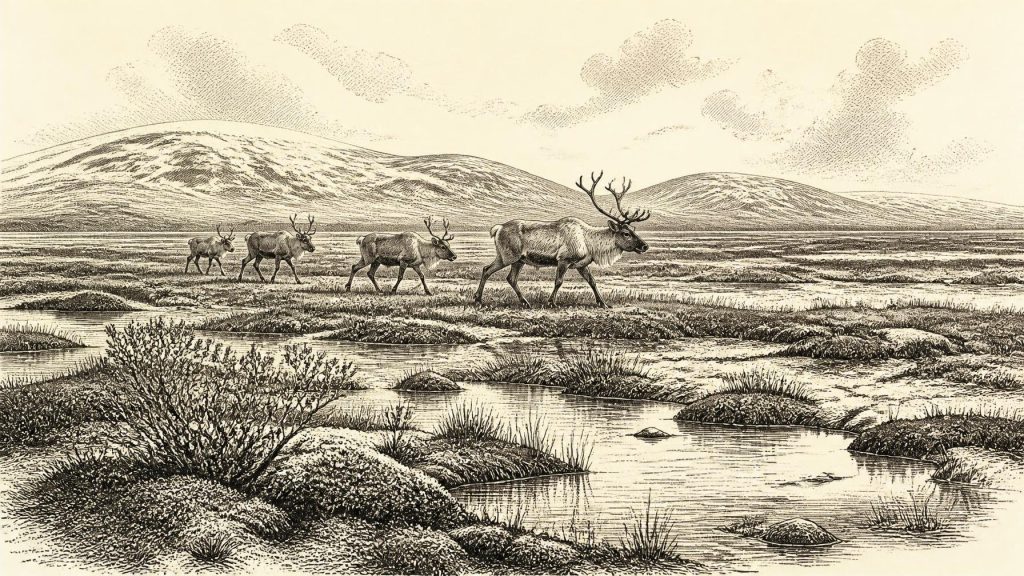
Derryvree is valuable precisely because its wetland was sealed between tills. The silts and sands preserve a local ecological record which later ice did not entirely destroy. Their plant and animal remains point to an open, treeless tundra environment and a periglacial climate: ground subject to severe frost, seasonal thaw, wind action and meltwater. This was not a timeless white wilderness. In favourable summer weeks, shallow water, wet margins and low vegetation could support a limited but varied community; in winter, the same landscape could have been intensely cold and difficult to cross.
Plant evidence includes mosses, sedges and herbs associated with wet ground, alongside dwarf-shrub and tundra elements. Aquatic and waterside species show that standing or slowly moving fresh water existed at the locality. Such evidence supports a picture of pools, sedge-fringed margins and damp mineral ground rather than forest. It does not justify importing later Irish bogs, oakwoods or familiar rural scenery into the scene. Trees were absent locally, and wood—so central to later Irish houses, boats, fuel and monuments—would have been scarce or unavailable.
Other Irish deposits, including sites at Greenagho, Hollymount and Aghnadarragh, preserve fragments of the wider pre-Last Glacial Maximum story. They show that the later Ice Age was not one uninterrupted episode of island-wide ice cover. Yet their dates and environments are not identical with Derryvree’s. They should be used to establish regional variability and repeated environmental change, not combined into a false single-day panorama of Ireland.
An Island on an Unsteady Ice Margin
By this stage, the wider British–Irish Ice Sheet system was dynamic. Recent syntheses stress both the strong evidence for the later, extensive Last Glacial Maximum ice sheet and the more difficult, partly indirect evidence for earlier advances and retreats during Marine Isotope Stage 3. The major maximum came later, broadly between 26,000 and 19,000 calendar years before present, when Ireland was probably largely or wholly glaciated. Around 30,265 BCE, that maximum still lay ahead, but the physical processes that would transform the island—snow accumulation, glacier growth, ice streaming and erosion—were already part of its regional setting.
Sea level was much lower globally than today because large quantities of water were stored in continental ice. Ireland’s present coastlines did not exist in their modern form. Broad areas of today’s continental shelf were exposed or altered, while ice, rivers and changing relative sea level affected possible routes between Ireland, Britain and the European mainland. It would nevertheless be unsafe to describe a simple, continuous “land bridge” available at every point. Access depended on the local pattern of sea, ice, terrain and climate, all of which changed through time.
Castlepook and the Human Question
The most arresting Irish clue close to this era comes from Castlepook Cave near Doneraile in north County Cork, historically known as Mammoth Cave. Its old excavated collections include remains of cold-stage mammals: reindeer, woolly mammoth, giant deer, brown bear, wolf, Arctic fox, lemmings and spotted hyaena. The cave was not a neat snapshot. Its bone assemblage accumulated through different episodes and may include animals brought in by predators and scavengers. Improved radiocarbon work has also shown that some older Irish cave dates require reassessment. The fauna nevertheless establishes that, during parts of Marine Isotope Stage 3, Ireland could support or receive substantial cold-adapted mammals.
One reindeer femur from Castlepook is especially significant. It has been reported as roughly 33,000 years old and bears a deep mark identified by zooarchaeologist Ruth Carden as consistent with cutting or chopping by a sharp stone tool while the bone was fresh. County Cork heritage material presents the object as evidence for Palaeolithic hunters processing reindeer at about 31,000 BCE. If that interpretation is sustained, it would extend evidence for human activity in Ireland dramatically earlier than the securely dated Late Upper Palaeolithic butchered bear bone from Alice and Gwendoline Cave in County Clare, dated to about 12,810–12,590 calibrated years before present.
The limits of the Castlepook evidence are as important as its promise. A modified bone is not a house floor, hearth, camp, burial, stone-tool assemblage or settlement. Its date is principally the date of the animal’s death, not a calendar date for the incision. Nor can it establish whether people killed the reindeer, found a carcass, processed it nearby, or visited Ireland repeatedly. The cave may have received remains through animal activity after human handling elsewhere. It is responsible to say that the bone may preserve evidence of human carcass processing in Ireland during the Upper Palaeolithic; it is not responsible to invent a permanent Doneraile hunting community.
Lives That Cannot Yet Be Recovered
If people were present, they would have needed practical knowledge of cold landscapes, animal behaviour and cutting tools. Reindeer offered meat, fat, hide, sinew and bone; seasonal movement across open country could have made herds a focus of attention. Those are reasonable general possibilities, strengthened by Upper Palaeolithic evidence elsewhere in north-west Europe. They remain interpretations in an Irish context. No diagnostic Irish toolkit of this age identifies an Aurignacian, Gravettian or other named archaeological tradition, and no excavated site reveals the number, kinship, language or ancestry of any visitors.
There is no evidence for political institutions, leaders, warfare, diplomacy, territorial boundaries, trade networks, religious places, formal burial practices or artistic traditions in Ireland at this date. Nor is there evidence for farming, domesticated animals, villages, cereal cultivation or exchange in the later prehistoric sense. The absence partly reflects a harsh and mobile world, but it also reflects preservation: later glaciation repeatedly eroded, reworked and buried landscapes where camps might once have existed. Archaeological silence must not be converted either into certainty that nobody came or into certainty that an organised society flourished.
What can be said is that Ireland was environmentally connected to the wider north-west European world. Animals could move through changing coastal and inland corridors, and any human incursion would have depended upon the same shifting geography. In this setting, the economy was ecological before it was social: available water, shelter, seasonal vegetation and the movements of large mammals set the terms of survival. Predators such as hyaenas and wolves were competitors as well as agents of bone accumulation, while caves were places where evidence could be concentrated and distorted.
Evidence, Not a Lost Chronicle
Ireland around 30,265 BCE was not yet the familiar island of fields, forests, farms, kingdoms or monuments. The strongest direct record is environmental: a Fermanagh freshwater tundra preserved between advances of ice. Castlepook adds the possibility—important, but still narrow—of a humanly modified reindeer bone from the broader period. Together they reveal an Ireland of open cold ground, wetland refuges, mobile fauna and approaching glacial transformation. They do not yield a recoverable year, a named people or a political story. Their real achievement is to show that even beneath later ice, fragments of a far older Irish world survive.
Primary Sources
- Middle Midlandian Freshwater Series at Derryvree, Maguiresbridge, County Fermanagh, Northern Ireland
- Middle Midlandian Freshwater Series at Derryvree, Maguiresbridge, County Fermanagh, Northern Ireland — Ulster University research record
- Deglacial Rates and Controls for the British-Irish Ice Sheet Western Margin
- The Timing and Magnitude of the British–Irish Ice Sheet Between Marine Isotope Stages 5d and 2
- Growth and Retreat of the Last British–Irish Ice Sheet, 31,000 to 15,000 Years Ago: the BRITICE-CHRONO Reconstruction
- New Data for the Last Glacial Maximum in Great Britain and Ireland
- Trimlines, Blockfields and the Vertical Extent of the Last Ice Sheet in Southern Ireland
- Late Pleistocene Chronostratigraphy and Ice Sheet Limits, Southern Ireland
- Figure 6: The Subdivision of the Quaternary Period in Ireland
- Quaternary Geology
- A Reconsideration of the Radiocarbon Dating of the Marine Isotope Stage 3 Fauna from Southern Ireland
- Occurrence of Mammalia Relicts at Castlepook Cave
- Heritage Artefacts of County Cork
- Archaeology Research Excavation Grant 2022: Castlepook Cave Final Report
- Reindeer Bone Found in North Cork to Alter Understanding of Irish Human History
- First Evidence of a Late Upper Palaeolithic Human Presence in Ireland
- Ireland: Submerged Prehistoric Sites and Landscapes
- The Mesolithic in Ireland: When Was It?
- Anthropogenic Changes to the Holocene Nitrogen Cycle in Ireland
- The Irish Elk: When and Why Did This Giant Deer Go Extinct and What Did It Look Like?
- The Colonization of Ireland: A Human Ecology Perspective
- Introduction to the Late Quaternary and Holocene of Northern Ireland