The Fermanagh Interlude30433 BCE
Thirty thousand four hundred and thirty-three BCE is only a modern label within a broad calibrated range for later Marine Isotope Stage 3. At Derryvree, County Fermanagh, sediments between tills preserve an ice-free freshwater basin with tundra vegetation, insects and seasonal periglacial conditions, later buried by returning glacier ice. Comparable deposits indicate complex, localised ice-free episodes, not an island-wide climate. Southern cave faunas demonstrate diverse cold-stage mammals, though their dates and associations are imperfect. No secure evidence establishes human occupation; a possibly cut-marked reindeer bone offers only tentative evidence of brief contact. This interval records fragile environments amid regional glaciation.
Dateline
30,433 BCE is a modern calendar label, not a date that prehistoric Ireland can match with year-by-year precision. It corresponds approximately to 32,383 years before the conventional radiocarbon baseline of AD 1950, but neither an event nor a human life can responsibly be assigned to that point. The best evidence is expressed in wide calibrated ranges, often spanning centuries or millennia. For this horizon, Ireland belongs to the later part of Marine Isotope Stage 3: a severe, unstable phase of the last Ice Age, before the fullest expansion of the British–Irish Ice Sheet.
The most illuminating Irish evidence comes not from a settlement, tomb or tool collection, but from a buried wetland at Derryvree near Maguiresbridge in County Fermanagh. It offers a rare view of a landscape that existed between glacial advances. Its value lies precisely in its limits: the sediments reveal environmental conditions in one northern locality over a broad interval, not a national snapshot of Ireland in a single numbered year.
A Date Inside a Range
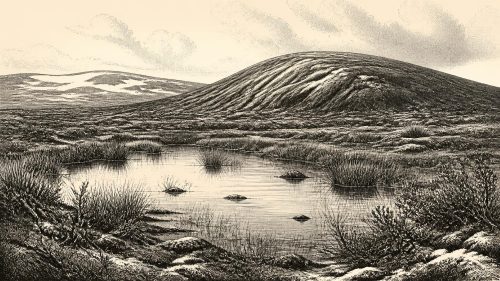
Roadworks in 1969 cut through a drumlin at Derryvree and exposed a remarkable sequence. Below lay one substantial sheet of till, the unsorted sediment deposited directly by glacier ice. Above lay another. Between them were fine sands, silts and organic-rich muds laid down in fresh water. The sequence establishes a basic history: ice occupied the locality; an interval followed in which standing or slow-moving water and vegetation developed; and glacier ice later returned, sealing the older environment beneath fresh till.
Organic material from the middle layer produced the radiocarbon determination Birm-166, conventionally dated to 30,500 radiocarbon years before present, with a large uncertainty of roughly a thousand years either side. Radiocarbon years are not calendar years. Because atmospheric carbon-14 has varied through time, results must be calibrated, producing probability ranges rather than exact dates. Published calibration places the Derryvree material broadly at about 36,900–31,700 calibrated years before present. The modern label 30,433 BCE falls within that range, but cannot identify a particular season, generation, or phase of sediment accumulation.
Archaeologists and Quaternary scientists have traditionally called this a Middle Midlandian freshwater series or interstadial deposit. Such terminology is useful shorthand for an interval between colder glacial episodes, but it should not suggest a uniformly warm climate. Derryvree was not a wooded, temperate Ireland. The fossil evidence points instead to cold, open and strongly seasonal country.
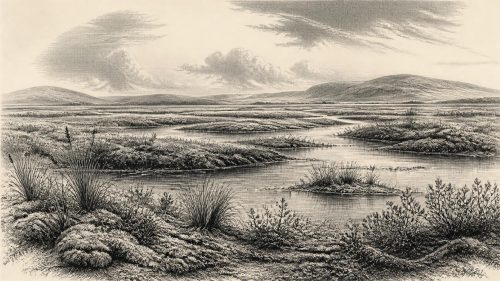
Water in a Treeless Land
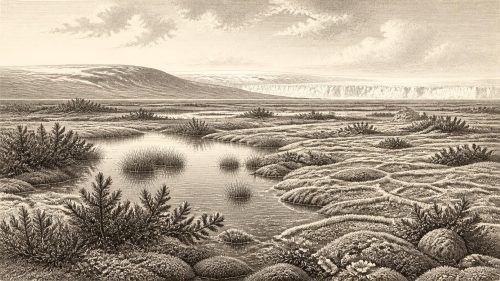
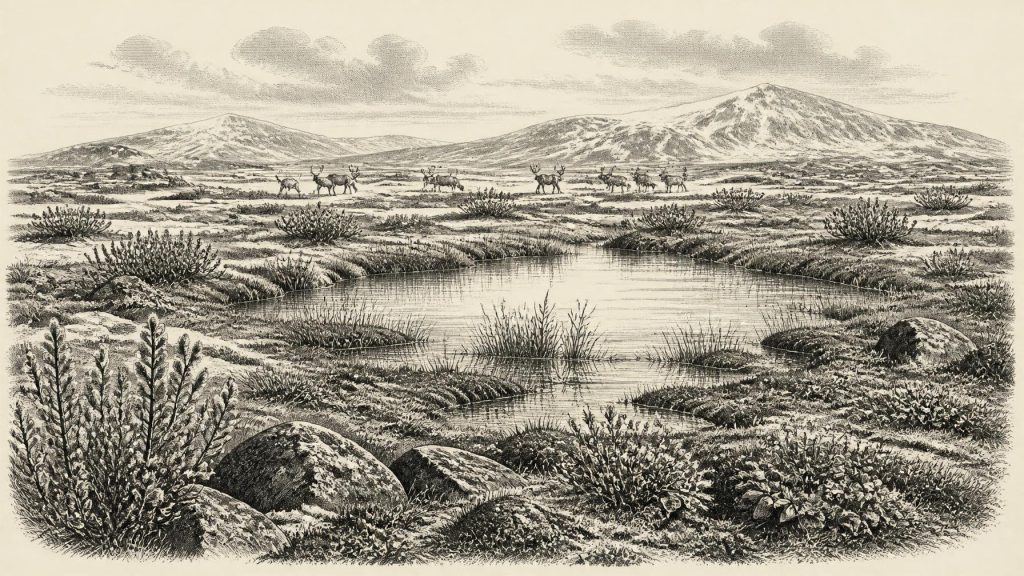
The Derryvree flora and fauna describe freshwater amid tundra-like vegetation. Mosses, sedges, grasses and herbaceous plants grew around wet ground; aquatic plants attest pools or quiet water. Dwarf willow and juniper indicate that low woody growth may have survived in favourable spots, but there is no case here for forest. The original investigators identified a flora and insect fauna of full-glacial aspect and interpreted the setting as open tundra under a periglacial climate.
This evidence allows a careful reconstruction of habitat rather than weather on a named day. In the growing season, a shallow basin could have supported mossy margins, sedge beds, flowering herbs and insects. Meltwater, thaw and summer light would have made such sheltered wetlands locally productive. In winter, exposed ground, frost action and bitter winds would have dominated. The contrast between a living freshwater hollow and the later glacial sediments above it is a powerful reminder that Ice Age Ireland changed sharply through time.
Related deposits in Fermanagh, including Greenagho near Belcoo, reinforce the broader conclusion that parts of northern Ireland could be ice-free during some Middle Midlandian intervals. They do not prove that all of Ireland was simultaneously free of ice, nor that the same plants flourished everywhere. They show that the island’s glacial history was more complicated than a simple alternation between a wholly frozen island and a wholly habitable one.
Ice Was Gathering Again
The wider north-west European setting was changing rapidly. Reconstructions of the British–Irish Ice Sheet show that major ice growth was under way in the region by about 31,000 years ago, although the timing, thickness and reach of ice differed greatly from sector to sector. Scottish ice was advancing through the Minch around 32,000–31,000 years ago and reached parts of the continental shelf edge by around 30,000 years ago. The greatest overall extent and volume of the ice sheet came later, not at one single moment, and its different margins behaved asynchronously.
For Ireland at the horizon represented by 30,433 BCE, the responsible conclusion is therefore local and conditional. Derryvree records an ice-free freshwater environment during a broad interval before it was overridden. Elsewhere, upland ice, advancing margins, periglacial ground and open terrain may all have coexisted. There is no basis for drawing a fixed coast, a reliable island-wide route, or a single ice boundary for this nominal year. Lower sea levels changed the geography of the Irish Sea region, but they do not demonstrate a permanent, easy land bridge between Ireland, Britain and continental Europe.
Caves and Cold-Stage Animals
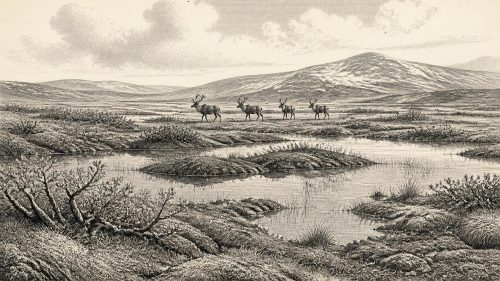
Southern Irish caves supply a different kind of evidence. Castlepook Cave, also called Mammoth Cave, near Doneraile in County Cork, has produced one of Ireland’s most important collections of Late Pleistocene animal remains. Reindeer, woolly mammoth, giant deer, brown bear, wolf, Arctic fox, mountain hare, lemmings and spotted hyaena are among the animals represented in cave collections and related Irish Quaternary Fauna Project research. Together they demonstrate that, at favourable times during Marine Isotope Stage 3, Ireland supported a much richer large-mammal community than the later island fauna.
Yet cave bones are not a census of one landscape at one time. Animals died, were dragged in by carnivores, were redeposited by water and sediment, and were excavated under antiquarian conditions that often recorded context imperfectly. Modern re-dating has also shown that some radiocarbon ages obtained in the 1990s from Castlepook require reconsideration because improved pretreatment methods can yield substantially older results. A mammoth bone or reindeer bone establishes that a species was present around a dated interval; it does not prove that every listed species shared a valley in 30,433 BCE.
Even so, the animal record helps give Derryvree’s open wetlands an ecological context. Reindeer and other grazing animals could exploit open vegetation; predators and scavengers followed opportunities created by herbivore herds and carcasses. This was a dynamic cold-stage environment, not an empty white wilderness. Its productive patches, however, were likely separated by difficult terrain and exposed by abrupt climatic deterioration.
The Human Question
No securely excavated occupation site, hearth, stone-tool assemblage, dwelling, burial or human skeleton is known from Ireland for this broad period. Consequently, there is no evidence for an Irish people, language, polity, territory or enduring settlement at 30,433 BCE. There can be no responsible account of rulers, diplomacy, warfare, religious observance, formal learning, trade networks or domestic routines. The absence of such evidence is not proof that no person ever reached the island, but it is decisive against inventing a prehistoric society.
One find from Castlepook makes the question more complicated. A reindeer femur has been presented by palaeozoologist Ruth Carden and County Cork heritage material as bearing a deep mark consistent with cutting by a sharp stone implement during carcass processing. If that interpretation and its chronological association are sustained, it may indicate a brief Upper Palaeolithic human encounter with a reindeer far earlier than Ireland’s long-established post-glacial settlement evidence. It would be evidence for an action on an animal, not for a camp, family group or continuously occupied homeland.
That distinction matters especially at this date. The bone is not securely tied to the Derryvree wetland or to the calendar label 30,433 BCE. Nor has it produced an accompanying toolkit, fire-place or occupation surface. The National Museum of Ireland accordingly continues to state that clear evidence for human presence in Ireland during the Palaeolithic has not emerged. The careful position is to recognise Castlepook as a significant and potentially transformative clue while treating sustained human occupation as unproven.
What Can Be Said of Ireland?
Ireland around this broad horizon was shaped above all by climate, ice, water and animal movement. Derryvree supplies direct evidence of a cold freshwater basin within open tundra vegetation, later buried by renewed glaciation. Cave collections show that southern Ireland was visited or inhabited by an array of Ice Age mammals across parts of Marine Isotope Stage 3. Regional ice-sheet research shows that the world around Ireland was entering a phase of dramatic glacial expansion.
For everyday life, economy and culture, however, silence is more truthful than invention. If people made short visits to Ireland, they may have sought animal resources or moved through a changing north-west European landscape, but that is interpretation, not demonstrated Irish history. The enduring historical importance of this interval lies in the evidence beneath the drumlin: plants, insects and freshwater mud reveal that even before the greatest ice advance, Ireland contained brief, fragile habitable environments whose traces survived only because later ice sealed them away.
Primary Sources
- Middle Midlandian Freshwater Series at Derryvree, Maguiresbridge, County Fermanagh, Northern Ireland
- Middle Midlandian Freshwater Series at Derryvree, Maguiresbridge, County Fermanagh, Northern Ireland
- Early Midlandian–Middle Midlandian, Pleistocene, Northern Ireland
- Quaternary of Northern Ireland: IQUA Field Guide 16
- Growth and Retreat of the Last British–Irish Ice Sheet, 31,000 to 15,000 Years Ago: the BRITICE-CHRONO Reconstruction
- Pattern and Timing of Retreat of the Last British-Irish Ice Sheet
- The Timing and Magnitude of the British–Irish Ice Sheet Between Marine Isotope Stages 5d and 2
- Trimlines, Blockfields and the Vertical Extent of the Last Ice Sheet in Southern Ireland
- Pleistocene Glaciations in Ireland
- New Data for the Last Glacial Maximum in Great Britain and Ireland
- The Irish Quaternary Fauna Project
- A Reconsideration of the Radiocarbon Dating of the Marine Isotope Stage 3 Fauna from Southern Ireland
- First Evidence of a Late Upper Palaeolithic Human Presence in Ireland
- First Evidence of a Late Upper Palaeolithic Human Presence in Ireland
- New Insights on the Fauna of Ireland's Younger Dryas and Early Holocene from Alice & Gwendoline Cave
- Heritage Artefacts of County Cork
- Prehistoric Details
- Ireland: Submerged Prehistoric Sites and Landscapes
- The Archaeology of Caves in Ireland
- Episodic Speleothem Deposition Tracks the Terrestrial Impact of Millennial-Scale Climate Variability During the Last Glacial Period
- Radiocarbon Dates from the Oxford AMS System: Archaeometry Datelist 31
- Introduction to the Glacial Sand and Gravel Landscapes of Northern Ireland
- The Geological Heritage of County Leitrim
- The Mesolithic in Ireland: When Was It?