Waterford’s Ice-Age Red Deer30304 BCE
Around 30,304 BCE, Ireland was in the unstable Late Pleistocene build-up to the last major glaciation, rather than a documented historical era. Radiocarbon-dated red deer bones from Waterford caves show that suitable habitats existed around 32,000 years ago, although they prove neither permanent herds nor human hunting. Fermanagh sediments indicate patchy, treeless tundra wetlands supporting diverse vegetation. Cork cave faunas reveal reindeer, mammoth, predators and other animals across the wider period. Ice growth, fluctuating coastlines and later erosion obscure evidence. A possibly cut-marked reindeer bone suggests brief human activity, but no secure settlement, tools, institutions or culture can be established.

Dateline
30,304 BCE is a modern chronological label, not a recoverable year in an Irish historical record. No inscription, settlement sequence or event allows Ireland at this depth of time to be dated with calendar-year precision. In archaeological practice, the meaningful evidence comes in calibrated radiocarbon ranges, sediment layers and broad climatic phases. This nominal year falls about 32,253 years before AD 1950, within the Late Pleistocene and Marine Isotope Stage 3: a cold, unstable part of the last Ice Age, before the fullest expansion of the last British–Irish Ice Sheet.
The most direct evidence close to this point is not a human monument or a weapon, but animal bone. Two red-deer specimens from caves in County Waterford have calibrated dates of 32,930–31,280 and 30,297–29,594 calibrated years before present. The earlier range encompasses the notional date considered here. This does not identify a particular year in which a deer moved through Waterford, nor does it prove a continuous resident herd. It does demonstrate that at least parts of Ireland could support red deer during a broad interval around 32,000 years ago.
A Date Without a Chronicle
Ireland had no recorded political communities in any meaningful historical sense. There is no evidence for rulers, territories, alliances, warfare, diplomacy, law or inherited institutions. Nor can later ethnic identities, languages or origin traditions be projected backwards into this landscape. The word “Ireland” is useful here only as a geographical shorthand for the landmass that would much later acquire that name.
Scientific evidence is powerful, but each category answers a limited question. A radiocarbon date can locate an animal’s death within a statistical range; it cannot reveal where the animal had ranged in every season. Cave bones can identify species, but a cave may have been used by carnivores, disturbed by water, altered by collapse and excavated using methods that pre-date modern recording standards. Pollen, plant macrofossils and insects can reconstruct habitats, but often from another county and another span of centuries or millennia. The responsible account is therefore a mosaic rather than a narrative of events.
Ice Growing, Habitats Changing
The broad regional setting was one of accelerating climatic change. The global Last Glacial Maximum is normally placed later, roughly 26,500–19,000 calibrated years ago, when ice sheets reached their greatest overall extent. Yet the growth of the British–Irish Ice Sheet was neither simultaneous nor uniform. Recent reconstructions treat approximately 32,000–23,000 years ago as a build-up phase in which mountain ice caps, regional glaciers and larger ice masses expanded, merged and shifted at different times.
For around 32,000 years ago, models and geological evidence allow several possibilities rather than one certain map. Small ice caps may have occupied high ground in north-west Ireland, while other districts remained open or only seasonally influenced by severe periglacial conditions. Ice was growing in the wider British–Irish region, but the evidence does not permit a confident claim that every Irish valley, coast or upland was ice-covered in 30,304 BCE. Later ice advances also erased or buried much earlier ground evidence, making the opening stages of glaciation especially difficult to reconstruct.
Lower global sea level altered coastlines, but it should not be turned into an assumed land bridge from Ireland to Britain or continental Europe. The Irish Sea basin remained a substantial obstacle, and scholarship on possible Late Quaternary connections finds no secure basis for a broad, enduring land route across it. Animals and, if people visited, people may have crossed changing marine passages by routes and means now beyond recovery; the evidence does not establish how.
Open Ground and Wet Places
The most informative environmental sequence from Ireland’s broader Middle Midlandian cold-stage record lies at Derryvree near Maguiresbridge, County Fermanagh. There, organic silts and fine sands were preserved between two tills in a road-cut drumlin section. The deposit, dated by the radiocarbon determination BIRM-166 to 30,500 ± 1,100 radiocarbon years before present, records an earlier ice-free interval before a later glacier overran and sealed it. Calibration and correlation make its exact calendar placement uncertain, so it should not be treated as a diary entry for 30,304 BCE. It is nevertheless valuable evidence for the kinds of habitats that northern Ireland could sustain during this changing cold stage.
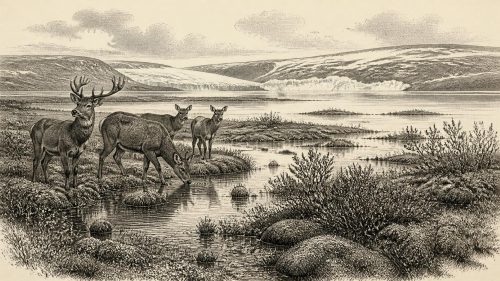
Its plant remains point to a treeless tundra or muskeg landscape: sedges, mosses, grasses, herbs, low shrubs and wet ground surrounding pools or sluggish fresh water. Fossil finds include mountain avens, dwarf willow, juniper and bogbean, alongside aquatic plants such as water-milfoil. Such a setting was not a uniform frozen desert. In a short growing season, sheltered hollows and shallow waters could be biologically productive, while exposed ground was subject to frost, wind and sharp seasonal contrasts.
This evidence supports an interpretation of patchy habitats rather than a single island-wide vegetation map. The Fermanagh wetland cannot be copied unchanged to Waterford or Cork. Even so, it helps explain how large mammals could use favourable corridors and feeding grounds in a generally harsh Atlantic-edge environment.
Deer, Reindeer and Carnivores
The Waterford red-deer dates provide an important corrective to the notion that Ice Age Ireland was empty of sizeable land animals. Red deer are adaptable browsers and grazers, but their presence should not be mistaken for woodland. Cold, open country can include scrub, river margins and protected patches of vegetation adequate for deer. The dated Waterford remains came from Shandon and Ballynamintra caves; their significance lies in confirmed animal presence within broad ranges, not in a claim that either cave was a deer shelter or a human hunting camp.
Other cave collections show a more formidable Late Pleistocene fauna. Castlepook Cave, also known as Mammoth Cave, near Doneraile in north County Cork has yielded remains attributed to reindeer, woolly mammoth, giant deer, brown bear, wolf, Arctic fox, hare, lemmings and spotted hyaena. These animals were not necessarily present at the same moment. Nevertheless, the assemblage indicates that, across the wider pre-maximum interval, Ireland contained open-country grazing opportunities and food webs capable of sustaining predators and scavengers as well as herbivores.
For everyday animal life, mobility mattered. Herds would have followed seasonally available forage; predators would have followed prey or exploited carcasses; caves could act as traps, dens, shelters or places where bones accumulated through scavenging. None of this demonstrates human management of animals, domestication or an organised hunting economy in Ireland. Agriculture, livestock keeping, fields and permanent food stores lay many millennia in the future.
The Unsettled Human Question
There is a tantalising but disputed possibility of human activity in the wider period. A reindeer femur from Castlepook bears a deep linear mark interpreted by zoologist Ruth Carden as a possible stone-tool cut or chop made while processing a fresh carcass. The bone has been publicly associated with an age of about 33,000 years ago. If that interpretation is confirmed by further contextual work and associated finds, it would push evidence for human activity in Ireland far back into the Upper Palaeolithic.
At present, however, one marked bone cannot bear the weight of a settlement history. No securely associated stone-tool assemblage, hearth, dwelling surface, burial, art site or repeated occupation layer has been recovered from Castlepook for this time. Natural processes and carnivore damage can complicate the reading of old bone collections, while antiquarian excavation makes stratigraphic reconstruction difficult. It is therefore prudent to describe the femur as a possible trace of carcass processing, not proof of an established population, named culture or continuous ancestry.
That distinction matters. If people did reach Ireland during this cold period, they may have been brief visitors exploiting a carcass or moving through a favourable window in a difficult landscape. They cannot responsibly be assigned political organisation, religious practice, trade networks or artistic traditions on Irish evidence alone. Continental Europe certainly contained Upper Palaeolithic societies with sophisticated technologies and cultural practices, but proximity is not evidence that these were present in Ireland.
What Cannot Yet Be Seen
There is no evidence for villages, houses, cultivated land, pottery, metalwork, textiles, formal cemeteries or monuments in Ireland around this date. There is likewise no basis for reconstructing exchange routes, marriage networks, ritual sites, education or collective memory. The absence of evidence is partly a consequence of later glaciation, erosion, sea-level change and acidic soils, all of which destroy or conceal fragile remains. But it is also a reminder not to manufacture a society from a handful of fossils.
The major development relevant to Ireland was environmental: an ecologically varied but increasingly precarious cold-stage landscape was being overtaken by the processes that would produce a far more extensive ice sheet. Waterford deer, Cork cave fauna and Fermanagh wetland sediments preserve separate glimpses of that world. Together they show that Ireland was neither timelessly ice-bound nor comfortably habitable. It was a changing frontier of open ground, wet hollows, large animals and advancing ice, whose human history—if it existed at all—remains almost entirely beyond the reach of the evidence.
Primary Sources
- Phylogeographic, ancient DNA, fossil and morphometric analyses reveal ancient and modern introductions of a large mammal: the complex case of red deer (Cervus elaphus) in Ireland
- The colonization of Ireland: A human ecology perspective
- New insights on the fauna of Ireland’s Younger Dryas and Early Holocene from Alice & Gwendoline Cave
- Irish Pleistocene biostratigraphy
- Figure 6.— The subdivision of the Quaternary Period in Ireland
- Irish Quaternary Association: Outreach and Education Resources
- The timing and magnitude of the British–Irish Ice Sheet between Marine Isotope Stages 5d and 2: implications for glacio-isostatic adjustment, high relative sea levels and ‘giant erratic’ emplacement
- Behavioural tendencies of the last British–Irish Ice Sheet revealed by data–model comparison
- Growth and retreat of the last British–Irish Ice Sheet, 31 000 to 15 000 years ago: the BRITICE-CHRONO reconstruction
- Growth and retreat of the last British–Irish Ice Sheet, 31 000 to 15 000 years ago: the BRITICE-CHRONO reconstruction
- Response of the Irish Ice Sheet to abrupt climate change during the last deglaciation
- Radiocarbon constraints on the age of the maximum advance of the British–Irish Ice Sheet in the Celtic Sea
- Late Pleistocene chronostratigraphy and ice sheet limits, southern Ireland
- Timing and pace of ice-sheet withdrawal across the marine–terrestrial transition west of Ireland during the last glaciation
- Early deglaciation of western Ireland: Implications for the timing and rate of ice-sheet retreat
- Deglaciation chronology of the Donegal Ice Centre, north-west Ireland
- Last Glacial Maximum cirque glaciation in Ireland and implications for reconstructions of the Irish Ice Sheet
- Dimensions and chronology of the last ice sheet in Western Ireland
- Reconstructing the last Irish Ice Sheet 2: a geomorphologically-driven model of ice sheet growth, retreat and dynamics
- The problem of a late quaternary landbridge between Britain and Ireland
- Archaeological Heritage of County Cork
- Ireland’s Palaeolithic Archaeology – Fleeting Footprints in a Frozen Land
- Menyanthes trifoliata