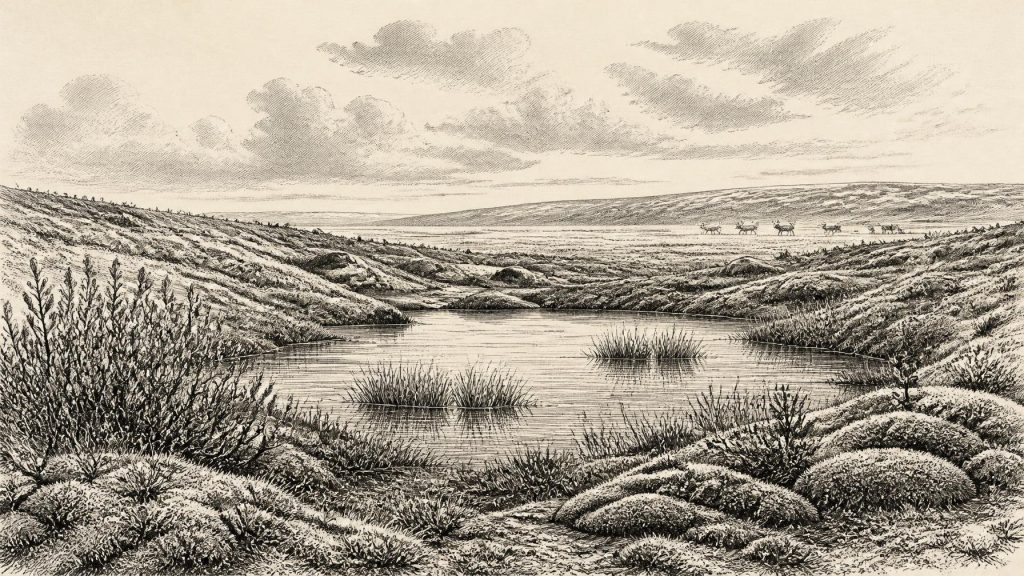
A Fermanagh Drumlin Pool30303 BCE
Around 30,303 BCE, Ireland lay within the unstable cold conditions of Marine Isotope Stage 3, as the British–Irish Ice Sheet expanded unevenly. At Derryvree in County Fermanagh, freshwater silts beneath glacial till preserve evidence of tundra vegetation, shallow water and periglacial conditions during an ice-free or ice-distal interval. Castlepook Cave in County Cork yielded fragmented remains of cold-stage fauna, including mammoth, reindeer and predators, demonstrating ecological links with Britain and continental Europe. No securely excavated evidence establishes human settlement at this date; a possibly butchered reindeer bone remains unconfirmed. These exceptional records support a cautious environmental rather than social reconstruction.
Dateline
30,303 BCE is a modern chronological label, not a recoverable year in Ireland’s deep past. No Irish written record, settlement layer or dated human event can be assigned to that single year. The responsible way to approach it is through broad, calibrated ranges and the traces preserved by geology, palaeobotany and animal bone. This point falls in the Late Pleistocene, within Marine Isotope Stage 3, when climates across north-west Europe changed sharply and the British–Irish Ice Sheet was beginning a major phase of growth. Ireland was not yet the familiar green island of later prehistory: its environments were cold, open, unstable and regionally varied.
A Date Beyond Annual History
Calendar-year precision is impossible at this depth of time. The date 30,303 BCE is equivalent to roughly 32,250 calibrated years before present, where “present” conventionally means 1950. Such conversion is only an aid to orientation. Radiocarbon measurements from this period have wide errors, and calibration curves themselves produce ranges rather than exact historical moments. An individual plant seed or bone can date the death of an organism; it does not automatically date the formation of a landscape, the arrival of an ice sheet or a human action.
The closest important Irish environmental record is from Derryvree townland, near Maguiresbridge in County Fermanagh. Road construction in 1969 cut through a drumlin and revealed a remarkable sequence: a lower mass of glacial till, freshwater silts and fine sands with organic material, and then another thick till above. The sequence shows that ice occupied the locality, an ice-free or ice-distal interval allowed freshwater sediment to gather, and later ice covered and sealed the deposit. It does not supply a diary of events in all parts of Ireland, but it is a rare window into an otherwise badly eroded period.
The Derryvree Interval
Organic material from the Derryvree freshwater beds produced the conventional radiocarbon determination BIRM-166, reported as 30,500 radiocarbon years BP, with a substantial uncertainty of roughly a millennium. When calibrated using modern curves, the result corresponds broadly to an interval of about 36,900–31,700 calibrated years BP. That wide span overlaps the modern label 30,303 BCE, but it cannot prove that the pool, its plants or its sediments were present in that exact calendar year. Nor should a single radiocarbon determination be treated as a precise date for the end of an interstadial or the onset of renewed glaciation.
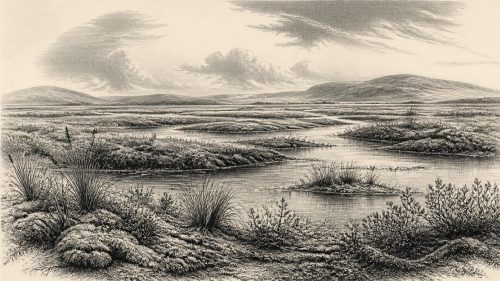
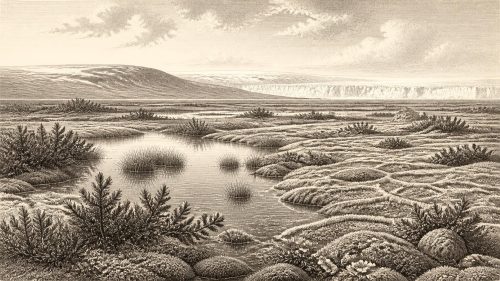
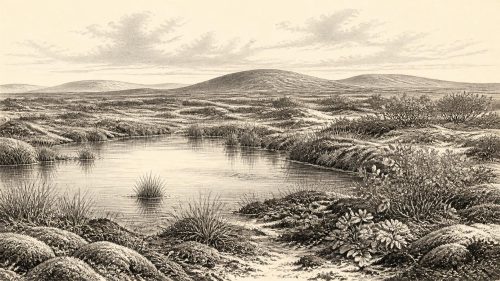
What the deposit does securely preserve is an ecological character. The original investigators described a flora and fauna of full-glacial aspect, indicating open tundra vegetation and a periglacial climate: land subject to severe cold, seasonal frost and thaw, but not necessarily buried under glacier ice. Plant remains included bogbean, an aquatic or wet-ground plant, and alternate water-milfoil, which points to freshwater. Other fossils, including mosses, sedges, dwarf willow, mountain avens and cold-adapted herbs, support a picture of shallow water and wet margins amid largely treeless ground.
This was therefore not an empty white wilderness. In a sheltered hollow near what is now Maguiresbridge, freshwater could persist long enough for aquatic plants, mosses and marginal vegetation to grow. Yet the surrounding terrain was likely exposed, with short growing seasons, sparse cover and frost-disturbed soils. There is no warrant for projecting the precise Derryvree plant community across every coast, upland and limestone district. Its value lies in demonstrating local environmental possibility: cold Ireland could still contain living freshwater habitats between episodes of glaciation.
Ice on the Move
At this broad horizon, the larger British–Irish Ice Sheet was entering a period of rapid and uneven expansion. Recent reconstructions place a Scottish-centred ice sheet advancing through the North Minch around 32,000–31,000 years ago, followed by major growth towards the continental shelf edge around 30,000 years ago. The chronology is strongest in some marine sectors and weaker across much of Ireland itself. Models commonly interpolate ice growth between dated points; their maps are powerful syntheses, but they are not photographs of the island in a given year.
For Ireland, the key message is regional change rather than uniformity. Ice-flow landforms show that ice from Britain later crossed northern and central Ireland, while evidence from Fermanagh records an earlier freshwater interlude beneath later till. In the south-west, reconstructions allow for local ice caps in mountainous country. The fullest expansion of the ice sheet came later, and its maximum limits were asynchronous: northern and western sectors reached far outward earlier than some southern margins. Around 30,303 BCE, landscapes and routes available to animals could have altered rapidly as snowfields enlarged, glaciers advanced, rivers changed course and sea levels fell.
Cave Fauna in North Cork
Castlepook Cave, also called Mammoth Cave, near Doneraile in County Cork offers a different kind of evidence. Antiquarian excavations there recovered a major assemblage of Pleistocene animal remains. Its complicated deposits and early excavation history mean that bones cannot all be assumed to be contemporary, but radiocarbon work has established that Ireland supported a varied cold-stage fauna between at least about 45,000 and 20,000 years ago. Castlepook is particularly important because it preserves evidence for animals that later ice action and erosion have often removed elsewhere.
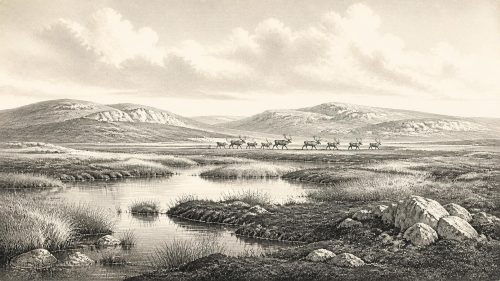
The assemblage includes woolly mammoth, reindeer, giant deer, brown bear, wolf, fox, Arctic fox, mountain hare, collared lemming, Norwegian lemming and spotted hyena. A mammoth bone has produced a Middle Devensian radiocarbon age of about 33,400 BP, broadly relevant to the long interval surrounding this article’s nominal date. The combination is evidence for cold, open habitats and for ecological connections with Britain and continental north-west Europe. It does not demonstrate that every listed species lived beside Castlepook at the same time, or that every species was present in every Irish region.
Spotted hyena remains are especially evocative. Hyenas used caves and could accumulate bones there through scavenging and denning, so a cave bone collection is not simply a list of animals hunted by people. Predators, natural deaths, water movement and later excavation all shaped what survived. Nonetheless, the finds show that Ireland was part of a wider Late Pleistocene animal world in which large herbivores and formidable carnivores could occupy the same broad landscape.
The Human Question
No securely excavated settlement, hearth, dwelling floor, stone-tool industry, burial or human skeleton demonstrates an established population in Ireland around 30,303 BCE. Accordingly, there can be no responsible account of Irish rulers, political communities, diplomacy, warfare, religious practice, language, art or formal learning at this date. There is likewise no evidence for farming, herding, pottery, metalworking, houses, long-distance commerce or a settled economy. Those are absences in the present record, not proofs that no person ever reached the island.
A reindeer femur from Castlepook has been publicly identified as bearing a deep mark interpreted as stone-tool butchery, and has been reported as approximately 33,000 years old. If the mark is confirmed as anthropogenic and belongs to the animal’s Late Pleistocene context, it would be extraordinary evidence that a person processed a reindeer in Ireland far earlier than the well-established post-glacial record. But the claim awaits full publication, and the cave collection lacks the intact archaeological context needed to turn one modified bone into proof of a camp or permanent occupation. The age of the bone is also not an exact timestamp for the cut.
The prudent interpretation is therefore narrow. A person or small group may have made a brief incursion into Ireland during a favourable interval, perhaps engaging with a reindeer carcass; equally, the evidence requires further testing. It cannot identify a people, a route, a season, a hunting strategy or a connection with a known Upper Palaeolithic culture. Later evidence for human activity in Ireland, including a butchered bear bone from County Clare dated to around 12,800–12,590 calibrated BP, is much younger and cannot fill this earlier gap.
Life Without a Society Record
If people did visit, the practical demands would have been severe. They would have needed warmth, food, tools, knowledge of animal behaviour and the ability to move through a landscape changing under cold conditions. Yet these are general inferences from Upper Palaeolithic life elsewhere, not discoveries from a 30,303 BCE Irish camp. The archaeological evidence currently permits a landscape history, not a social history of named communities.
The economy visible at Derryvree was ecological rather than human: freshwater plants exploiting a wet hollow; tundra vegetation enduring a short season; grazing animals and predators moving through open ground; and ice repeatedly remaking the terrain. Any exchange or travel between Ireland and neighbouring lands is unrecorded. Lower global sea levels altered coastlines, but changing sea level alone does not establish a dependable land bridge, route or crossing at this particular time. The geography of access remains a subject for glacial and marine research, not a licence to invent migration narratives.
A Landscape Preserved by Accident
The most significant development around this notional year was environmental: Ireland stood within an unstable cold-stage world, with some freshwater and tundra environments persisting while the ice sheet system gathered strength. Derryvree’s silts survived only because later till buried them; Castlepook’s bones survived because a limestone cave sheltered parts of a fragmented faunal archive. Both records are exceptional, and both demand caution.
For 30,303 BCE, Ireland’s past is not a sequence of events but a carefully bounded reconstruction. A Fermanagh pool, cold-climate plants, a Cork cave and advancing ice provide real evidence. Kings, tribes, battles, temples and villages do not. That distinction is not a deficit: it is the central historical fact of this extraordinarily remote Irish horizon.
Primary Sources
- A Middle Midlandian Freshwater Series at Derryvree, Maguiresbridge, County Fermanagh, Northern Ireland
- Growth and Retreat of the Last British–Irish Ice Sheet, 31,000 to 15,000 Years Ago: The BRITICE-CHRONO Reconstruction
- The Irish Quaternary Fauna Project
- Pleistocene Glaciations in Ireland
- Radiocarbon Constraints on the Age of the Maximum Advance of the British–Irish Ice Sheet in the Celtic Sea
- New Data for the Last Glacial Maximum in Great Britain and Ireland
- Pattern and Timing of Retreat of the Last British–Irish Ice Sheet
- Deglaciation Chronology of the Donegal Ice Centre, North-West Ireland
- Stratigraphic and Palaeo-Geomorphological Evidence for the Glacial-Deglacial History of the Last British-Irish Ice Sheet in the North-Western Irish Sea
- A Critical Review and Re-Investigation of the Pleistocene Deposits Between Cranfield Point and Kilkeel, Northern Ireland: Implications for Regional Sea-Level Models and Glacial Reconstructions of the Northern Irish Sea Basin
- The IntCal20 Northern Hemisphere Radiocarbon Age Calibration Curve (0–55 cal kBP)
- IntCal: International Radiocarbon Calibration
- First Evidence of a Late Upper Palaeolithic Human Presence in Ireland
- New Insights on the Fauna of Ireland's Younger Dryas and Early Holocene from Alice & Gwendoline Cave
- Spotted Hyena Skull
- Heritage Artefacts of County Cork
- Mammoth Cave
- Figure 6.—The Subdivision of the Quaternary Period in Ireland
- References and Recommended Reading: IQUA Guide 16
- BSBI: Menyanthes trifoliata
- BSBI: Myriophyllum alterniflorum
- Pleistocene Vertebrates in the British Isles