The Waterford Deer Horizon30544 BCE
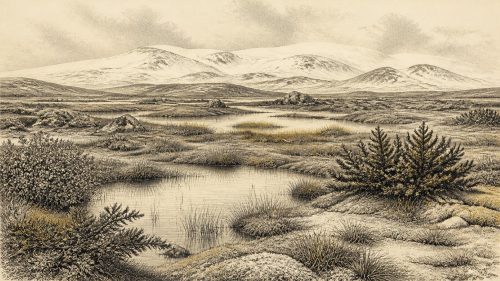
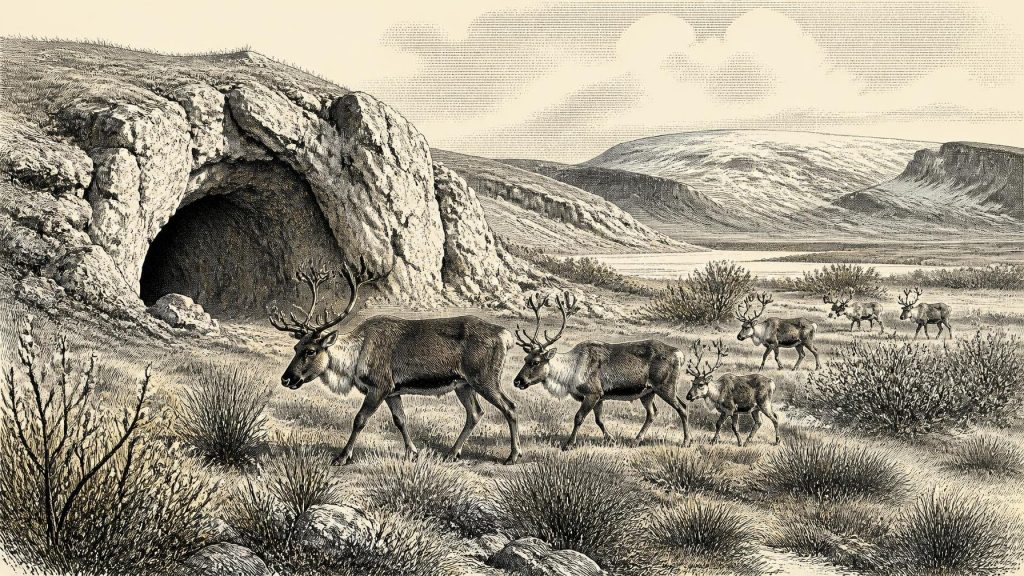
Around 30,544 BCE, Ireland lay in an unstable later Pleistocene environment, before maximum glaciation, with changing climates, exposed continental shelves and expanding ice. Waterford red-deer bones show large grazers occupied parts of the island during this broad period. Cave collections, especially Castlepook in Cork, preserve mammoth, reindeer, giant deer, bears, wolves, Arctic foxes, lemmings and hyenas, indicating varied open and wet tundra habitats. A marked reindeer femur may record Upper Palaeolithic butchery, but its old excavation context prevents firm conclusions about human presence. No settlements, political systems, trade or ritual are known. Subsequent glaciation destroyed or buried much fragile evidence.
Dateline
The label “30,544 BCE” is a modern chronological convenience, not a year that can be matched to an Irish event, ruler, settlement or season. At this depth of time, calendar-year precision is unavailable. In radiocarbon and palaeoenvironmental research, the more responsible language is that of calibrated ranges, stratigraphic sequences and changing probabilities. The notional date falls about 32,493 calendar years before 1950, placing it in the later part of the Pleistocene, before the Last Glacial Maximum engulfed Ireland. It lies very close to the onset of Greenland Interstadial 5.2 in the Greenland ice-core chronology, a relatively milder episode within a generally severe and unstable Ice Age world. That regional climatic framework is useful, but it is not a weather report for any one Irish valley.
A Date Without a Chronicle
No written records, named communities or recognisable political institutions survive from Ireland at this time. There are no securely dated houses, hearths, cemeteries, tool-making floors or art sites that permit a year-by-year human narrative. The evidence instead comes from animal bones, cave deposits, pollen and plant remains, glacial sediments, landforms, and the modern re-examination of old museum collections. Each has a different strength. A directly dated bone can show that an animal was present within a statistical range; it cannot, by itself, describe a whole landscape or prove the presence of people. A buried organic layer can record vegetation and water conditions, but may not be precisely contemporary with a fossil from another county.
For 30,544 BCE, the most relevant Irish evidence is therefore environmental and faunal. Two pre-Last-Glacial-Maximum red-deer specimens from Waterford caves have calibrated ranges of c. 32,930–31,280 and 30,297–29,594 cal BP. The earlier range spans the notional date used here. This does not mean that a particular red deer was alive in Waterford in a precisely identified year; it shows that deer occupied at least parts of Ireland during this broad interval. Their presence is a valuable indication of a land capable, at times and in places, of supporting large grazing mammals.
An Unstable Ice-Age Ireland
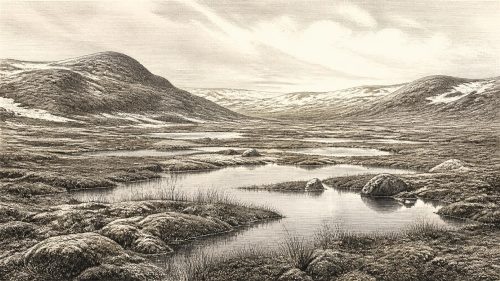
Ireland was not yet the uniformly ice-covered land of the glacial maximum. The major British–Irish Ice Sheet was growing, however, and its eventual expansion would transform the island and its surrounding shelf. Modern reconstructions suggest that by about 31,000 years ago substantial ice had developed in northern Ireland and in several upland areas, while smaller ice masses or glaciers existed in the south-western mountains. At c. 27,000–23,000 cal BP, ice reached its fullest known extent across Ireland and far onto the continental shelf. The landscape represented by 30,544 BCE was thus one of thresholds: cold, open habitats persisted in some areas while ice and periglacial conditions were becoming increasingly influential elsewhere.
The climate did not decline in a smooth line towards maximum glaciation. Greenland ice cores register abrupt shifts between colder stadials and relatively warmer interstadials. The approximate position of this date near the beginning of Greenland Interstadial 5.2 suggests a phase in which environmental conditions may have become less severe than in the preceding cold interval. But the connection must be made carefully. Greenland records atmospheric change at a great distance; Ireland’s temperature, snowfall, local ice extent, rainfall and growing season were shaped additionally by Atlantic circulation, altitude, exposure and the behaviour of nearby glaciers. What can responsibly be said is that Ireland formed part of a dynamic north-west European climatic zone, not a static frozen wilderness.
Lower global sea levels exposed much of the continental shelf around Ireland, although the exact coastlines and the character of sea crossings varied by region and through time. Those lost lowlands mattered ecologically. Rivers ran across terrain now submerged; grazing routes and animal habitats extended beyond the modern shore; and later glacial erosion or marine inundation removed or concealed much evidence. The absence of campsites on today’s coasts is therefore not proof that no people ever travelled through such landscapes. Equally, it is not evidence that they did. The archaeological record is patchy both because populations, if present, may have been sparse and because suitable deposits have been repeatedly destroyed, buried or drowned.
Caves and the Animal Record
Irish caves provide the clearest windows onto this older fauna. Castlepook Cave, also known as Mammoth Cave, near Doneraile in north County Cork, is particularly important. Excavations conducted between 1904 and 1908 produced a large collection of Pleistocene animal remains, now largely held by the National Museum of Ireland. The collection includes woolly mammoth, reindeer, giant deer, brown bear, wolf, Arctic fox, lemming and spotted hyena. Not every specimen belongs to exactly the same moment, and early twentieth-century excavation methods did not preserve the contextual detail expected today. Nevertheless, the assemblage demonstrates that Ireland was periodically occupied by a far richer cold-stage mammal community than the modern island supports.
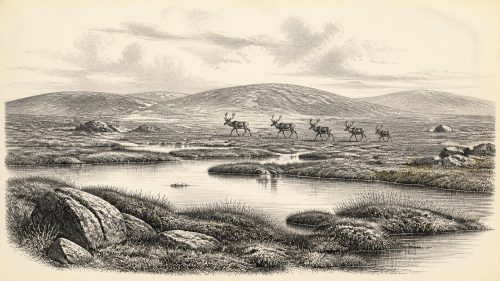
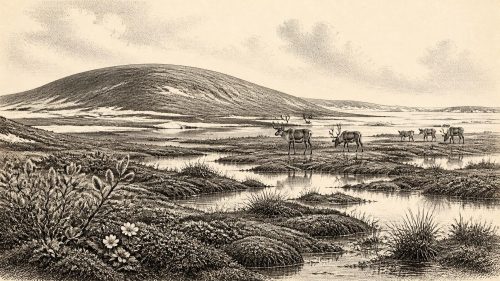
Spotted hyena is especially revealing. Hyenas are predators, scavengers and powerful bone accumulators; a cave containing their remains and those of prey need not have been a human shelter. Their presence, alongside large herbivores and carnivores, points to a productive open landscape with enough prey to sustain a food web. Reindeer and deer would have found forage in grassland, herb-rich tundra, shrub patches and sheltered ground. Mammoth remains evoke extensive open terrain rather than closed forest. Such evidence supports a mosaic of habitats, but it does not justify reconstructing a single, continuous “mammoth steppe” across every part of Ireland.
Plant evidence from beneath or between glacial deposits elsewhere in Ireland adds another dimension. Organic beds at Derryvree near Maguiresbridge, County Fermanagh, have yielded remains of cold-adapted vegetation, including sedges, mosses, dwarf willow, mountain avens and aquatic plants such as bogbean and water-milfoil. These deposits belong to changing intervals of the wider Late Pleistocene rather than to a documented moment at 30,544 BCE. Their significance is environmental: even in very cold periods, parts of Ireland could include freshwater pools, wet ground and vegetated tundra rather than unbroken ice. In a landscape of short summers, thawing margins and exposed soils, small wetlands could have been disproportionately important to animals.
The Castlepook Question
A reindeer femur from Castlepook has brought the possibility of a much earlier human presence into public view. It has been reported as roughly 33,000 years old and bears a deep mark interpreted by Ruth Carden and others as damage made by a stone tool during butchery. If that diagnosis and its chronological association are upheld, it would be striking evidence that a person processed a reindeer in Ireland during the Upper Palaeolithic, vastly earlier than the island’s well-attested Mesolithic settlement.
But the qualification is central to the history. The bone came from an old cave collection, not from a newly excavated and intact occupation surface with tools, hearth charcoal, refitting animal remains and human bones. A date on the bone identifies the age of the animal’s death, while the interpretation of a surface incision requires separate taphonomic analysis. Carnivore activity, sediment movement and the loss of excavation context must all be considered. Ongoing archaeological work at Castlepook seeks precisely the evidence that could test these possibilities: secure deposits, lithics, charcoal, further modified bone, and a clearer reconstruction of how materials entered the cave.
It would therefore be wrong either to announce a settled Irish population in 30,544 BCE or to dismiss the possibility of a brief human visit. The balanced conclusion is narrower: Ireland had suitable animal resources in at least some pre-glacial intervals, and Castlepook supplies an important but still limited possible trace of human action. There is no basis for assigning the mark to a named culture, for calling its maker Irish in any later ethnic sense, or for claiming a continuous ancestry from such a visitor to later populations.
No Kingdoms, No Trade Network
Political affairs, diplomacy and organised warfare cannot be recovered for Ireland at this date. There is no evidence for chiefs, territories, alliances, formal exchange systems or conflict between human groups on the island. Nor can religion be identified: no burials, shrines, images, ritual deposits or ceremonial structures are known from this horizon. Silence on these subjects is not a claim that people, if they arrived, had no social relationships, beliefs or cultural practices. It is a statement about what the Irish material record can presently demonstrate.
The same restraint applies to economy and everyday life. If people did reach Ireland during a relatively favourable interval, they would have been highly mobile foragers operating in a difficult, seasonal environment, rather than farmers or villagers. The reindeer femur, if genuinely butchered by people, would indicate the processing of meat, marrow, hide or bone, but cannot show the size of a group, the duration of a stay, their route, or whether hunting took place locally. There is no evidence for cultivation, domestic animals, pottery, metalwork, fixed fields or regular trade. Any movement of people and animals through this Atlantic-edge landscape was shaped above all by climate, food availability and changing routes across land and water.
Before the Great Advance
The importance of this date lies not in an invented event but in its position before a profound environmental rupture. Over the following millennia, expanding ice would scour much of Ireland, reshape drainage, bury older surfaces and greatly reduce the chances that fragile campsites would survive. This helps explain why the evidence is so thin. Yet caves, bones and buried wetlands preserve enough to overturn an older image of an empty, featureless Ireland before the Mesolithic. Around 30,544 BCE, the island was a cold and changing habitat used by large mammals and formidable carnivores; perhaps, on rare occasions, by people. That possibility remains one of the most consequential open questions in Irish prehistory.
Primary Sources
- The IntCal20 Northern Hemisphere Radiocarbon Age Calibration Curve (0–55 cal kBP)
- IntCal Publications
- The Greenland Ice Core Chronology 2005, 15–42 ka. Part 1: Constructing the Time Scale
- A Stratigraphic Framework for Abrupt Climatic Changes During the Last Glacial Period Based on Three Synchronized Greenland Ice-Core Records
- Growth and Retreat of the Last British–Irish Ice Sheet, 31,000 to 15,000 Years Ago: the BRITICE-CHRONO Reconstruction
- BRITICE-CHRONO Maps and GIS Data of the Last British-Irish Ice Sheet 31 to 15 ka
- The Timing and Magnitude of the British–Irish Ice Sheet Between Marine Isotope Stages 5d and 2
- Ireland: Submerged Prehistoric Sites and Landscapes
- Spotted Hyena Skull
- Heritage Artefacts of County Cork
- Archaeology Research Excavation Grant 2022: Final Report
- Royal Irish Academy Activities 2017
- UCD School of Archaeology Research Day 2022
- The Mesolithic in Ireland: When Was It?
- First Evidence of a Late Upper Palaeolithic Human Presence in Ireland
- New Insights on the Fauna of Ireland’s Younger Dryas and Early Holocene from Alice & Gwendoline Cave
- Phylogeographic, Ancient DNA, Fossil and Morphometric Analyses Reveal Ancient and Modern Introductions of a Large Mammal: the Complex Case of Red Deer in Ireland
- The Irish Quaternary Fauna Project
- Figure 6: The Subdivision of the Quaternary Period in Ireland
- Archaeological Excavations at Killuragh Cave, Co. Limerick