
Elephant Hall’s Long Silence31755 BCE
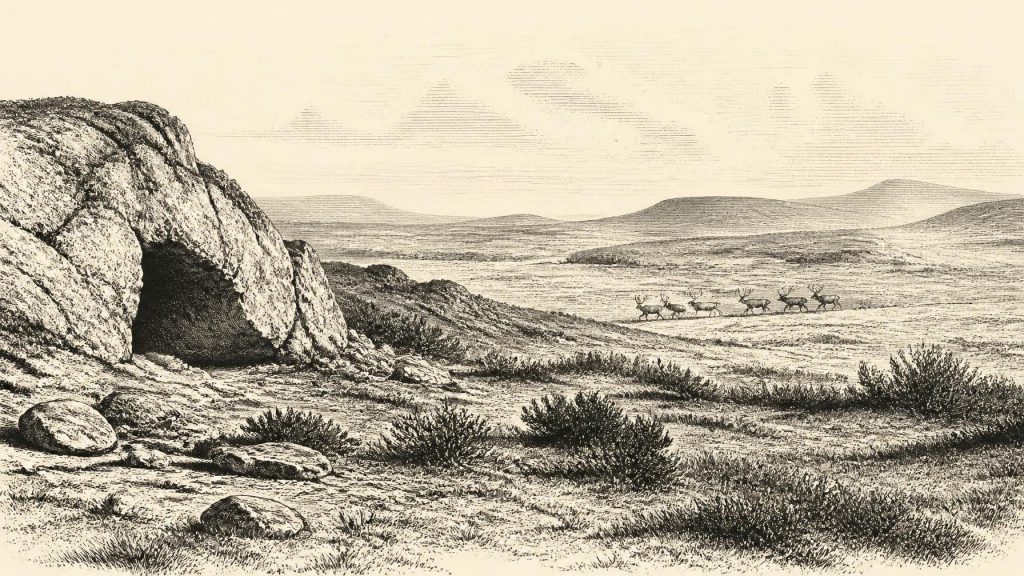
Circa 31,755 BCE, Ireland lay within the volatile later Marine Isotope Stage 3 of the last Ice Age, as the British–Irish Ice Sheet expanded unevenly. Much of the island’s contemporary environment remains uncertain, later glaciation having erased or disturbed evidence. Castlepook Cave, County Cork, preserves Ireland’s richest relevant vertebrate assemblage, including reindeer, mammoth, giant deer, predators and lemmings, indicating cold, open habitats. Its mixed, imperfectly dated deposits document a long faunal sequence, not a single community. A possibly cut-marked reindeer bone suggests but cannot prove early human visitation. No secure evidence establishes settlement, culture or events in this nominal year.
Dateline
The label 31,755 BCE is a modern chronological convenience, not a date that anyone in prehistoric Ireland could have named or recorded. At this depth in time, modern calendar-year precision is unavailable. Counting back from the conventional radiocarbon reference year of AD 1950 places the nominal year at roughly 33,700 years before present, but the responsible language is one of broad calibrated ranges, laboratory uncertainty and changing scientific models. It belongs to the later part of Marine Isotope Stage 3, a volatile phase of the last Ice Age, rather than to a recoverable Irish ‘year’ of events.
There were no written records, states, rulers, political communities or calendars in Ireland from which political history could be reconstructed. Nor can archaeology currently identify a settlement, a family, a hunt or a ritual that happened in this particular year. What can be examined are the physical traces of the Ice Age: cave bones, buried sediments, landforms, pollen and insects, together with the limits and movements of the British–Irish Ice Sheet. They reveal an island at a crucial environmental threshold, and they show why certainty must be kept separate from plausible interpretation.
An Ice Sheet in Growth
About 33,700 years ago, Ireland was entering the major expansion phase that led towards the Last Glacial Maximum. A widely used chronological model places the build-up of the British–Irish Ice Sheet after about 35,000–32,000 years ago, with its broad maximum later, approximately 27,000–21,000 years ago. More recent reconstructions, built from extensive marine geophysics and hundreds of new dates, likewise show that the ice sheet was dynamic, growing in different sectors at different times rather than advancing as one uniform frozen blanket.
This distinction matters. It would be misleading to say simply that all Ireland lay beneath ice in 31,755 BCE. The eventual ice sheet did cover almost the whole island, and its grinding passage profoundly reshaped the country. Yet at the nominal date, the extent, thickness and behaviour of ice varied regionally and remain partly uncertain. Northern and western marine sectors were being transformed by advancing ice masses, while evidence from the south and from caves preserves hints of landscapes and animals that existed before later ice, water and sediment disturbed or buried them.
The older countryside cannot be recovered as a map with crisp boundaries. Glaciers later removed soils, eroded bedrock and redeposited immense quantities of till. Sea-level change also altered the outline of the island and the breadth of its surrounding shelf. The Irish Sea and Celtic Sea were not necessarily barriers in the modern sense, but neither is it safe to imagine a simple, continuous land route to Britain or continental Europe. Ice margins, shallow seas, exposed shelf, rivers and periglacial ground changed repeatedly over long periods.
Castlepook’s Fragmentary Record
The most important Irish archive for this broad interval lies in north County Cork. Castlepook Cave, near Doneraile, is a limestone maze whose chambers acquired evocative names from earlier explorers, including Elephant Hall and Hyenahall. Excavations in the early twentieth century recovered more than 2,000 bones and teeth. The resulting collection is Ireland’s richest record of vertebrate life in the period leading towards the Last Glacial Maximum, but it is not a neatly layered snapshot of one moment.
The assemblage includes remains attributed to reindeer, mammoth, giant deer, brown bear, wolf, fox, spotted hyaena, mountain hare and lemmings, as well as birds. Taken carefully, those finds demonstrate that Ice Age animals reached southern Ireland. They support the existence, at least during portions of the cave sequence, of cold, open habitats capable of sustaining grazing and browsing herbivores and their predators. Reindeer and lemmings especially point towards conditions far removed from the wooded Ireland of later millennia.
But the cave’s bones cannot all be treated as companions. They were recovered during early excavations from sands, speleothem floors and disturbed deposits; some material may have been moved by water, carnivores, excavation or later contamination. Individual radiocarbon determinations span a long period. A mammoth bone was reported with an age of 33,400 ± 1,200 radiocarbon years before present, while later reassessment has emphasised the need to reconsider the dating and integrity of the Marine Isotope Stage 3 fauna. Castlepook therefore illuminates a long-lived faunal record, not a settled animal community assembled in one season around 31,755 BCE.
A Reindeer Bone and a Necessary Caution
A reindeer femur from Castlepook has made this phase of Irish prehistory especially arresting. It has been described as carrying a deep mark consistent with cutting or chopping by a sharp stone tool, and it has been associated in public heritage material with an age of about 33,000 years ago. If the mark was made by a person on fresh bone, it would indicate that somebody processed a reindeer in Ireland during the Upper Palaeolithic—many thousands of years earlier than the previously accepted evidence for human presence.
That proposition should be neither dismissed nor inflated. The bone is an important object for further specialist study, but it is not evidence for an Irish population, camp or society. Its date concerns the animal bone rather than a calendar date for the mark. The specimen also comes from an old cave collection rather than a recently excavated occupation surface with associated tools, hearths, structures and securely documented layers. The 2022 investigation at Castlepook successfully located surviving cave sediments, but did not establish a Pleistocene occupation deposit. It confirmed how much work remains to be done.
The mark is best regarded as a potentially significant indication of human activity, not proof of permanent settlement. A single butchery trace, if confirmed, could reflect a brief visit by mobile hunters familiar with the wider north-west European landscape. It cannot tell us how many people came, where they travelled from, whether they returned, how long they stayed, or whether they lived on the island at all. The better-supported later evidence from Alice and Gwendoline Cave in County Clare—a cut-marked brown-bear kneecap dated to around 12,800–12,600 calibrated years before present—shows the standard that securely dated and studied finds can achieve, while also illustrating how sparse Ireland’s earliest human record remains.
Life Without a Human History
For the landscape itself, Castlepook allows stronger conclusions than it does for people. The fauna suggests mosaics of herb-rich grassland, tundra-like vegetation and sparse shrub cover rather than continuous forest. Such terrain could feed reindeer, giant deer and mammoth, although each species had different requirements and their presence need not have overlapped exactly. Mosses, sedges, herbs and hardy low shrubs were likely important parts of the vegetation in exposed areas, while sheltered hollows and watercourses may have supported more varied plant communities.
The climate was severe but not uniformly static. Marine Isotope Stage 3 contained abrupt climatic shifts, and Ireland stood at the Atlantic edge of a northern European world affected by changing sea ice, ocean circulation and ice-sheet growth. Seasons would have governed food availability, animal movements and the usefulness of sheltered places. Cave deposits record that predators and scavengers could make use of such places. Hyenas might accumulate bones in dens; carnivores, water and gravity could all alter a deposit long before archaeologists encountered it.
There is no evidence from this date for agriculture, livestock, pottery, metalworking, monuments, long-distance trade, named territories or organised diplomacy. There is equally no basis for describing battles or political conflict. Predation and scavenging were real features of the animal world, but they are not human warfare. If humans ever visited, their economy would have depended on highly mobile foraging and the immediate use of animal and plant resources; even that remains an inference rather than a demonstrated Irish way of life for this particular interval.
Religion, Culture and Settlement
Nothing currently recovered from Ireland around this nominal date can establish religious practice, language, music, artistic tradition or formal learning. Caves can easily invite imaginative stories about ceremonial use, but a cave containing animal bones is not automatically a shrine, a home or a hunting station. Nor is there evidence for houses, hearths, burials, tool-making floors or repeated domestic rubbish. The absence of such evidence may partly reflect the destructive power of later glaciation and the difficulty of finding ancient shorelines and surface sites, many of which may now be submerged or erased. Absence is not proof that no person ever arrived; it is, however, a firm reason not to invent a community.
Ireland’s first securely recognised substantial settlement evidence is far later. At Mount Sandel beside the River Bann, Mesolithic occupation is generally dated to roughly 7900–7600 BCE. Those people left recognisable structures, hearth debris and stone tools. The contrast is revealing: the remote Palaeolithic record offers isolated bones and contested or limited traces, whereas the post-glacial record permits a genuine human history. Around 31,755 BCE, the island’s story is principally geological and ecological.
An Edge, Not a Beginning
The importance of this period lies precisely in its uncertainty. Ireland was not yet a country of farms, monuments or remembered ancestors. It was an Atlantic peninsula-or-island landscape being reshaped by climate, ice and sea, intermittently available to large mammals and perhaps, on present evidence, to occasional human visitors. Castlepook’s animal remains preserve an extraordinary glimpse of that vanished world, but they impose limits as well as possibilities.
The responsible historical conclusion is therefore modest. Around the nominal year 31,755 BCE, the British–Irish Ice Sheet was in a phase of growth, Irish environments were becoming colder and more exposed, and the south of the island supported—or had recently supported—an Ice Age fauna of remarkable variety. A marked reindeer bone raises the possibility of an early human encounter with that landscape. It does not yet yield a named people, a permanent settlement or an event that can be assigned to a calendar year. Elephant Hall’s long silence remains one of the most important facts of Ireland’s deepest past.
Primary Sources
- Growth and retreat of the last British–Irish Ice Sheet, 31,000 to 15,000 years ago: the BRITICE-CHRONO reconstruction
- Growth and retreat of the last British–Irish Ice Sheet, 31,000 to 15,000 years ago: the BRITICE-CHRONO reconstruction
- Extent and timing of the Last Glacial Maximum (LGM) in Britain and Ireland: a review
- Maximum extent and dynamic behaviour of the last British–Irish Ice Sheet west of Ireland
- New age constraints for the maximum extent of the last British-Irish Ice Sheet (NW sector)
- Trimlines, blockfields and the vertical extent of the last ice sheet in southern Ireland
- A reconsideration of the radiocarbon dating of the Marine Isotope Stage 3 fauna from southern Ireland
- Castlepook Cave
- Occurrence of mammalia relicts at site Castlepook Cave
- Pleistocene vertebrates in the British Isles
- 2022:564 – Castlepook Cave, Castlepook South, Cork
- Archaeological Heritage of County Cork
- Prehistoric Details: Mell Flint Flake
- Guide to the National Museum of Ireland
- First evidence of a Late Upper Palaeolithic human presence in Ireland
- First evidence of a Late Upper Palaeolithic human presence in Ireland
- New insights on the fauna of Ireland's Younger Dryas and Early Holocene from Alice & Gwendoline Cave
- Historical Geography: Volume 2
- Mountsandel
- Our Ancient Landscapes: Hunter-Gatherers in Ireland
- The Irish Quaternary Association: Outreach and Education Resources
- The Quaternary of the Irish Midlands