

Castlepook’s Pleistocene Menagerie30202 BCE
Thirty thousand two hundred and two BCE is a modern label for roughly 32,100 years before AD 1950, not a datable Irish event. Ireland then experienced cold conditions preceding expansion of the British–Irish Ice Sheet, whose extent remains uncertain. Treeless environments, meltwater and permafrost characterised exposed ground, while glaciation later destroyed sites. Castlepook Cave in County Cork preserves remains of mammoth, giant deer, reindeer, bears, wolves, Arctic foxes and hyenas, although deposits span episodes. A marked reindeer femur may indicate butchery by humans around 33,000 years ago, but no settlement evidence exists. The period reveals environmental change, not documented society.
Dateline
30,202 BCE is not a date that can be matched to a recorded Irish event. It is a modern calendar label for a point roughly 32,000 years before the conventional radiocarbon reference year of AD 1950. Neither people nor animals in prehistoric Ireland marked years in this way, and the evidence cannot distinguish one season, let alone one calendar year, from another. The responsible history of Ireland at this depth of time is therefore a history of landscapes, ice, fossils and uncertain traces of human activity. It belongs broadly to the later part of Marine Isotope Stage 3, immediately before the great expansion of the last British–Irish Ice Sheet.
A Date Beyond Calendar Precision
Archaeologists and Quaternary scientists normally work here with ranges expressed in thousands of calibrated years before present: ka cal BP, with “present” fixed at AD 1950. A mechanical conversion makes 30,202 BCE approximately 32.1 ka cal BP, but that should not imply a precision which the evidence lacks. Radiocarbon measurements have laboratory uncertainty, their conversion to calendar age uses calibration curves, and cave deposits may contain bones moved by water, scavengers, excavation or later disturbance. The relevant question is not what happened in Ireland in a single named year, but what conditions and possibilities are supported for the broad interval around 33,000–31,000 years ago.
This was a changing world. The global Last Glacial Maximum is generally placed later, at about 26,500–19,000 years ago, but ice sheets do not grow everywhere at the same pace. Recent reconstructions of the British–Irish Ice Sheet begin their closely dated sequence at 31 ka and show ice building across Ireland and Britain from roughly 31–26 ka. Evidence for the preceding period is markedly less secure. Around the nominal date used here, Ireland may have included ice-covered districts, ice-free or seasonally open areas, and landscapes repeatedly altered by advancing ice. It is not defensible to draw a single coast-to-coast boundary line for this one notional year.
An Island Becoming an Ice Landscape
The principal political force in Ireland, if the term may be used metaphorically, was ice. There were no known states, rulers, frontiers or diplomatic communities. Instead, regional change was governed by the growth of the Irish component of the British–Irish Ice Sheet, by snowfall and summer melt, and by the movement of glacier ice through valleys, across lowlands and towards the continental shelf. Later advances removed, buried or reworked much of the ground surface on which any earlier people might have camped. This destruction is one major reason why the archaeological record is so slight.
At the scale of centuries and millennia, ice was dynamic rather than static. Offshore mapping, marine sediment cores, glacial landforms and exposure dating demonstrate that the last ice sheet expanded to the shelf edge in several sectors, but they also show that its maximum extent and subsequent retreat were asynchronous. For the early growth phase, the exact timing and extent in Ireland remain debated. Southern and western evidence cannot simply be applied to Donegal, the midlands or Ulster. A map for 30,202 BCE would thus be a model with broad uncertainty bands, not a photograph of a known landscape.
Where ground was exposed, it would not have resembled the wooded island familiar today. Treeless cold-stage vegetation, low herbs, grasses, sedges, mosses and dwarf shrubs are the appropriate ecological expectation for open, cold environments, but their local distribution depended on soil, wind exposure, snow cover, drainage and proximity to ice. Permafrost processes, frost-shattered rock, seasonal meltwater and sparse cover could leave a terrain vulnerable to erosion. Lakes, marshes, river channels and cave entrances could preserve fragments of that world; most dry-land traces were far less likely to survive later glacial action.
Castlepook and the Animal Record
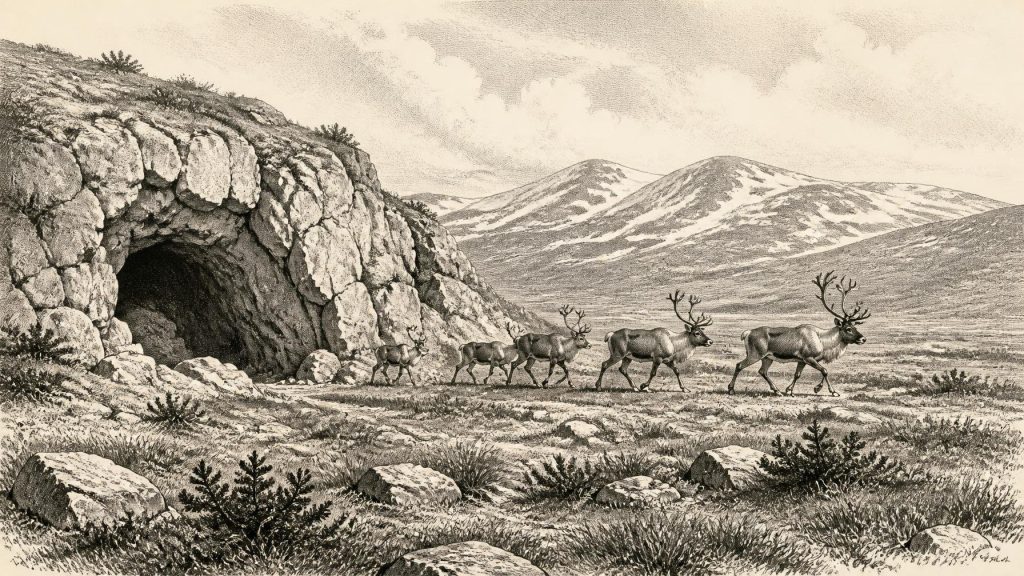
The strongest directly Irish evidence for the broad period comes from caves, above all Castlepook Cave, also called Mammoth Cave, near Doneraile in north County Cork. Antiquarian excavations there recovered a remarkable assemblage of Late Pleistocene animal remains. The cave record includes woolly mammoth, giant deer, reindeer, brown bear, wolf, Arctic fox and spotted hyena, while later cold-stage material includes lemmings and mountain hare. It establishes that Ireland was not an empty geological stage during the last Ice Age: at various times, substantial mammals and their predators entered and used parts of the island.
Yet Castlepook must be handled with care. A cave is a trap, den, shelter and sedimentary container, not a simple census of animals standing together in one valley. Hyenas and other carnivores could have carried bones into the cave; water could have moved material; and early excavation did not record deposits to modern standards. The assemblage spans more than one episode. Improved radiocarbon methods have also prompted reassessment of some older Irish cave dates, with research suggesting that particular species formerly assigned to a single late interval may be significantly older. The fossils illuminate a broad Middle-to-Late Pleistocene faunal history, not an exact annual fauna for 30,202 BCE.
Nevertheless, the animals are historically important. Reindeer imply access to cold, open feeding landscapes; mammoth and giant deer indicate that at least some Irish environments could support large herbivores; hyena, wolf and bear demonstrate a food web with major carnivores. The mixture need not mean that every species was abundant everywhere or continuously present. Animal populations could have arrived, disappeared locally and returned as climate, vegetation, sea level and ice margins changed. Ireland’s position at the western edge of Eurasia made such populations especially sensitive to changing routes and habitats.
The Reindeer Femur Question
Castlepook also presents the most provocative human question for this era. A reindeer femur from the old collection has been reported as about 33,000 years old and bears a deep linear mark interpreted by zooarchaeologist Ruth Carden as damage made by a sharp stone implement while fresh bone was being butchered. If that interpretation is confirmed, it may represent the earliest known indication that humans handled an animal in Ireland. It would show an episode of carcass processing, perhaps by a short-lived hunting party, at some point broadly near the chronological horizon considered here.
That possibility must not be inflated into a settled Palaeolithic Ireland. No securely associated stone-tool assemblage, hearth, dwelling floor, burial, human bone, artwork or stratified camp of comparable age has been published from the cave. Nor does one marked bone reveal the number, language, ancestry, sex, beliefs or destination of the people who may have made the mark. The original excavations and the complicated history of the deposits limit what can be inferred. Recent archaeological work at Castlepook is valuable precisely because it seeks better-controlled evidence rather than treating the femur as a final answer.
The contrast with later evidence is instructive. Ireland’s first well-established Upper Palaeolithic human presence is represented by a butchered brown-bear bone from Alice and Gwendoline Cave in County Clare, dated to about 12,810–12,590 cal BP. Substantial evidence for hunter-gatherer life belongs later again, in the Mesolithic. The Castlepook femur, therefore, is best described as a potentially transformative but currently isolated clue, not proof of continuous occupation between the early Upper Palaeolithic and the post-glacial settlement of Ireland.
No Politics, Trade or Religion Can Be Recovered
For the usual categories of a year-by-year history, silence is itself an important finding. There is no evidence from around 32.1 ka cal BP for Irish political institutions, named groups, warfare between human communities, diplomacy, markets, farming, herding, seafaring networks, monuments, ritual deposits or writing. It would be misleading to turn animal predation into warfare, a possible butchery mark into an economy, or a cave into a shrine. Religion and culture may have existed if people reached Ireland, as they certainly did among contemporary Upper Palaeolithic communities elsewhere in Europe, but Ireland has not yielded evidence that identifies their local form.
Everyday life can be discussed only conditionally. A human group capable of reaching or moving through Ireland at this time would have required practical knowledge of severe weather, animal behaviour, stone tools, fire and seasonal mobility. Those are reasonable inferences from the wider European Upper Palaeolithic, not discoveries made in Ireland itself. Whether access involved exposed shelves, short sea crossings, ice margins or routes through what is now the Irish Sea cannot presently be established. Lower sea levels altered coastlines, but lower sea level alone does not prove a walkable land bridge or regular contact.
Evidence, Loss and Future Discovery
The chief development around this nominal year was environmental: Ireland was entering the long interval in which expanding ice would reshape its terrain and severely constrain the survival of older archaeological sites. Caves such as Castlepook, protected pockets of sediment, offshore cores and glacial landforms are consequently more informative than conventional settlements. They preserve a record of ecological opportunity, extinction, recolonisation and upheaval rather than a narrative of kings and battles.
Future excavation, refined radiocarbon pretreatment, ancient DNA, sedimentary analysis and renewed study of museum collections may alter the picture. For now, the most secure conclusion is deliberately modest. Around the modernly labelled year 30,202 BCE, Ireland lay in an unstable cold-stage world approaching major glaciation. Its animal record shows that large mammals and carnivores had used the island during the wider period. A single marked reindeer bone raises the serious possibility of a much earlier human visit. It does not yet give Ireland a documented population, society or event for that year.
Primary Sources
- Growth and Retreat of the Last British–Irish Ice Sheet, 31,000 to 15,000 Years Ago: The BRITICE-CHRONO Reconstruction
- The Timing and Magnitude of the British–Irish Ice Sheet Between Marine Isotope Stages 5d and 2
- Trimlines, Blockfields and the Vertical Extent of the Last Ice Sheet in Southern Ireland
- Dimensions and Chronology of the Last Ice Sheet in Western Ireland
- Radiocarbon Constraints on the Age of the Maximum Advance of the British–Irish Ice Sheet in the Celtic Sea
- Timing and Pace of Ice-Sheet Withdrawal Across the Marine–Terrestrial Transition West of Ireland During the Last Glaciation
- Deglaciation Chronology of the Donegal Ice Centre, North-West Ireland
- Advance and Retreat of the Marine-Terminating Irish Sea Ice Stream into the Celtic Sea During the Last Glacial: Timing and Maximum Extent
- Maximum Extent and Readvance Dynamics of the Irish Sea Ice Stream and Irish Sea Glacier Since the Last Glacial Maximum
- A Reconsideration of the Radiocarbon Dating of the Marine Isotope Stage 3 Fauna from Southern Ireland
- The Irish Quaternary Fauna Project
- Castlepook Cave, County Cork: County Geological Site Report
- Occurrence of Mammalia Relicts at Site Castlepook Cave
- Pleistocene Vertebrates in the British Isles
- Archaeology Research Excavation Grant 2022: Final Report
- 2022:564 – Castlepook Cave, Castlepook South, Cork
- Heritage Artefacts of County Cork
- First Evidence of a Late Upper Palaeolithic Human Presence in Ireland
- New Insights on the Fauna of Ireland's Younger Dryas and Early Holocene from Alice and Gwendoline Cave
- The Colonization of Ireland: A Human Ecology Perspective
- The Mesolithic in Ireland: When Was It?
- Ireland: Submerged Prehistoric Sites and Landscapes


