The Doneraile Bone Archive30578 BCE
Thirty thousand five hundred and seventy-eight BCE is a modern approximation for a Late Pleistocene Irish landscape in Marine Isotope Stage 3, near Greenland Interstadial 5.2. Ireland experienced comparatively milder yet volatile glacial conditions, with lower seas and changing access routes. Castlepook Cave near Doneraile, Cork, preserves over 2,000 bones accumulated across millennia, including mammoth, reindeer, giant deer, bear and hyaena. These indicate open, cold habitats, but do not form a single contemporary scene. A possibly stone-tool-marked reindeer bone raises early human presence, though no securely associated settlement evidence exists. Later ice expansion erased or buried evidence, requiring cautious interpretation.

Dateline
The label 30,578 BCE is a modern chronological convenience, not a year that can be recovered from Irish evidence. No calendar, written record or annually resolved archaeological sequence exists for Ireland at this depth in time. Expressed in the usual archaeological convention, it falls roughly 32,528 years before AD 1950, or about 32.5 thousand calibrated years before present. That places it near the beginning of Greenland Interstadial 5.2 in the North Atlantic ice-core chronology, but the correlation is broad: the ice-core event itself has chronological uncertainty, and an event recognised in Greenland cannot be treated as a weather report for a particular day, decade or valley in Ireland.
What can responsibly be said is that Ireland lay in the Late Pleistocene, within Marine Isotope Stage 3 and the Irish Midlandian glacial cycle. It was not yet at the maximum extent of the last British–Irish Ice Sheet, but it was approaching a period in which expanding ice would repeatedly transform the island and its surrounding shelf. The most illuminating Irish evidence comes not from settlements or monuments but from caves, animal bones, sediments, glacial landforms and the scientific re-dating of old museum collections. Around this notional date, the story is chiefly one of a changing northern landscape and of the animals capable of using it.
A Brief Mild Interval
Greenland Interstadial 5.2 represents a relatively milder interruption within a long cold period. “Milder” must be understood comparatively. It does not imply a wooded Ireland, settled farmland or conditions resembling the modern climate. Across the North Atlantic world, rapid shifts in temperature, snowfall, sea ice and wind could alter the extent of open ground, the length of growing seasons and the routes available to animals. Ireland’s own response would have varied sharply by region, altitude and proximity to ice margins and coasts.
At approximately 32.5 thousand years ago, lower global sea levels exposed far more of the continental shelf than is visible today. Ireland was part of a larger physical and ecological world, although the precise configuration of land, shallow sea, glaciers and possible crossings changed over time. The presence in Ireland of large terrestrial mammals demonstrates that access was possible during parts of the Late Pleistocene. It does not, however, identify a single route, prove a continuous land bridge at this exact point, or show that every animal and human group reached the island under identical conditions.
The later Last Glacial Maximum would cover much of Ireland with ice and powerfully erode or bury earlier surfaces. That is one reason why open-air evidence for this period is so scarce. The absence of known campsites is not proof that no person ever entered Ireland, but it does mean that claims about an organised population, permanent villages or a distinct Irish Upper Palaeolithic culture would go well beyond the evidence.
Castlepook’s Long Record
The most important archive for southern Ireland is Castlepook Cave, also called Mammoth Cave, near Doneraile in north County Cork. Its limestone galleries produced more than 2,000 bones during excavations in the early twentieth century. Geological Survey Ireland describes it as the island’s richest known vertebrate site for the period leading up to the Last Glacial Maximum. The cave’s evocatively named passages, including Hyenahall and Elephant Hall, preserve a record accumulated over a very long interval rather than a snapshot of one season.
That distinction matters. Bones reached caves through numerous processes: carnivores dragged in prey; animals died in or near entrances; water disturbed and redistributed deposits; and early excavators worked before modern standards of stratigraphic recording. Radiocarbon programmes have shown that some older determinations from Castlepook were substantially too young, while individual bones span many millennia. The assemblage can therefore illuminate the kinds of animals that occupied Ireland during the middle and later Ice Age, but it cannot be used to place all its species together at 30,578 BCE.
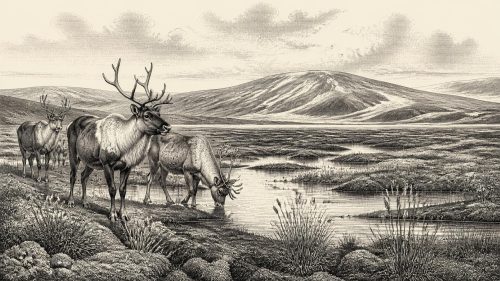
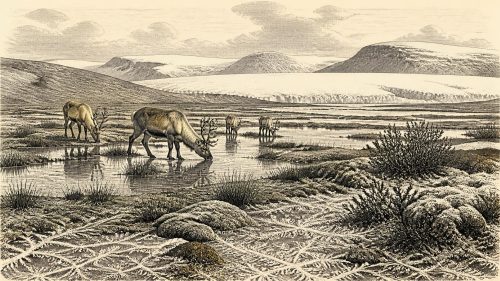
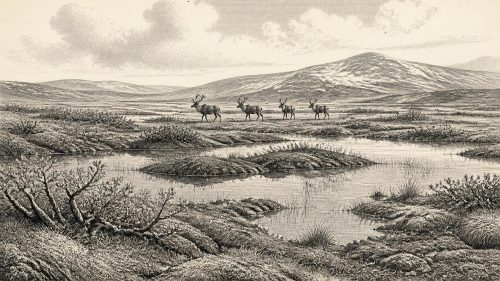
Its fauna is nonetheless striking. Castlepook has yielded remains of woolly mammoth, reindeer, giant deer, brown bear and spotted hyaena, with Arctic fox, wolf, mountain hare and lemmings also represented in the wider Late Pleistocene record. These animals point to a cold, predominantly open environment: a mosaic of grassland, herb-rich steppe-tundra, dwarf shrubs, exposed soils, wet hollows and patches of more sheltered vegetation. Such terrain could support herds and the predators or scavengers that followed them, yet it would have been a demanding world, shaped by short summers, severe winters and unstable weather.
Animals, Not a Single “Ice Age Scene”
It is tempting to imagine mammoths, reindeer, hyaenas and giant deer all gathered in one Cork landscape at the same moment. The evidence does not permit that simple picture. Different species’ remains may belong to different climatic phases and may have entered the cave in different ways. The responsible conclusion is narrower but still remarkable: Pleistocene Ireland supported a wider and more cold-adapted mammal community than the island’s later historic fauna suggests.
Reindeer would have been especially well suited to open ground and seasonal movement. Giant deer, despite the modern nickname “Irish elk”, were neither uniquely Irish nor elk; they were a widespread Eurasian deer, Megaloceros giganteus. Woolly mammoth remains attest to the former reach of mammoth-steppe ecosystems into Ireland. Spotted hyaena remains are equally important because they show that caves could be carnivore places before they became archaeological archives. A bone in such a setting is evidence first of an animal and its depositional history; it is not automatically evidence of hunting, feasting or human residence.
The Human Question
The possibility of very early human activity in Ireland has become more prominent through the re-examination of Castlepook material. A reindeer femur from the cave has been reported as bearing a deep mark interpreted by zooarchaeologist Ruth Carden as damage from a stone tool used while processing fresh bone. If that interpretation is confirmed, it would suggest that people handled a reindeer carcass in Ireland during the Upper Palaeolithic, vastly earlier than the well-established post-glacial record.
Yet this is a possibility requiring continued testing, not a licence to narrate a settled human Ireland. The date of an animal bone is not necessarily the date of a surface mark; a modified bone does not reveal the size of a party, the duration of its visit, its route of arrival or whether it left descendants on the island. Nor has Castlepook yet produced a securely associated lithic assemblage, hearth, dwelling floor, burial or stratified occupation horizon of this age. The cave’s disturbed deposits make careful new excavation, microscopic examination of marks, sediment analysis and improved dating especially important.
Accordingly, politics, diplomacy and warfare cannot be reconstructed. There were no known Irish kingdoms, leaders, boundaries, institutions or named peoples. Nor is there evidence for trade, regular seafaring, exchange networks, formal religion, art or learning in Ireland around this point. The lack of evidence is meaningful: these subjects lie beyond the resolution of the present record, rather than being blank spaces historians may safely fill with later Celtic, medieval or modern identities.
Life at the Edge of the Record
If people did enter Ireland during a comparatively favourable interval in Marine Isotope Stage 3, they would most plausibly have been highly mobile hunter-gatherers, equipped with perishable gear and stone tools, following opportunities created by animal movements and local shelter. This is an inference from Upper Palaeolithic societies elsewhere in north-west Europe, not a direct description of a Castlepook community. Ireland has yielded no house, campsite, food store, clothing, personal ornament or human bone securely attributable to 30,578 BCE.
For animals, everyday survival was inseparable from landscape change. Grazers needed productive open ground; carnivores needed prey; scavengers and cave users required secure refuges; and all depended on routes that could disappear as glaciers advanced, meltwater altered valleys or rising seas later submerged lowlands. The apparent richness of the pre-Last Glacial Maximum fauna should therefore be read as evidence of repeated colonisation and ecological opportunity, not of a stable, self-contained island ecosystem.
Evidence With Limits
The principal development relevant to this date is environmental rather than political: a short-lived warming phase in the wider North Atlantic climate system occurred while Ireland remained within a volatile glacial world. Cave faunas, especially the Doneraile archive, show that cold-adapted mammals used parts of Ireland before the greatest expansion of the last ice sheet. They also preserve a carefully bounded question about human presence.
The history of Ireland at 30,578 BCE is therefore not a story of a recorded event. It is an archaeological horizon defined by calibrated ranges, imperfect deposits and disciplined uncertainty. The cave bones are invaluable precisely because they are fragmentary: they make it possible to see Ireland as a changing Pleistocene landscape connected to the wider north-west European world, while warning against claims that the evidence cannot yet bear.
Primary Sources
- Castlepook Cave: Cork County Geological Site Report
- A Reconsideration of the Radiocarbon Dating of the Marine Isotope Stage 3 Fauna from Southern Ireland
- The Irish Quaternary Fauna Project
- Irish Quaternary Vertebrates
- Late Pleistocene Chronostratigraphy and Ice Sheet Limits, Southern Ireland
- Growth and Retreat of the Last British–Irish Ice Sheet, 31,000 to 15,000 Years Ago: The BRITICE-CHRONO Reconstruction
- Pattern and Timing of Retreat of the Last British-Irish Ice Sheet
- Character of Advance and Retreat of the Southwest Sector of the British-Irish Ice Sheet During the Last Glaciation
- Using Novel Methods to Track British and Irish Ice Sheet Dynamics Since the Late Pleistocene, Along the West Porcupine Bank, NE Atlantic
- A Stratigraphic Framework for Abrupt Climatic Changes During the Last Glacial Period Based on Three Synchronized Greenland Ice-Core Records
- The IntCal20 Northern Hemisphere Radiocarbon Age Calibration Curve (0–55 cal kBP)
- IntCal: Radiocarbon Calibration Curves and Data
- First Evidence of a Late Upper Palaeolithic Human Presence in Ireland
- New Insights on the Fauna of Ireland’s Younger Dryas and Early Holocene from Alice and Gwendoline Cave
- Archaeology Research Excavation Grant 2022: Final Report
- 2022:564 – Castlepook Cave, Castlepook South, Cork
- The Mesolithic in Ireland: When Was It?
- Late Pleistocene Chronostratigraphy and Ice Sheet Limits, Southern Ireland
- Dating Constraints on the Last British-Irish Ice Sheet: A Map and Database
- Cork Geological Heritage Audit Report