Doneraile’s Cutmark Question30882 BCE
Around 32,800 calibrated years before 1950, Ireland experienced cold, unstable MIS 3 conditions, with open vegetation, lower seas and changing ice margins. Cave deposits, particularly Castlepook Cave, preserve evidence of reindeer, mammoth, giant deer, predators and other fauna, although disturbed deposits limit reconstruction. A reindeer femur, about 33,000 years old, bears a possible stone-tool cutmark, suggesting but not proving Upper Palaeolithic human activity. No associated settlement, artefacts or evidence of permanent population survives. Later butchered bear remains confirm human visitation around 12,800 cal BP. Expanding ice subsequently erased many traces, leaving cautious interpretation dependent on bones, sediments, dating and research.
Dateline
The label 30,882 BCE is a modern chronological convenience, not a recoverable Irish calendar year. No one in Ireland recorded a date, and no excavation can isolate an event, season or individual to this particular year. It is more responsible to place the point broadly around 32,800 calibrated years before AD 1950, within the later part of Marine Isotope Stage 3 (MIS 3), a long, climatically unstable phase of the Late Pleistocene. The evidence is sparse, discontinuous and often recovered from old cave excavations. It can illuminate environments, animals and a possible human encounter, but not a year-by-year national history.
A Changing Cold-Stage Landscape
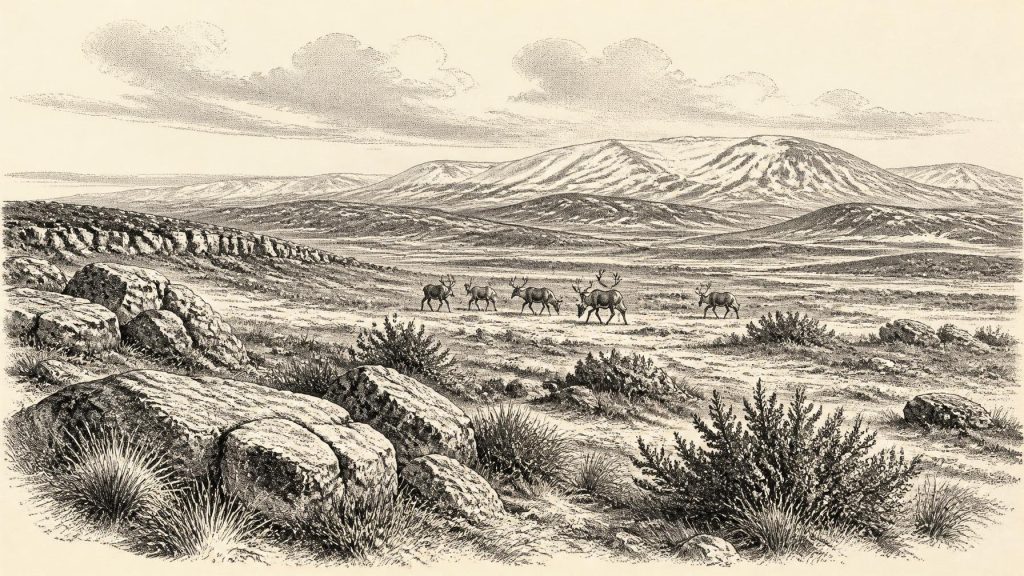
Ireland at this time was not the green, wooded island familiar from later prehistory. The climate was generally cold, and vegetation was likely open and patchy: grasses, sedges, herbs, mosses and low shrubs could occupy favourable ground, while frost, wind and seasonal snow restricted tree growth. Yet this was not necessarily a single, uniform frozen wilderness. Greenland ice-core records show abrupt climatic swings during MIS 3, and the Irish evidence suggests that habitats and ice margins changed markedly over relatively short geological intervals. A precise map for 30,882 BCE cannot be drawn. What can be said is that Ireland lay in a northern Atlantic world increasingly affected by cold conditions and the developing British–Irish Ice Sheet.
The sea was much lower than today because vast quantities of water were held in continental ice sheets. Ireland’s coast therefore stood farther out across parts of the modern seabed, altering river courses and the shape of the surrounding plain. Lower seas do not, however, prove a simple dry land bridge to Britain or continental Europe at this precise time. The routes available to animals and any people depended on shifting shorelines, channels, ice, local topography and weather. Access may at times have been easier than in the modern island setting, but neither a crossing route nor a journey can be demonstrated for this date.
What the Caves Preserve
The clearest Irish evidence for this broad period comes from cave deposits and old museum collections, especially at Castlepook Cave near Doneraile in north County Cork. These caves are not ordinary settlements preserved beneath a floor of domestic debris. Their deposits accumulated through many processes: animals died in or near caves; carnivores carried in prey; water and sediment moved bones; and nineteenth- and early twentieth-century digging disturbed layers that would now be excavated very differently. A bone from Castlepook is therefore powerful evidence that an animal lived in Ireland, but it does not automatically place all species together in one landscape or one generation.
Even with that caution, Castlepook gives a valuable picture of Late Pleistocene Ireland. Its wider fauna includes reindeer, woolly mammoth, giant deer, brown bear, wolf, Arctic fox, lemmings and spotted hyaena. The revised radiocarbon programme for southern Irish cave fauna has shown that several older measurements required reconsideration after advances in collagen purification and accelerator dating. These revisions matter because contamination can make ancient bones appear younger than they are. The resulting chronology indicates that some cold-stage mammals occupied southern Ireland during MIS 3, while giant deer and spotted hyaena may have disappeared locally before the Last Glacial Maximum.
For this article’s notional date, the most defensible reconstruction is thus ecological rather than dramatic. Reindeer could have ranged across open country; mammoths and giant deer belonged to a broader large-herbivore community; wolves and hyaenas were significant predators and scavengers. Caves such as Castlepook may have served at different times as shelters, carnivore dens or traps in the landscape, rather than as places belonging to a single species. The animal bones attest to a living food web. They do not supply a census of the island, a fixed hunting ground or an unbroken sequence of occupation.
The Reindeer Femur
One find makes this period exceptionally important for Irish prehistory: a reindeer femur from the Castlepook collection, publicly reported as roughly 33,000 years old and bearing a deep mark interpreted as the result of cutting or chopping with a sharp stone tool. If that interpretation is confirmed, it would indicate that a person handled a reindeer carcass in Ireland in the Upper Palaeolithic, vastly earlier than the long-established evidence for human activity after the final retreat of the ice.
The implications must nevertheless be kept proportionate to the evidence. The radiocarbon result dates the animal’s death, not an exact calendar year for the mark. Nor does a modified bone by itself prove that the animal was killed at the cave, that people camped there, or that a settled population existed nearby. There is no securely associated hearth, dwelling floor, human burial, stone-tool assemblage, ornament, artwork or repeatedly used butchery area from Ireland of this age. The mark must also be assessed against natural alternatives, including carnivore damage, trampling, sediment abrasion, breakage and excavation damage. Castlepook therefore offers a major possibility of human activity, not proof of a permanent community at 30,882 BCE.
There is firmer evidence for a much later Upper Palaeolithic visit at Alice and Gwendoline Cave in County Clare. A brown-bear kneecap bearing butchery marks has two closely agreeing calibrated ranges of about 12,810–12,590 and 12,810–12,685 cal BP. That discovery demonstrates the kind of evidence required to establish human action securely. It cannot, however, fill the roughly twenty-thousand-year gap between the terminal Pleistocene find and the possible Castlepook evidence. Each site and date must stand on its own archaeological context.
People, If Present
Across north-west Europe, Homo sapiens communities of the Upper Palaeolithic were mobile hunter-gatherers who made stone tools, processed animal carcasses, fashioned clothing and maintained connections over wide territories. In some regions they produced ornaments, figurative art and cave images. Such evidence gives useful continental context, but it cannot be transferred automatically to Ireland. No Irish artefact assemblage establishes whether the possible visitors at Castlepook made a particular tool type, travelled in a certain season, spoke a particular language or belonged to a named archaeological culture.
If people did reach Ireland during this interval, a short expedition by a small group is more supportable than an image of villages or a continuously inhabited island. Reindeer would have offered meat, hide, sinew, antler, marrow and bone, but it cannot be demonstrated which resources were taken from the Castlepook animal. Their movements may have followed changing game distributions and opportunities created by open terrain and lowered sea levels. That is an interpretation drawn from Upper Palaeolithic lifeways elsewhere, not direct proof of a Cork hunting camp.
No Politics, Trade or Ritual Record
There is no evidence from Ireland around this time for political institutions, named peoples, chiefs, territorial borders, diplomacy, warfare or law. Equally, there is no basis for identifying organised religion, formal learning, monuments, graves or visual art on the island. Absence of evidence does not mean that any visitors lacked social bonds, beliefs or knowledge; all human groups possess culture. It means that Irish archaeology has not recovered material traces capable of describing those matters. Terms such as “Irish”, “Gaelic” or “Celtic” would be profoundly anachronistic here.
Nor is there evidence for an Irish economy of farming, metalworking, trade or exchange. Agriculture was still many millennia in the future. A possible hunter’s action on a reindeer carcass should not be mistaken for a trade network or a settled economic system. At most, the evidence allows the possibility that people moving through the wider north-west European world briefly exploited an Irish animal resource. Whether they arrived from Britain, returned there, or left descendants cannot be known.
Ice, Loss and Survival
Within several millennia of this notional date, the climatic trajectory led towards the Last Glacial Maximum. The British–Irish Ice Sheet expanded and, at its greatest later extent, covered much of Ireland. Glacial erosion, sediment movement, sea-level change and subsequent vegetation growth all reduced the chances that fragile campsites, hearths and stone scatters would survive or be found. This helps explain why caves and isolated bones carry so much weight in the Irish record: they are rare surviving windows into a landscape otherwise repeatedly remodelled by ice.
The principal development relevant to 30,882 BCE is therefore not a dated battle, ruler or foundation. It is the uncertain possibility of a human presence in a cold, biologically rich but unstable Late Pleistocene Ireland. Castlepook’s fauna securely shows that large mammals and predators occupied parts of the island during MIS 3. The marked reindeer femur may add a human episode to that story, but it remains too slight to yield a social or political narrative. Research, re-dating and careful excavation continue to matter because this deep past is illuminated not by chronicles, but by sediments, bones and the disciplined distinction between evidence and inference.
Primary Sources
- A Reconsideration of the Radiocarbon Dating of the Marine Isotope Stage 3 Fauna from Southern Ireland
- The Irish Quaternary Fauna Project
- New Insights on the Fauna of Ireland's Younger Dryas and Early Holocene from Alice & Gwendoline Cave
- First Evidence of a Late Upper Palaeolithic Human Presence in Ireland
- 2022:564 – Castlepook Cave, Castlepook South, Cork
- Archaeology Research Excavation Grant 2022
- Spatio-Temporal Dynamics of Speleothem Growth and Glaciation in the British Isles
- Growth and Retreat of the Last British–Irish Ice Sheet, 31,000 to 15,000 Years Ago: the BRITICE-CHRONO Reconstruction
- BRITICE-CHRONO Maps and GIS Data of the Last British-Irish Ice Sheet 31 to 15 ka
- Oscillating Retreat of the Last British-Irish Ice Sheet on the Continental Shelf Offshore Galway Bay, Western Ireland
- Last Glacial Maximum Cirque Glaciation in Ireland and Implications for Reconstructions of the Irish Ice Sheet
- Dimensions and Chronology of the Last Ice Sheet in Western Ireland
- Trimlines, Blockfields and the Vertical Extent of the Last Ice Sheet in Southern Ireland
- Dynamic Cycles, Ice Streams and Their Impact on the Extent, Chronology and Deglaciation of the British-Irish Ice Sheet
- Quaternary
- Advances in Irish Quaternary Studies
- The Archaeological Heritage of County Cork
- Heritage Artefacts of County Cork
- Ireland's Palaeolithic Archaeology – Fleeting Footprints in a Frozen Land
- Preliminary Assessment of the Archive of Faunal Remains from Excavated Irish Cave Sites