Cork’s Hyena-Den Landscape30190 BCE
Around 30,190 BCE, Ireland lay in the later Marine Isotope Stage 3, approaching major glaciation but not necessarily uniformly ice-covered. Dating and ice margins remain uncertain. Glacial processes were shaping landforms later visible across Ireland. Castlepook Cave, County Cork, preserves a time-averaged MIS 3 fauna including reindeer, mammoth, giant deer, bears, wolves and spotted hyenas. Revised dates mean these animals cannot securely be placed in this year. Treeless or sparse cold-steppe and tundra supported shifting ecological communities, while changing sea levels and ice affected dispersal. No accepted evidence demonstrates human settlement or activity; Ireland’s earliest confirmed human evidence is later.
Dateline
Modern calendar-year precision is not available for Ireland in 30,190 BCE. The label is a retrospective conversion, approximately 32,100 years before AD 1950, rather than a date that prehistoric people could have recognised or recorded. Archaeology and earth science can instead place this point broadly in the later part of Marine Isotope Stage 3 (MIS 3), before the Last Glacial Maximum. The relevant evidence comes from dated cave bones, sediment sequences, marine records, landforms and ice-sheet modelling, each with uncertainties larger than a single year. The responsible picture is therefore not an event in 30,190 BCE, but an Irish landscape approaching a major climatic transformation.
A Landscape Before Maximum Ice
Ireland was within the Late Pleistocene, during the Midlandian phase of the last glacial cycle. Yet 30,190 BCE should not be imagined simply as a moment when the island lay uniformly beneath ice. The greatest extent of the last British–Irish Ice Sheet belongs later, with many reconstructions placing the principal maximum around c. 27,000–23,000 years before present, although its margins advanced and retreated at different times in different sectors. A recent ice-sheet-wide synthesis begins its reconstruction at c. 31,000 years before present because earlier constraints are sparse; its authors stress that the geographic timing of maximum ice was asynchronous.
That distinction matters. Around the requested date, growth of ice in and around Ireland was under way or impending, but the exact footprint of glacier ice across particular valleys, coasts and uplands cannot be fixed. Western-Irish evidence indicates substantial ice-sheet loading and high relative sea levels at intervals between about 40,000 and 19,000 calibrated years before present. Other studies identify advances onto the continental shelf around 28,000 calibrated years before present. These findings establish an unstable glacial setting, not a licence to draw a sharp island-wide ice margin for 30,190 BCE.
Much of the physical Ireland familiar today was being prepared by processes rather than occupied as a settled country. Moving ice eroded bedrock and sediment; freeze-thaw broke exposed rock; meltwater and later glacier drainage redistributed sand, gravel and silt. The drumlin fields, moraines, streamlined bedrock, eskers and till sheets that now give Ireland much of its surface character are archives of repeated ice movement and meltwater activity. Most cannot be assigned to this particular year. They are evidence for the broader last-glacial history, often overprinted by later phases of advance and retreat.
Castlepook and the Faunal Record
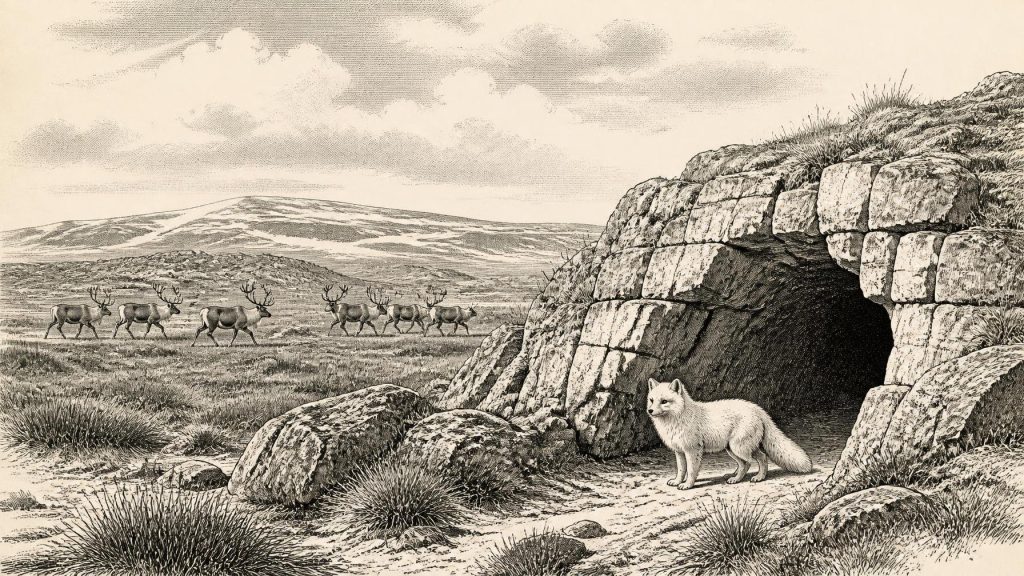
The most evocative Irish evidence for the period comes from limestone caves, especially Castlepook Cave near Doneraile in north County Cork. Cave deposits have yielded remains attributed to animals including brown bear, reindeer, giant deer, woolly mammoth, wolf, Arctic fox, lemmings and spotted hyena. Such a list conveys an open, cold and ecologically varied Pleistocene world very different from modern Ireland. It does not mean that every species lived together at Castlepook on one day, or even in one century. Cave assemblages accumulate through time, can be disturbed by water, scavengers, excavation and redeposition, and contain bones brought in by animals as well as bones of animals that died there.
Spotted hyena is particularly important. Castlepook is Ireland’s key record for the animal, and the cave may have been used as a den or scavenging place. Hyenas alter bone assemblages: they drag prey remains into sheltered places, gnaw and break bones, and leave deposits that are not a straightforward census of the surrounding countryside. Their presence nevertheless shows that Ireland was connected ecologically to the wider north-west European mammal world during parts of MIS 3. The term ‘cave hyena’ is commonly used for Pleistocene spotted hyenas, but its exact taxonomic rank remains debated; the historical point is that a large social carnivore once ranged in southern Ireland.
Recent reassessment has made the chronology more cautious. Improved radiocarbon pretreatment has shown that some older Irish cave-bone determinations were unreliable or misleadingly young. The revised work suggests that giant deer and spotted hyena may have disappeared locally before roughly 40,000 calibrated years before present, well before the Last Glacial Maximum. Consequently, it would be unsafe to state that hyenas, mammoths or giant deer certainly inhabited Cork in 30,190 BCE merely because their remains occur in a broadly MIS 3 cave archive. The correct conclusion is narrower: the Castlepook evidence records a pre-maximum Irish fauna and demonstrates the kinds of animal communities that occurred in the wider period.
Climate, Vegetation and Animal Life
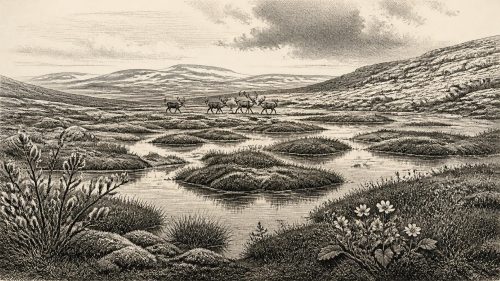
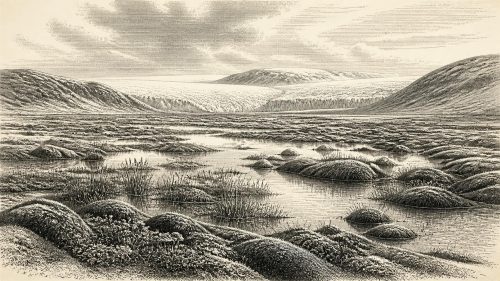
Where land was not ice-covered, the likely environment was largely treeless or sparsely wooded cold-steppe and tundra mosaic, shaped by severe winters, short growing seasons, wind and fluctuating moisture. Open ground could support grasses, sedges, herbs, dwarf shrubs and patches of moss. Local habitats would have differed sharply. Sheltered hollows, river margins, cave entrances and south-facing slopes could retain more vegetation than exposed high ground or freshly disturbed glacial terrain. Evidence from plants, insects and small mammals in Irish Pleistocene deposits confirms that cold-adapted conditions repeatedly occurred, but it does not justify a precise vegetation map for this date.
Large herbivores and carnivores were part of a food web rather than symbols of a fixed ‘Ice Age menagerie’. Reindeer and mountain hare fit cold, open landscapes; Arctic fox and lemmings likewise point towards severe conditions. Brown bears, wolves, giant deer and mammoths had differing ecological tolerances and histories. Their fossils mark the changing possibilities for animal movement into, through and out of Ireland as climate, sea level, vegetation and ice barriers altered. Their disappearance from a local cave sequence might mean extinction, migration, changed use of the cave or simply the incompleteness of preservation.
Sea level was far lower globally than today because water was stored in northern ice sheets, but coastlines and routes were not stable. The Irish Sea basin, glaciers and changing relative sea level complicate any simple claim that people or animals could always walk from Britain to Ireland. For the later Late Glacial, Ireland seems to have remained an island while Britain was connected to continental Europe. For this earlier interval, precise routes varied and remain a specialist geological question. The prudent observation is that faunal links imply periodic connectivity or dispersal opportunities, not an assured, permanent land bridge.
No Demonstrable Human Community
There is no accepted evidence for a human settlement, camp, burial, tool-making site or person in Ireland at 30,190 BCE. This absence must be stated plainly. It cannot prove that no person ever reached the island during MIS 3: Pleistocene sites are rare, later ice destroyed or buried many deposits, and low sea levels placed possible coastal landscapes beyond today’s shoreline. But archaeology cannot convert possibility into population history.
Nor should stone marks reported on individual animal bones be treated casually as proof. A marked reindeer femur from Castlepook has been discussed as potentially cut with a sharp stone tool, but taphonomy is difficult: carnivore damage, trampling, sediment movement, excavation damage and natural fractures can imitate or obscure human modification. The earliest published evidence widely accepted as human activity in Ireland is far later: cut marks on a brown-bear patella from Alice and Gwendoline Cave, County Clare, directly dated to about 12,810–12,590 calibrated years before present. That discovery is remarkable precisely because it does not establish a human presence thirty millennia earlier.
The social categories expected of a historical year therefore have no secure content here. There were no known Irish polities, rulers, diplomatic relationships, wars, named communities, religious institutions, monuments, languages or systems of learning. There is no evidence for houses, hearths, clothing, hunting parties, exchange networks or ritual practice on the island at this date. It would be misleading to supply an imagined hunter-gatherer society merely because Upper Palaeolithic people elsewhere in Europe made sophisticated tools, art and ornaments. Continental evidence provides context for what humans were capable of; it is not evidence that those activities occurred in Ireland.
Economy, Settlement and Regional Change
Insofar as an ‘economy’ can be described, it was ecological rather than human: plants converted the brief growing season into browse and forage; herbivores moved through suitable terrain; carnivores hunted or scavenged; caves served intermittently as dens, traps, shelters or bone repositories. This was not yet the agricultural Ireland of fields, livestock and enclosed land, nor even the later Mesolithic Ireland of documented hunter-gatherer camps. Any material exchange was animal dispersal across changing landscapes, not demonstrable human trade.
Regional change was the central development. In Cork’s karst country, caves such as Castlepook preserved fragments of animal life because limestone cavities could shelter bones from some surface erosion. Elsewhere, advancing and later retreating ice erased, reworked or sealed evidence. In western, northern and eastern seas, offshore landforms and sediments now help reconstruct ice streams that were then transforming the margins of the land. Inland, later drumlinisation and till deposition would make the geological past visible in rolling ground long after the animals and ice had gone.
For Ireland around 30,190 BCE, then, the most important history is not human political drama but environmental threshold. The island was part of a northern European world of cold-climate fauna and rapidly changing ice. Cave deposits in Cork offer a precious but time-averaged glimpse of that world; glacial geology shows that a more extensive ice-sheet phase was approaching; and the silence of the archaeological record sets firm limits on claims about people. This combination of evidence and restraint is the closest responsible account of Ireland at so remote a point in time.
Primary Sources
- Growth and Retreat of the Last British–Irish Ice Sheet, 31,000 to 15,000 Years Ago: The BRITICE-CHRONO Reconstruction
- Growth and Retreat of the Last British–Irish Ice Sheet, 31,000 to 15,000 Years Ago: The BRITICE-CHRONO Reconstruction (PDF)
- Radiocarbon Constraints on the History of the Western Irish Ice Sheet Prior to the Last Glacial Maximum
- The Quaternary Geology of Ireland
- Last Glacial Maximum Cirque Glaciation in Ireland and Implications for Reconstructions of the Irish Ice Sheet
- Dimensions and Chronology of the Last Ice Sheet in Western Ireland
- Trimlines, Blockfields and the Vertical Extent of the Last Ice Sheet in Southern Ireland
- Radiocarbon Constraints on the Age of the Maximum Advance of the British–Irish Ice Sheet in the Celtic Sea
- Stratigraphic and Palaeo-Geomorphological Evidence for the Glacial-Deglacial History of the Last British-Irish Ice Sheet in the North-Western Irish Sea
- Early Deglaciation of the British-Irish Ice Sheet on the Atlantic Shelf Northwest of Ireland Driven by Glacioisostatic Depression and High Relative Sea Level
- Timing and Pace of Ice-Sheet Withdrawal Across the Marine–Terrestrial Transition West of Ireland During the Last Glaciation
- Deglaciation Chronology of the Donegal Ice Centre, North-West Ireland
- A Reconsideration of the Radiocarbon Dating of the Marine Isotope Stage 3 Fauna from Southern Ireland
- New Insights on the Fauna of Ireland’s Younger Dryas and Early Holocene from Alice & Gwendoline Cave
- New Insights on the Fauna of Ireland’s Younger Dryas and Early Holocene from Alice & Gwendoline Cave (PDF)
- First Evidence of a Late Upper Palaeolithic Human Presence in Ireland
- Prehistoric Details: Mell Flint Flake
- The Mesolithic in Ireland: When Was It?
- The Archaeological Heritage of County Cork
- Ireland Under the Ice
- The Irish Quaternary Fauna Project
- Archaeological Excavations at Killuragh Cave, Co. Limerick
- Grey Wolf Genomic History Reveals a Dual Ancestry of Dogs