Derryvree’s Sedgewater World30333 BCE
Around 30,333 BCE, Ireland’s evidence belongs to the climatically unstable Marine Isotope Stage 3, not a recoverable historical year. At Derryvree, County Fermanagh, freshwater organic sediments between glacial tills indicate a local ice-free interval within a cold, open, wetland landscape of sedges, mosses, shallow water, low shrubs and insects. Radiocarbon calibration places this deposit broadly between about 34,950 and 29,750 BCE. Castlepook Cave, County Cork, preserves Middle Devensian fauna, including mammoth, reindeer, giant deer, predators and small cold-adapted mammals. A possibly cut-marked reindeer bone suggests human presence, but cannot prove settlement. No camps, tools, hearths or social institutions are known.
Dateline
30,333 BCE is a modern chronological label, not a year that can be recovered from the Irish archaeological record. No calendar, writing system, dated event or named community survives from this point in the Late Pleistocene. In calendar terms it lies roughly 32,300 years before AD 1950, but neither radiocarbon dating nor environmental evidence can identify a particular season, generation or incident in Ireland. The responsible approach is therefore to place it within broader, calibrated ranges and to distinguish physical evidence from the interpretations built upon it.
A Date Within a Wide Window
This was part of Marine Isotope Stage 3, a volatile middle phase of the last Ice Age, when northern climates repeatedly swung between comparatively milder interstadials and severe stadials. Greenland ice-core records demonstrate that these shifts could be abrupt on geological timescales, but an ice-core climate signal is not a diary of Irish weather. Ireland’s own record is much thinner, repeatedly disturbed by advancing ice and by later erosion. The numbered date 30,333 BCE should therefore be understood as a point within a long interval of environmental change, rather than as a historical moment.
The nearest especially valuable Irish archive is Derryvree townland, about 2 km north-east of Maguiresbridge in County Fermanagh. Roadworks in 1969 cut through a drumlin and exposed a remarkable sequence: an older glacial till below, organic-rich freshwater silts and fine sands in the middle, and a later till above. Till is the unsorted debris deposited directly by glacier ice. The ordering is decisive evidence that local ice first occupied the site, that an interval without ice at that spot allowed freshwater sediment and organic remains to accumulate, and that a renewed ice advance later buried the deposit.
Organic material from the Derryvree freshwater series produced a conventional radiocarbon age of 30,500 +1,170/−1,030 radiocarbon years BP. Such a result is not identical to a calendar date: atmospheric radiocarbon has varied through time and ages must be calibrated. Treatments using modern calibration curves place the relevant horizon broadly within about 36,900–31,700 calibrated years BP, or approximately 34,950–29,750 BCE. That wide span encompasses 30,333 BCE, but it does not demonstrate that every fossil in the deposit, still less every part of Ireland, belonged to that precise numbered year.
Fresh Water Between the Tills
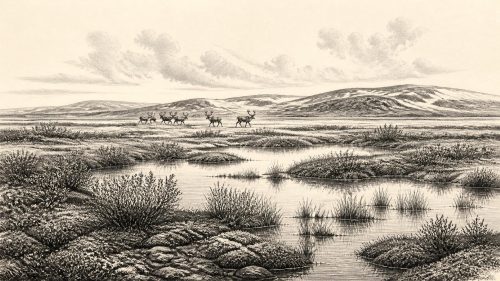
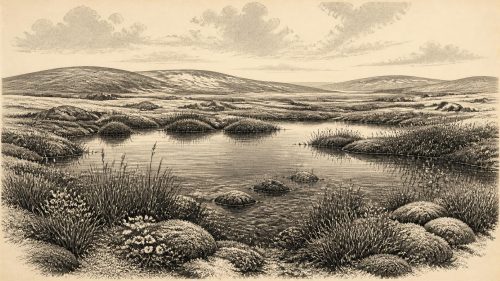
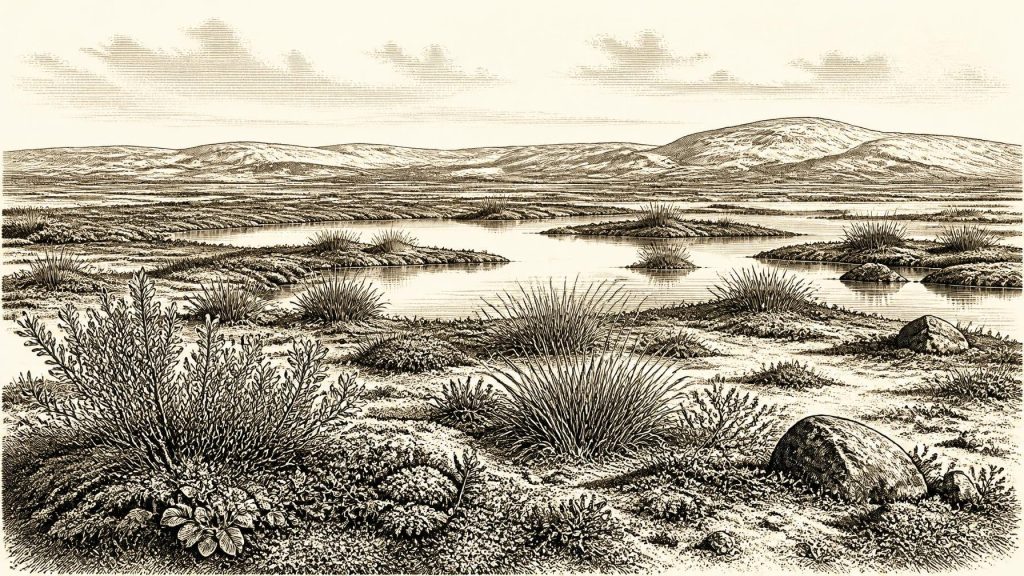
Derryvree offers unusually direct evidence for a functioning local ecosystem. The silts contained freshwater mosses, sedges, grass and herb pollen, plant macrofossils and an insect fauna with a cold northern character. Identified or reported plant evidence includes bogbean, water-milfoil, dwarf willow, mountain-avens and lesser clubmoss. Bogbean and water-milfoil are particularly useful indicators: they point to shallow or slow-moving fresh water and waterlogged margins, not merely to wind-blown vegetation deposited on bare ground.
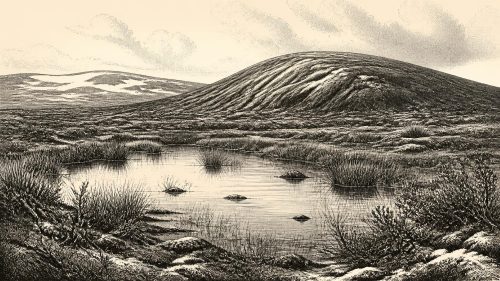
The strongest interpretation is of a cold, open, largely treeless wetland mosaic. There were probably shallow pools, mossy and sedge-rich edges, damp mineral ground, low shrubs and herbaceous vegetation, with frost action shaping more exposed surfaces nearby. Summers could still sustain liquid water, plants and insects; the scene should not be imagined as an unbroken white desert. Yet neither was it a familiar Irish bog, wooded lake shore or meadow. The evidence is for a periglacial landscape with short growing seasons and harsh winters.
Its limits matter. Pollen preservation was poor, and a small basin cannot map the whole island. Derryvree proves that such an environment existed locally during the represented interval. It does not establish annual temperatures, the exact extent of woodland-free ground, or an island-wide vegetation map for 30,333 BCE. The plant and insect record is evidence; the reconstruction of a tundra-like wetland is a careful ecological interpretation of that evidence.
Ice, Ground and Changing Coasts
The two tills enclosing Derryvree’s organic beds are a warning against any simple picture of a permanently frozen or permanently ice-free Ireland. The island’s glacial history involved multiple advances and retreats, whose detailed timing and extent remain debated because later ice could scour away earlier deposits. Derryvree records a local non-glacial interval, not a claim that all Ireland stood free of ice. The later growth of the British–Irish Ice Sheet would cover substantial areas during the Last Glacial Maximum, many millennia after the freshwater deposit formed.
Sea levels during Marine Isotope Stage 3 were generally far lower than today because much water was held in continental ice. Coastlines and the Irish Sea basin consequently differed greatly from their modern form. But lower seas do not automatically demonstrate a continuous dry route, a particular migration corridor or a settled human population in Ireland. Ice margins, sea crossings, exposed ground and changing habitats all affected movement. The fossil record can show that animals reached Ireland; it cannot reconstruct every route or every season of their arrival.
The Castlepook Fauna
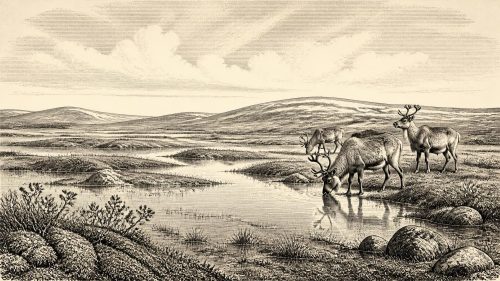
County Cork provides the other major Irish window on this broad period. Castlepook Cave, near Doneraile and often called Mammoth Cave, yielded a striking Pleistocene fauna during antiquarian and early twentieth-century excavations. The assemblage includes woolly mammoth, reindeer, giant deer, spotted hyaena, wolf, foxes, Arctic fox, mountain hare and lemmings. A mammoth bone has produced a Middle Devensian radiocarbon age, and subsequent redating has shown that some specimens are considerably older than earlier measurements suggested.
These animals make ecological sense beside the Fermanagh wetland evidence. Reindeer, hares and lemmings are compatible with open cold-country habitats; mammoths and giant deer indicate larger grazing opportunities; wolves and hyaenas belong to a food web containing predators, scavengers and large herbivores. But Castlepook is not a single frozen tableau. Cave deposits accumulated over long periods, were affected by carnivores and water, and were excavated before modern stratigraphic standards. The fauna demonstrates repeated animal presence during the wider Late Pleistocene, not that every listed species lived together beside the cave in 30,333 BCE.
The Human Question
Castlepook also supplies the most provocative, but still limited, possible human trace. A reindeer femur from the historic collection has been reported as about 33,000 years old and bears a deep linear mark interpreted as having been made by a sharp stone tool during butchery. If that assessment is confirmed, it would show that a person handled a fresh reindeer carcass in Ireland during the Upper Palaeolithic, vastly earlier than the island’s better-established terminal-Pleistocene and Mesolithic evidence.
The claim must remain narrow. The dated bone is not part of a securely excavated domestic floor with associated tools, hearths, structures or human remains. Dating establishes the age of the animal bone, while identifying a surface modification as a human cut mark is a separate taphonomic judgement. Nor does one possible butchered bone prove permanent occupation, a resident population or uninterrupted settlement. At most, it supports the possibility of a brief visit or an episode of carcass processing within a landscape used chiefly by wild animals.
No Politics, No Trade, No Named People
There is no evidence from Ireland around this date for political institutions, leaders, territories, diplomacy, warfare, ethnic identities or languages. It would be misleading to turn encounters between hyaenas, wolves and prey animals into ‘conflict’ in a human historical sense. Likewise, there is no evidence for farming, managed livestock, pottery, metalwork, markets, exchange networks or trade. Mammoth, reindeer and other species demonstrate faunal dispersal and ecological connectivity, not commerce.
Religion, formal learning and artistic traditions are equally beyond recovery here. No Irish ritual place, burial, image, inscription or securely associated artefact of this age has been identified. If people did reach Castlepook, they would necessarily have possessed knowledge and practical skill: recognising an animal carcass, using a sharp implement and surviving in a demanding seasonal environment. Yet the Irish evidence cannot reveal their beliefs, social organisation, oral traditions, kinship, clothing, language or cultural affiliation. Those are possibilities, not recoverable facts.
Settlement as a Possibility, Not a Fact
There is no known dwelling, camp surface, hearth, midden or stone-tool assemblage in Ireland that can securely be placed at 30,333 BCE. The Derryvree evidence concerns environment, not settlement. Castlepook is a cave with an important but mixed faunal record, not a demonstrated Palaeolithic village. The absence of evidence is partly meaningful and partly geological: later glaciation, erosion, acidic soils and old excavation practices have all reduced the chance that fragile traces survived. Still, lost evidence must not be invented to fill the gap.
Ireland at this point is best approached through a buried Fermanagh wetland and a Cork cave fauna. Together they reveal an Ice Age island or near-island landscape of local fresh water, sedges, mosses, low vegetation, large grazers and formidable carnivores, with ice repeatedly remaking the terrain. They also leave open, but do not settle, the question of early human visits. That uncertainty is not a failure of the record. It is the central historical fact of Ireland around 30,333 BCE.
Primary Sources
- Middle Midlandian Interstadial Deposits at Greenagho, Near Belcoo, County Fermanagh, Northern Ireland
- Palaeoecology: The Middle Midlandian palaeoenvironment of south Fermanagh
- The Irish Quaternary Fauna Project
- A Reconsideration of the Radiocarbon Dating of the Marine Isotope Stage 3 Fauna from Southern Ireland
- New Insights on the Fauna of Ireland’s Younger Dryas
- Pleistocene Vertebrates in the British Isles
- Irish Pleistocene Biostratigraphy
- Radiocarbon Constraints on the Age of the Maximum Advance of the British–Irish Ice Sheet in the Celtic Sea
- Late Pleistocene Chronostratigraphy and Ice Sheet Limits, Southern Ireland
- Pattern and Timing of Retreat of the Last British–Irish Ice Sheet
- Growth and Retreat of the Last British–Irish Ice Sheet, 31,000 to 15,000 Years Ago: the BRITICE-CHRONO Reconstruction
- A Stratigraphic Framework for Abrupt Climatic Changes During the Last Glacial Period Based on Three Synchronized Greenland Ice-Core Records
- The IntCal20 Northern Hemisphere Radiocarbon Age Calibration Curve (0–55 cal kBP)
- IntCal: International Radiocarbon Calibration
- Dansgaard–Oeschger Events in Climate Models: Review and Baseline Marine Isotope Stage 3 Protocol
- The Marine δ18O Record Overestimates Continental Ice Volume During Marine Isotope Stage 3
- Menyanthes trifoliata L. (Bogbean): Fossil Record in Fermanagh
- Salix herbacea L. (Dwarf Willow): Fossil Record in Fermanagh
- Selaginella selaginoides (Lesser Clubmoss): Fossil Record in Fermanagh
- Our Ancient Landscapes: Hunter-Gatherers in Ireland
- The Colonization of Ireland: A Human Ecology Perspective
- Heritage Artefacts of County Cork