
Derryvree’s Alpine Sandwort30620 BCE
The label 30,620 BCE denotes a broad, uncertain Late Pleistocene interval within Marine Isotope Stage 3, rather than a recoverable Irish year. At Derryvree, County Fermanagh, freshwater sediments between glacial tills, radiocarbon dated broadly to 36,900–31,700 calibrated years ago, record an ice-free, severe tundra wetland with aquatic plants, sedges, mosses, insects and alpine flora. Castlepook Cave, County Cork, preserves remains of mammoth, reindeer, giant deer and predators, but accumulated over changing periods. A cut-marked reindeer bone may indicate brief human activity, although no occupation evidence exists. Ireland was a climatically volatile, locally habitable landscape repeatedly vulnerable to renewed ice advance.
Dateline
30,620 BCE is a modern label for a point roughly 32,570 years before AD 1950, not a year that can be recovered from the Irish archaeological record. There were no written calendars, named communities or annual chronicles in Ireland. Even radiocarbon dating cannot achieve that degree of precision at this depth of time: it produces probability ranges, then requires calibration against changing atmospheric carbon-14. The responsible subject is therefore Ireland during a broad Late Pleistocene interval, not an event in a single year.
The date lies within Marine Isotope Stage 3, a long and climatically unstable part of the last glacial cycle. Ireland’s evidence for it is unusually fragmentary because later glacier advances eroded, disturbed or buried earlier landscapes. Yet two very different archives make the period visible: freshwater sediments sealed beneath a drumlin at Derryvree, near Maguiresbridge in County Fermanagh, and animal remains from Castlepook Cave near Doneraile in north County Cork. They do not describe one day or one society. Together, they reveal a cold island of open ground, pools, grazing animals and powerful carnivores, with only a tentative indication that people may have briefly entered it.
A Date Within a Range
The closest important Irish environmental sequence is the Middle Midlandian deposit at Derryvree. Road works in 1969 cut through a drumlin and exposed a striking order of deposits: a lower layer of glacial till, freshwater silts and fine sands containing organic material, and a second thick till above. Till is the unsorted debris left directly by glacier ice. The sequence shows, beyond reasonable doubt, that ice had occupied the locality; that an interval followed in which water, plants and sediments accumulated; and that later ice again covered and sealed the site.
Organic material from the freshwater bed produced the conventional radiocarbon determination BIRM-166, 30,500 radiocarbon years before present, with a substantial uncertainty of plus 1,170 and minus 1,030 years. A radiocarbon age is not a calendar date. Modern calibration curves are built from independently dated environmental records and show why a single laboratory number must not be converted mechanically into a BCE year. Published discussion places Derryvree broadly within about 36,900–31,700 calibrated years before present, or approximately 34,950–29,750 BCE. The nominal year 30,620 BCE falls inside that wide window, but cannot be assigned to a particular sediment layer, season, animal or human action.
This is more than a technical caution. Derryvree represents one locality in south Fermanagh, not a complete map of Ireland. Its deposits demonstrate that this place was ice-free while a freshwater wetland formed. They do not prove that all parts of the island were simultaneously free of ice, equally cold, or occupied by the same plants and animals. Nor should an older term such as ‘interstadial’ be read as meaning mild by modern standards. The evidence indicates a severe, periglacial world with local variation in moisture, vegetation and ice cover.
Freshwater Beneath the Ice
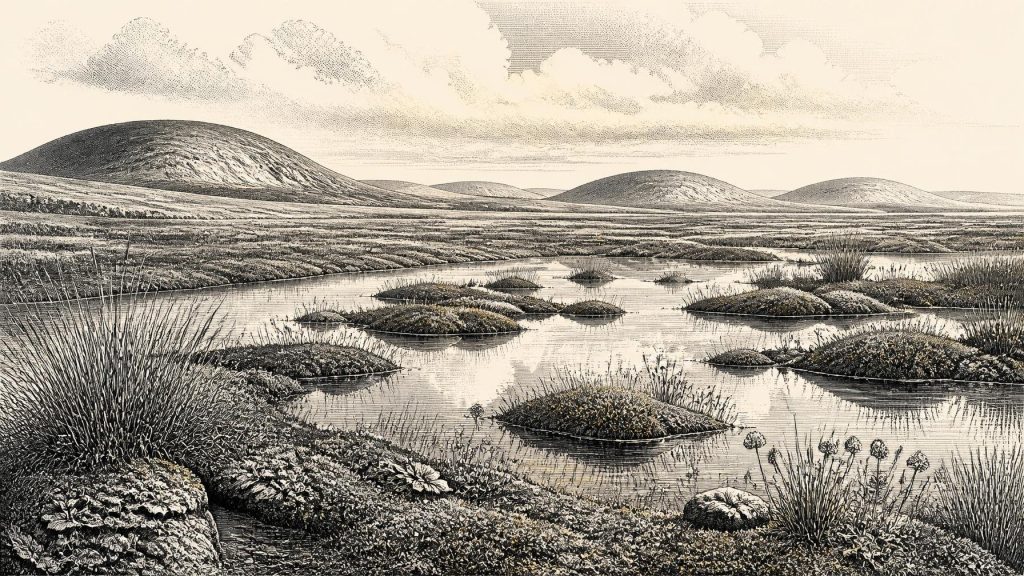
The Derryvree plant and animal evidence gives the clearest picture of the local environment. The pollen was poorly preserved, but the organic beds also contained identifiable plant macrofossils, mosses and insect remains. Their combined signal is of treeless, open tundra or tundra-like wetland. Sedges, grasses, hardy herbs and low shrubs could exploit exposed ground; mossy, waterlogged areas lay around pools and slow-moving freshwater. Finds include bogbean (Menyanthes trifoliata), an aquatic wetland plant, and Arctic-alpine taxa such as mountain-avens and alpine sandwort. Water-milfoil indicates standing or gently moving freshwater.
These remains complicate any simple image of an Irish wilderness locked permanently under ice. Even in a cold stage, a shallow basin could support aquatic plants, shore vegetation and insects. Summer warmth, however short, mattered. It allowed growth, feeding and reproduction; winter frost and wind limited trees and exposed soils. The best interpretation is a patchwork rather than a uniform plain: wet hollows and pools, sedge-rich margins, thinly vegetated mineral ground, perhaps dwarf willow in sheltered places, and more barren terrain nearby.
The wider climate of Marine Isotope Stage 3 was volatile on millennial scales. Greenland ice-core records show repeated abrupt shifts between colder stadials and relatively warmer interstadials. Ireland stood at the Atlantic edge of this system. Its local response was shaped by sea, topography and ice-sheet behaviour, so it would be unwise to match one Fermanagh deposit exactly to a named Greenland fluctuation. Still, the Derryvree sequence preserves the essential fact: ecological opportunity could exist between glacial episodes, only to be overwhelmed or buried when ice conditions changed again.
Animals and Cave Archives
Castlepook Cave, sometimes called Mammoth Cave, provides a complementary but less neatly dated archive. Excavations and later reassessments have identified remains of woolly mammoth, reindeer, giant deer, brown bear, wolf, Arctic fox, mountain hare, stoat, lemmings and spotted hyaena. This is powerful evidence that Ice-Age Ireland could at different times sustain, or receive, a fauna far richer and more continental than that of the modern island. Large herbivores imply extensive grazing; wolves and hyaenas imply predation and scavenging; small cold-adapted mammals reinforce the picture of open northern environments.
It would nevertheless be wrong to gather all these species into one illustrated herd for 30,620 BCE. Cave deposits commonly accumulate over long periods. Carnivores drag in prey; animals die naturally; water and sediment shift bones; nineteenth- and early twentieth-century excavations did not record contexts to modern standards. Radiocarbon dates from Castlepook also span different phases. The cave is evidence for a changing Pleistocene faunal history, rather than a precisely dated census of one valley or one generation.
Its mammals illuminate everyday ecological relationships rather than human politics. Reindeer were adapted to open, cold country and may have moved seasonally across broad grazing ranges. Mammoths and giant deer required substantial plant resources, but their presence does not establish that their ranges overlapped continuously or that any one species was common. Spotted hyaenas may have used caves as dens or feeding places, which helps explain why cave bone collections cannot automatically be treated as human rubbish deposits. In this environment, shelter, water, carrion and grazing patches would have been contested resources among animals.
The Human Question
The most provocative evidence near this broad period is a reindeer femur from Castlepook reported to carry a deep incision consistent with cutting or chopping by a sharp stone tool. Public accounts have associated the specimen with an age of about 33,000 years ago and suggested that it may push evidence for human activity in Ireland dramatically earlier than the formerly accepted terminal-Pleistocene record. If the mark was made by a person on a fresh carcass, it would demonstrate at least one episode of animal processing by Upper Palaeolithic visitors.
That conclusion must remain narrow. The bone is not a securely excavated occupation floor. It has no firmly associated hearth, stone-tool assemblage, built shelter, burial, artwork or human skeletal remains. A date on an animal bone does not, by itself, date the instant at which a cut was made. Nor can one marked specimen establish a permanent settlement, a population size, an ethnic identity, a migration route, or continuous descent to later inhabitants of Ireland. The sound formulation is that Castlepook offers an important, still limited claim for early human presence; it does not supply a foundation story for an Irish people.
If people did reach Ireland in this interval, comparison with documented Upper Palaeolithic communities elsewhere in north-west Europe suggests that they would have travelled in small, mobile groups and relied on detailed knowledge of animals, weather and seasonal terrain. That is an inference from neighbouring evidence, not a fact demonstrated at Derryvree or Castlepook. No responsible reconstruction can specify their language, beliefs, kinship arrangements, political leadership, trade networks or rituals. There is no evidence for agriculture, livestock keeping, villages, monuments, metalwork, formal diplomacy or organised warfare in Ireland at this date.
An Island Before History
Political affairs, diplomacy and cultural institutions therefore leave no archaeological trace for 30,620 BCE. The most meaningful ‘regional change’ was environmental: the shifting relationship of ice, water, vegetation and animal movement. Sea level was much lower during glacial times than today, changing coastlines and the geography of surrounding shelves, but the precise routes available to any possible visitors at this particular point remain uncertain. Ireland’s position at the western edge of Europe made access highly contingent on climate, terrain and sea crossings or exposed land connections that changed through time.
Derryvree is the central witness because it records life in the interval between two ice-laid deposits. Its mosses, aquatic plants, insects and hardy herbs preserve an ecological world that later glacier action nearly erased. Castlepook broadens the picture with large mammals and carnivores, while also posing an unresolved question about people. Around 30,620 BCE, then, Ireland cannot be given an annual historical narrative. It can be understood as a cold, dynamic Late Pleistocene landscape: locally watered and vegetated, inhabited by specialised fauna, vulnerable to renewed ice, and perhaps visited by humans whose presence remains far less securely documented than the wetland and the bones.
Primary Sources
- A Middle Midlandian Freshwater Series at Derryvree, Maguiresbridge, County Fermanagh, Northern Ireland
- Palaeoecology
- Figure 6.— The Subdivision of the Quaternary Period in Ireland
- The Irish Quaternary Fauna Project
- New Insights on the Fauna of Ireland’s Younger Dryas and the Transition to the Holocene
- Irish Pleistocene Biostratigraphy
- The Timing and Magnitude of the British–Irish Ice Sheet Between Marine Isotope Stages 5d and 2
- Exploring Controls of the Early and Stepped Deglaciation on the Western Margin of the British Irish Ice Sheet
- Trimlines, Blockfields and the Vertical Extent of the Last Ice Sheet in Southern Ireland
- Timing and Pace of Ice-Sheet Withdrawal Across the Marine–Terrestrial Transition West of Ireland During the Last Glaciation
- Pattern and Timing of Retreat of the Last British–Irish Ice Sheet
- The Last Glacial Maximum
- The IntCal20 Northern Hemisphere Radiocarbon Age Calibration Curve (0–55 cal kBP)
- IntCal Publications
- Marine20—The Marine Radiocarbon Age Calibration Curve (0–55,000 cal BP)
- Fast and Slow Components of Interstadial Warming in the North Atlantic During the Last Glacial
- Rapid Global Ocean-Atmosphere Response to Southern Ocean Freshening During the Last Glacial
- The Nature of MIS 3 Stadial–Interstadial Transitions in Europe: New Insights From Model–Data Comparisons
- Menyanthes trifoliata L.
- Introduction to the Glacial Sand and Gravel Landscapes of Northern Ireland
- Reindeer Bone Found in Cork Cave Shows Human Activity in Ireland 33,000 Years Ago
- What Was on the Menu in Prehistoric Ireland?