Colhoun’s Derryvree Section30495 BCE
30,495 BCE is a modern label within a broad calibrated age range, not a recoverable Irish year. At Derryvree, County Fermanagh, freshwater sediments between two glacial tills record an ice-free wetland during Marine Isotope Stage 3. Plant and insect remains indicate treeless, cold, productive terrain of pools, sedges, mosses and frost-disturbed ground. Castlepook Cave, County Cork, preserves evidence of changing Ice Age faunas, including mammoth, giant deer, reindeer, hyaena and cold-adapted mammals, but not a single scene. Human presence remains unproven, despite a possible butchered reindeer bone. The period is known as an environmentally variable, intermittently connected Ice Age landscape.

Dateline
The label 30,495 BCE is a modern chronological convenience, not a year that can be recovered from an Irish annal, settlement sequence or dated event. At this depth in time, modern calendar-year precision is unavailable. In simple calendar arithmetic it lies roughly 32,444 years before AD 1950, but archaeological evidence must be expressed as broad radiocarbon and calibrated ranges. The closest major Irish environmental record is the Derryvree freshwater deposit near Maguiresbridge, County Fermanagh: its conventional radiocarbon determination, BIRM-166, was reported as 30,500 radiocarbon years before present, with an uncertainty of about a millennium. Modern calibration places its age broadly around 36,900–31,700 calibrated years before present, approximately 34,950–29,750 BCE. The nominated year falls within that wide interval, but cannot be attached to a particular season, generation or occurrence.
What follows is therefore not a narrative of rulers, wars or a named Irish community. It is a reconstruction of Late Pleistocene Ireland during Marine Isotope Stage 3, a climatically unstable part of the last Ice Age. Its strongest evidence consists of buried sediments, fossil plants and insects, animal bones, cave deposits and laboratory dating. These sources provide an unusually vivid environmental history, while also imposing firm limits on what can be claimed about people.
Fresh Water Between the Tills
Derryvree is the central witness. Road works in 1969 cut through a drumlin about two kilometres north-east of Maguiresbridge and revealed an exceptional sequence. A lower sheet of till — unsorted debris laid down by glacier ice — was overlain by freshwater silts, fine sands and organic layers; another thick till sheet capped the sequence. The relative history is secure. Ice had previously crossed the site. There followed an interval in which water, sediment, plants and small animals occupied a hollow in the landscape. Ice later returned and sealed that evidence beneath its debris.
This does not prove that all Ireland was ice-free at once. Derryvree is a local record from south Fermanagh, and the island’s terrain, coasts and glaciers changed unevenly. Yet it decisively corrects the idea of an entirely sterile Irish Ice Age. During the interval represented by the freshwater beds, a low-lying basin supported standing or slow-moving water, wet margins and enough seasonal productivity for a distinctive cold-climate flora and fauna. The later advance that created the overlying till was destructive elsewhere, but at Derryvree it also preserved the earlier wetland as a geological time capsule.
A Treeless Wetland Landscape
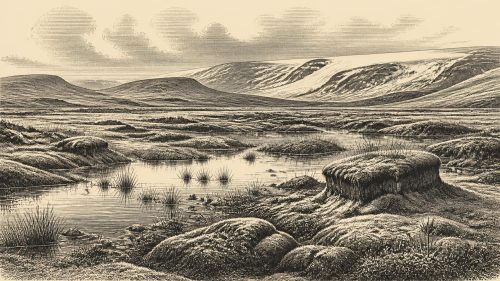
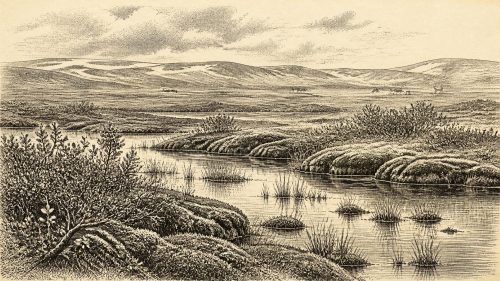
The organic deposits contain poorly preserved pollen, plant macrofossils, mosses and insect remains. Their combined testimony is stronger than any single specimen. Herbaceous pollen and macrofossils indicate open vegetation rather than forest. Fossil mosses, grasses, sedges and herbs describe wet or damp ground; the recorded remains of bogbean, water-milfoil, mountain avens, dwarf willow and lesser clubmoss show that shallow fresh water, saturated margins and cold-tolerant land vegetation existed close together. A few pollen grains of tree taxa are not evidence for woodland: they may have travelled far, and the original investigators judged dry-land vegetation to have been sparse.
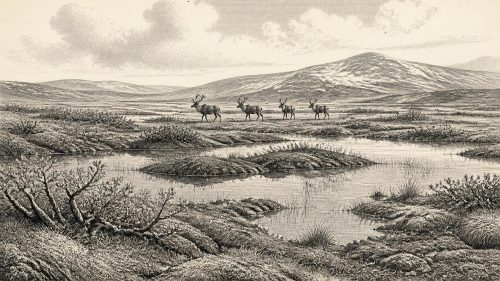
Terms such as tundra, periglacial and muskeg-like are useful shorthand, provided they are not mistaken for a precise modern analogue. The Derryvree evidence supports an open, largely treeless mosaic of pools, sedge-rich edges, mossy ground and exposed, frost-affected surfaces. Winters were severe; seasonal freezing and thaw would have disturbed soils and altered drainage. In warmer months, however, freshwater plants and low vegetation could flourish in protected hollows. The important historical point is contrast: a landscape could be cold enough to inhibit woodland and still contain water, plant cover, insects and grazing opportunities.
This was not yet the Last Glacial Maximum, the coldest and most extensive later phase of the last glaciation. Around the broad period represented at Derryvree, Irish environments could shift markedly between ice advance, local ice-free conditions and renewed glaciation. The dated freshwater bed therefore records an interval in a changing Ice Age, not a stable “Irish climate” or a timeless frozen wilderness.
Animals and Changing Connections
For larger animals, Castlepook Cave near Doneraile in north County Cork is indispensable. Also known as Mammoth Cave, it is Ireland’s richest cave archive for vertebrate life leading towards the Last Glacial Maximum. Excavations between 1904 and 1918 recovered more than 2,000 bones from galleries with evocative later names such as Hyenahall and Elephant Hall. The assemblage includes woolly mammoth, giant deer, reindeer, brown bear and spotted hyaena, with Arctic fox, wolf, Norwegian lemming and collared lemming among the later cold-stage fauna.
Those animals show that Ireland was intermittently connected ecologically to wider north-west European populations during the Ice Age. Mammals capable of living in open, cold landscapes reached the island, and predators as well as herbivores were present. They also show that the Ireland of this period was biologically very different from the later wooded island familiar to Mesolithic foragers, farmers and historic communities. Reindeer and mammoth evoke grass- and herb-rich open country; lemmings and Arctic fox signal cold conditions; hyaenas and wolves indicate food webs that included large carrion and prey.
But Castlepook cannot furnish a single illustrated scene for 30,495 BCE. Cave bones accumulated over a very long time, were moved by water and animal activity, and were excavated before modern standards of stratigraphic recording. Improved radiocarbon pretreatment has also shown that a number of older Irish cave dates were too young. Re-dating at Castlepook produced ages thousands of radiocarbon years older than earlier results and suggests that giant deer and spotted hyaena may have disappeared locally before the Last Glacial Maximum, around 40,000 calibrated years ago. Thus the assemblage demonstrates a sequence of Ice Age faunas, not a guarantee that mammoth, hyaena, reindeer and every other listed species occupied Cork together in this particular notional year.
The Human Question
There is no securely excavated dwelling, hearth, tool assemblage, grave, artwork or human bone that establishes a resident human population in Ireland around this date. Accordingly, there can be no responsible account of Irish political affairs, diplomacy, institutions, language, ritual practice or organised conflict. Nor is there evidence for a settled economy, trade network or permanent village. Such absences are especially important because later glacier action erased or buried large areas of the old landscape, while many surviving cave collections lack precise original contexts.
One intriguing but limited find has made the question less simple. A reindeer femur from Castlepook has been reported as bearing a deep mark interpreted as damage made by a stone tool during carcass processing, and has been publicised as evidence of human activity in Ireland roughly 33,000 years ago. If that interpretation is sustained, it would indicate a brief Upper Palaeolithic human encounter with an animal carcass. It would not demonstrate a permanent settlement, identify a culture, establish a route of arrival or show that people were present in 30,495 BCE itself. The bone’s cave context, the long time-span represented by the deposits and the distinction between the date of an animal bone and the identification of a cut mark all require caution.
At most, the broader European comparison permits a conditional inference: people capable of reaching an Irish cold-stage landscape would have required mobile knowledge of terrain, weather, animal behaviour, stone resources and seasonal risk. That is an inference from hunter-gatherer lifeways elsewhere, not direct evidence of an Irish camp. Nothing presently supports claims for an Irish polity, intergroup diplomacy, formal trade, religious monument or named cultural tradition at Derryvree’s date.
What This Date Means
The most important development illuminated by this nominal year is environmental, not political. Derryvree preserves a moment within a broad calibrated window when part of Fermanagh contained fresh water and a cold, open wetland between episodes of glaciation. Castlepook demonstrates that, across wider spans of the Late Pleistocene, Ireland supported or received a remarkable large-mammal fauna. Together they reveal an island of pronounced regional variation, rapid climatic vulnerability and intermittent biological connections beyond its shores.
Its human history remains unresolved. That is not a failure of imagination but the proper conclusion of the evidence. Future work on undisturbed cave sediments, refined radiocarbon methods, ancient DNA and carefully recorded excavations may narrow the picture. For now, 30,495 BCE belongs to an Ireland known chiefly through a buried Fermanagh wetland and a Cork cave archive: a country of frost, shallow pools, sparse vegetation and shifting Ice Age animal worlds, rather than of recoverable historical events.
Primary Sources
- A Middle Midlandian Freshwater Series at Derryvree, Maguiresbridge, County Fermanagh, Northern Ireland
- Early Midlandian–Middle Midlandian, Pleistocene, Northern Ireland
- Figure 6.— The Subdivision of the Quaternary Period in Ireland
- A Reconsideration of the Radiocarbon Dating of the Marine Isotope Stage 3 Fauna from Southern Ireland
- The Irish Quaternary Fauna Project
- Castlepook Cave: Cork County Geological Site Report
- Occurrence of Mammalia Relicts at Site Castlepook Cave
- New Insights on the Fauna of Ireland's Younger Dryas and Early Holocene from Alice & Gwendoline Cave
- First Evidence of a Late Upper Palaeolithic Human Presence in Ireland
- The Colonization of Ireland: A Human Ecology Perspective
- The IntCal20 Northern Hemisphere Radiocarbon Age Calibration Curve (0–55 cal kBP)
- IntCal Publications
- IntCal History
- Menyanthes trifoliata
- Dryas octopetala
- Selaginella selaginoides
- Heritage Artefacts of County Cork
- Archaeological Heritage of County Cork
- The Stratigraphic Position and Age of the Gortian
- Proceedings of the Irish Biogeographical Society: Postglacial Colonisation Conference