Derryvree’s Two-Till Witness30422 BCE
Labelled 30,422 BCE, this period in Ireland belongs to climatically unstable Marine Isotope Stage 3 and cannot be reconstructed as a single year. At Derryvree, County Fermanagh, freshwater sediments between two glacial tills record an interstadial landscape of cold, open wetlands supporting arctic-alpine plants and insects before ice returned. Castlepook Cave, County Cork, preserves diverse cold-stage fauna, including reindeer, mammoth, giant deer, predators and lemmings, accumulated across extended periods. A cut-marked reindeer femur may indicate brief human handling, but proves neither settlement nor continuity. No securely contemporary Irish camps, tools, burials or institutions are known; glaciation severely damaged earlier evidence.
Dateline
“30,422 BCE” is a modern chronological label, not a date that can be matched to a recorded Irish event or even to a single securely resolved archaeological season. At this depth in time, modern calendar-year precision is unavailable. The label corresponds roughly to 32,372 years before AD 1950, the conventional reference point for “before present” dating. Ireland then belonged to the Late Pleistocene, within Marine Isotope Stage 3: a long, climatically unstable part of the last Ice Age, preceding the fullest expansion of the British–Irish Ice Sheet.
The responsible history of Ireland at this point is therefore a history of evidence, scale and uncertainty. There are no known Irish houses, hearths, graves, monuments, tool-making floors, fields or named communities which can be assigned to this particular year. Nor is there material evidence for government, diplomacy, organised warfare, religious institutions, formal teaching, farming or regular trade. What survives is more indirect but still remarkable: freshwater sediments caught between glacial deposits in Fermanagh, cave bones from southern Ireland, and the evidence of a landscape repeatedly transformed by ice, water, wind and cold.
An Interval Rather Than a Date
The closest Irish environmental record to this notional date is at Derryvree townland, near Maguiresbridge in County Fermanagh. Roadworks in 1969 cut through a drumlin and exposed a striking sequence. A lower layer of till — unsorted debris deposited by glacier ice — was followed by freshwater silts, fine sands and organic-rich sediments, before a second thick till sealed the deposit. The order of layers is unambiguous: ice had occupied the site; a period without local glacier cover permitted water, plants and animals to leave traces; and ice later returned.
The organic material produced radiocarbon determination BIRM-166, conventionally reported as 30,500 radiocarbon years BP, with a substantial uncertainty. A radiocarbon age is not a calendar age. Atmospheric carbon-14 levels varied through time, and results must be calibrated using independently dated environmental records. Modern calibration places the Derryvree material broadly at about 36,900–31,700 calibrated years BP, approximately 34,950–29,750 BCE. The numbered year 30,422 BCE lies within that wide range, but this does not mean that the wetland can be portrayed as a photograph of Ireland in that year. It is evidence for a regional environmental interval, probably spanning more than one climatic oscillation.
That distinction matters especially because MIS 3 was not a uniformly cold, static age. Greenland ice-core records and Irish cave deposits indicate sharp climatic shifts on millennial scales. A warming episode could enable liquid water, vegetation and biological activity; renewed cold could suppress them rapidly. The Derryvree beds are best understood as a precious local window onto one of these relatively favourable interstadial phases, not as proof that the whole island was ice-free, temperate or continuously habitable.
Fresh Water Beneath the Drumlin
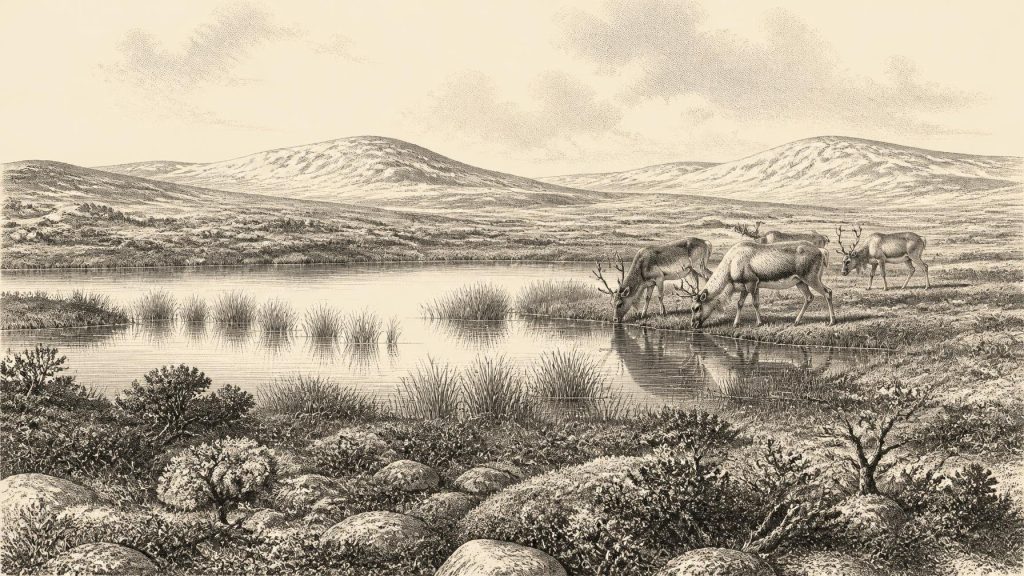
Derryvree’s preserved flora and fauna provide the clearest picture of conditions. Mosses, sedges, grasses, dwarf shrubs and aquatic or waterside plants occurred around shallow fresh water and wet ground. Finds include water-milfoil, bogbean, dwarf willow, mountain avens and other species now associated with cold or arctic-alpine settings. Insects likewise point towards a cold northern environment. These remains demonstrate vegetation, not a forest: this was open country, exposed to severe seasonal weather and shaped by frost, snow cover, short growing seasons and periglacial processes.
Yet “tundra” should not be imagined as featureless emptiness. The freshwater silts indicate ponds, slow water or wet margins where plants could grow, insects could breed and animal life could find forage. In favourable summer weeks, sheltered hollows may have been relatively productive patches within a wider treeless terrain. The contrast between such local wetland abundance and the harsher surrounding ground is central to understanding the landscape. It was not modern Fermanagh, with its settled farms, hedged fields and mature woodland, but nor was it simply an unbroken white wilderness.
The later upper till is equally important. It records the advance or renewed influence of glacier ice after the freshwater phase. Subsequent glaciation did more than alter scenery: it eroded older soils, shifted sediment and obscured or destroyed many surfaces on which people might otherwise have left traces. This helps explain why the Irish record for the earlier Upper Palaeolithic is extraordinarily slight. Absence of camps and tools is not proof that no person ever arrived, but it sets a strict limit on what can honestly be claimed.
Animals of a Changing Island
Cave deposits at Castlepook, near Doneraile in north County Cork, supply a complementary picture of Late Pleistocene animal life. Over a long period, the cave accumulated remains of reindeer, woolly mammoth, giant deer, brown bear, wolf, Arctic fox, spotted hyaena, lemmings and other animals. Radiocarbon dating has shown that some individual bones belong to Marine Isotope Stage 3, though not all came from the same moment and old excavations disturbed parts of the deposits. Castlepook must not be treated as a single-day census or as evidence that every listed species lived side by side in 30,422 BCE.
Nevertheless, the broader conclusion is secure: parts of Ireland supported a much richer cold-stage mammal fauna before the Last Glacial Maximum than later Irish landscapes did. Reindeer imply open feeding grounds; lemmings and Arctic foxes reinforce the impression of severe, treeless conditions. Hyaenas complicate any simple vision of an exclusively Arctic fauna. As carnivores and scavengers, they could carry bones into caves and create accumulations that look superficially like human food debris. Cave assemblages must therefore be read through taphonomy — the study of how remains were deposited, moved, gnawed, broken and preserved.
The animals also illuminate the island’s shifting connections with neighbouring landmasses. Sea level was lower than today, coastlines differed and the continental shelf was more exposed. But low sea level does not automatically establish an easy land bridge from Ireland to Britain or continental Europe. The character, timing and usefulness of possible routes remain debated, especially during earlier glacial phases. Animal presence proves that populations reached Ireland somehow over long spans; it does not tell us the exact route, season or frequency of movement at this particular point.
The Reindeer Femur Question
One object has changed the discussion of possible human presence: a reindeer femur from Castlepook Cave, re-examined by zooarchaeologist Ruth Carden. The bone carries a deep linear mark interpreted as damage from a sharp stone implement during the processing of a fresh carcass. Public heritage accounts place the bone broadly around 33,000 years ago. If the mark is confirmed as anthropogenic and belongs to the same broad episode as the animal’s death, it may be Ireland’s earliest evidence that a person handled animal remains.
Its importance should not be inflated. A radiocarbon date dates the animal bone, not necessarily the exact instant at which the incision was made, the identity of its maker, or the duration of any visit. A single potentially modified bone cannot demonstrate a resident population, a camp at Castlepook, a successful hunt, a regular crossing route or cultural continuity. It is entirely possible that people made a brief exploratory journey, processed a found or hunted carcass, and left no other recoverable trace. No human bone, unequivocal contemporary stone-tool assemblage, hearth, dwelling floor, burial or art has yet been securely published from Ireland for this interval.
That limitation affects everyday life as well. Upper Palaeolithic communities elsewhere in Europe possessed sophisticated technical traditions, social ties and symbolic practices, but those wider facts cannot simply be transferred to Ireland. The Castlepook femur may suggest a moment of butchery; it does not reveal language, kinship, beliefs, clothing, boat use, hunting strategy or the size of a travelling party. The ethical historical choice is to preserve the distinction between a compelling possibility and established evidence.
No Polities, but a Deep Human Context
There were no Irish political affairs in the documentary sense: no chiefs identifiable by name, no territories, treaties, tribute systems or diplomatic exchanges that archaeology can recover for this date. Nor is there evidence for organised conflict. Predation, competition among animals and the dangers of exposure were real features of the environment, but they are not equivalents of warfare. Similarly, there is no basis for describing formal religion, shrines, ritual gatherings, schools or artistic traditions in Ireland around this point.
Economy and trade must be treated with the same restraint. Farming lay far in the future. If people were present, their subsistence would have depended on mobile foraging, hunting, scavenging and knowledge of a difficult seasonal landscape, but this is an inference from the environment and the wider European Upper Palaeolithic, not a directly documented Irish economy. There is no evidence for Irish exchange networks, domesticated animals, crops, pottery or permanent settlement.
The major development relevant to Ireland was environmental rather than political: a changing ice-age world in which locally open, wet tundra existed between episodes of glaciation. Derryvree shows that life persisted in a cold Fermanagh basin; Castlepook shows that large mammals entered or survived in southern Ireland; and the later ice advance demonstrates how fragile the archaeological record was. For 30,422 BCE, that is the honest historical horizon: not a story of an Irish society already known to us, but a carefully bounded account of landscapes, animals and a tantalising possibility of human contact.
Primary Sources
- Middle Midlandian Freshwater Series at Derryvree, Maguiresbridge, County Fermanagh, Northern Ireland
- A Middle Midlandian Freshwater Series at Derryvree, Maguiresbridge, County Fermanagh, Northern Ireland
- Irish Quaternary Association Guide No. 16: The Quaternary of County Fermanagh
- Early Midlandian–Middle Midlandian, Pleistocene, Northern Ireland
- Middle Midlandian Interstadial Deposits at Greenagho, Near Belcoo, County Fermanagh, Northern Ireland
- Episodic Speleothem Deposition Tracks the Terrestrial Impact of Millennial-Scale Last Glacial Climate Variability in SW Ireland
- Growth and Retreat of the Last British–Irish Ice Sheet, 31,000 to 15,000 Years Ago: the BRITICE-CHRONO Reconstruction
- Growth and Retreat of the Last British–Irish Ice Sheet, 31,000 to 15,000 Years Ago: the BRITICE-CHRONO Reconstruction
- A Reconsideration of the Radiocarbon Dating of the Marine Isotope Stage 3 Fauna from Southern Ireland
- The Irish Quaternary Fauna Project
- The Irish Quaternary Fauna Project
- The IntCal20 Northern Hemisphere Radiocarbon Age Calibration Curve (0–55 cal kBP)
- The IntCal20 Northern Hemisphere Radiocarbon Age Calibration Curve (0–55 cal kBP)
- The Problem of a Late Quaternary Landbridge Between Britain and Ireland
- Menyanthes trifoliata L. in Fermanagh
- Archaeological Heritage of County Cork
- New Insights on the Fauna of Ireland’s Younger Dryas and Early Holocene from Alice & Gwendoline Cave
- The Geological Heritage of County Leitrim
- Our Ancient Landscapes: Hunter-Gatherers in Ireland
- Research Groups and Publications