
Athlone Congress and Coal1934 CE
During 1934, de Valera’s Free State confronted Blueshirt militancy by restricting political uniforms, while seeking unsuccessfully to abolish the Seanad. The Economic War strained rural Ireland, contributing to violence at Cork’s Copley Street cattle sale, though December’s cattle-and-coal agreement provided limited relief without ending the dispute. Republican Congress emerged at Athlone, linking independence with socialism, but rapidly divided. In Northern Ireland, Craigavon’s declaration of a Protestant state highlighted entrenched Unionist dominance, alongside civic developments including Belfast Zoo. Cultural life included Man of Aran, Dublin’s Theatre Royal closure, a newspaper strike, and Adolf Mahr’s National Museum directorship, reflecting contested Irish identities.
Dateline
A State Managing Its Opponents
In 1934 Ireland was politically divided in more than the constitutional sense. The Irish Free State, governed by Éamon de Valera’s Fianna Fáil since 1932, was still disentangling itself from the political arrangements inherited from the Anglo-Irish Treaty. Northern Ireland remained within the United Kingdom under Lord Craigavon’s Unionist administration. Across the island, the legacy of revolution and civil war still shaped party loyalties, policing and public argument. Yet the year was not simply one of old conflicts replayed. It brought attempts to regulate political militancy, a new socialist-republican initiative, a limited opening in the damaging trade dispute with Britain, and significant cultural representations of Ireland at home and abroad.
In the Free State, the most conspicuous domestic political issue of the spring was the campaign associated with Eoin O’Duffy’s Blueshirts. The movement had grown from the Army Comrades Association, initially organised around former National Army men and support for farmers affected by the Economic War. Its blue uniform, marching formations and use of quasi-military language alarmed Fianna Fáil ministers, who argued that public order could not safely be left to partisan bodies. Supporters of the movement, linked to the new Fine Gael party, replied that they were defending constitutional politics and free speech against republican intimidation.
On 23 February the government introduced the Wearing of Uniform (Restriction) Bill. Its scope was wider than a ban on blue shirts alone: it addressed political uniforms, badges and banners, military titles and the carrying of weapons around certain public meetings and processions. In the Dáil debate, Justice Minister P. J. Ruttledge presented the measure as a protection against disorder and against private organisations assuming functions that belonged to the Gardaí and the State. Opponents attacked it as excessive executive power and a partisan assault on the opposition. The Dáil carried the measure in March, and its passage made a visible political uniform a legal and practical liability.
The dispute revealed how unsettled political culture remained. Ireland had escaped the seizure of power by a mass authoritarian movement, but it was not insulated from the European decade’s language, styles and anxieties. The parliamentary exchanges repeatedly invoked foreign uniformed movements, communism, fascism and the dangers of political violence. Their intensity also showed that the Civil War was not a distant historical memory: former enemies still faced one another in the Oireachtas and in public meetings.
The government also pursued an institutional challenge to its opponents. In May it introduced the Constitution (Amendment No. 24) Bill, which proposed abolishing Seanad Éireann as the Free State legislature’s second chamber. Fianna Fáil regarded the Seanad, whose membership contained many critics of the government, as an obstruction to the programme endorsed at the 1933 general election. Senators defended its revising function and warned against concentrating legislative authority in the Dáil. The 1934 bill did not abolish the Seanad; it was held up by the constitutional process and the chamber continued. Indeed, a new Free State Seanad first met in December. The episode nevertheless made plain de Valera’s determination to reshape the institutions of the 1922 state, a process completed only later.
Cattle, Coal and Rural Pressure
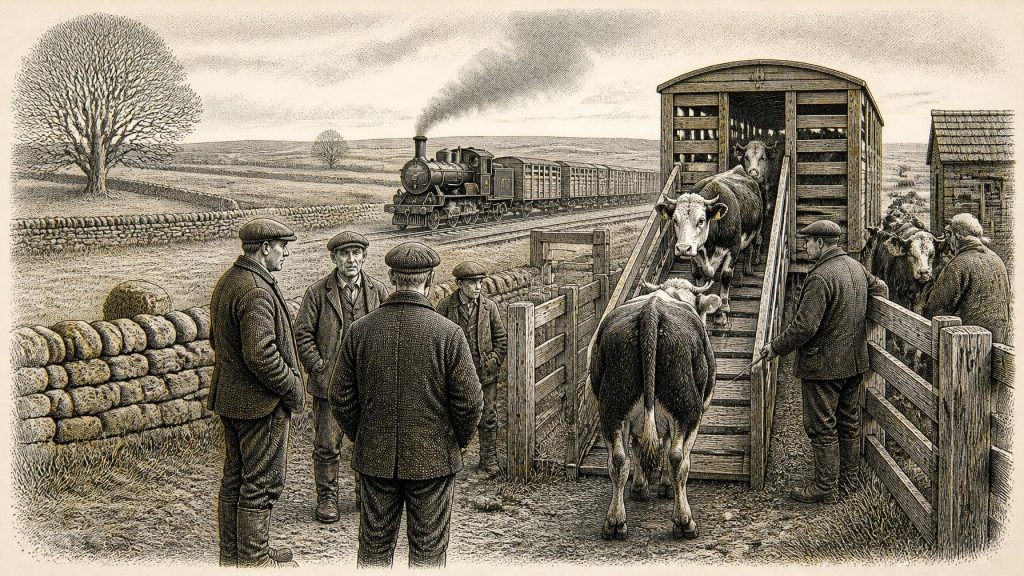
For many households, constitutional arguments mattered less immediately than the continuing Economic War with Britain. The dispute had begun in 1932 after the Free State withheld land-annuity payments claimed by the British government. Britain retaliated with duties on Irish agricultural produce, while the Free State imposed counter-duties. The burden fell heavily on a country whose farming economy, especially its cattle trade, was closely tied to the British market. Land annuities, cattle prices, seizures and auctions could therefore become matters of intense local feeling rather than abstract diplomacy.
That tension was starkly demonstrated at Cork’s Copley Street cattle repository on 13 August. Opposition to the sale of cattle seized in connection with unpaid annuities culminated in a violent confrontation between Blueshirt protesters and auxiliary Gardaí, popularly called the Broy Harriers. Michael Lynch, a young participant, was fatally wounded. The incident should not be treated as representative of all rural protest, but it exposed the dangerous overlap between economic grievance, partisan mobilisation and memories of armed politics.
There was, however, a modest diplomatic movement before the year ended. On 21 December the Free State and British governments reached the cattle-and-coal understanding. Britain agreed to admit additional Free State cattle during 1935; in return, the Free State undertook to purchase British coal on an equivalent value basis. The arrangement did not settle the land-annuity dispute or end the Economic War, which continued until 1938. Nor did it restore the older trading relationship. It did offer a practical respite, though, and demonstrated that even hostile governments could negotiate sector by sector when farmers, miners, merchants and consumers all had something to gain.
Another internationally entangled source of Irish revenue suffered a reverse in 1934. The Irish Hospitals Sweepstake had raised money for hospitals through large lotteries sold extensively in Britain. Westminster’s Betting and Lotteries Act curtailed the British sale of sweepstake tickets. Because British purchasers had supplied the overwhelming share of sales up to that point, the new law threatened an enterprise that connected voluntary-hospital finance in Ireland to mass gambling across the Irish Sea. The episode was a reminder that the Free State’s economic sovereignty still operated in a highly dependent trading and financial environment.
A Republican Split at Athlone
The year also produced a significant fracture within militant republicanism. At an IRA convention in March, advocates of a new political organisation capable of linking republican aims with workers’ and small farmers’ interests failed to secure agreement. Peadar O’Donnell, Frank Ryan and George Gilmore were among those who went on to establish the Republican Congress at Athlone on 7–8 April.
The Congress’s founding statement argued that a united Irish republic could not be achieved without a struggle against capitalism. This was a major departure from a republican politics framed solely by national sovereignty or by abstention from Free State institutions. It sought to bring labour activists, small farmers, republicans and northern workers into a broad anti-imperialist movement. Its language explicitly connected partition, class and economic power; in principle, this offered an alternative to both Fianna Fáil’s constitutional nationalism and the IRA’s narrower organisational priorities.
Its early history also showed the difficulty of that ambition. The IRA leadership treated the initiative as a disruptive breakaway, while the Congress itself soon divided over whether it should remain a wide united front or become a disciplined revolutionary party. At its first annual meeting in Rathmines on 29–30 September, that disagreement became an open split. The organisation’s short life should not obscure the importance of 1934: Athlone marked one of the clearest attempts in interwar Ireland to make social transformation, rather than national independence alone, the centre of republican strategy.
Partition’s Daily Reality
Events in Northern Ireland gave the island’s division a particularly blunt political expression. At Stormont on 24 April, Lord Craigavon declared in debate that he boasted that Northern Ireland was “a Protestant Parliament and a Protestant State”. The precise wording matters, since it is often recast as a different slogan. In its actual setting, the remark came amid discussion of allegations concerning discrimination against Catholics in employment. It conveyed the confidence of the Unionist governing order, but also the alienation of the nationalist minority within it.
Belfast in 1934 was not defined only by Stormont. On 28 March Belfast Zoological Gardens opened at Bellevue, created by Belfast Corporation beside a long-established pleasure-garden destination served by the city’s tram network. The project had employed 150 men in construction and cost £10,000. Such a municipal attraction speaks to a different side of interwar urban life: civic investment in leisure, family outings and a public landscape above the industrial city. Its opening did not erase unemployment, sectarian division or political inequality, but it belonged to the everyday Belfast experienced beyond parliamentary debate.
Images, Institutions and Public Culture
Irish culture in 1934 ranged from crowded Dublin disputes to international screens. Robert J. Flaherty’s Man of Aran, released that year, brought the Aran Islands to a wide audience. Filmed with islanders and drawing powerfully on the Atlantic landscape, it presented a dramatic vision of precarious island life. It should not be read as a transparent documentary record: Flaherty arranged scenes and foregrounded practices that were no longer an ordinary account of daily life. Nevertheless, the film fixed an enduring international image of the west of Ireland—rock, sea, labour and family endurance—at a time when modern Ireland was arguing intensely over its identity.
In Dublin, the third Theatre Royal closed on 3 March, another sign of changing urban entertainment. A newspaper strike during late summer and autumn temporarily disrupted the city’s printed news culture, underlining both the importance of newspapers to political argument and the vulnerability of workers in a difficult economy. Meanwhile, the appointment in July of the Austrian archaeologist Adolf Mahr as director of the National Museum of Ireland placed a capable prehistorian at the head of a major national cultural institution. His appointment must be viewed with the knowledge that he had joined the Nazi Party in 1933; that association would become gravely significant in later years.
Thus 1934 was neither a settled year nor a single turning point. It was a year of contested authority: over shirts and streets, cattle and coal, parliament and republican purpose, cultural memory and the meaning of Ireland itself. The limited trade accord suggested pragmatism was possible, but the island’s constitutional division and its sharp political antagonisms remained deeply embedded.
Primary Sources
- Timeline of events, 1919–69
- Wearing of Uniform (Restriction) Bill, 1934—Second Stage, Dáil Éireann, 28 February 1934
- Wearing of Uniform (Restriction) Bill, 1934—Second Stage, Seanad Éireann, 21 March 1934
- Wearing of Uniform (Restriction) Bill, 1934
- Constitution (Amendment No. 24) Bill, 1934
- Constitution (Amendment No. 24) Bill, 1934—Second Stage, Seanad Éireann, 30 May 1934
- Dáil and Seanad Terms
- Trade Relations with Britain, 7 December 1934
- Irish Free State (Coal and Cattle Understanding), House of Commons, 28 January 1935
- Irish Free State, Foreign Relations of the United States, 1934, Volume I
- Socialism and Republican Schism in Ireland: The Emergence of the Republican Congress in 1934
- Radicals and the Republic: Socialist Republicanism in the Irish Free State 1925–1937
- The Irish Hospitals Sweepstake in the United States of America, 1930–39
- Betting and Lotteries Bill, House of Commons, 27 June 1934
- Copley Street Riot
- History of Belfast Zoo
- The Parliamentary Debates: Official Report Archives
- A Protestant Parliament for a Protestant People
- Man of Aran (1934)
- Man of Aran, National Library of Ireland Catalogue
- Mahr, Adolf
- Donal Fallon Transcript
- Irish Statute Book: Acts of 1934