Coal, Cattle and Citizenship1935 CE
In 1935, the Irish Free State pursued autonomy amid economic hardship and the continuing Anglo-Irish Economic War. The Coal–Cattle Pact expanded cattle exports to Britain in return for coal purchases, easing but not resolving agricultural distress. Citizenship legislation and constitutional planning strengthened state identity, while laws regulating dance halls, contraception, labour and agricultural production extended official control. Interventionist measures addressed bacon, dairy, transport and employment, yet emigration and insecurity persisted. Belfast’s July sectarian riots, causing ten deaths, revealed partition’s instability; Carson’s funeral affirmed unionism. At Geneva, de Valera supported League collective security during Italy’s Abyssinia crisis, demonstrating Ireland’s international ambitions.
Dateline
In 1935, the Irish Free State was neither settled nor isolated. Éamon de Valera’s Fianna Fáil government continued to make the institutions of the State more distinctly Irish while resisting the financial claims that lay behind the Anglo-Irish Economic War. Yet practical necessity also pressed hard. Cattle farmers needed markets, households depended on imported coal, and employment remained insecure. The year therefore combined a limited Anglo-Irish trade accommodation with a striking programme of legislation touching citizenship, farming, public recreation, labour and sexual morality. Across the border, Belfast’s July riots exposed how profoundly partition had failed to remove sectarian fear or political antagonism from Irish life.
A Limited Trade Thaw
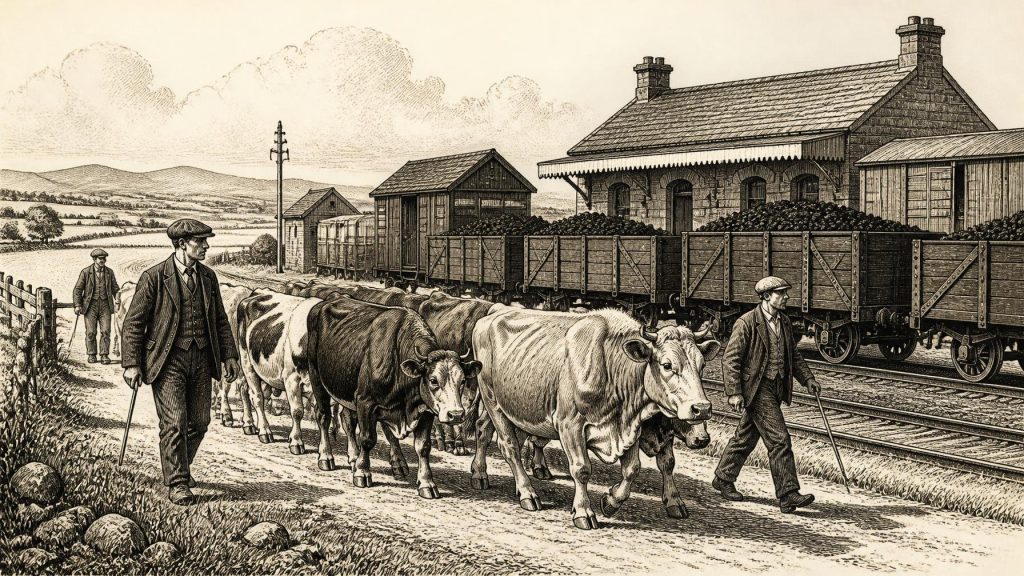
The year began with the Coal–Cattle Pact, announced on 3 January. It was not a final settlement of the Economic War, which had begun after the Free State withheld land-annuity payments claimed by Britain under the Treaty settlement. Rather, it was a practical bargain. Britain enlarged the quota for Irish cattle entering its market, while the Free State undertook to buy a corresponding value of British coal. John Dulanty, the Irish High Commissioner in London, played a central part in securing the arrangement.
The pact mattered because cattle lay at the heart of the southern economy. A reduced British outlet had damaged livestock prices and left many farmers, dealers and rural labourers acutely exposed. Coal, meanwhile, was indispensable to homes, railways, industry and urban commerce. The agreement showed that de Valera’s government could negotiate with London without abandoning its larger argument over sovereignty and annuities. Contemporary critics, including opposition deputies, argued that the improvement did too little for producers and that fair prices had not recovered. Both views contained truth: the pact eased a pressure point, but did not end the wider dispute or reverse the agricultural depression.
Making a State in Law
Legislation in 1935 gives an unusually clear view of a government building administrative authority. The Irish Nationality and Citizenship Act received assent on 10 April. It set out rules for citizenship by birth, naturalisation, marriage and the registration of people born abroad. Its language was that of Saorstát Éireann, and its reach was both domestic and international. In a decade when Irish governments were stripping away constitutional links inherited from the Treaty, a comprehensive citizenship law was a practical assertion that the Free State determined who belonged to it.
That assertion did not make the State synonymous with the whole island. The Act did not dissolve partition, and Northern Ireland remained within the United Kingdom. But it gave legal form to an Irish political community with its own registers, certificates and naturalisation process. In everyday terms, citizenship was not simply an abstract national ideal: it affected passports, family status, migration, inheritance of nationality and the position of Irish people abroad.
De Valera was also looking beyond piecemeal amendment. In late April he instructed the legal adviser John Hearne to begin preparing heads for a new constitution; on 29 May he told the Dáil that he intended to introduce a constitution that would be wholly Irish in internal affairs. No new constitution was enacted in 1935, and it would be wrong to project the text of 1937 backwards into this year. But 1935 firmly belongs to the preparatory stage of that constitutional project.
Morality, Recreation and Control
Two early statutes brought private conduct and public leisure within more formal supervision. The Public Dance Halls Act, enacted on 19 February, required public dancing places to be licensed, provided for published applications and objections, allowed conditions to be attached to licences, and gave the Gardaí enforcement powers. It did not end dancing; rather, it established a system through which courts and police could regulate where, when and under what conditions dances were held. For young people in towns and rural districts, dances were important sites of music, courtship and sociability. The Act consequently made a social institution subject to official permission.
On 28 February, the Criminal Law Amendment Act became law. Its provisions addressed several sexual offences and altered the legal treatment of sexual conduct involving young women. Its most enduringly consequential provision prohibited the sale, advertising, importation for sale and other commercial supply of contraceptives. The measure reflected the strong influence of Catholic moral teaching on public policy, though it was enacted by the Oireachtas rather than by the Church. It also illustrates a broader feature of the period: the State was extending its regulatory reach while defining respectable family and sexual life in restrictive terms. The law’s effects fell especially heavily on women and married couples whose private choices were now constrained by criminal prohibition.
Work, Food and the Managed Economy
Economic policy in 1935 was not confined to the cattle trade. A long list of Acts concerned milk, dairy-price stabilisation, cereals, fisheries, road transport, railways, unemployment assistance and agricultural rates. The Pigs and Bacon Act was especially substantial. Brought into operation in stages from July to September, it established detailed controls over curing, slaughtering, inspection, grading, licences, marketing and production quotas. Bacon was a major export and a source of rural employment; the legislation sought to make its production more orderly, standardised and marketable.
This was a protectionist and interventionist State at work. Officials and boards were being given greater power to supervise production, quality and export trade, while farmers were asked to adapt to unstable markets. The Trade Union Act, signed on 2 August after being introduced by Labour deputies William Norton, James Everett and William Davin, was another reminder that organised workers were active participants in the political system. None of this removed hardship. The economic background of 1935 still included emigration, under-employment and sharp differences between the prospects of city workers, smallholders, larger graziers and industrial employees.
Belfast in July
The gravest violence connected with Ireland in 1935 occurred in Belfast. Sectarian tension had risen during the spring and early summer, and the Northern Ireland authorities briefly prohibited parades in June. The prohibition was withdrawn after Orange pressure. On 12 July, as Orange processions returned through the city, clashes developed into sustained rioting. The disorder lasted for eight nights, with further disturbances thereafter. British troops were deployed alongside the Royal Ulster Constabulary; a curfew was imposed in affected districts.
Accounts differ in their final totals as violence continued beyond the first week, but ten civilian deaths during the July outbreak are commonly recorded, alongside many serious injuries. Homes and property were attacked, particularly in vulnerable Catholic districts, and families were driven from their streets. The immediate trigger lay in the contested ritual and routes of the Twelfth, but the causes were deeper: unequal political power, insecure employment, segregated neighbourhoods and the unresolved identities created by partition. The riots were a direct warning that Northern Ireland’s apparent inter-war stability rested on fragile ground.
Carson’s Funeral
Later that year Belfast became the setting for a very different public demonstration of unionist identity. Edward Carson, the Dublin-born barrister and foremost leader of pre-partition Ulster unionism, died in England in October. His funeral took place at St Anne’s Cathedral, Belfast, on Saturday 26 October. His body was brought by destroyer to the city, and he was buried inside the cathedral after special legislation permitted it. The ceremony drew immense attention, including from shipyard workers, and marked Carson as the symbolic founder of Northern Ireland’s unionist political tradition.
The contrast with July was revealing. Carson’s funeral presented an orderly, official unionist Belfast; the riots had exposed a divided and combustible city. Both belonged to the same political landscape. For nationalists, Carson’s career represented the defeat of all-Ireland self-government. For unionists, he remained the defender of their position within the United Kingdom.
Geneva and Collective Security
Ireland’s external affairs acquired unusual prominence in the autumn during the Abyssinia crisis. On 16 September de Valera addressed the League of Nations Assembly at Geneva as Italy’s threatened invasion of Ethiopia placed collective security under its sternest test. He argued that the League could survive only if its obligations applied impartially to strong and weak states alike. The speech expressed a small state’s interest in international law, but it was also shaped by Ireland’s own experience of seeking recognition and autonomy.
When the League moved towards sanctions against Italy, the Free State prepared to honour its membership obligations. An October government memorandum recorded the intention to implement financial sanctions, and the Oireachtas considered the League of Nations (Obligations of Membership) Bill later in the year. This was not neutrality in the later wartime sense. In 1935, de Valera publicly committed the Free State to collective action through the League, even as events showed how limited the League’s power could be.
Thus 1935 was a year of partial compromises and lasting boundaries. Coal and cattle reopened a narrow channel to Britain, but the Economic War continued. Citizenship law and constitutional planning strengthened the Free State’s separate identity, while new moral and social regulation shaped ordinary lives. Belfast’s violence demonstrated the human cost of division, and Geneva tested the ideals of sovereignty and international order that Irish leaders invoked. The year did not resolve Ireland’s central questions; it made their competing pressures unmistakably visible.
Primary Sources
- Coal Cattle Pact
- ‘Our Cattle Problem’: Fianna Fáil, the Irish Cattle Trade and the Economic War, 1932–1938
- Supplementary Estimate: Vote No. 3—Department of the President of the Executive Council, 28 May 1935
- Irish Statute Book: Public Acts of 1935
- Irish Nationality and Citizenship Act, 1935
- Criminal Law Amendment Act 1935
- Public Dance Halls Act, 1935
- The Public Dance Halls Act, 1935: a re-examination
- Conditions of Employment Bill, 1935
- Trade Union Act, 1935 – No. 35 of 1935
- Pigs and Bacon Act, 1935
- Pigs and Bacon Act 1935: Commencement and Amendments
- Census 1936 Volume 6: Industrial Status
- Speech by de Valera at the League of Nations, 16 September 1935
- Sanctions against Italy, 21 October 1935
- League of Nations (Obligations of Membership) Bill, 1935—Second Stage
- CAIN: Issues of Conflict – Parades Chronology
- Jewish Identity and Community in Belfast, 1920–1948
- St Anne’s Cathedral – Commemorative Booklet from Sir Edward Carson’s Funeral
- Lord Carson of Duncairn at Rest, Belfast Cathedral, October 26 1935
- De Valera, Éamon (‘Dev’)
- Cosgrave, William Thomas
- MacDermot, Francis Charles (‘Frank’)
- Macardle, Dorothy Margaret