
Mammoth Cave’s Single Mark31757 BCE
Around 31,757 BCE, Ireland lay within fluctuating Marine Isotope Stage 3 Ice Age conditions, with uncertain chronology and shifting ice, seas and land connections. Open, seasonal, largely treeless landscapes supported reindeer, mammoth, giant deer, bears, wolves, hyaenas and other cold-adapted fauna. Cave deposits and inter-till sediments provide fragmentary evidence, while older excavations and revised radiocarbon dating require caution. Castlepook, or Mammoth Cave, preserves Ireland’s major late-Pleistocene mammal assemblage. A cut-marked reindeer femur may indicate brief Upper Palaeolithic carcass processing, but cannot demonstrate settlement, continuous population or wider social practices. No political, religious or cultural institutions are evidenced. Modern investigation continues.
Dateline
“31,757 BCE” is a modern way of labelling a point far beyond the reach of calendar history. It should not be read as a date on which any recorded Irish event occurred. In conventional archaeological notation, it corresponds approximately to 33.7 thousand years before present, where “present” is fixed at 1950; but radiocarbon measurements must be calibrated and yield ranges rather than a single historical year. The responsible subject is therefore Ireland in the later part of Marine Isotope Stage 3 (MIS 3), during the last Ice Age, several millennia before the Last Glacial Maximum. At this depth of time, Ireland has no names, states, communities or narratives that can be recovered. Its evidence consists chiefly of landforms, cave deposits, animal bones, pollen, beetles and the difficult results of scientific dating.
A Date Without a Diary
Calendar precision is unavailable. An animal bone can be dated, within statistical limits, to the time when the animal died; it cannot by itself identify the season, the people who may have handled it, or an event in a numbered year. Calibration curves are essential because the concentration of atmospheric radiocarbon has changed through time, and the far past contains substantial uncertainty. Recent reassessment has also shown why older Irish cave dates require caution: improved pretreatment and ultrafiltration of bone collagen made several Castlepook results thousands of radiocarbon years older than earlier determinations. The date label used here is useful only as a navigational point within a broad, calibrated late-Pleistocene interval, not as a claim of exact chronology.
That limitation matters especially because the evidence is uneven. Northern sites such as Aghnadarragh, Hollymount and Derryvree or Greenagho in Ulster preserve organic layers trapped between glacial deposits. Their pollen, plant macrofossils and insect remains register changing environments, but their date ranges are broad and correlations with global climate records remain debated. In southern Ireland, limestone caves have preserved animal remains, particularly at Castlepook Cave, also known as Mammoth Cave, near Doneraile in County Cork, and at Shandon Cave near Dungarvan. Such sites offer rare windows into Irish Pleistocene life, but many were excavated before modern standards of stratigraphic recording. The archive is valuable precisely because it is fragmentary, not because it permits a complete reconstruction.
Between Ice Advances
Ireland at this time was part of a changing north-west European world, not the island familiar today. Sea level was generally lower than now, and the configuration of coasts, shallow seas, ice and exposed shelf land altered repeatedly as climate changed. The presence of large terrestrial mammals in Ireland demonstrates that dispersal from Britain and continental Europe was possible during portions of the last cold stage. It does not securely establish one permanent, dry “land bridge”, nor does it show that every species crossed at the same time or by the same route. Ice, sea and terrain formed shifting barriers and corridors.
The British–Irish Ice Sheet was not yet simply the uniform, island-covering mass often imagined in popular accounts of the Ice Age. Research identifies advance–retreat dynamics during MIS 3, but also stresses that the evidence for its pre-Last Glacial Maximum extent is indirect and incompletely dated. At roughly this chronological horizon, some ground may have been ice-free while other areas were affected by glacier growth, periglacial cold and changing sea margins. The securely mapped great expansion belongs chiefly to the later Last Glacial Maximum, after about 27,000 years ago. It would be unsafe to draw a single ice edge across Ireland for 31,757 BCE.
Open Country and Mobile Fauna
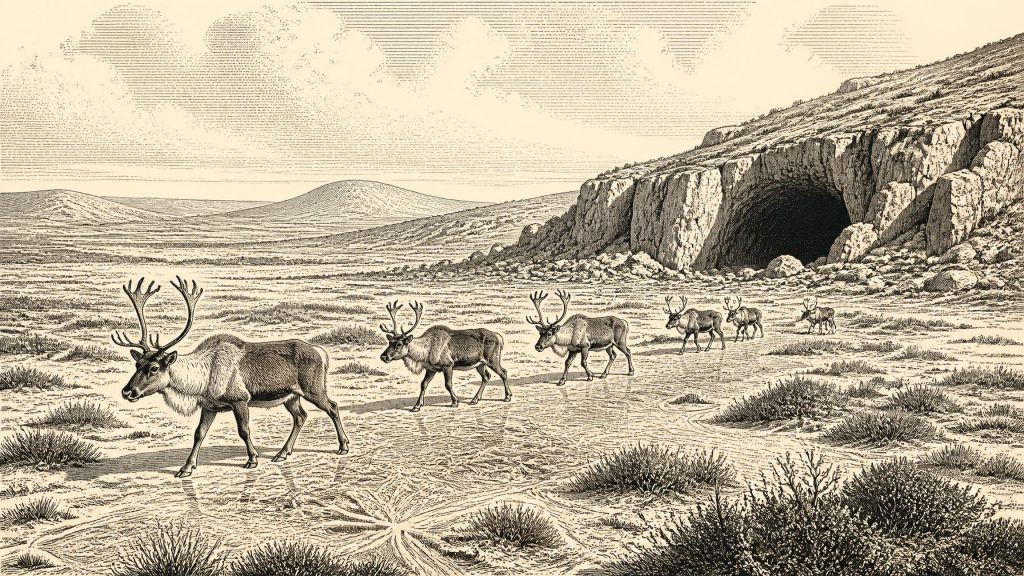
The best-supported environmental picture is one of cold, exposed and strongly seasonal landscapes rather than a wooded Ireland. Pollen and beetle evidence from relevant Irish inter-till deposits points to open, treeless or sparsely shrubby ground in cold phases, with wet hollows, sedge-rich water margins and mossy habitats in some localities. The exact local mosaic differed with altitude, drainage, proximity to ice and climatic fluctuation. Wind could move fine sediment across bare ground; frost action disturbed soils and rock; short summers would have concentrated plant growth. This was not an empty white wilderness. It was a biologically productive, though demanding, Pleistocene landscape.
Irish cave collections preserve members of a cold-stage fauna that now seems extraordinary: reindeer, woolly mammoth, giant deer, brown bear, wolf, Arctic fox, lemmings, mountain hare and spotted hyaena. Not all are securely contemporary with one another, and not every identified species can be assigned to the narrow span around this date. Yet Castlepook is exceptionally important because it contains a substantial assemblage from the last cold stage. The National Museum of Ireland describes it as Ireland’s most important cave site for mammal remains of that period; its spotted-hyaena material indicates that carnivores as well as herbivores reached southern Ireland between roughly 45,000 and 30,000 years ago.
These animals imply food webs rather than a settled human economy. Reindeer moved through open country capable of supporting grazing; mammoth and giant deer suggest extensive forage; wolves and hyaenas could scavenge, hunt and carry bones into caves. Caves were not necessarily homes for any of these species. They could act successively as dens, traps, shelters, drainage routes and repositories into which water, sediment and animal remains accumulated. Gnawing, trampling, collapse and later excavation can all alter a bone assemblage. A bone found in a cave is therefore evidence of a chain of processes, not automatically evidence of a kill-site or camp.
The Castlepook Possibility
One specimen nevertheless makes this period unusually consequential for Irish archaeology: a reindeer femur from Castlepook bearing a deep incision that zooarchaeologist Ruth Carden has interpreted as a mark made by a sharp stone tool during carcass processing. County Cork heritage material presents it as potentially placing Stone Age hunters in the region about 30,000 years ago. If that interpretation is sustained, it is possible evidence that Upper Palaeolithic people reached Ireland far earlier than the long-established post-glacial record. The implication is striking, but it must remain conditional.
The femur is not a settlement. It was recovered from an antiquarian cave collection, rather than an intact excavation surface with a recorded hearth, stone-tool assemblage, dwelling structure or human remains. The radiocarbon result dates the reindeer’s death, not necessarily the moment of cutting, where the animal was killed, or how long people stayed nearby. Nor does one incision disclose the number, language, ancestry, kinship or identity of those who may have made it. A cautious reading is both more modest and more important: it may record a brief human encounter with a reindeer carcass, perhaps involving meat, hide, sinew or marrow, but it does not prove permanent occupation, a seasonal settlement or a continuous Irish population.
No Politics, No Proven Religion
There is no evidence from Ireland around this time for political authority, warfare, diplomacy, territorial boundaries or institutions. Likewise, there are no securely associated burials, shrines, ornaments, cave art or symbolic objects from which religion, language, learning or social rank could responsibly be inferred. It would be tempting to import knowledge of contemporary Upper Palaeolithic societies elsewhere in Europe, where people made sophisticated stone tools, ornaments and images. That comparison provides context, not proof that equivalent practices occurred in Ireland. The Irish record must be allowed its silence.
Should the Castlepook mark be confirmed as anthropogenic, the smallest defensible social inference is of one or more highly mobile people with access to a sharp lithic edge and the practical knowledge to process a large animal. Such a visit would belong to hunting and foraging, not farming, trade networks or village life. There is no direct evidence for exchange, cultivation, domesticated animals, built houses or long-distance political relations. Nature itself dictated mobility: herds shifted, weather changed rapidly and useful resources were scattered across an open, hazardous terrain.
What Survives
The principal development relevant to Ireland around 31,757 BCE is not a named human deed but the preservation of a precarious archive. Inter-till organic beds reveal that Ice Age conditions varied; cave faunas show that Ireland supported, or was reached by, a rich cold-adapted mammal community; and Castlepook’s marked reindeer femur raises the possibility of an early human incursion. Renewed excavation at Castlepook in 2022 sought surviving Pleistocene deposits after the early twentieth-century work had removed much material. Its results underline the value of re-examining old collections and cave sediments with modern methods.
For this moment, then, the honest history is one of scale and uncertainty: a fluctuating Ice Age Ireland; open country occupied by reindeer and formidable predators; advancing and retreating ice whose local limits remain hard to fix; and perhaps a single humanly modified bone. That is not a thin version of later history. It is the beginning of the material record from which any deeper Irish past must be built.
Primary Sources
- A reconsideration of the radiocarbon dating of the Marine Isotope Stage 3 fauna from southern Ireland
- The timing and magnitude of the British–Irish Ice Sheet between Marine Isotope Stages 5d and 2: implications for glacio-isostatic adjustment, high relative sea levels and ‘giant erratic’ emplacement
- Growth and retreat of the last British–Irish Ice Sheet, 31,000 to 15,000 years ago: the BRITICE-CHRONO reconstruction
- Pattern and timing of retreat of the last British-Irish Ice Sheet
- Late Pleistocene chronostratigraphy and ice sheet limits, southern Ireland
- Trimlines, blockfields and the vertical extent of the last ice sheet in southern Ireland
- Maximum extent and dynamic behaviour of the last British–Irish Ice Sheet west of Ireland
- Oscillating retreat of the last British-Irish Ice Sheet on the continental shelf offshore Galway Bay, western Ireland
- New data for the Last Glacial Maximum in Great Britain and Ireland
- Freshwater organic deposits and stratified sediments between early and late Midlandian (Devensian) till sheets at Aghnadarragh, County Antrim, Northern Ireland
- Figure 6.— The subdivision of the Quaternary Period in Ireland
- Spotted Hyena Skull
- Heritage Artefacts of County Cork
- 2022:564 – Castlepook Cave, Castlepook South, Cork
- Archaeology Research Excavation Grant 2022
- New insights on the fauna of Ireland's Younger Dryas and Early Holocene from Alice & Gwendoline Cave
- Irish Cave Exploration
- Occurrence of mammalia relicts at site Castlepook Cave
- The Archaeology of Caves in Ireland
- The IntCal20 Northern Hemisphere radiocarbon age calibration curve (0–55 cal kBP)
- IntCal13 and Marine13 radiocarbon age calibration curves 0–50,000 years cal BP
- AMS radiocarbon dating of ancient bone using ultrafiltration