Mammoth Cave’s Thin Evidence31704 BCE
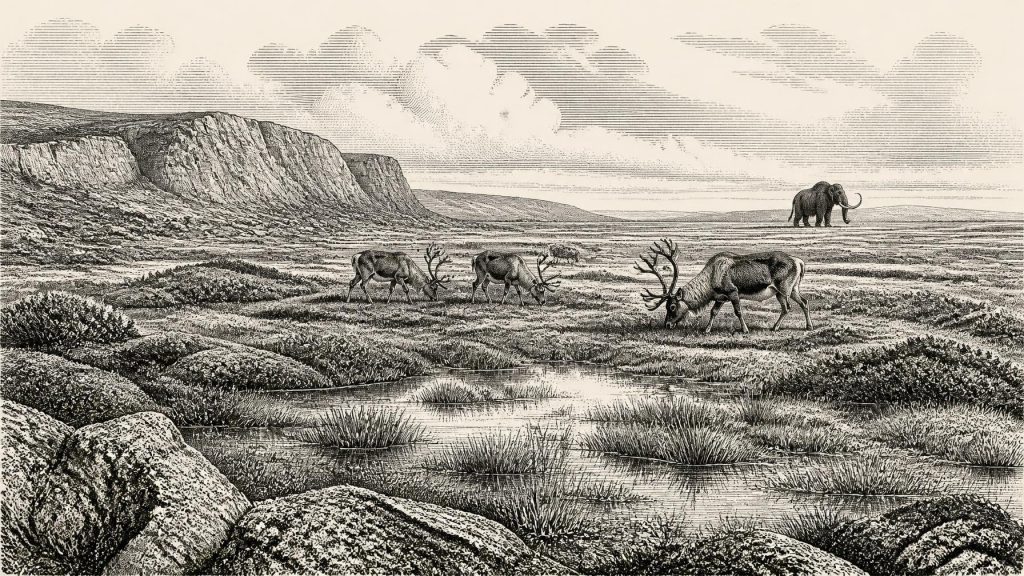
Around 31,704 BCE, Ireland lay within an unstable Late Pleistocene cold phase, not a precisely datable historical year. Evidence indicates varied, severe environments before maximum ice-sheet expansion. Derryvree, County Fermanagh, preserves freshwater deposits, tundra vegetation, insects and seasonal wet ground, while Crag Cave calcite suggests episodic liquid water. Castlepook Cave, County Cork, yielded mammoth, reindeer, giant deer, bears, hyaena and other fauna, demonstrating habitats for cold-stage animals. A marked reindeer femur may record butchery by Upper Palaeolithic people, but its disturbed context and uncertain interpretation prevent claims for settlement. No communities, artefacts, structures or institutions are securely known. Uncertainty endures.
Dateline
The label 31,704 BCE is a modern chronological convenience, not a date that can be recovered from the Irish archaeological record with calendar-year precision. No one in Ireland recorded a year, season or event at this depth of time; there are no written sources, named communities, monuments or excavated settlements to attach to it. In modern chronological terms it falls around 33,650 years before AD 1950, within the Late Pleistocene and broadly Marine Isotope Stage 3. Responsible discussion must therefore use wide, calibrated ranges and evidence from the surrounding millennia rather than pretend that a particular occurrence can be dated to this one year.
For Ireland, this was a difficult interval before the fullest expansion of the last British–Irish Ice Sheet. It was not simply the familiar green island made colder, nor can it safely be pictured as uniformly buried beneath permanent ice. Ice margins, sea levels, vegetation and animal distributions changed repeatedly over long spans. The best evidence suggests a strongly seasonal, unstable cold-stage world in which some areas could support freshwater basins, tundra plants and large mammals, while ice was growing and conditions were becoming more severe. Its contours remain debated because later glaciation eroded or buried much of the earlier landscape.
A Date Measured in Millennia
Radiocarbon and other scientific dates are estimates with ranges, not timestamps. At about 34,000 calibrated years ago, calibration itself is technically challenging: atmospheric radiocarbon varied over time, and the conversion from a radiocarbon measurement to calendar years depends on calibration curves and stated probability ranges. Older Irish cave collections bring a further problem. Many were excavated before present-day recording standards, so the original position of a bone within a deposit, and its relationship to other material, can be uncertain. A date on bone establishes when the animal died within a statistical range; it does not automatically date an apparent cut, a human visit, or a whole occupation.
The period is conventionally called the Middle Midlandian or, in wider north-west European terminology, part of the later Weichselian/Devensian cold stage. Such labels are useful shorthand, but they should not obscure local variation. The long glacial cycle included milder episodes, cold phases and advancing ice, rather than one unchanging “Ice Age”. At this approximate point the future Last Glacial Maximum lay ahead. Reconstructions agree that the British–Irish Ice Sheet later reached a far greater extent, but differ on precisely how much Irish ground was already glaciated and when separate sectors advanced. Recent work has particularly stressed that pre-maximum ice history remains less securely resolved than the better dated retreat after about 30,000 years ago.
Wet Tundra at Derryvree
The clearest Irish environmental evidence close in broad age comes from Derryvree, near Maguiresbridge in County Fermanagh. Roadworks there exposed freshwater silts and fine sands trapped between glacial deposits. A radiocarbon determination of 30,500 ± 1,170/1,030 radiocarbon years BP places the deposit within the Middle Midlandian, although it must not be converted into an exact BCE year. Its pollen, plant macrofossils, mosses and insects indicate a cold, open and largely treeless landscape around pools and waterlogged ground. Researchers used the term muskeg for this moss-rich, wet terrain with shallow water and accumulating plant matter.
Among the significant remains are sedges, grasses, herbs, low shrubs and cold-adapted plants including bogbean and mountain avens. These finds demonstrate that there were places with unfrozen seasonal water, growing vegetation and insect life. They do not supply a photographic map of the entire island. Pollen can travel long distances, can be reworked from older deposits, and represents a catchment rather than every hillside. Nonetheless, the combined evidence firmly rules out an image of uninterrupted forest or an entirely lifeless ice sheet. In the north-western Irish landscape represented at Derryvree, exposed ground, wet hollows, short growing seasons and harsh winters were more plausible than woodland.
Crag Cave in County Kerry provides another, very different kind of clue. Uranium-series dates on cave calcite show that speleothem formation occurred episodically during Marine Isotope Stage 3. Calcite requires water moving through the cave system, so it indicates intervals when liquid water was available. It does not mean that all of south-west Ireland was mild or forested, but it reinforces the larger lesson: Ireland’s late Ice Age environment shifted through changing conditions and cannot be reduced to a single frozen tableau.
Castlepook and Its Animals
The most evocative evidence comes from Castlepook Cave, also known as Mammoth Cave, near Doneraile in north County Cork. Excavations directed by the naturalist Richard J. Ussher between 1904 and 1912 produced a substantial collection of animal remains, now associated with the National Museum of Ireland’s natural-history collections. Later work, including accelerator mass spectrometry dating and reassessment of species identifications, has made this cave central to the study of pre-maximum Irish fauna.
The cave record shows that Ireland was reached, at intervals, by a much wider Pleistocene fauna than survived into later historic times. Material attributed to the broader Castlepook assemblage includes woolly mammoth, reindeer, giant deer, brown bear, wolf, foxes, hare, lemmings and spotted hyaena. Not every species necessarily lived together at exactly the same time, and a cave accumulation is not a census of one landscape. Carnivores could carry prey in, animals could die in or near openings, water and sediment could move remains, and early excavation disturbed original relationships. Even so, the assemblage is compelling evidence that suitable habitats and routes existed for cold-stage mammals during portions of the period.
Spotted hyaena is particularly informative. The animal is now strongly associated with Africa in the public imagination, but during the Pleistocene it ranged across parts of Europe. Its presence at Castlepook signals that ecological communities could include large scavengers and predators as well as herbivores. Mammoth and reindeer point towards open habitats capable of sustaining grazing animals, while lemmings and mountain hare fit cold conditions. This was not necessarily a uniform “mammoth-steppe” extending without interruption across Ireland; it was probably a varied mosaic of exposed mineral ground, grasses and herbs, wetland edges, sheltered limestone terrain and seasonally productive patches.
The Reindeer Femur Question
A reindeer femur from Castlepook has made this period archaeologically important beyond its animal history. Zooarchaeologist Ruth Carden identified a deep mark on the bone as consistent with modification by a sharp stone edge during butchery, while public reporting and local heritage material have associated the specimen with an age of roughly 33,000 years. If that assessment is confirmed, it would indicate that Upper Palaeolithic people processed a reindeer in Ireland tens of millennia before the island’s long-established post-glacial human record.
That is a consequential possibility, but it is not the same as proof of a settled Ice Age population. The object derives from an older cave collection rather than a modern excavation of a sealed occupation floor. Its date relates to the animal’s bone, not independently to the mark. No securely associated hearth, stone-tool assemblage, dwelling surface, human remains, burial, artwork or repeated food-processing area of comparable antiquity has yet demonstrated a resident community in Ireland. Natural damage from carnivores, trampling, sediment movement or excavation must be distinguished microscopically and contextually from human tool use. The careful conclusion is that the femur is a potentially important indication of human activity, not a basis for inventing a village, named group or continuous settlement.
If people did reach Ireland in this phase, they would have belonged to the wider Upper Palaeolithic world of north-west Europe, whose communities depended on mobility, detailed environmental knowledge and stone technology. Yet no Irish artefact assemblage permits a secure cultural attribution. Nor can lowered sea level be casually converted into a land bridge. Coastlines lay differently, but water barriers, ice, shifting channels and difficult terrain mattered. Travel from Britain or continental Europe remains an inference requiring evidence, not a demonstrated route for a particular party.
No Politics, but a Living Landscape
There is no evidence from Ireland around this time for political institutions, rulers, territories, diplomacy, organised warfare, formal religion, trade networks or learning in the later historical senses. There are no farms, crops, domestic livestock, towns, pottery traditions or monuments that can responsibly be placed in this horizon. The absence is meaningful: these are not missing details of a known society, but categories unsupported by the surviving Irish record. A putative butchery trace could suggest a brief encounter between people and prey; it cannot reveal language, kinship, beliefs or authority.
The economy visible in the evidence is ecological rather than commercial. Herbivores fed on what the open country and wetlands could produce; predators and scavengers followed animal populations; caves served as natural traps, dens, shelters or sedimentary archives. If humans were present, the reindeer-femur interpretation suggests opportunistic hunting or carcass processing, perhaps within a highly mobile subsistence strategy. It does not demonstrate regular hunting territories or exchange with other groups. Seasonal movement by animals is plausible, but the precise routes and timing are unknown.
The most important development, then, was environmental and evidential. Ireland stood in a narrowing climatic window before later ice-sheet expansion transformed much of its surface and erased much of what had gone before. Derryvree preserves water, plants and insects from cold open ground; Castlepook preserves the bones of a striking fauna and a disputed possible human trace. Together they show a country neither empty of life nor securely known as a human homeland. For 31,704 BCE, that disciplined uncertainty is not a failure of history. It is the most accurate account the evidence allows.
Primary Sources
- A reconsideration of the radiocarbon dating of the Marine Isotope Stage 3 fauna from southern Ireland
- The Irish Quaternary Fauna Project
- Growth and retreat of the last British–Irish Ice Sheet, 31 000 to 15 000 years ago: the BRITICE-CHRONO reconstruction
- The timing and magnitude of the British–Irish Ice Sheet between Marine Isotope Stages 5d and 2: implications for glacio-isostatic adjustment, high relative sea levels and ‘giant erratic’ emplacement
- The Last Irish Ice Sheet: Extent and Chronology
- Maximum extent and dynamic behaviour of the last British–Irish Ice Sheet west of Ireland
- Stratigraphic and palaeo-geomorphological evidence for the glacial-deglacial history of the last British-Irish Ice Sheet in the north-western Irish Sea
- New data for the Last Glacial Maximum in Great Britain and Ireland
- Pattern and timing of retreat of the last British-Irish Ice Sheet
- Timing, pace and controls on ice sheet retreat: an introduction to the BRITICE-CHRONO transect reconstructions of the British-Irish Ice Sheet
- Dimensions and chronology of the last ice sheet in Western Ireland
- Irish Pleistocene biostratigraphy
- Palaeoecology
- Figure 6.— The subdivision of the Quaternary Period in Ireland
- Menyanthes trifoliata
- Dryas octopetala
- Soils of Co. Waterford
- The Brown Bear (Ursus arctos L.) in Ireland
- New insights on the fauna of Ireland's Younger Dryas and Early Holocene from Alice & Gwendoline Cave
- Ireland: Submerged Prehistoric Sites and Landscapes
- Archaeological Heritage of County Cork
- Heritage Artefacts of County Cork