Mag Adair’s Uprooted Tree982 CE
In 982, Máel Sechnaill mac Domnaill, king of Tara, raided Dál Cais territory and uprooted the Tree of Mag Adair, an inauguration symbol challenging Brian’s growing Munster power. Annalistic dating varies, but several sources connect these events with 982. Munster forces raided Osraige, gaining booty but suffering losses, while Ímar of Waterford plundered or destroyed Kildare, exposing the wealth and vulnerability of major churches. Deaths and killings among rulers in Leinster, Ulster, Connacht and smaller kingdoms highlighted unstable successions. The year reveals Ireland as interconnected competing lordships, where raids, sacred sites, ecclesiastical wealth and dynastic authority shaped political power throughout.
Dateline
In 982, a short annalistic notice recorded an act whose physical scale was small but whose political meaning was immense: the breaking of the Tree of Mag Adair in what is now County Clare. The tree stood at an inauguration landscape associated with the Dál Cais, the rising Munster dynasty of Brian son of Cennétig, later known as Brian Boru. Its destruction by Máel Sechnaill mac Domnaill, overking of Mide and king of Tara, made visible a widening contest between two ambitious rulers. The same year also brought a Munster raid into Osraige, the plundering of Kildare by Ímar of Waterford, and deaths among regional ruling families. Ireland in 982 was not a unified kingdom, but a country of competing lordships in which cattle, churches, fortresses, kinship and sacred places all carried political weight.
A Carefully Dated Year
The evidence requires care. The principal contemporary-style sources are Irish annals, copied and compiled over generations, and their year-numbering is not always aligned. The Annals of Inisfallen place a Munster foray into Osraige and the breaking of the Tree of Mag Adair under 982. The Annals of Tigernach likewise enter the destruction of Kildare by Ímar of Waterford, the death of Bruatar of Uí Chennselaig, the killing of Árchú of Ulaid, and Máel Sechnaill’s attack on the Dál Cais under that year. The Annals of Ulster label comparable material ‘AD 981 alias 982’, while the later Annals of the Four Masters explicitly correct their relevant heading from 981 to 982. These overlaps permit the events considered here to be connected responsibly with the calendar year 982, even though the annals do not provide modern-style dates or a complete sequence of operations.
That limitation matters. The annals preserve what their writers considered memorable: deaths of kings and churchmen, attacks on prominent churches, major raids, and actions bearing on lordship. They say little directly about the routines of most people. Yet their terse entries reveal the pressures under which communities lived: armed companies moved across provincial frontiers; livestock and produce could be seized; religious establishments were repositories of wealth; and dynastic authority could be challenged through carefully chosen acts of violence and symbolism.
Máel Sechnaill at Mag Adair
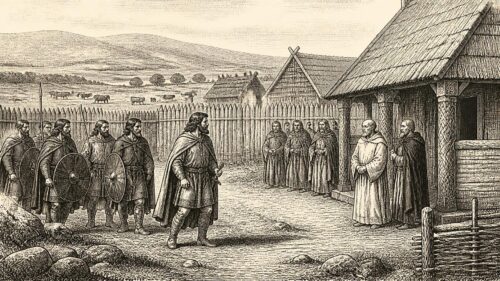
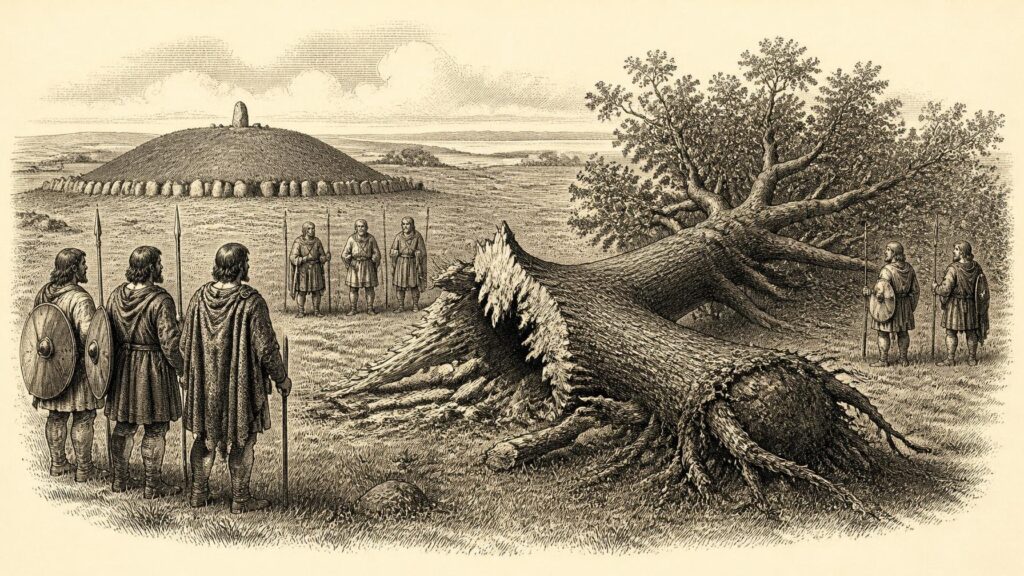
Máel Sechnaill mac Domnaill had become king of Tara after the death of Domnall ua Néill in 980 and had quickly demonstrated his strength against Dublin’s rulers at the battle of Tara. By 982, he was also directing force south-westwards. The Annals of Tigernach state that he plundered the Dál Cais and cut down their sacred tree at Mag Adair; the Annals of the Four Masters add the vivid detail that the tree was dug out with its roots. The Annals of Inisfallen, using the larger political expression Leth Cuinn—the northern half of Ireland—simply says that the Tree of Mag Adair was broken.
Mag Adair was no ordinary wood. It was an inauguration site in Dál Cais territory, near modern Ennis, where the dynasty’s rulers were associated in tradition with rites of accession. An inauguration landscape joined territory, ancestry and public authority. To damage its emblematic tree was therefore more than plunder or timber-cutting. It was a declaration that Máel Sechnaill could penetrate the Dál Cais heartland and affront the ceremonial claims of its leading kindred. The language of ‘sacred tree’ belongs especially to the later annalistic tradition, but the convergence of the sources makes the assault itself secure.
The target also tells us much about the rival. Brian had established himself as the foremost power in Munster after the death of his brother Mathgamain and the defeat of rival kings in the later 970s. He was not yet king of Ireland, and Máel Sechnaill’s position was still the stronger in formal prestige. But Brian’s expanding resources, military following and control in the Shannon region made him a serious challenger. The attack at Mag Adair was a warning that the king of Tara would not accept a southern power growing without restraint.
Raid and Counter-Raid in Osraige
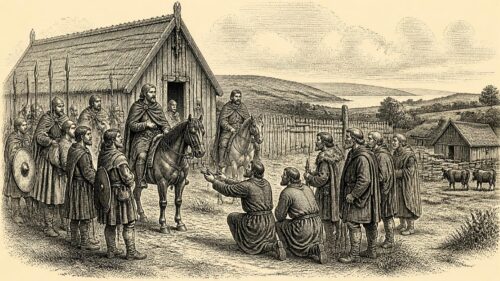
At the same time, the men of Mumu, or Munster, made a foray into Osraige and took what the Annals of Inisfallen calls a great prey. A ‘prey’ in this context chiefly meant movable wealth, above all cattle, but could include other goods and captives. The annalist adds that a considerable number of the raiders were killed there. The Annals of the Four Masters, in its corrected 982 entry, attributes the plundering of Osraige directly to Brian.
Osraige lay between Munster and Leinster, roughly corresponding to much of modern County Kilkenny and adjoining districts. Its position made it a crucial corridor as well as a prize: armies moving between the south-west, the midlands and the eastern plain could not disregard it. Raiding there could enrich a ruler, test the loyalty of subordinate groups, and demonstrate access to routes leading towards Leinster. It also carried substantial danger. A raiding host burdened with animals and booty was vulnerable to local resistance, as the reported Munster casualties show.
It is tempting to arrange these notices as a simple scene in which Máel Sechnaill struck Dál Cais while Brian was absent in Osraige. That may be broadly right, and later historical writing commonly makes the connection. Still, the annals do not supply a day-by-day campaign narrative. What can safely be said is that both actions belong to 982 and expose an active frontier conflict between Brian’s Munster interests and Máel Sechnaill’s wider claim to supremacy.
Kildare and Ímar of Waterford
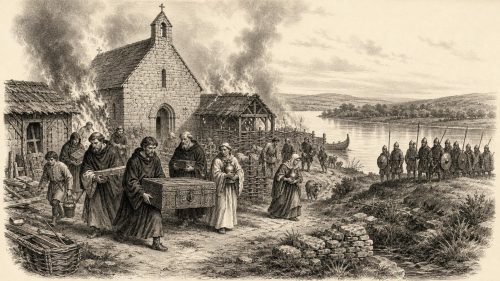
Another firmly connected event was the plundering of Cill Dara, Kildare, by Ímar of Port Láirge, Waterford. The Annals of Ulster call it a plundering; Tigernach uses the stronger word ‘destruction’. Neither description should be expanded into an unsupported claim that every church or dwelling at Kildare was burned. But an armed seizure of such a place was a major occurrence. Kildare was one of Ireland’s most important ecclesiastical settlements, associated with Brigit and embedded in the political landscape of Leinster. Its church, lands, dependants, hospitality and stored resources made it both spiritually prominent and materially attractive.
Ímar’s designation identifies him with Waterford, one of the coastal settlements shaped by Scandinavian activity and Irish Sea commerce. By the later tenth century, such places were not merely raiding camps. They were centres of shipping, exchange, craft production and armed power, connected to Irish rulers as allies, enemies, tributaries and rivals. Annalists often call their leaders ‘foreigners’, but this should not imply a simple division between separate Irish and Scandinavian worlds. Intermarriage, local alliances, bilingual dealings and shared economic interests had created more entangled political societies.
The attack on Kildare demonstrates the reach of Waterford-based power. It also reveals the vulnerability of even the greatest ecclesiastical communities. Monastic settlements were not secluded institutions apart from secular life: they possessed lands and livestock, hosted travellers, employed craftsmen, maintained churches and schools, and drew support from kings. An assault on one could damage worship and learning, but it could also redistribute wealth and interfere with the authority of patrons who claimed protection over it.
Deaths, Succession and Local Power
The annals attach 982 to several deaths and killings that underline the instability of regional politics. Bruatar son of Tigernach, king of Uí Chennselaig in south Leinster, died. His death mattered because Uí Chennselaig was a major Leinster dynasty whose leaders competed both within the province and beyond it. The royal heir Árchú son of Niall was killed treacherously by the sons of Ardgar, according to the Annals of Ulster; Tigernach calls him crown prince of Ulaid. Such an entry illustrates how succession could be contested within a ruling kin-group as much as in open battle.
The Ulster annals also record the peaceful death of Áed ua Dubdai, king in northern Connacht. In the southern record, the deaths of Cathal son of Gébennach, royal heir of In Déis Bec, Uainide son of Donnubán, king of Uí Chairpri, and Donnchadh son of Máel Sechnaill, king of Gabair, are grouped together. These notices do not explain every succession that followed, but they show a map of authority made up of many kingdoms. ‘Ireland’ was a network of such polities, linked by overlordship, marriage, fosterage, church alliances, hostage-taking and warfare rather than by a single uniform administration.
What the Year Reveals
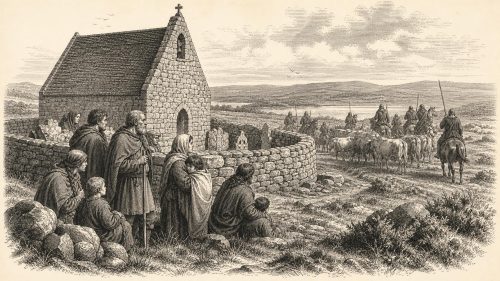
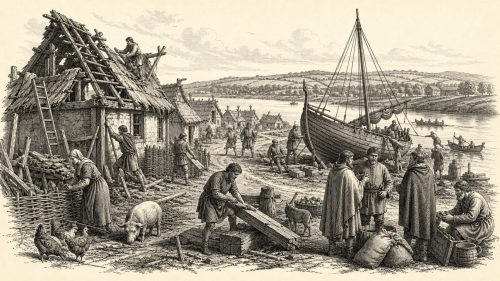
For ordinary households, the year’s headline events were not distant court politics. A raid could mean the loss of cattle needed for food, dairying, traction, rent and status; it could bring armed men through cultivated land and oblige neighbours to defend or recover stock. For religious communities, Kildare’s plundering was a reminder that sanctity did not secure immunity. For kings, the uprooted tree of Mag Adair carried an especially sharp message: authority rested on places as well as persons.
Thus 982 was not simply a prelude to Brian Boru’s later career. It was a year in which Máel Sechnaill still acted decisively as king of Tara, Brian’s Munster power tested the eastern frontier, Waterford’s ruler projected force into Leinster, and regional successions remained perilous. The broken tree at Mag Adair condensed these realities into one memorable image: political rivalry had reached into the ceremonial ground on which a dynasty imagined its right to rule.
Primary Sources
- Annals of Inisfallen
- Annals of Ulster
- Annals of Ulster, Year U982
- Annals of Tigernach
- Annals of the Four Masters, Part 8
- Annals of the Four Masters
- Chronicon Scotorum
- Exploring the Irish Annals
- The Viking Age in Ireland
- The Vikings in Ninth-Century Ireland: Sources and Settlements
- Ireland’s Viking-Age Hoards: Sources and Contacts
- Magh Adhair: National Monuments in State Care, Clare
- High Crosses
- Early Christian Monasteries
- Brigid and Kildare
- Monuments in Glendalough
- Early Waterford History
- Local History
- Medieval Ireland: Territorial, Political and Economic Divisions
- Technological Change in the Agrarian Economy of Early Medieval Ireland: New Archaeological Evidence for the Introduction of the Coulter Plough
- Edition Directory: KRONOS Chronology Project
- Viking-Age Hoards and Hoarding in Ireland and the Viking World