Éire’s Founding Plebiscite1937 CE
In 1937, Éamon de Valera’s government drafted, debated and submitted a Constitution to voters, replacing much of the Irish Free State’s imperial framework. Approved by the Dáil and endorsed in the 1 July plebiscite by 685,105 votes to 526,945, it came into force on 29 December, naming the State Éire/Ireland. It established the presidency, Taoiseach, reconstituted Seanad and Supreme Court, while asserting an all-island claim. Its Catholic-inflected provisions on religion and family prompted criticism. Fianna Fáil retained power without a majority. Amid poverty, emigration and dependence on Britain, legislation addressed housing and welfare, while Spain and insecurity shaped foreign policy.
Dateline
A Year Framed by a Constitution
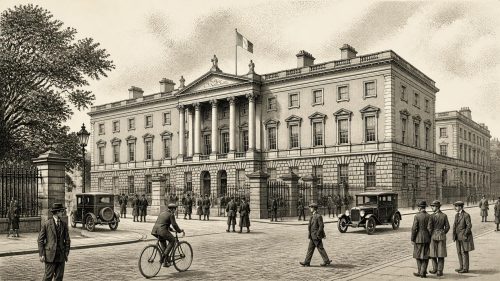
For Ireland, 1937 was defined above all by the making, approval and commencement of a new constitution. The process was neither a single dramatic day nor an uncomplicated national consensus. It unfolded through public argument, parliamentary scrutiny, an election and a plebiscite, while the State remained economically entangled with Britain, politically divided by partition and socially marked by poverty, emigration and religious authority. Yet the outcome gave the twenty-six-county State its enduring constitutional name, institutions and vocabulary. On 29 December, the Constitution of Ireland came into operation: the Irish Free State’s constitutional order was replaced by one describing the State as Éire in Irish and Ireland in English.
Éamon de Valera and his Fianna Fáil government had been working towards such a settlement for several years. The removal of the oath of allegiance, the abolition of the Senate in 1936 and the changes made during the abdication crisis had already dismantled much of the 1922 Free State constitution’s visible imperial framework. The proposed constitution of 1937 was intended to consolidate that work. It was an Irish-made fundamental law, approved directly by voters rather than enacted solely by the Oireachtas. But it did not resolve every ambiguity left by the break with Britain: the External Relations Act of December 1936 still provided a limited role for the King in specified diplomatic functions, while the new constitution supplied a domestic framework for government, citizenship and national aspiration.
Drafting the New State
The draft was published on 30 April. Its preparation had involved de Valera, senior civil servants and legal drafters, notably John Hearne, alongside consultation that extended beyond government. John Charles McQuaid, then president of Blackrock College and a close associate of de Valera, offered advice and material derived from Catholic social thought. His influence should not be overstated: de Valera and the officials did not adopt the stronger confessional language sought by some churchmen. Nevertheless, the document plainly reflected a Catholic intellectual and social environment in its preamble, its treatment of the family, education, property and religion.
From 11 May, the Dáil debated the draft at length. Its advocates presented it as the culmination of a constitutional recovery: a democratic safeguard against arbitrary government and a statement of national sovereignty. Critics did not all object on the same grounds. Fine Gael figures questioned the need to discard the remaining Free State settlement and feared the effects on relations with Britain and unionists in Northern Ireland. Others challenged particular provisions on religion, the family, executive authority and the proposed second chamber. The debates were therefore about much more than constitutional mechanics. They tested rival understandings of independence: whether it meant completing separation from imperial institutions, preserving continuity and external goodwill, or making an all-island claim more central to public life.
On 14 June the Dáil approved the draft by 62 votes to 48. The text described the Irish language as the national language and first official language, with English recognised as a second official language. It created the office of President of Ireland, a Government headed by a Taoiseach, a reconstituted Seanad Éireann and a Supreme Court within a new judicial order. It recognised personal rights, though subject in several places to qualifications and to legislative interpretation. It also offered social principles rather than enforceable guarantees in areas such as welfare and economic justice. The Constitution’s aspiration to regulate public life was consequently wider than a simple institutional blueprint, but its practical reach remained dependent on legislation and courts.
One Ballot Day, Two Decisions
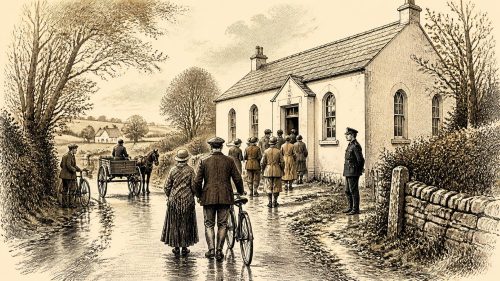
The constitution was submitted to a popular plebiscite on 1 July, the same day as a general election. That conjunction made an already charged campaign still more complicated. De Valera insisted that voters were free to support the constitution while opposing Fianna Fáil, or to vote otherwise in the parliamentary contest. In practice, the constitutional question and judgement on the government were difficult to disentangle. The proposal passed with 685,105 votes in favour and 526,945 against. It had a clear majority, but not an overwhelming one; more than half a million voters rejected it.
The accompanying election returned Fianna Fáil as the largest party with 69 of the 138 Dáil seats, one seat short of an overall majority. Fine Gael remained the principal opposition, while Labour, independents and smaller groupings ensured that parliamentary politics could not be reduced to a simple plebiscitary mandate. De Valera formed a new government on 21 July. The result gave him authority to continue, but it also showed the limits of Fianna Fáil’s dominance at a time when ordinary political loyalties were still shaped by the divisions of revolution, treaty and civil war.
The new constitution’s national claims were particularly sensitive. Articles 2 and 3, in their original 1937 form, asserted a claim to the whole island while acknowledging that, pending reintegration, the laws of the State would apply only within the area then governed by the Oireachtas. For supporters, this refused to normalise partition. For unionists, it could appear a constitutional challenge to Northern Ireland’s position in the United Kingdom. The text did not change the border, the powers of the Northern Ireland Parliament, or the absence of all-Ireland political institutions. Its importance was declaratory and symbolic, but symbols carried real diplomatic and communal weight.
Religion, Family and Difference
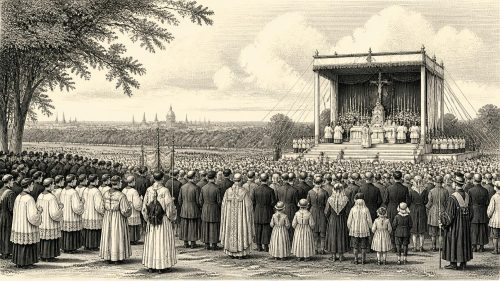
The constitution’s religious language became one of the year’s most discussed features. It guaranteed freedom of conscience and the free profession and practice of religion, prohibited the endowment of any religion, and protected denominational institutions. At the same time, Article 44 recognised the “special position” of the Catholic Church as guardian of the faith professed by the great majority of citizens. It also named the Church of Ireland, Presbyterian and Methodist churches, the Religious Society of Friends, Jewish congregations and other existing denominations. This was not an establishment of Catholicism, and it did not satisfy those who wanted one; still, it made the constitutional document unmistakably reflective of majority Catholic Ireland and generated unease among many Protestants, particularly in the North.
Article 41 similarly expressed an ideal of social order centred on marriage and the family. It affirmed the family as the natural primary and fundamental unit of society, prohibited divorce, and stated that the State should endeavour to ensure that mothers would not be obliged by economic necessity to work outside the home to the neglect of duties in the home. Such language captured a prevailing conservative vision, but it was not a neutral description of women’s lives. Women were already wage-earners, household managers, farmers’ partners, teachers, domestic workers and emigrants; economic necessity often shaped their choices. The constitutional ideal therefore sat alongside, rather than replaced, the harder realities of employment, low incomes and constrained opportunity.
Daily Pressures and State Building
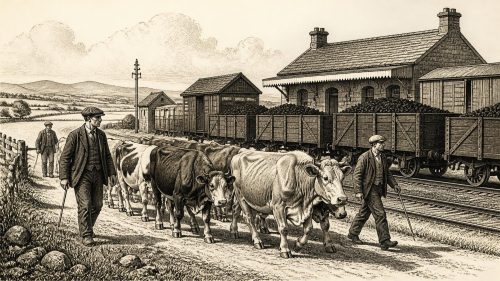
Those realities were visible in the legislation of 1937. The State remained predominantly rural, with agriculture and manual work central to employment, while industrialisation was limited and emigration continued to shadow family life. Government policy combined protection for domestic industry with intervention in agriculture and public services. The long-running Anglo-Irish economic dispute, often called the Economic War, was not settled in 1937. Nonetheless, the coal-and-cattle arrangement with Britain was renewed and enlarged early in the year, a reminder that access to British markets and British coal remained crucial to Irish livelihoods.
Housing was another persistent concern. The Housing and Labourers Act, passed on 18 December, amended and extended existing schemes for urban housing and labourers’ cottages. Its technical provisions did not transform living conditions overnight, but they show the State responding to overcrowding, poor housing and the needs of rural labouring households. Other measures dealt with public assistance, widows’ and orphans’ pensions, fisheries, import controls and local employment. These were modest but important parts of government: constitutional nation-building was accompanied by the unglamorous business of grants, relief, food production, wages, transport and homes.
December legislation also prepared the machinery of the new order. The Presidential Elections Act laid down procedures for choosing a president; the Constitution (Consequential Provisions) Act adapted the terminology of existing law; and the Defence Forces Act placed military command within the constitutional relationship between President, Government and minister. The presidency itself would not be filled until 1938, but by the end of 1937 the office had been designed in law. Radio helped make the transition audible as well as legal: the inauguration of the constitution was marked by a special broadcast, bringing the language of the new State into homes beyond Dublin’s parliamentary chambers.
Spain, Britain and an Unsettled Europe
Ireland’s concerns did not stop at its shores. The Spanish Civil War exposed fierce ideological and religious divisions among Irish people. The State’s Spanish Civil War (Non-Intervention) Act aligned Ireland with international efforts to prevent recruitment and material assistance, though volunteers had already travelled and continued to make their way to Spain. Irishmen fought on opposing sides: republican socialists associated with Frank Ryan served with the International Brigades, while Eoin O’Duffy’s Irish Brigade supported Franco’s insurgents in the name of Catholic Spain and anti-communism.
In June, most of O’Duffy’s brigade returned after a troubled and militarily unsuccessful venture. Its homecoming punctured the grander claims made for the expedition, though Spain remained a potent subject in Catholic and political discussion. Meanwhile, Irish diplomatic reporting from London and elsewhere followed the war, British policy and the wider European crisis closely. In September de Valera met the British Dominions Secretary, Malcolm MacDonald, at Geneva; in November he proposed talks on issues that might arise if war came. Britain agreed in December. These exchanges foreshadowed the negotiations of 1938, but in 1937 they chiefly revealed a government thinking about security, sovereignty and the practical vulnerabilities of a small State beside a major power.
Thus 1937 ended not with a finished national settlement but with a framework. The Constitution gave Ireland a new name in law, new offices, a durable political grammar and a powerful statement of territorial aspiration. It also preserved contradictions: an island claimed but divided, an independent State still commercially dependent on Britain, broad rights framed by social conservatism, and democratic approval achieved amid substantial dissent. Its arrival on 29 December was a landmark precisely because it made those tensions part of the country’s governing text rather than making them disappear.
Primary Sources
- Constitution of Ireland
- Plebiscite (Draft Constitution) Bill, 1937
- Bunreacht na hEireann (Dréacht)—Dara Céim, 11 May 1937
- Bunreacht na hEireann (Dréacht)—Tuarasgabháil (d'ath-thógaint), 14 June 1937
- Notable Debates in the Dáil
- Eamon de Valera Papers: Descriptive Catalogue
- ‘The will of the people’: putting the referendum in the Irish constitution
- De Valera, Éamon (‘Dev’)
- McQuaid, John Charles
- Visit to Rome / Constitution
- Work of the High Commissioner’s Office, London
- Irish Brigade in Spain
- Executive Authority (External Relations) Act, 1936
- Spanish Civil War (Non-Intervention) Act, 1937
- Public Assistance Act, 1937
- Widows' and Orphans' Pensions Act, 1937
- Presidential Elections Act, 1937
- Constitution (Consequential Provisions) Act, 1937
- Defence Forces Act, 1937
- Housing and Labourers Act, 1937
- Special Report: Seanad Electoral (Panel Members) Bill, 1937
- 1922–2022: 100 Years of Seanad Éireann
- Occupations Then and Now: Life in Ireland in 1926 and 2022
- RTÉ Archives: Lá an Bhunreachta