
Phoenix Park, O’Connell’s Bronze1882 CE
1882 in Ireland combined attempted settlement, assassination, land relief, coercion, injustice, and nationalist reorganisation. Informal negotiations between Parnell and Gladstone’s government secured nationalist releases and promised arrears relief, prompting Forster’s resignation. Days later, Irish National Invincibles murdered Chief Secretary Lord Frederick Cavendish and under-secretary Thomas Henry Burke in Phoenix Park, damaging constitutional nationalism. The government responded with the Prevention of Crime Act and the limited Arrears of Rent Act. At Maamtrasna, inadequate interpretation imperilled Irish-speaking defendants; Myles Joyce was executed and posthumously pardoned. Parnell’s supporters founded the Irish National League, while Dublin unveiled O’Connell’s monument, affirming constitutional public national aspirations.
Dateline
In Ireland, 1882 was a year in which an attempted political settlement, a spectacular act of violence and an important measure of tenant relief followed each other with extraordinary speed. It began amid the unfinished business of the Land War. The Land Act of 1881 had recognised fair rent, free sale and fixity of tenure in important ways, but it could not by itself solve the accumulated arrears borne by tenants after several poor years. Nor had it reconciled the Liberal government with Charles Stewart Parnell’s movement. Many leading nationalists remained imprisoned without trial under the Protection of Person and Property Act; the Irish National Land League had been suppressed; boycotting, evictions, intimidation and agrarian crime kept much of the countryside politically tense.
An Informal Settlement
The immediate question in the spring was whether coercion or concession would govern British policy. William Edward Forster, chief secretary for Ireland, believed that further exceptional powers were necessary. Parnell, held in Kilmainham Gaol since October 1881, and his allies sought release and practical relief for indebted tenants. Through Captain William O’Shea, an intermediary with access to both sides, messages passed between Parnell and ministers. Parnell’s letter of 28 April set out his willingness to use his influence against violence and to support the working of the land legislation if the government addressed the arrears problem.
This arrangement has long been called the “Kilmainham Treaty”, but the name can mislead. It was not a signed bilateral treaty, nor did it settle every contention between Ireland and Westminster. It was an informal and politically precarious understanding. Gladstone’s cabinet moved away from Forster’s preferred policy, envisaged the release of the detained nationalist leaders, and prepared legislation to deal with rent arrears. Forster resigned on 2 May rather than administer that change. Parnell was released from Kilmainham the same day. Michael Davitt, whose ticket-of-leave had been revoked in February after an inflammatory speech, was released from Portland prison on 6 May.
The hoped-for policy was conciliatory in presentation as well as substance. John Poyntz, fifth Earl Spencer, returned to Dublin as lord lieutenant, and Lord Frederick Cavendish, a Liberal close to Gladstone, was appointed chief secretary. Cavendish had taken an interest in Irish land purchase and was intended to signal that Dublin Castle would not simply continue Forster’s regime. Thomas Henry Burke, the permanent under-secretary since 1869, remained the crucial senior civil servant at the Castle: conscientious, experienced and, to opponents of coercion, closely identified with its practical operation. The distinction mattered. Ministers could change; Burke represented the continuity of the administration.
The Phoenix Park Killings
On the evening of 6 May, Cavendish and Burke were killed in the Phoenix Park while walking near the viceregal lodge. Cavendish had arrived in Dublin only that day. Their attackers belonged to the Irish National Invincibles, a clandestine militant group with connections to radical Fenian and Land League circles. Evidence later given by participants indicated that Burke was the principal target, after earlier unsuccessful attempts on Forster; Cavendish was killed when he intervened. The two deaths were immediately recognised as a catastrophe, both human and political. They destroyed the atmosphere in which the Kilmainham understanding had been made and appalled opinion in Ireland as well as Britain.
Nationalist leaders acted quickly to separate constitutional agitation from the assassinations. Parnell, Davitt and John Dillon signed a manifesto condemning the deed. That denunciation was necessary but could not prevent opponents from treating the killings as evidence that concession encouraged violence, or from attempting to associate parliamentary nationalism with secret conspiracy. Parnell’s task thereafter was doubly difficult: he had to retain the trust of a tenant movement formed in confrontation with landlords and the state, while demonstrating that his political strategy was incompatible with assassination.
The murders also revealed the danger of treating the Irish struggle as a single, unified movement. The Land League’s campaigns had mobilised mass pressure around rents, tenure and eviction; the Invincibles pursued a covert politics of retaliatory violence. Their overlap in personnel and sympathies was real enough to be politically damaging, but their methods and objectives were not identical. To collapse them into one story obscures why the Phoenix Park event was so consequential. It allowed the British government to combine a concession on land with sharper measures of criminal law and policing.
Relief and Repression
That combination came into law during the summer. The Prevention of Crime (Ireland) Act received royal assent on 12 July. Introduced shortly after the Phoenix Park killings, it enlarged the executive’s powers and allowed specified serious offences to be tried without a jury before special courts. It was a coercive answer to an atmosphere in which the authorities feared organised violence, witness intimidation and agrarian outrage. Spencer’s administration enforced it firmly, even though the most dramatic Phoenix Park prosecutions lay in the following year after James Carey turned informer.
Yet the government did not abandon the arrears policy. The Arrears of Rent (Ireland) Act received royal assent on 18 August. It applied under strict conditions to small holdings: tenants had to satisfy the current year’s rent requirement, landlords had to make a remission, and public funds could help settle qualifying arrears through the Land Commission. It was therefore not a general cancellation of rural debt. Its machinery was cumbersome, its deadlines short, and it excluded many tenants. Even so, it accepted a principle of lasting importance: arrears generated by distress could not be treated merely as an ordinary private debt if the result was widespread eviction and social disorder.
For tenant households, these measures produced a contradictory daily reality. An application for relief could mean dealings with landlords, agents, Land Commission officials and legal paperwork; failure could mean continued insecurity. At the same time, police activity, special courts and the prospect of detention remained part of political life. Ireland in 1882 was not moving cleanly from conflict to reform. It was experiencing reform under the shadow of exceptional law.
Maamtrasna and Language
In the west, a separate murder case exposed another fault-line in the administration of justice. On 17 August, five members of the Joyce family were killed at Maamtrasna, a remote Irish-speaking district by Lough Mask on the Galway–Mayo border; a young son died of injuries the next day. The motives were contested even at the time. Arrests followed, and ten local men were charged. The proceedings became bound up with the wider official preoccupation with secret societies and rural violence.
The trials were held in Dublin in November. Most of the accused spoke only Irish, while the court worked in English, with deeply inadequate interpretation. Three men—Maolra Seoighe, generally known then as Myles Joyce, Patrick Joyce and Patrick Casey—were convicted and executed at Galway Gaol on 15 December. The case was controversial from the outset. Two co-accused had become approvers; two condemned men reportedly asserted Maolra Seoighe’s innocence before their deaths. Later evidence and scholarship made his conviction a defining Irish example of miscarriage of justice, and he received a posthumous presidential pardon in 2018. For 1882 itself, the central fact is plainer and more immediate: linguistic inequality left Irish-speaking defendants dangerously exposed in a capital trial conducted by a state they could not fully understand.
Rebuilding Constitutional Nationalism
The year nevertheless ended with an organisational response rather than political collapse. At a Dublin conference on 17 October, Parnell’s supporters founded the Irish National League as successor to the suppressed Land League. Timothy Healy drafted its constitution and Timothy Harrington became its principal secretary. The new body retained the land question but framed it within a broader programme: Home Rule, electoral reform and economic concerns as well as tenant interests. Its creation acknowledged that the old organisation could not simply be revived after coercion and Phoenix Park. It also gave Parnell a more disciplined national structure through which parliamentary politics could be linked to local branches.
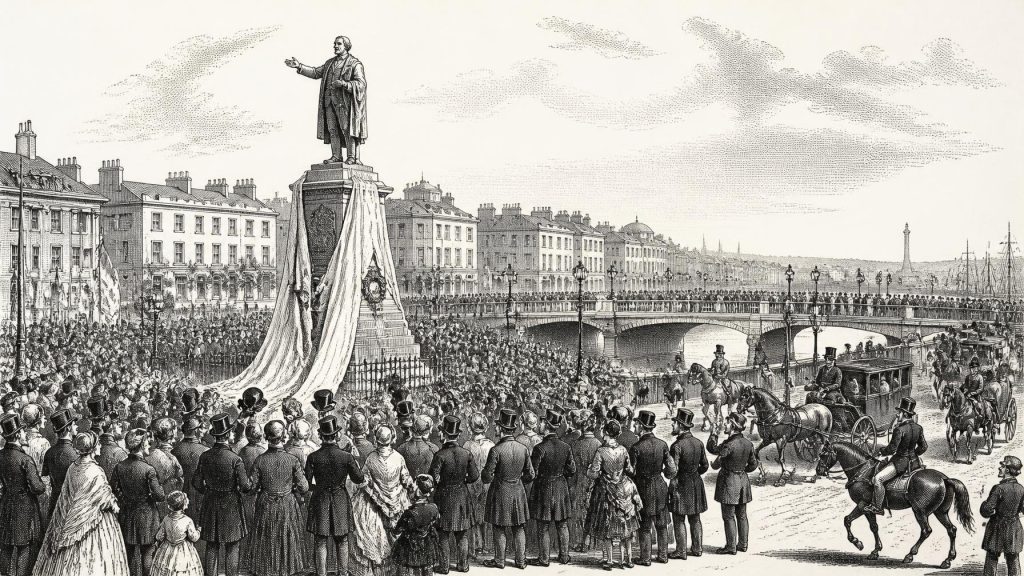
Dublin supplied a striking civic counterpoint to the year’s violence. On 15 August, amid the Industrial and Agricultural Exhibition in the Rotunda Gardens, the Daniel O’Connell Monument was unveiled at the south end of Sackville Street. The new and widened Carlisle Bridge was renamed O’Connell Bridge. John Henry Foley had designed the great granite-and-bronze memorial; after his death, Thomas Brock completed it. Its imagery—O’Connell, emancipation, Erin and figures representing civic virtues—placed constitutional mass politics visibly in the capital’s streetscape. The ceremony did not erase the tensions of 1882. Rather, it asserted an alternative inheritance: public mobilisation, Catholic emancipation and national dignity represented through law, speech and popular commemoration.
That contrast makes 1882 unusually revealing. The Phoenix Park killings were neither the whole of Irish nationalism nor an accidental footnote to it; they reshaped the possibilities open to every party. The Arrears Act brought material help to many distressed small tenants, while the Crimes Act strengthened the state. Maamtrasna demonstrated the perils of justice without linguistic equality. The National League and the O’Connell monument, meanwhile, showed that constitutional nationalism was reorganising itself in institutions, symbols and public space. Ireland left the year still divided and policed, but with the land question more firmly joined to the demand for national self-government.
Primary Sources
- Burke, Thomas Henry | Dictionary of Irish Biography
- Cavendish, Lord Frederick Charles | Dictionary of Irish Biography
- Forster, William Edward | Dictionary of Irish Biography
- Spencer, John Poyntz | Dictionary of Irish Biography
- Davitt, Michael | Dictionary of Irish Biography
- Parnell, Charles Stewart | Dictionary of Irish Biography
- Brady, Joe | Dictionary of Irish Biography
- Carey, James | Dictionary of Irish Biography
- Healy, Timothy Michael | Dictionary of Irish Biography
- Harrington, Timothy Charles | Dictionary of Irish Biography
- Kilmainham – The Treaty that Never Was
- Kilmainham Gaol Document Pack
- Arrears of Rent (Ireland) Act 1882
- Prevention of Crime (Ireland) Act 1882
- Arrears Of Rent (Ireland) (Recommitted) Bill—Bill 213
- Arrears of Rent (Ireland) Bill, Lords debate, 27 July 1882
- Information Note: The Maamtrasna Case
- The Maamtrasna Murders: The Trial of Myles Joyce
- The Maamtrasna Murders: The Trial of Myles Joyce
- O’Connell Monument, O’Connell Street Lower, Dublin 1
- Dublin, O’Connell Street Lower, O’Connell Monument
- The Constitution of the Irish National League
- The Telephone Company of Ireland, 1878–93: An Exploration of the Early Marketing, Development, Expansion, Financing and Users of Telephony
- Chapter 9: My Personal Finances, the Phoenix Park Murders, and the Parnell Tribute
- Appendix: Irish Land War Legislation [1958]