
Mercy House and Foyle Baseline1827 CE
In 1827, Ireland remained politically unsettled as Catholic emancipation was debated but denied, despite petitions, Daniel O’Connell’s New Catholic Association and concern for vulnerable forty-shilling freeholders. The Petty Sessions Act regularised magistrates’ courts, while Beggars Bush Barracks reflected the state’s military reach. Fever, drought and harvest uncertainty exposed rural precarity. Religious controversy appeared in Dublin’s Maguire–Pope debate, alongside Franciscan restorations and Catherine McAuley’s lay House of Mercy. Ordnance Surveyors began the Lough Foyle baseline, initiating systematic mapping. In Callan, Amhlaoibh Ó Súilleabháin commenced his Irish-language diary, recording everyday life and cultural continuity amid administrative, religious and social change during 1827.
Dateline
Ireland in 1827 did not experience a single, decisive political settlement. Catholic emancipation was still unresolved, rural insecurity remained close to the surface, and government was attempting to make its local machinery more regular. Yet the year left unusually tangible traces: a new charitable house opened on Dublin’s Baggot Street; surveyors began the exact measurement from which the first Ordnance Survey of Ireland would grow; Franciscan worship returned to restored friary churches; and an Irish-language diarist began a record of everyday life in County Kilkenny. These were developments of different scales, but together they show a country in which political exclusion, religious renewal, expanding administration and local culture existed side by side.
Emancipation Without Settlement
The central public question was the continuing exclusion of Roman Catholics from parliament and from a range of public offices. The Act of Union had joined Ireland to Great Britain in 1801, but it had not removed the oaths and tests that prevented Catholics from taking seats at Westminster. For a Catholic majority, this was not an abstract constitutional anomaly. It was bound up with access to authority, the position of the established Church of Ireland, local patronage and the security of Catholic voters and tenants.
In the opening months of 1827, petitions and debate at Westminster kept the matter before the British political nation. A petition from the Roman Catholic bishops of Ireland was presented to the House of Commons on 2 March, asking for the repeal of religious tests and disabilities. Debate in the Lords also demonstrated the sharpness of the argument: supporters described the disabilities as unjust and destabilising, while opponents continued to represent emancipation as a threat to the Protestant constitution. No relief measure became law that year. That negative fact matters: the tension in 1827 lay precisely in the gap between increasingly organised Catholic political pressure and the refusal of parliament to provide a final settlement.
The change of ministry in London made the issue seem newly open. George Canning became prime minister in April and was identified with the cause of Catholic relief, though his ministry was short-lived; he died on 8 August 1827. In Dublin, the New Catholic Association continued to operate from the Corn Exchange under Daniel O’Connell’s leadership. Surviving reports of meetings on 28 and 30 April show an organisation sustained by letters, printed addresses, committees and subscriptions, rather than merely by great speeches. They also reveal its concern for forty-shilling freeholders: small property-qualified voters whose dependence upon landlords could turn an election or a political declaration into a personal economic risk.
In July, correspondence read at an Association meeting complained that the Catholic rent was not being collected vigorously enough and that freeholders in Waterford still needed protection from retaliation. Such records do not mean that every Catholic tenant was politically mobilised, or that the Association commanded Ireland uniformly. They do show, however, how a national campaign entered parish and county life. O’Connell’s achievement in this period was organisational as well as rhetorical: he and his allies created channels through which small contributions, local grievances and electoral anxieties could be made visible in Dublin and, through the press and petitions, in London.
Courts, Barracks and the Reach of the State
Administrative reform advanced in a more prosaic register. The Petty Sessions (Ireland) Act received royal assent on 2 July 1827. Petty sessions were magistrates’ courts dealing with a wide range of lesser civil and criminal matters. The Act enabled the fixing or alteration of petty-sessions districts and venues, provided for clerks, regulated fees and required written registers of summonses and proceedings. It even specified that a rented justice room should not be in a house selling alcohol. These provisions were not a democratic reconstruction of local justice: magistrates remained central, and access to law could still be unequal. But the Act promoted more standardised places, paperwork and routines in a system that shaped many ordinary encounters with authority.
The same year is associated with the building of Beggars Bush Barracks in Dublin, another reminder that the Union state rested upon a substantial military presence as well as civil administration. Barracks, magistrates, revenue officers and parish institutions formed part of the landscape through which rural unrest, property disputes and public order were managed. For many people, government was encountered less in parliamentary debate than in a summons, a constable, a landlord’s agent, a tax demand or soldiers passing through a town.
Contemporary official chronology also records a fever epidemic and drought causing a poor harvest in 1827. The surviving evidence should be handled carefully: weather and harvest experience varied markedly between districts, and one Catholic Association letter later referred to an abundant harvest in its own locality. Nevertheless, the conjunction of fever and harvest anxiety points to the vulnerability of a poor, heavily rural population. Families with little reserve of food or cash could be badly affected by a local crop failure, illness or interruption to seasonal work. This was not the Great Famine, which belonged to a later generation, but it was a society in which subsistence remained precarious.
Faith in Public View
Religious controversy was conspicuous in Dublin in April. From 19 to 25 April, the Roman Catholic priest Thomas Maguire and the Protestant clergyman Richard T. P. Pope held six days of public theological discussion in the lecture room of the Dublin Institution. Printed reports preserve the formal rules, the subjects debated and the determination to regulate an encounter that could otherwise have inflamed denominational feeling. The event illustrates both division and confidence: religious difference was vigorously argued before an audience, in print, within an urban culture of lectures, pamphlets and disputation.
Elsewhere, Catholic institutional life was becoming more visible in material form. At Clonmel, the Franciscan friary was restored in 1827. In County Westmeath, the Franciscans restored worship at Multyfarnham’s old friary church after a long interruption; Mass returned to the revived church that year. These were local developments, not evidence that all legal or social restraints upon Catholicism had disappeared. Their importance lay in continuity. Medieval religious sites, long damaged or altered, were again being adapted for living communities and public worship.
A particularly consequential Dublin initiative began on 24 September, the feast of Our Lady of Mercy. Catherine McAuley’s partly finished House of Mercy on Baggot Street received its first resident helpers, Catherine Byrn and Anna Maria Doyle. McAuley had used an inheritance to establish a house intended to assist poor servant girls, homeless women and poor children through shelter, instruction and practical care. It was not yet a convent or the Sisters of Mercy, which would be founded only later. In 1827 it was a lay charitable undertaking, shaped by Catholic conviction but directed towards pressing social needs among women and children in the city.
Measuring the Island
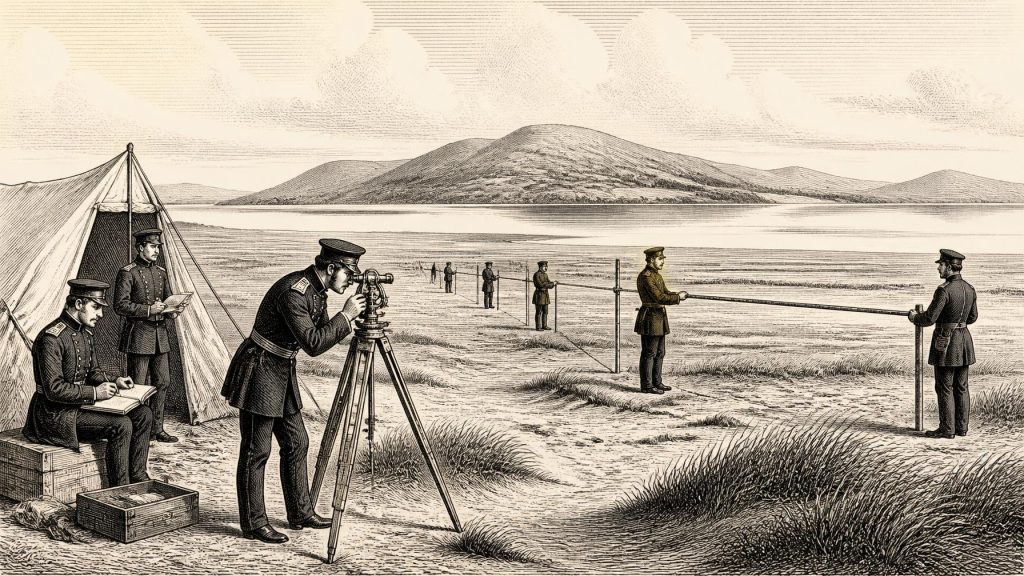
On 6 September 1827, Ordnance Survey staff began measuring the Lough Foyle baseline between the Magilligan and Ballykelly area. This was a foundational operation, not the completion of a national map. The measuring continued into November 1828, but its first season belongs firmly to 1827. Under Major-General Thomas Colby’s direction, surveyors used carefully designed compensation bars to reduce errors caused by changes in temperature. From a precisely measured line, a triangulation network could be extended across the island.
The enterprise combined scientific ambition with practical government. Ireland was to be mapped in unprecedented detail, including its townlands, roads, physical features and boundaries. The first published sheets still lay ahead, so it would be wrong to imagine Irish people in 1827 suddenly possessing modern maps of their localities. But the work at Lough Foyle marked the beginning of a transformation in how land could be measured, taxed, valued, administered and understood. The survey’s methods would eventually leave a deep imprint on place-names, property records, archaeology and historical research.
A Diary Begins in Callan
On 1 January 1827, Amhlaoibh Ó Súilleabháin, also known as Humphrey O’Sullivan, began the Irish-language diary later called Cín Lae Amhlaoibh. A linen draper, former hedge-school teacher and active participant in local Catholic politics, he wrote from Callan in County Kilkenny. His diary would continue for years, but its beginning belongs to this calendar year and is itself an important cultural event. It is a rare extended record in Irish of nineteenth-century daily life, attentive to weather, work, trade, travel, news, people and language.
The diary cautions against treating pre-Famine Ireland as an undifferentiated rural mass. O’Sullivan moved through networks linking Callan with larger towns and markets, dealt in commodities, retained deep knowledge of Irish tradition and used writing to interpret the changing world around him. His manuscript also demonstrates that Irish remained a living written language in parts of the country, even as English expanded through administration, commerce and schooling.
Thus 1827 was a year of beginnings rather than resolution. The House of Mercy opened its doors; a baseline was laid across the Foyle shore; a diary commenced in Callan; and courts were given more regular procedures. At the same time, Catholic emancipation remained incomplete, public theological dispute was intense, and illness and harvest uncertainty exposed enduring hardship. Ireland’s future was not settled in 1827, but several institutions and records begun or renewed that year would make its social and political transformation easier to see.
Primary Sources
- An Act for the better Administration of Justice at the holding of Petty Sessions by Justices of the Peace in Ireland
- The Office of the Chief Secretary of Ireland: Chronology
- Memorandum of meetings entitled 'Proceedings of the New Catholic Association held at The Corn Exchange Dublin', Saturday 28 April 1827, and 'Proceedings of the Separate Meeting' Monday 30 April 1827
- Catholic Emancipation—Petition of the Roman Catholic Bishops of Ireland
- Catholic Emancipation
- The New Administration—Exposition of the Late Ministers
- O'Connell, Daniel
- Receipt and expenditure of new Catholic rent for all purposes not prohibited by law
- Important controversial discussion between the Rev. Mr. Pope and the Rev. Mr. Maguire, on the doctrines of the Church of Rome, &c.
- The Celebrated Controversial Discussion Between the Rev. Thomas Maguire and the Rev. Richard Pope, 1827
- Introducing Catherine
- 1827 – an important year for the Franciscans in Multyfarnham
- SS. Peter & Paul’s Clonmel: Friary
- The Origin of Ireland’s Ordnance Survey
- The Lough Foyle Base Line
- Marks of the Ordnance Survey
- Cinnlae Amhlaoibh Uí Shúileabháin = The diary of Humphrey O'Sullivan. Part I
- Diaries as Historical Sources
- ‘Very savage’: letters from a visitor to Ireland in 1827
- Currency Choices in Ireland Past and Present
- Activity Sheet 4: Beggars Bush Barracks