Carbury Castle’s Betrayal1305 CE
In 1305, Ireland experienced interconnected local conflicts amid divided Gaelic and Anglo-Irish lordships. Piers de Bermingham treacherously killed Muirchertach Ó Conchobair Fhailghe, his brother and leading followers at Carbury Castle, exposing fragility of frontier agreements. Áed Ó Conchobair’s forces defeated Muintir Raighilligh, causing heavy losses, while warfare and killings disturbed Leinster, Desmond and Breifne. Annals also noted early-summer hardship, without specifying its cause. Richard de Burgh built Northburgh Castle on Lough Foyle, strengthening Ulster influence. Meanwhile, royal administration continued through payments, legal inquiries and ecclesiastical property regulation, illustrating Ireland’s patchwork of competing powers across towns, lordships, churches, and royal jurisdictions.

Dateline
In 1305, Ireland’s political landscape was marked less by a single national turning point than by a series of violent, local contests whose consequences travelled far beyond the places where they occurred. The surviving annals bring the year into unusually sharp focus: a massacre at Carbury Castle in Offaly, a major defeat in the Connacht–Breifne borderlands, warfare in Leinster and Desmond, hardship at the start of summer, and the building of a new stronghold on Lough Foyle. Together they show an island divided among Gaelic lordships, Anglo-Irish liberties, towns and ecclesiastical jurisdictions, all connected by raiding, alliance, trade, tribute and royal government.
A Safe Conduct Broken
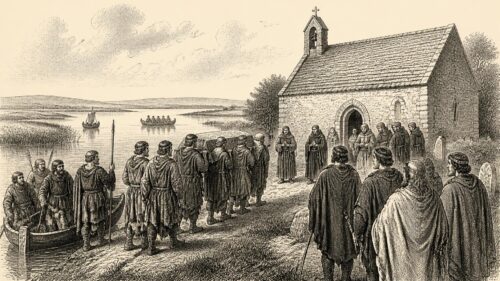
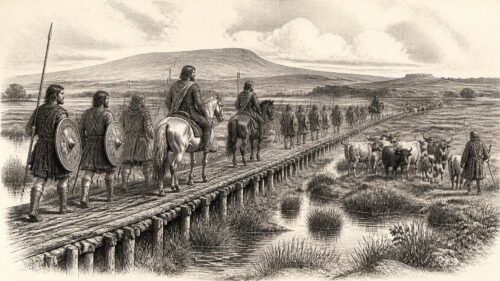
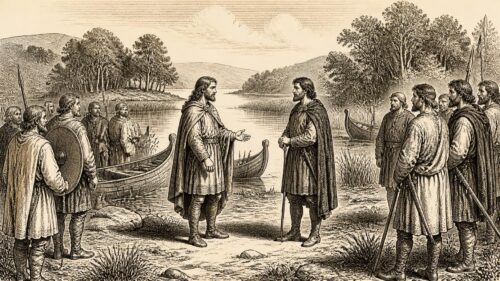
The year’s most notorious episode was the killing of Muirchertach Ó Conchobair Fhailghe, ruler of Uí Fhailghe in central Leinster, his brother Máel Mórda ‘an Calbhach’, and many of their followers at Carbury Castle. Annála Connacht records that Sir Piers Mac Feorais, or Piers de Bermingham, killed the brothers and twenty-nine leading men of their people by ‘hideous treachery’. The Annals of Inisfallen gives a still more elaborate and morally charged account: Piers had invited them in deceit, and had personal spiritual ties to the family through sponsorship at baptism and confirmation. Its account also reports the killing of a small child, the discovery of survivors hiding in the castle, and the delivery of heads to Dublin.
These details must be handled with care. The annals were not neutral court records, and the Inisfallen chronicler wrote with open anger. Yet the central fact is corroborated across Irish traditions and is firm: leading members of the ruling family of Uí Fhailghe were killed at the Bermingham stronghold in 1305. The event was more than an atrocity in private warfare. It exposed the precarious character of agreements across the frontier between the lordship of Ireland and independent or semi-independent Gaelic polities. The Inisfallen annalist’s warning against trusting either a king’s peace or ‘foreigners’ conveyed a Gaelic interpretation of the episode: formal assurances offered little protection when a neighbouring magnate judged violence advantageous.
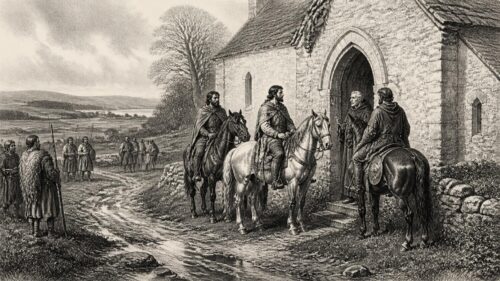
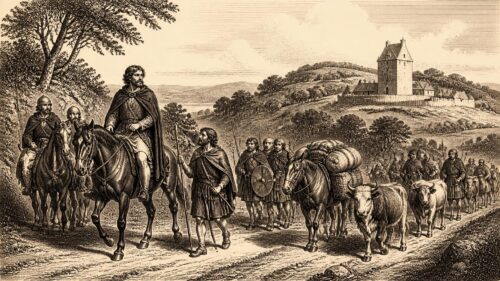
Carbury lay in a contested zone between the settlement and lordship structures of the English colony and the Gaelic territories of the midlands. Piers de Bermingham was no distant representative of crown authority, but a powerful marcher lord whose family’s estates and military interests were embedded in that landscape. The murder therefore illustrates a central reality of early fourteenth-century Ireland. English royal institutions existed, especially in Dublin and the shired counties, but local power was exercised through lordships capable of making war, holding castles and negotiating directly with Gaelic rulers. Kinship, fosterage and religious sponsorship could create bonds across cultural and political divisions; they did not prevent their violent breach.
Battle on the Connacht Border
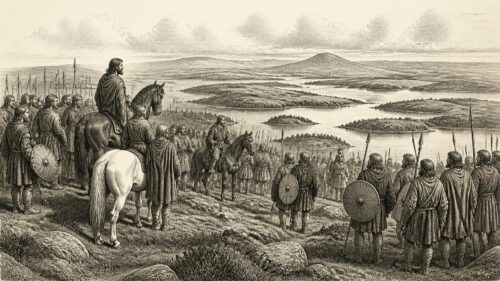
In the west and north-west, conflict between rival Gaelic interests produced another conspicuous body of casualties. Annála Connacht places a victory by Áed, son of Cathal Ó Conchobair, and Clann Muircheartaigh over Muintir Raighilligh in 1305. Pilip Ó Raighilligh was killed, along with the heirs of Clann Suibhne and a Mac Buirrce described as captain of the gallowglasses of the country; the annalist adds a total of 140 other dead. This was plainly not a small cattle raid. The naming of leading casualties and of a gallowglass commander suggests a serious encounter involving households and professional fighting men, on a frontier where Connacht, Breifne and the interests of the de Burgh lordship met.
The reference to gallowglasses is particularly revealing. These heavily armed mercenaries, frequently of Hebridean and Scottish family origin, had become a significant feature of Irish warfare. Their presence did not mean that armies were modern or centrally organised. Rather, it shows how regional lords combined kin-based followings, tenant obligations and paid military service. A commander’s death could alter the balance of power between a lord’s household and his rivals, while the loss of heirs made the political damage last beyond the battlefield.
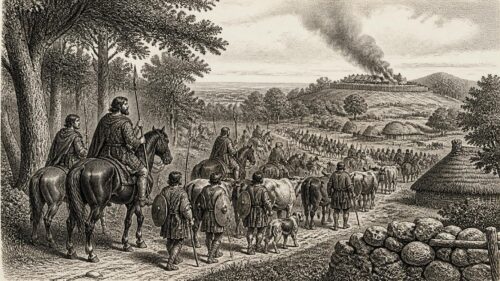
Other deaths recorded under the year underline the unsettled condition of Breifne and its neighbouring lordships. Matha Óg Ó Raighilligh was killed by the Tellach Dúnchada, while Áed Óg Ó Fearghail died. Such notices are brief, but they matter because lordship depended on living networks of kinsmen, clients, learned families and fighting retainers. The deaths of chiefs and prospective successors could open fresh disputes over land, tribute and leadership. For ordinary households, political conflict commonly meant danger to herds, crops and movement through the countryside rather than participation in a named battle.
A chronological caution is necessary here. The Annals of Ulster contains vivid notices of a further Connacht succession struggle under its entry labelled 1305, including the death of Áed, son of Eógan Ó Conchobair, and interventions by William de Burgh. However, other annal traditions place the same sequence in 1309. It should therefore not be presented as a securely dated event of the calendar year 1305. The discrepancy is a useful reminder that annal headings, although indispensable, must be compared rather than treated as infallible modern dates.
Hardship and Warfare in the South
The Annals of Inisfallen records ‘great hardship’ at the beginning of the summer. It does not identify the cause, so it would be unsafe to call this a famine or to attribute it to a particular harvest failure. Nevertheless, the remark preserves an important glimpse of conditions beyond elite politics. Early summer was the vulnerable interval before new grain could be gathered, when stores from the previous harvest might be low. In a year of recurrent raiding and insecurity, shortage could be especially acute for labourers, tenants and those without substantial livestock or granaries.
Munster was also turbulent. Geoffrey Óc de Carew was killed on May Day by sons of Fíngen Ó Mathgamna. Ruaidrí Buide Mac Mathgamna and his kinsman Tadc were killed at Dísert Muirthile by Tairdelbach Óc Ó Briain and Donnchad, son of Muiris Ó Cennétig; the annalist preserves uncertainty over who betrayed them. Further killings involved Mac Carthaigh, Ó Briain and Ó Súilliubáin interests. The same source summarised the wider position starkly as ‘great warfare’ between foreigners and Gaels in Leinster and Desmond.
That phrase should not be read as a simple war between two fixed communities. Anglo-Irish families such as the Carews, Gaelic dynasties and local followers all made alliances and pursued feuds that did not always align with ethnic labels. Still, the annalist’s language reflects real tensions around landholding, military expansion and control of routes between the towns and the Gaelic lordships. Violence also reached religious personnel: Ó hInmainéin, described as a noble and pious coarb, was captured and killed, and Milis Ó Donnocáin and a kinsman died while seeking vengeance connected with that killing. Ecclesiastical office carried spiritual authority, land rights and local influence; churchmen were not insulated from political conflict.
A Castle on Lough Foyle
At Ireland’s northern edge, Richard de Burgh, the ‘Red Earl’ of Ulster, built a new castle in Inishowen. The annals call it simply the new castle of Inis Eógain; it is generally identified with Northburgh, now Greencastle, on the western side of the entrance to Lough Foyle. The construction belongs securely to 1305, though the precise stages of planning and building cannot be recovered from the terse notice.
This was an assertion of lordly power in stone. A castle at the lough’s mouth could oversee a maritime approach and support the earl’s influence in north-west Ulster, where Gaelic powers in Tír Eógain and Tír Chonaill remained formidable. It also belonged to a wider world of sea crossings: Ulster, western Scotland and the Isles were linked by travel, trade, kinship and the movement of soldiers. The fortress should not be imagined as controlling every shore or community around it. Its significance was that it gave the earl a durable base, a defended landing-place and a visible claim to authority at a strategically important inlet.
Church, Town and Administration
Religious life was woven through these political pressures. Annála Connacht records the death of Donnchad Ó Flaithbertaig, bishop of Killala, under 1305 and praises him as exceptionally chaste and pious. Ecclesiastical succession lists, however, place his death around February 1306. The safest conclusion is that his final illness or death lay close to the year’s boundary, and that the annal’s dating should not be converted into a falsely precise 1305 event. The discrepancy also shows why medieval Irish chronology requires restraint.
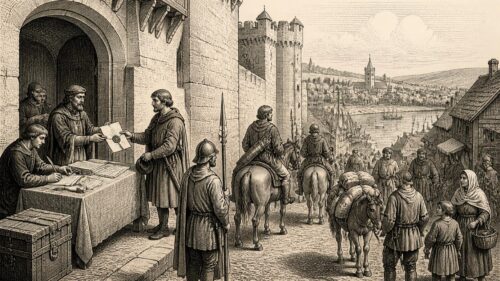
Firmly dated administrative records reveal a different Ireland from the annals of raids and killings. On 1 July 1305, the English crown ordered payment to John Wogan, justiciar of Ireland, towards his annual salary. On 28 December, a writ instructed Wogan to inquire whether it would damage royal interests if Maurice, archbishop of Cashel, granted land at Fethard to Augustinian friars for a new manse. The resulting inquiry, undertaken at Cashel in 1306, recorded a modest plot valued at twelve pence yearly. Such business concerned salaries, landholding, ecclesiastical patronage and legal procedure: routine mechanisms of government that continued even while lordships fought.
Thus 1305 was not merely a year of bloodshed. It was a year in which castles were built, clerical property was regulated and administrative wages were paid; but these quieter processes existed alongside betrayal, warfare and reported hardship. Carbury Castle’s massacre most clearly captures the year’s instability, while Northburgh’s construction shows the parallel drive to secure power through permanent structures. Ireland in 1305 was neither wholly conquered nor wholly outside royal rule. It was a patchwork of authorities, in which trust, force, faith and local survival were continually tested.
Primary Sources
- Annála Connacht: Annal 1305
- Annála Connacht (Irish text): Annal 1305
- The Annals of Ulster: Year U1305
- Annala Uladh: Year U1305 in the Irish text
- Annals of Inisfallen: Annal AI1305
- Annals of Inisfallen: Navigator and edition index
- Annals of the Four Masters, English translation, Volume 3
- Annals of the Four Masters, Irish text, Volume 3
- Annales Hiberniae
- Annals of Dublin from 1173 to 1500
- Calendar of Documents Relating to Ireland, Volume 5, Item 483 (28 December 1305)
- Close Roll 33 Edward I (1304–1305), Item 19
- English Pipe Roll 33 Edward I: Richard de Bereford, treasurer of Ireland
- Burgh, Richard de
- Bermingham, Peter (Piers, Feoras) de
- Irish Castles: 1180 to 1310
- Journal of the Royal Society of Antiquaries of Ireland: material on Anglo-Norman Ulster and Northburgh
- Acts of Archbishop Colton in His Metropolitan Visitation of the Diocese of Derry
- Definition and Classification of Ireland’s Seascapes
- Donegal County Council material on Greencastle and Inishowen heritage