O’Connell at Ennis1828 CE
Daniel O’Connell’s decisive County Clare by-election victory at Ennis in 1828 exposed the contradiction of allowing Catholic freeholders to vote while barring Catholic MPs from taking Westminster oaths. Challenging ministerial supporter William Vesey Fitzgerald, O’Connell secured 2,057 votes to 982, aided by priests, organisers and disciplined popular mobilisation. Though unable to take his seat, he forced government and parliament to confront Catholic exclusion. The campaign demonstrated constitutional agitation’s power amid rural poverty, contested education, coercive criminal law, and uneven economic development. Belfast’s new Botanic Garden and expanding trade statistics reflected urban and administrative ambitions, while Clare transformed local politics nationally.
Dateline
In 1828, an election in County Clare turned an apparently technical parliamentary formality into the most consequential Irish political confrontation of its generation. Daniel O’Connell’s victory at Ennis did not itself win Catholic emancipation: when the year ended, he remained legally unable to take the seat to which Clare had elected him. Yet the contest demonstrated, with unusual clarity and discipline, that Ireland’s Catholic majority could organise voters, clergy, funds and public opinion on a national constitutional question. The immediate issue was a single Westminster seat. The larger issue was whether the United Kingdom could indefinitely deny Roman Catholics full political participation while permitting many of them to vote.
A Constitutional Contradiction
The position of Irish Catholics in 1828 contained a glaring contradiction. Since 1793, qualifying Catholics in Ireland had been able to vote in parliamentary elections, and Catholic candidates could put themselves before an electorate. But a successful Catholic could not take the parliamentary oaths required at Westminster without denying principles of his religion. The franchise thus gave Catholic freeholders a voice in choosing representatives while excluding a Catholic whom they might choose from sitting as one.
That contradiction mattered because the campaign for Catholic relief had already created a wide political network. O’Connell, a barrister from Kerry and the foremost public advocate of Catholic claims, had helped make the Catholic Association a national force. Its support was drawn from bishops, priests, middle-class activists, members of the Catholic gentry and the modest contributions known as the Catholic Rent. Government records from 1828 preserve subscriptions sent from places far beyond Clare, as well as accounts of meetings at Dublin’s Corn Exchange. The organisation was not a substitute parliament, as hostile contemporaries alleged, but it was a powerful extra-parliamentary means of coordinating petitions, publicity, finance and electoral action.
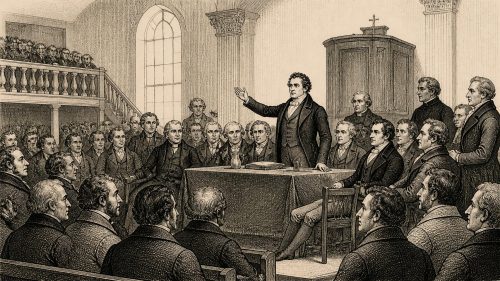
At Westminster, the question remained unresolved. In June, the Lords debated whether the laws affecting Roman Catholics in Britain and Ireland should be reconsidered in pursuit of peace and concord. The debate exposed the scale of the division. Advocates of relief argued that exclusion itself fostered grievance and instability; opponents treated the Protestant establishment, especially in Ireland, as inseparable from the constitutional order. These were not abstract theological disputes. They concerned offices, political authority, education, the established church and the governing of a country where most people were Catholic.
The Clare Challenge
The opening came through William Vesey Fitzgerald, Clare’s sitting member of parliament. A well-connected Irish politician and a comparatively popular local landlord, he was appointed President of the Board of Trade in June 1828. Under the convention governing ministerial appointments, he had to seek re-election. Normally that requirement might have brought an uncontested return. Vesey Fitzgerald was personally sympathetic to Catholic relief, which initially made it difficult for the Catholic Association to find anyone willing to oppose him.
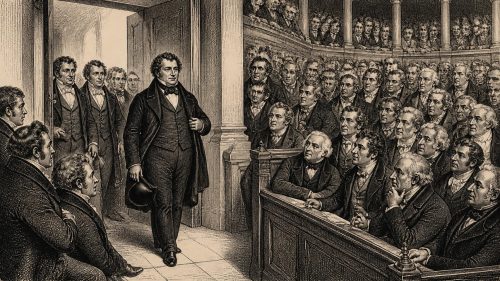
The Association had, however, resolved to challenge Irish supporters of the Wellington–Peel ministry. O’Connell eventually accepted the invitation to stand. He issued an address to Clare electors on 24 June, fully aware that election could not by itself get him into the House of Commons. The decision transformed a local by-election into a test of whether an Irish Catholic electorate could impose a political fact that the existing parliamentary settlement had no easy way to absorb.
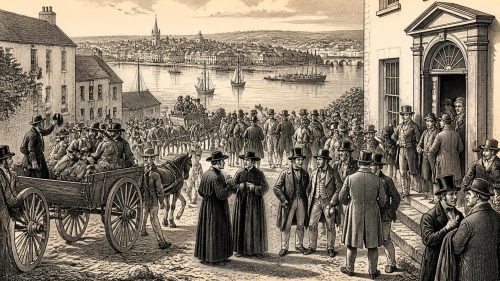
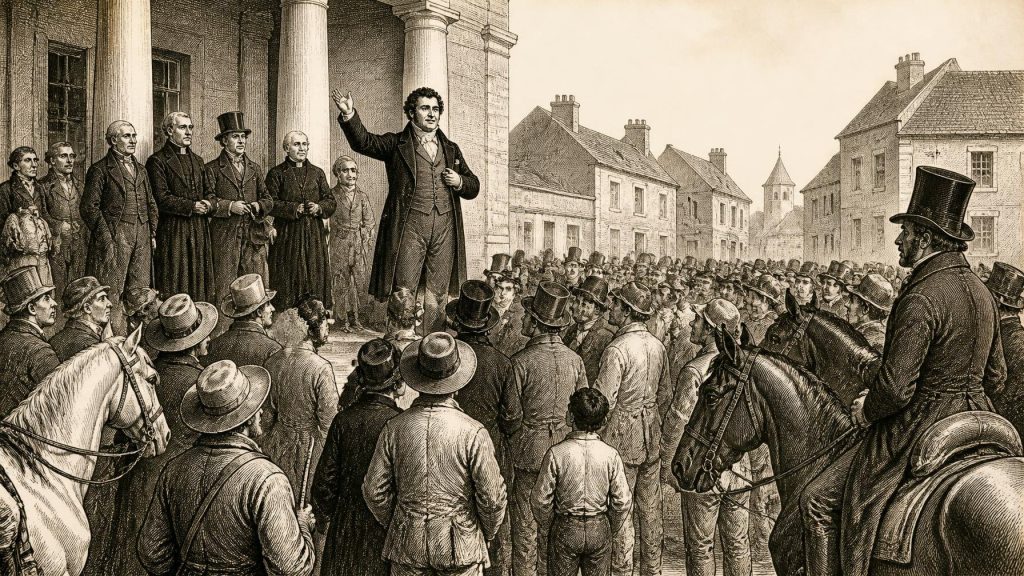
The election was held publicly, not by secret ballot. Voters declared their choices before the sheriff and the crowds at Ennis, leaving them exposed to the observation and possible pressure of landlords, agents, neighbours and clergy. The electorate was also narrow by modern standards, though in Ireland it included many Catholic forty-shilling freeholders: small holders whose land qualification entitled them to vote. Their participation was decisive. The contest showed that votes which landlords had long expected to command could be cast according to a national religious and political cause.
Polling began on 1 July and continued until 5 July. O’Connell won decisively, receiving 2,057 votes to Vesey Fitzgerald’s 982. The result was all the more striking because the defeated candidate was neither an unknown outsider nor an uncomplicated enemy of Catholic claims. Clare’s freeholders had rejected a locally established, pro-relief Protestant landlord in favour of a Catholic candidate who was barred from taking his seat. Their verdict made the constitutional defect impossible to ignore.
Priests, Freeholders and Order
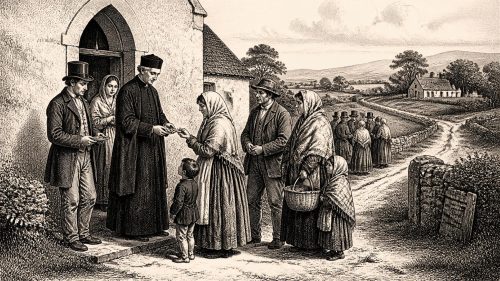
The election’s mechanics reveal why it resonated so widely. Priests worked energetically for O’Connell, travelling with and encouraging voters, while lay organisers such as Thomas Steele and James Patrick O’Gorman Mahon helped direct the campaign. Clerical activity was politically significant not because every priest commanded every parishioner, but because priests possessed local knowledge, authority and routes of communication in communities that had little access to formal political power. Their intervention connected parish life to a national campaign.
Contemporary reports sent to Dublin Castle are especially revealing. Officials and supporters of Vesey Fitzgerald complained that landlord influence had been overturned and that the clergy had gained control of the electorate. Yet the same reports repeatedly registered surprise at the orderliness of the immense gatherings. Crowds arrived in organised bodies; observers noted that they were sober, quiet and effectively marshalled. The sheriff requested extra forces to preserve the peace, but military observers recorded that O’Connell’s supporters themselves helped prevent disorder. This did not make the campaign free from intimidation, tension or partisan exaggeration. It does show that O’Connell’s strategy depended on disciplined mass mobilisation rather than an armed rising.
That restraint was central to the political achievement of 1828. O’Connell had long insisted that constitutional agitation could extract concessions denied to rebellion. At Ennis, voters and non-voters alike made a dramatic demonstration without giving the government the obvious pretext of violence. The crowds mattered even when they lacked a vote: they supplied visibility, solidarity and pressure. The voters, meanwhile, supplied the legal result.
Victory Without a Seat
O’Connell’s return did not settle the matter. The oath required of a member of parliament remained incompatible with Catholic conscience, so the successful candidate could not simply enter the Commons and take his place. It is therefore misleading to treat 1828 as the year of Catholic emancipation. No general settlement had been enacted by December. What happened was more immediate and more disruptive: Clare had elected a man whom the law would not permit to serve, forcing ministers and parliament to confront the contradiction in practical form.
The result altered the calculations of the Wellington government and of those defending the existing settlement. It suggested that further elections could produce similar confrontations, while resistance to the Clare verdict risked widening public agitation in Ireland. O’Connell’s victory also gave Catholics a powerful claim to have acted within, rather than outside, the constitutional system. The election was not a revolution, but it made political exclusion harder to defend as a stable basis for government.
Life Beyond the Hustings
The drama at Ennis unfolded against deep social strain. Parliamentary discussion in 1828 repeatedly returned to the severe poverty of much of rural Ireland, though speakers disputed both its causes and its remedies. Ireland had no statutory poor-law system. Relief for people unable to work depended heavily on family support, neighbours, charity, landlords, religious bodies and voluntary institutions. In the Lords, speakers described a large population willing to work but unable to find regular employment; others challenged both the diagnosis and the proposed solutions. The disagreement itself is important: Ireland’s poverty was visible enough to be a parliamentary issue, but there was no agreed public framework for addressing it.
For many labouring households, subsistence rested on small plots, potatoes, pigs, seasonal earnings and precarious access to land. A good market for pigs and a cheap potato supply could offer a temporary breathing space, but neither altered insecurity created by underemployment, low cash incomes and dependence on a narrow range of resources. Political mobilisation did not remove those pressures. It did, however, give many poor Catholic freeholders an arena in which their choices could have national consequences.
Education was another contested field. In March, the Commons considered whether reports on Irish education should be sent to a select committee. The debate exposed distrust of institutions associated with the established church and the difficulty of designing schools acceptable to Catholics and Protestants alike. Catholic leaders were prepared to contemplate shared schooling only where separate religious instruction and acceptable books and teachers were safeguarded. The argument was about literacy and schooling, but also about parental authority, proselytism and control over the moral formation of children. A universally accepted national system was still some distance away.
Legislation also reflected the continuing effort to rationalise government and law across the United Kingdom. The Criminal Law (Ireland) Act of 1828 formed part of a wider consolidation of criminal statutes. Its provisions remind us that the state’s presence in everyday life was not confined to elections: prosecution, imprisonment, transportation and capital punishment remained central features of the legal order. Political hopes in 1828 therefore existed alongside formidable coercive powers.
Gardens, Trade and Urban Ambition
Not every development was a constitutional crisis. In Belfast, promoters established the Botanic and Horticultural Garden on land outside the growing town. Contemporary notice described a fourteen-acre project financed through five-guinea shares, intended as a place of resort, a centre for botanical study, a means of improving gardening and an aid to agriculture. Its subscription model reveals the confidence of a commercial and professional urban society able to invest in scientific recreation and practical improvement.
Trade, too, was being measured with increasing care. A parliamentary account produced in 1828 compared Irish imports and exports over more than a century, while later series preserve annual figures for the period. Such returns do not describe the whole economy, especially internal trade with Great Britain or the uneven distribution of income, but they show the growing administrative importance of commercial statistics. Ireland in 1828 was connected by ports, markets and migration to Britain and the wider empire, even as its rural majority experienced that connected economy very unevenly.
Thus the year’s defining event was not isolated from ordinary life. The Clare election drew its strength from parishes, small holdings, priests, market towns, fundraising networks and an electorate conscious of both religious exclusion and social hierarchy. At Ennis, O’Connell’s supporters turned those local worlds into a national constitutional challenge. By the close of 1828 the law had not caught up with their vote, but Irish politics had been permanently changed.
Primary Sources
- The Clare Election of 1828
- O'Connell, Daniel
- Fitzgerald, William Vesey
- The Registered Papers of the Chief Secretary's Office: 1828 Outrage Reports
- The Registered Papers of the Chief Secretary's Office: Catholic Association
- Councillor O'Connell's Grand Address: To the Freeholders of the Co. Clare
- Marking Daniel O’Connell’s Birthday
- Roman Catholic Claims, House of Lords, 9 June 1828
- Roman Catholic Claims, House of Commons, 12 June 1828
- State of the Population of Ireland, House of Lords, 1 May 1828
- Education in Ireland, House of Commons, 11 March 1828
- Repeal of the Test and Corporation Acts, House of Commons, 26 February 1828
- Test and Corporation Acts: Petition of Roman Catholics for Repeal Of, House of Commons, 14 February 1828
- Criminal Law (Ireland) Act, 1828
- Account of Exports and Imports of Ireland, 1720, 1760, 1790, 1800, 1810, 1820 and 1827
- International Trade
- Notes and Papers Relating to Belfast Natural History Society
- Botanic Gardens History
- The Terry Alt Movement 1829–31
- Who Was Terry Alt?
- Agrarian Conflict in Clare, 1815–1831: The Terry Alts
- 1828