Membership is completely free, giving members unlimited access to all available resources, services, features, and benefits without any restrictions or fees.
Welcome back. Sign in to continue enjoying unlimited access to all available resources, services, features, and member benefits at no cost.
The immediate background belonged to the years before 1829, but it determined the shape of this one. Daniel O’Connell, a Kerry-born barrister and leader of the Catholic Association, had been elected for County Clare in July 1828. As a Catholic, he could not take the existing oath required of a member of parliament. His election nonetheless demonstrated that a Catholic candidate could defeat the nominee of major Protestant property and government influence through open, legal electoral mobilisation. The result placed the ministry of the Duke of Wellington and the home secretary, Robert Peel, under pressure to find a settlement which they had previously resisted.
The position of Irish Catholics in 1828 contained a glaring contradiction. Since 1793, qualifying Catholics in Ireland had been able to vote in parliamentary elections, and Catholic candidates could put themselves before an electorate. But a successful Catholic could not take the parliamentary oaths required at Westminster without denying principles of his religion. The franchise thus gave Catholic freeholders a voice in choosing representatives while excluding a Catholic whom they might choose from sitting as one.
The central public question was the continuing exclusion of Roman Catholics from parliament and from a range of public offices. The Act of Union had joined Ireland to Great Britain in 1801, but it had not removed the oaths and tests that prevented Catholics from taking seats at Westminster. For a Catholic majority, this was not an abstract constitutional anomaly. It was bound up with access to authority, the position of the established Church of Ireland, local patronage and the security of Catholic voters and tenants.
On 5 January, the Currency Act of 1825 took effect in Ireland. It assimilated Irish currency to that of Great Britain, establishing sterling as the uniform money of account throughout the United Kingdom. This was not simply a matter of coin in a purse. The Irish pound had stood at a different value from sterling: a British pound had formerly been reckoned as £1 1s. 8d. Irish. The new arrangement required contracts, rents, debts, bank business, public accounts and ordinary commercial calculations to be understood in British currency. The Act expressly sought to prevent disturbance between debtors and creditors, but its practical effect was to make Ireland’s financial language more directly uniform with that of Britain.
The central political event was the Unlawful Societies (Ireland) Act, which received royal assent on 9 March. It extended earlier restrictions on bodies claiming to represent the people or to seek redress of grievances in church or state. Its immediate political target was widely understood to be the Catholic Association, founded in 1823 by O’Connell, Richard Lalor Sheil and others to press for Catholic Emancipation. Its provisions also bore upon Orange organisation. The law did not grant Catholics the parliamentary and office-holding rights they sought; instead, it attempted to remove the national political machinery that had made those demands so powerful.
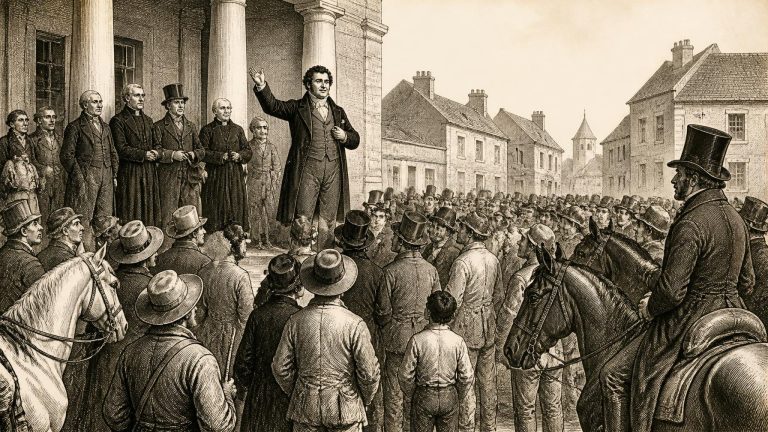
The firmest political turning point of the year came in the Catholic Association’s adoption of what became known as the Catholic Rent. O’Connell had helped found the Association in 1823 to pursue Catholic emancipation: the removal of remaining legal disabilities that excluded Roman Catholics from parliament and important offices. Early in 1824 he advanced a deliberately modest subscription: a penny a month, or a shilling a year, could make a contributor an associate member. The smallness of the payment was the point. It enabled a national political body to draw support from people who could never have afforded the guinea subscription expected of full members.
The firmly dated moment came on 10 May, when an aggregate meeting at Townsend Street Chapel, Dublin, resolved to form the Catholic Association. Lord Killeen chaired the gathering. O’Connell moved the proposal, Sir Thomas Esmonde seconded it, and Richard Lalor Sheil was among its prominent advocates. Its stated object was the redress of Catholic grievances, above all the remaining legal disabilities that denied Catholics full participation in public life. The place was significant: a Catholic chapel in the capital became a venue for political deliberation at a time when religious affiliation still shaped access to power.