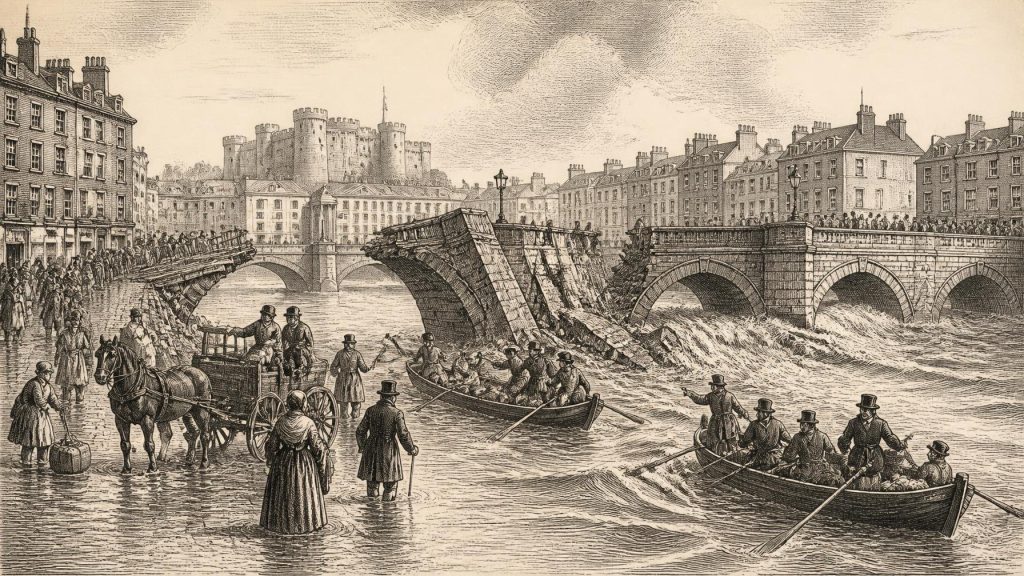
Ormond Bridge’s Winter Torrent1802 CE
In 1802, Ireland adjusted to Union government as its first Westminster election exposed restricted representation and Catholic exclusion. The Treaty of Amiens briefly eased fears of French intervention, yet official vigilance persisted and Robert Emmet’s return signalled surviving revolutionary ambition. Social initiatives addressed poverty and disease: Edmund Rice began educating poor Catholic boys in Waterford, Cork opened a fever hospital, Dublin’s dispensary aided the poor, and Belfast’s library gained Linen Hall premises. In December, torrential rain flooded Dublin, bursting rivers and destroying Ormond Bridge. These events revealed a society experiencing constitutional change, unresolved grievances, voluntary reform, urban hardship and vulnerability.
Dateline
In 1802, Ireland was living through the unsettled first full year of the United Kingdom created by the Act of Union. The separate Irish parliament had ceased to exist on 1 January 1801, but the consequences of that constitutional change were still being worked out in streets, parishes, ports and county towns. This was not a year of open rebellion in Ireland. Yet it contained a revealing combination of apparent calm, political exclusion, fresh educational and charitable initiatives, revived underground ambition and a dramatic urban flood. Each exposed a different side of a country being governed in a new framework without having resolved the grievances that had helped produce the rebellion of 1798.
The First Union Election
Political life in 1802 was conducted under the new Union settlement. Ireland now sent 100 members to the House of Commons at Westminster: two for each of the 32 counties, members for selected boroughs and cities, and one for Trinity College Dublin. The arrangement sharply reduced the number of Irish borough seats compared with the old Dublin parliament, while preserving a political system in which land, property, patronage and established interests carried immense weight.
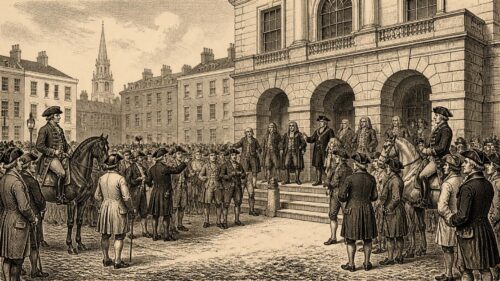
The general election held from 5 July to 28 August 1802 was the first election in which Irish constituencies returned members to a newly elected United Kingdom parliament. It therefore made the Union tangible. Westminster, not College Green, was now the destination for Irish MPs. The vote did not represent the population at large: the franchise was restricted, women did not vote, and many borough contests remained tightly managed by powerful patrons. Nevertheless, elections brought canvassing, expenditure, local loyalties and disputes over influence into public view across the island.
For Catholics, the new constitutional order brought a particularly painful contradiction. The Union had been associated, in Catholic expectation, with the prospect of further relief, but full political emancipation had not followed. Catholics could not sit in parliament. The issue was consequently not a later historical inevitability but an immediate frustration in 1802, felt alongside the more practical concerns of rent, work, harvests, credit and local security. Dublin Castle remained the centre of Irish executive government, while legislation and parliamentary authority had moved across the Irish Sea.
A Short Peace, An Enduring Anxiety
International diplomacy briefly changed the atmosphere. On 25 March, Britain and France signed the Treaty of Amiens, with the treaty taking effect two days later. Its language named the king of the “United Kingdom of Great Britain and Ireland”, a reminder that Ireland’s new political status was inseparable from Britain’s European war. The peace ended years in which French intervention and the memory of the 1798 landing at Killala had made Ireland appear strategically vulnerable.
The effect was real but temporary. Irish militia units were disembodied over the following months, giving many part-time soldiers a return to civilian life and removing one visible aspect of wartime mobilisation. The authorities did not, however, treat Ireland as a settled country. The recent rebellion, surviving United Irish networks and the possibility of another Franco-British rupture ensured continued official vigilance. By November, preparations to re-embody militia reflected how little confidence there was that peace would last. The Treaty of Amiens would indeed prove brief, but in 1802 its immediate importance lay in the pause it created: a pause in war, not a resolution of Irish political conflict.
Robert Emmet’s Return
That distinction is clearest in the movements of Robert Emmet. A former Trinity College student associated with the United Irishmen, Emmet had left Ireland for the Continent after 1798. His brother Thomas Addis Emmet and other state prisoners were released from Fort George on 30 June 1802, after the peace, and travelled into northern Europe. Robert joined Thomas in Amsterdam during August.
In the autumn Robert Emmet decided to return to Ireland. The precise course and extent of his early contacts are not fully recoverable, and his later denial of knowledge of a conspiracy has to be read against the circumstances that followed. What can responsibly be said is that his return marked the re-entry into Dublin of a determined young United Irishman who had become distrustful of French intentions but had not abandoned the cause of Irish independence. His father, Dr Robert Emmet, died on 9 December, leaving him £2,000. That inheritance would later be committed to insurrectionary preparations.
It is important not to turn 1802 into the year of Emmet’s rising: the attempted Dublin insurrection belongs to July 1803. In 1802, the development was preparatory and clandestine. It shows that the apparent easing of international tension did not extinguish revolutionary politics. The Union had removed the Irish parliament, but it had not reconciled former radicals to British rule or settled the question of how Catholics might obtain equal political rights.
Schools, Books and Fever Care
Elsewhere, the year brought institutions that responded to urban poverty and changing ideas of improvement. In Waterford, Edmund Rice established a school for poor Catholic boys. Rice was a prosperous merchant and a widower whose charitable work had increasingly centred on education. During 1802 he and companions began community life above a converted stable in New Street used as a school, while work commenced in June on the more substantial Mount Sion foundation in the Ballybricken district.
The importance of this beginning lies in what it was, rather than in later labels projected backwards. Rice had not yet founded the fully developed religious congregations later known as the Presentation Brothers and Irish Christian Brothers. But the Waterford venture was their genesis. Its curriculum combined reading, writing, arithmetic and religious instruction, with practical subjects for older pupils. In a society where poverty and limited access to schooling narrowed children’s prospects, the school sought to provide poor boys with literacy, discipline and a Catholic formation.
In Cork, another response to hardship took a medical form. Dr John Milner Barry’s campaign for organised fever care led to the opening in November of the Cork House of Recovery, commonly known as the Cork Fever Hospital. Barry had already advocated vaccination and written on infectious disease in the city. The new institution aimed not merely to treat sufferers but to separate fever patients from overcrowded homes, where infection could spread rapidly among families and neighbours. Supported through subscriptions and, later, public local funding, it reveals both the seriousness with which epidemic disease was understood and the limited, voluntary character of much early nineteenth-century welfare provision.
Evidence from Dublin points to the same landscape of philanthropic medicine. A surviving 1802 printed appeal of the Dublin General Dispensary records an institution supplying medical assistance to the poor. Such efforts did not amount to a comprehensive public health system. They depended on donors, governors, medical practitioners and local organisation. Still, the initiatives at Waterford, Cork and Dublin show that the everyday pressures of urban life could produce durable institutions as well as political resentment.
In Belfast, the Belfast Library and Society for Promoting Knowledge took a room in the White Linen Hall, holding its first meeting there on 27 May. The move gave the subscription library the building from which it would acquire its familiar name, the Linen Hall. Its members were not creating a universal public library: access depended on subscription. Yet the institution’s survival after the political repression that followed 1798, and its new accommodation within a centre of the linen trade, made it a significant expression of associational and intellectual life in a rapidly changing Ulster town.
Dublin Under Water
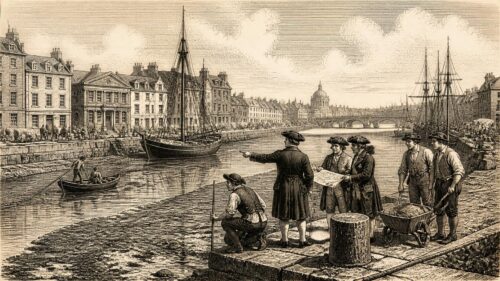
The year ended with an event that cut through distinctions of rank and constitutional allegiance. On 2 and 3 December, exceptionally heavy and persistent rain fell over Dublin. Modern analysis based on contemporary reporting calculates about 75 millimetres in roughly thirty hours, close to a normal December rainfall delivered in little more than a day. The Liffey, Poddle and Dodder burst their banks; central districts were inundated, and reports described rescue boats operating where streets had become watercourses.
The flood struck especially hard in low-lying and poorer neighbourhoods. Water reportedly reached extraordinary depths in lower Castle Yard and Patrick Street. Ormond Bridge, the seventeenth-century stone bridge across the Liffey on the line of today’s O’Donovan Rossa Bridge, was washed away. Its destruction disrupted a vital crossing between the city’s north and south sides and demonstrated the vulnerability of urban infrastructure to the river system on which Dublin’s commerce depended.
The torrent offers a fitting close to 1802. Ireland was neither simply tranquil nor simply revolutionary. It was a country adapting to Union government, briefly released from continental war, still shadowed by the politics of 1798, and facing the ordinary but severe realities of disease, poverty, education, commerce and weather. The new school in Waterford, the fever hospital in Cork, the library in Belfast and the flooded streets of Dublin all belong to the same year: local, practical histories unfolding beneath an unresolved national settlement.
Primary Sources
- Parliamentary union
- Constituency boundary reviews and the number of MPs
- Constituencies | Ulster Historical Foundation
- Treaty of Amiens, March 25, 1802 – Official text
- Emmet, Robert | Dictionary of Irish Biography
- Emmet, Thomas Addis | Dictionary of Irish Biography
- The Rebellion, State of the Country, and Official Papers Collections
- Between Two Parliaments
- Reform, Religion, and Radicalism
- Dublin: A short history
- Criminal Jurisdiction Act, 1802
- Army Estimates — Resumed Debate
- Rice, Edmund Ignatius | Dictionary of Irish Biography
- The Story of Edmund Rice
- Fever Hospitals in Ireland, 1780, 1797-1806
- Cork Hospitals and Asylums – Topographical Dictionary of Ireland (1837)
- Holdings: Dublin General Dispensary
- History of The Linen Hall
- The Linen Hall Library-A History of Education, Philanthropy & Rebellion
- Cultural Record Keepers: The Belfast Library and Society for Promoting Knowledge
- 200-year anniversary of severe Dublin flooding
- Holdings: Wilson's Dublin directory, for the year …
- Holdings: Memoirs of the different rebellions in Ireland
- Holdings: Adjutant General's Office, Dublin, 14th April, 1802