
Cross Guns and College Hill1790 CE
In 1790, Ireland combined institutional development with deep political and social exclusion. Parliament was dissolved and elections returned 300 MPs, yet power remained Protestant, propertied and shaped by patronage. John Keogh’s Catholic Committee revived constitutional campaigning for relief. Commercial improvement advanced through Royal Canal construction, Boyne navigation legislation and substantial linen exports, while Dublin’s Roomkeepers’ Society exposed severe urban poverty. Armagh Observatory opened under Archbishop Robinson, and work began on Emo Court. Although no national rebellion occurred, official concern over disorder reflected persistent agrarian and economic tensions. The year’s canals, charitable initiatives and learned institutions coexisted with inequality, foreshadowing turmoil.
Dateline
Ireland in 1790 was not yet in open rebellion, nor was it politically settled. The year is best understood through institutions beginning, elections being fought, and practical works being driven into the ground. In Dublin, a small charitable society confronted the misery of people living unseen in rented rooms; labourers began digging the Royal Canal westward from Cross Guns Bridge; and the Irish parliament was dissolved and newly elected. At Armagh, an observatory opened under the patronage of the Church of Ireland. These were modest or gradual developments beside the upheavals soon to convulse Europe and Ireland, but they illuminate a kingdom of expanding commerce, formidable inequality and increasingly contested political authority.
A Parliament Renewed, Not Reformed
The Kingdom of Ireland possessed its own parliament at College Green, a fact of great importance in political argument after the constitutional changes of 1782. Yet legislative independence did not make the parliament representative of the island’s population. Executive influence still flowed through Dublin Castle, office, pensions and the management of borough seats. The political nation was overwhelmingly Protestant and propertied. Roman Catholics could not vote in parliamentary elections or sit at Westminster or College Green; the franchise and the structure of constituencies also excluded most poorer Protestants and Presbyterians. The country’s constitutional life therefore rested on a narrow social base.
On 8 April 1790 a proclamation dissolved the Irish parliament and summoned another. The ensuing general election, held across April and May, returned 300 members to the House of Commons. It was the first election under the Octennial Act’s expectation of regular eight-year parliaments, but regularity should not be confused with democratic breadth. County contests could involve substantial numbers of qualified freeholders and vigorous local organisation, while many boroughs remained subject to landlord or patron control. Elections were occasions for dinners, drinking, promises, processions and pressure as well as votes. They also tested networks of family, property and religious interest that reached far beyond polling days.
Henry Grattan retained a conspicuous place in public life, being elected for Dublin City. His followers defended the constitutional achievement of 1782 and pressed, with varying consistency, for cleaner administration and reform. Across the chamber stood an administration strengthened by John FitzGibbon, lord chancellor since 1789, whose defence of property, Protestant ascendancy and governmental authority made him one of the defining political figures of the decade. Neither side represented a modern party in the later sense. Alliances were personal and shifting; patronage mattered greatly. Nevertheless, the election showed that Ireland’s supposedly independent parliament remained the central arena in which arguments about power, commerce, religion and the connection with Britain were conducted.
Keogh and Catholic Political Organisation
For most Irish Catholics, that arena remained closed. Relief measures passed since 1778 had eased important restrictions upon property and religious practice, but civil equality was still remote. Catholics could worship more securely than earlier in the century, lease and inherit property on improved terms, and build a growing lay and clerical public life. They nevertheless stood outside parliamentary elections and public office, while the established Church continued to receive tithes from a population that was predominantly Catholic.
In this setting, 1790 marked the hesitant beginning of a more sustained Catholic campaign. John Keogh, a Dublin silk merchant, became chairman of the Catholic Committee. Its work was constitutional and petitionary: it sought redress through meetings, addresses and contact with ministers rather than through insurrection. That distinction matters. The committee was not the later Catholic Convention, and the Society of United Irishmen had not yet been founded; Belfast’s United Irish society would only be established in October 1791. Yet the committee’s revival of organised lay Catholic politics made 1790 an important threshold. It connected merchants, professional men and county interests, and began to formulate grievances in a manner government could not indefinitely disregard.
The French Revolution, already under way across the Channel, formed an inescapable background to these discussions. Its precise Irish consequences should not be projected backwards from 1798. In 1790, however, arguments over representation, religious exclusion and the rights of citizens acquired a wider and more unsettling European resonance. To reformers, limited concession might make the constitution safer; to defenders of the ascendancy, reform risked loosening the social and religious order on which their authority depended. Those contrasting assumptions would shape Irish politics throughout the decade.
Canals, Cloth and the Working City
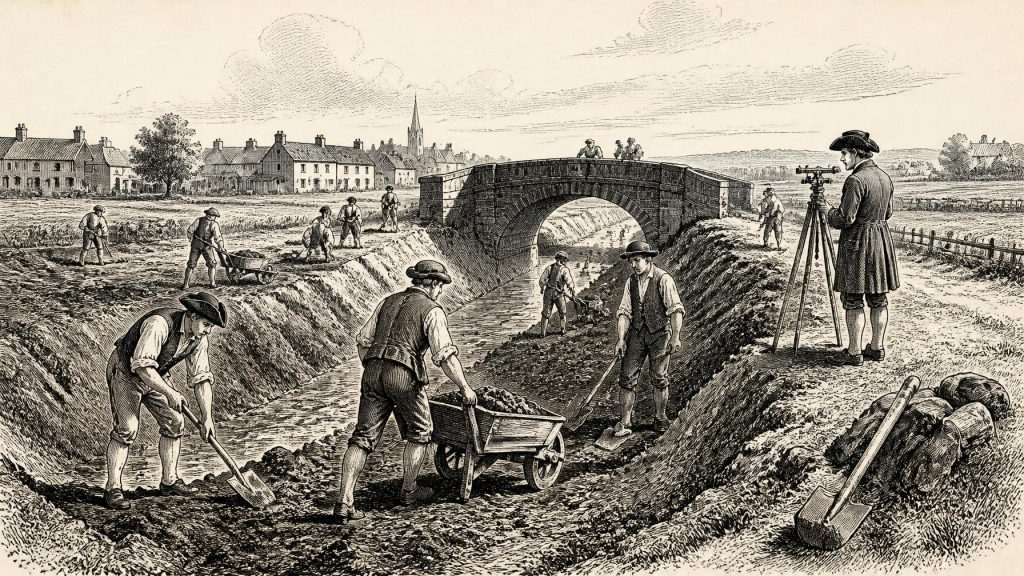
Political exclusion coexisted with energetic schemes for improvement. In May, construction of the Royal Canal began at Cross Guns Bridge in Phibsborough, on Dublin’s north side, advancing initially west towards Ashtown. The proposed waterway aimed ultimately to connect Dublin with the Shannon country. It was a major assertion that inland transport could be reorganised for trade, agriculture and urban supply. Its route also advertised rivalry with the older Grand Canal. The difficult, costly history that followed should not obscure the confidence embodied in the first works of 1790: investors and promoters imagined Dublin’s hinterland being pulled more closely into the city’s commercial orbit.
The same year’s legislation also addressed the Boyne navigation. The Boyne Navigation Act provided for the transfer of publicly made works between Carrick Lock, Drogheda and Trim to the river company, subject to the company completing navigation to Navan. Such measures show that improvement was not confined to the capital. Rivers, canals, quays and harbours were becoming objects of sustained corporate and parliamentary attention, because moving bulky goods cheaply was fundamental to markets.
Linen remained the leading emblem of Irish export manufacture. Official returns for the year ending 25 March 1790 recorded more than 37.3 million yards of plain linen cloth exported, alongside coloured linens, cambrics and lawns. The figure cannot tell us what every spinner, bleacher, weaver or labourer earned, and it should not disguise regional inequality. Still, it indicates the scale of an industry binding flax-growing districts, dispersed household production, bleaching greens, merchants, ports and overseas buyers together. Ulster was especially associated with linen, while Belfast was also developing cotton manufacture. Dublin supported skilled and semi-skilled trades, including tabinet and poplin making, alongside finance, government and port activity.
Commerce did not remove precariousness. On 15 March, Samuel Rosborough, Laurence Toole and nine others established the Charitable Society for the Relief of Room-Keepers of All Religious Persuasions in the City of Dublin, later known as the Sick and Indigent Roomkeepers’ Society. Its deliberately inclusive title is revealing. The founders had witnessed severe want among people occupying crowded rooms, garrets and cellars around St Michan’s parish behind Ormond Quay: people unable to work, reluctant to beg and vulnerable to hunger, cold and illness. In its early years the society distributed practical relief such as food, fuel, straw and small sums of money. The body was not a public welfare system; it depended on voluntary subscriptions and local visitors. But its creation supplies unusually direct evidence of urban poverty beneath the Georgian city’s imposing streets and public buildings.
Knowledge, Landscape and Display
At College Hill, Armagh Observatory opened in 1790 through the initiative of Archbishop Richard Robinson, Baron Rokeby. Robinson had reshaped Armagh as a cathedral and educational town, and the observatory formed part of a larger aspiration to give it learned institutions of national stature. Astronomy required instruments, records, trained observers and long-term patronage. Its opening therefore represented more than a handsome building: it created a durable site for systematic observation in Ireland. It also displayed the resources and cultural confidence of the established Church, whose leaders could sponsor science while presiding over a confessional political order.
In Queen’s County, now County Laois, work progressed from 1790 on James Gandon’s design for a new mansion for John Dawson, first earl of Portarlington, at Emo. The project reworked both house and designed landscape. Gandon was already associated with Dublin’s Custom House, and Emo extended the language of high neo-classicism into an estate setting: ordered façades, carefully composed approaches and a landscape shaped to frame rank and property. The house was far from complete when Dawson died in 1798, so it would be misleading to treat the later building as a finished achievement of 1790. What the year securely offers is the start of a long construction project, and a reminder that improvement could mean the monumental display of landed wealth as readily as a canal or navigation scheme.
Two births offer a retrospective cultural footnote rather than evidence of a contemporary movement. George Petrie was born in Dublin on 1 January 1790; he would become an artist, antiquary and collector of Irish traditional music. The Capuchin priest Theobald Mathew was born in Thomastown, County Tipperary, on 10 October; he would later lead the great temperance movement. Neither future career can be read back into the year of birth. Their arrival does, however, place 1790 on the threshold of generations that would reshape how Ireland studied its past, understood popular culture and organised moral reform.
Quiet Before a Hard Decade
There was no island-wide war or rebellion in 1790. The Dublin administration nevertheless issued proclamations concerning riots, land-possession resistance, deserters and the recruitment of seamen for the royal fleet. Such records should not be inflated into evidence of a single national crisis. They do show a state attentive to disorder and to imperial military needs, while local grievances over rents, tithes, employment and land remained capable of disturbance. In rural districts, older patterns of agrarian protest and secret association had not disappeared; nor had the social divisions that made them possible.
Thus 1790 was a year of foundations and pressures rather than a dramatic turning point. The Irish parliament was renewed without becoming representative; Catholic political organisation gained renewed purpose without securing immediate relief; trade and transport expanded without ending poverty; and learned or architectural institutions rose within a society marked by religious hierarchy. Cross Guns and College Hill capture two sides of that moment: a canal cut into the ground for commerce, and an observatory opened to the sky for knowledge. Both belonged to a confident improving Ireland. Both existed beside exclusions that would make the decade far less quiet than it began.
Primary Sources
- Statute Law Revision Act 2015
- Boyne Navigation Act 1790
- Pre-Union British Statutes
- SIRKS: History
- Armagh Observatory and Planetarium: Heritage
- Emo Court Collection Digitised
- Dictionary of Irish Architects: Emo Court, County Laois
- Dictionary of Irish Architects: James Gandon
- Holdings: By the Trustees for Promoting the Linen and Hempen Manufactures of Ireland, 2 March 1790
- Part 14 of History of the Commercial and Financial Relations between England and Ireland from the Period of the Restoration
- Grattan, Henry
- FitzGibbon, John
- Keogh, John
- Triumph of the Catholic Committee: the Irish Catholic Campaign, 1790–1793
- Revolution, Counter-Revolution and Union: Ireland in the 1790s
- The Society of United Irishmen and Reform
- The Catholic Question in the Eighteenth Century
- Petrie, George
- Mathew, Theobald
- Limerick Papers
- Armagh Observatory Records, circa 1790–1916
- Whiteboys