

Chichester House Claims1700 CE
In 1700, the Act of Resumption required claimants to register interests in forfeited Irish estates at Chichester House, Dublin, producing over 3,000 claims involving families, creditors, tenants and purchasers. The process consolidated a post-Williamite Protestant order while exposing Catholic insecurity over land and rights. Ireland remained a separate but subordinate kingdom, governed through London-linked institutions amid confessional restrictions and commercial controls, notably woollen export limits. Agricultural life, regional trade and Dublin’s growth continued under unequal conditions. Intellectual activity included Edward Lhuyd’s antiquarian work, Ulster printing and George Berkeley’s Trinity admission. Paperwork, property, religion and allegiance defined this unsettled post-war society.
Dateline
A Deadline on College Green
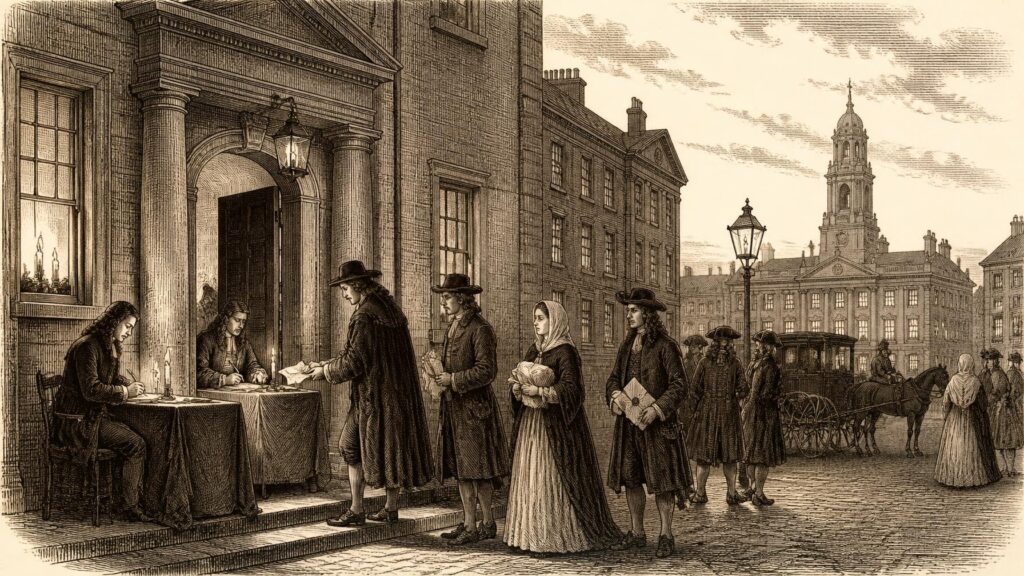
On 10 August 1700, Chichester House on Dublin’s College Green became the setting for one of the most consequential administrative deadlines in post-war Ireland. By midnight, anyone claiming an interest in property forfeited after the Williamite victory had to lodge papers with the trustees created by the English Act of Resumption. Clerks remained at work by candlelight as claimants and their agents delivered deeds, mortgages, leases, judgments and family settlements. More than 3,000 claims were ultimately entered. The scene was not a parliament in session, nor a public trial, but it exposed a central fact of life in Ireland at the opening of the eighteenth century: land, law and political security were inseparable.
The Act of Resumption had taken effect in 1700 after the English parliament objected to William III’s grants of Irish forfeited estates to favourites and military commanders. These lands had belonged largely to supporters of the defeated James II, though the legal position of particular parcels could be tangled. The act cancelled most royal grants and vested identifiable forfeited property in thirteen trustees. It also allowed people who could show an interest dating from before William and Mary’s accession on 13 February 1689 to register a claim before the August deadline.
This was therefore not a simple process of taking land from one religious community and handing it to another. The claims concerned a web of ownership and obligation: widows asserting marriage settlements, creditors seeking repayment, tenants defending leases, purchasers protecting bargains and relatives claiming inheritance. Women appeared among the claimants in significant numbers. Yet the process operated within, rather than overturned, the immense transfer of landed power produced by the seventeenth-century wars. For many Catholic families, the question was whether any fragment of an old estate, income or legal right could be preserved in a kingdom now governed in the interests of a Protestant minority.
William’s Kingdom
Ireland in 1700 remained a distinct kingdom under King William III, with its own institutions, revenue and parliament, but it was decisively subordinate to the English crown and parliament. Poynings’ Law constrained the passage of Irish legislation, the Dublin administration answered ultimately to London, and English politicians had demonstrated their power by legislating directly on the forfeited estates. William Molyneux’s The Case of Ireland’s Being Bound by Acts of Parliament in England, Stated, published in 1698, had given memorable expression to Protestant unease at this constitutional dependence. The debate it raised did not make Ireland autonomous in 1700; rather, it sharpened a question that commercial restrictions and the Resumption Act made impossible for politically alert Protestants to ignore.
The Irish parliament was not sitting during the August claims rush. Government was conducted through Dublin Castle, the privy council, courts, revenue offices and local magistracy. The Lords Justices included Charles Berkeley, Earl of Berkeley, and Henri de Massue, Earl of Galway, a Huguenot soldier who had served William’s cause. Their administration was part of a wider post-war order built around a permanent military presence, Protestant office-holding and suspicion of Jacobitism. The memory of the conflict of 1689–91—sieges, campaigns, confiscations and the Treaty of Limerick—was not remote history but the immediate background to decisions about land, worship and loyalty.
On 28 December, Laurence Hyde, first Earl of Rochester, was appointed lord lieutenant of Ireland. The appointment was a change at the summit of the administration, not an instantaneous change on the streets of Dublin: Rochester would not be sworn in until September 1701. Nonetheless, the choice of a prominent English statesman underlined the continuing practice of governing Ireland through a viceroy appointed from the metropolitan political world. It also came as European politics grew more tense over the Spanish succession, a contest that would soon make Ireland’s strategic position, military establishment and confessional allegiances newly important.
Majority Faith, Minority Rule
The constitutional order of 1700 rested on a profound religious imbalance. Most inhabitants of Ireland were Catholic, while the established Church of Ireland and the great bulk of political power belonged to Protestants. Catholics could still vote in parliamentary elections at this date if they met the property qualification, but they could not sit in parliament because the required oaths excluded them. Presbyterians and other Protestant dissenters were also outside the established church, though their position differed markedly from that of Catholics and varied by locality, especially in Ulster.
The punitive legislation commonly called the penal laws was already shaping everyday calculations. Measures passed in the 1690s had restricted Catholic bishops, regular clergy and religious orders, placed limits on Catholic public participation and reinforced Protestant control of arms and office. The comprehensive statute often remembered as the Popery Act still lay four years ahead, in 1704; it should not be projected backwards into 1700. Even so, the earlier legislation, the confiscation settlement and the insecurity surrounding Catholic landholding made the year a hard one in which to separate religious observance from practical questions of family, tenancy and inheritance.
Catholic religious life did not disappear. Priests continued to minister, households continued to mark baptisms, marriages and funerals, and communities retained devotional habits that could not be legislated away. The Treaty of Limerick’s terms and their contested interpretation also mattered. Some Catholics who had remained after the Jacobite surrender claimed protection as ‘articlemen’; others had left for continental military service or sought new livelihoods abroad. The post-war Catholic population was not politically inert or socially uniform. It included gentry defending legal claims, merchants and professionals working within constraints, tenants negotiating with landlords, and clergy maintaining networks of worship and education.
Land, Labour and Trade
For most people, the rhythm of 1700 was agricultural. Labour was organised through estates, leases, smallholdings, cottier arrangements, seasonal hiring, common rights and local markets. Cattle, dairying, grain and wool remained important, but the distribution of gains was uneven. Landlords and large leaseholders could profit from expanding commercial links, while poorer households were vulnerable to rents, debt, illness and fluctuations in harvests or food prices. Ireland’s cool, Atlantic climate was a permanent material condition, and the wider period belonged to the colder centuries often termed the Little Ice Age; there is no sound basis, however, for attaching a particular island-wide weather catastrophe to 1700 itself.
The economic significance of the recent woollen restrictions was clearer. Irish parliamentary duties imposed in 1698, followed by the English Woollen Act of 1699, sharply constrained the export of Irish woollen manufactures. By 1700 merchants, clothiers, spinners and landowners were living with the new rules rather than merely debating them. The restrictions did not eliminate all domestic wool work, nor did they instantly create a linen boom. They did, however, channel investment and argument towards linen, an industry that would become increasingly important in Ulster and beyond during the eighteenth century. The year marks an early stage in that redirection, not its completed outcome.
Dublin was the principal administrative and commercial centre. By about 1700 its population had reached roughly 60,000, making it far larger than any other Irish town. Its growth rested on port traffic, craft production, the courts, financial dealing, government employment and Trinity College. The city was also visibly divided by wealth and confession: grander new streets and institutions existed alongside overcrowding, insecure work and charitable need. Elsewhere, regional differences mattered. Ulster’s plantation society contained substantial Anglican and Presbyterian settler populations alongside Catholic communities; western counties retained stronger Catholic landed connections in places; ports such as Cork, Limerick, Waterford and Belfast connected their hinterlands to Irish Sea, Atlantic and continental trade.
Manuscripts, Print and Learning
Political exclusion did not erase Ireland’s intellectual diversity. In February 1700 the Royal Society heard an account, communicated from Edward Lhuyd, concerning inscriptions and antiquities found in Ireland and Scotland. Lhuyd’s Irish travels of 1699–1700 formed part of an ambitious enquiry into languages, manuscripts, monuments and natural history across the Celtic-speaking world. During the Irish tour he acquired, or assembled from acquired codices, the composite manuscript now known as the Yellow Book of Lecan. Its medieval and early modern Irish texts, including poetry associated with learned families, were a striking reminder that Gaelic scholarship survived despite the destruction of many older political and patronage structures.
The precise circumstances of the Yellow Book’s acquisition remain less certain than the fact of its connection with Lhuyd’s 1700 tour. That distinction matters. It would be unsafe to turn a probable March purchase into a confidently dated encounter. What can responsibly be said is that 1700 joined an important Irish manuscript tradition to a wider antiquarian and comparative-linguistic project, one that later helped scholars understand the relationships among Irish, Welsh, Scottish Gaelic, Cornish and Breton.
Print also crossed cultural boundaries. A 1700 Ulster edition of the late sixteenth-century Scottish poet Alexander Montgomerie’s The Cherrie and the Slae was among the earliest books printed in Ulster. Its appearance points to the connected literary world of Scotland and north-east Ireland, shaped by migration, Presbyterian and Anglican settlement, trade and shared language. In Dublin, meanwhile, the fifteen-year-old George Berkeley entered Trinity College on 21 March. No one could have foreseen his later fame as philosopher and bishop, but his admission offers a small, firmly dated glimpse of the educational institutions through which the Protestant governing class reproduced itself.
A Year of Paper Power
There was no single battle, rebellion or treaty in Ireland in 1700. Its importance lies instead in paperwork that determined power: claims filed at Chichester House, laws governing confiscated estates, commercial rules made across the Irish Sea, oaths defining political membership and manuscripts carried into new scholarly networks. The year’s most vivid dated moment—the closing of the claims register on 10 August—captures the character of the age. Peace after war had not produced a settled society. It had produced a contested Protestant state in which ownership, religion and allegiance continued to be argued over deed by deed.
Primary Sources
- The Representation of Female Claimants Before the Trustees for the Irish Forfeitures, 1700–1703
- Newly Published: A List of the Claims, 1700
- A List of the Claims, 1700
- Hyde, Laurence
- Berkeley, George
- Irish Legislation Database: Browse Regnal Years
- ‘Like Amphibious Animals’: Irish Protestants, Ancient Britons, 1691–1707
- Anti-Standing Army Ideology, Identity, and Ideas of Union within the British Isles, 1689–1714
- Records of Convocation: Introduction
- Catholic Survival in Protestant Ireland, 1660–1711
- ‘They Were Drawn by Some Furious Lawyer’: Implementing the Minor Articles of Surrender, 1691–1704
- The Penal Laws: Origins, Purpose, Enforcement and Impact
- The Emergence of a Protestant Society, 1691–1730
- About the Down Survey of Ireland
- Dublin: A Short History
- History of the Commercial and Financial Relations between England and Ireland from the Period of the Restoration
- The Early Modern Economy, 1600–1780
- Climate
- Irish Script on Screen – MS 1318: The Yellow Book of Lecan
- Account of Some Roman, French and Irish Inscriptions and Antiquities Lately Found in Ireland and Scotland by Mr Edward Lluyd
- The Tour of Edward Lhuyd in Ireland in 1699 and 1700
- The Cherrie and the Slae
- Language of the Settlers
- The Case of Ireland’s Being Bound by Acts of Parliament in England, Stated
- By the Lords Justices and Council, a Proclamation