Provision Embargo1770 CE
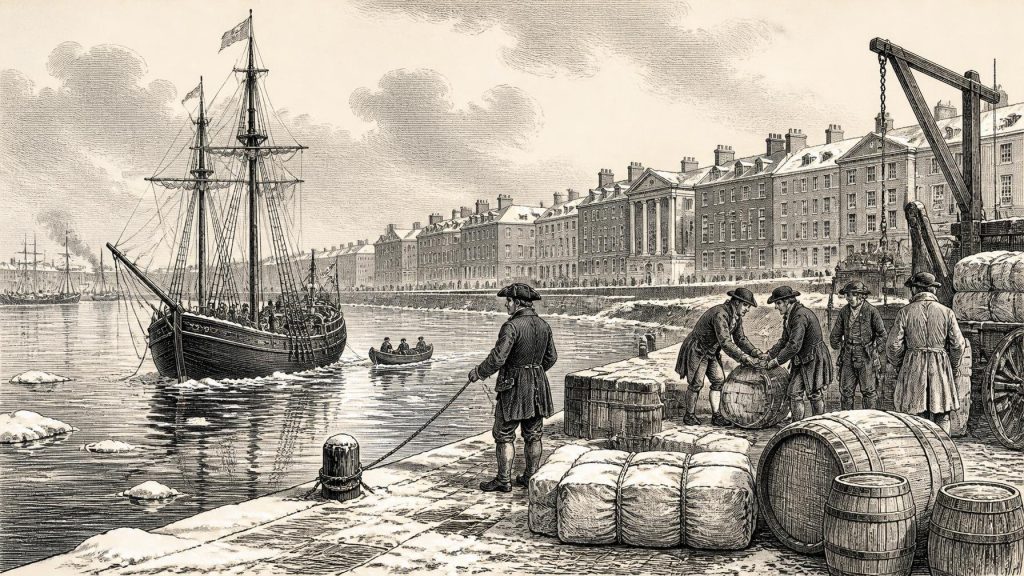
In 1770, Ireland was governed during Parliament’s prorogation as Lord Townshend used patronage to weaken parliamentary undertakers and strengthen Dublin Castle. Westminster sustained bounties supporting Irish linen, while the Dublin Society promoted economic improvement. Quarantine regulations monitored shipping routes and goods amid fears of plague. In December, authorities embargoed provision-laden vessels, reflecting concern over supplies without proving famine; butter received exemption in 1771. Catholic and Presbyterian exclusion, landlord power and dependence on agriculture and exports persisted. Trinity’s College Historical Society began meeting, while Burke and Goldsmith published works. The year reveals an unequal kingdom managed through law, commerce and patronage.
Dateline
In 1770, Ireland’s most revealing developments were often administrative rather than dramatic. No parliament sat in Dublin, no great rebellion broke out, and the surviving record does not justify attaching a single, island-wide social crisis to the year. Yet decisions made from Dublin Castle, the continuance of linen policy in Westminster, the business of learned societies and the regulation of shipping together show a kingdom whose politics, food supply and commerce were closely managed within a wider British and Atlantic system.
The year should therefore be read with care. Several events can be firmly dated: the first meeting of Trinity College Dublin’s College Historical Society in March; a British statute of May continuing export bounties on Irish linen; quarantine orders in November and December; and, on 20 December, an embargo on ships carrying provisions from Irish ports. Other features of the picture – denominational inequality, landlord power, household manufacture and dependence on external markets – are broader conditions, not occurrences that began in 1770.
A Parliament Kept Waiting
Ireland remained a separate kingdom with its own parliament, but it was not politically independent in the modern sense. Under Poynings’ Law, proposed Irish legislation passed through the British Privy Council before it could be accepted or rejected at Dublin. The British Declaratory Act of 1719 had also asserted Westminster’s right to legislate for Ireland. The Irish House of Commons was nevertheless an important arena for office, influence, taxation and local interests. It was a Protestant political institution, dominated by landowners and borough patrons, in a country whose population was predominantly Catholic.
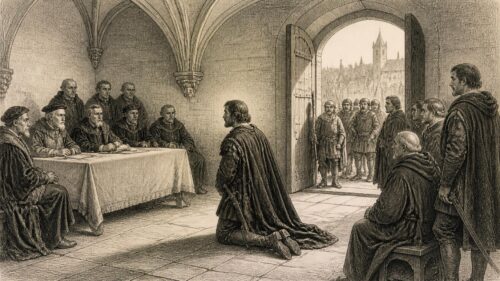
In 1770 that arena was deliberately closed. Lord Townshend, lord lieutenant since 1767, governed from Dublin Castle during a prolonged prorogation. The immediate background was the constitutional confrontation of late 1769. On 21 November 1769, the Commons had rejected a money bill because it had not originated with them, a challenge to the established procedure under Poynings’ Law. On 21 December they accepted an increase in the Irish-funded military establishment. Parliament was then prorogued on 26 December.
Thus 1770 was not a year of parliamentary debate but of political repositioning. Townshend’s larger purpose was to diminish the authority of the ‘undertakers’: powerful Irish parliamentary managers, notably John Ponsonby and the earl of Shannon, who had traditionally delivered government business in return for a substantial share of patronage. A resident lord lieutenant had greater scope to make Dublin Castle, rather than these magnates, the centre of administration. The political change was not completed during 1770; Townshend’s commanding Castle majority emerged when parliament returned in 1771. But the year was crucial as an interval in which offices, pensions and influence could be used to prepare that outcome.
The formal machinery of delay continued to the year’s end. An order of 10 December prorogued parliament to 15 January 1771; a further postponement followed in January, and the Houses did not meet until 26 February. In December, too, Ponsonby was removed from his lucrative position at the head of the revenue board. That dismissal was an unmistakable sign that the old system of parliamentary management was being dismantled. It was not democratic reform: rather, power was being redistributed within the narrow Protestant governing class, with stronger direction from the Castle and backing from London.
Linen, Provisions and Imperial Markets
Economic policy shows why politics at Dublin Castle mattered far beyond its chambers. On 19 May 1770, the British parliament continued bounties on the export of British and Irish linen, prolonged the removal of duties on imported foreign flax yarn, and extended encouragement to particular linen goods. This was a Westminster measure, not an act passed in Dublin, but its explicit inclusion of Irish linen mattered greatly.
Linen was the exceptional branch of Irish manufacture that received sustained official encouragement within an imperial trading order that constrained many other Irish industries. Flax cultivation, spinning, bleaching, weaving and marketing linked rural households, small towns, merchants and ports, especially in Ulster but not solely there. Much spinning was domestic work, while weaving could be carried on by artisans working from cottages or workshops. The benefits were uneven, and the work depended on credit, middlemen, merchants and access to markets; nevertheless, the 1770 statute confirms that exported linen remained a recognised imperial priority.
That priority should not be mistaken for commercial freedom. Ireland’s trade was shaped by navigation rules, British customs policy and restrictions on competing manufactures. The long-established provision trade in beef, butter, hides and tallow, together with linen, connected Irish producers to Britain, continental Europe and the colonies. These markets could bring income to graziers and merchants, but they also made food and raw materials matters of state concern. A decision in London or Dublin could affect a weaver’s yarn, a merchant’s cargo, a farmer’s sale or the price faced by a labouring household.
The Dublin Society, later the Royal Dublin Society, represents another side of this improvement-minded economy. Its surviving proceedings include an index for business from 25 October 1770 onwards. The Society had long promoted agriculture, manufactures, arts and practical knowledge through premiums, exhibitions and correspondence. Its presence in the record for 1770 is not evidence of a sudden economic transformation, but it shows how elite reformers tried to make the kingdom more productive through organised enquiry and reward.
Ports Under Watch
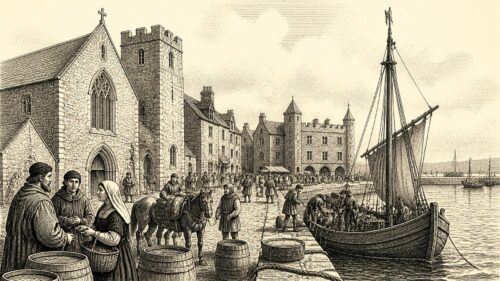
Ireland’s coastline made the kingdom both commercially connected and medically vulnerable. In November and December, the Irish authorities issued a sequence of quarantine orders. On 21 November, quarantine was imposed because of plague at Constantinople. In December, vessels from America and the West Indies were exempted from the particular restrictions, while ships arriving from Hamburg or Bremen with specified goods – including hemp, flax, hair and feathers – were required to perform forty days’ quarantine.
These orders do not demonstrate that plague reached Ireland; they are evidence of prevention, not outbreak. Their importance lies elsewhere. They show officials tracking the routes by which goods, crews and disease might arrive: the Mediterranean, the North Sea, German ports, the Atlantic and the Caribbean. Flax and hemp were commercially useful materials, but they could also be treated as dangerous carriers of infection. For sailors, merchants, dock labourers and coastal communities, the operation of quarantine was a practical interruption to trade as well as a public-health precaution.
On 20 December the lord lieutenant imposed an embargo on all ships and vessels laden with provisions. The text of the order establishes the embargo itself, but does not by itself prove a general famine or identify a single cause. It is safest to regard it as an official attempt to retain foodstuffs within the kingdom amid concern over supply and market conditions. Its limited and contingent character is underlined by the subsequent relaxation for butter on 30 January 1771. Even so, the December decision is a valuable reminder that food was not merely an agricultural commodity: it was a political question, capable of bringing export trade to a halt.
Unequal Kingdom, Limited Record
Everyday life in 1770 was shaped by inequalities that no Castle order could erase. The established Church of Ireland possessed public authority and parliamentary influence, although most Irish people were Roman Catholics. Penal restrictions continued to limit Catholics’ political and property rights, while Presbyterians, particularly numerous in parts of Ulster, also stood outside the established church. No general census was taken in this year, and it would be irresponsible to supply precise national figures for occupation, faith or living standards.
What can be said more securely is that most people lived close to the agricultural economy. Potatoes, oats and other grains formed essential elements of poorer diets; cattle, dairying and provisions could serve export markets; and access to land was often mediated through landlords, leases, subletting and middlemen. Conditions varied sharply between fertile lowlands, grazing districts, linen-producing areas, fishing settlements and towns. The December embargo matters precisely because, in such a society, shifts in supply, prices or export opportunities could touch households very differently.
There is no basis for presenting 1770 as a year of general religious settlement or popular political inclusion. Rather, it was a year in which the established order endured while the Castle rearranged its relationship with the Protestant political elite. Catholic emancipation, the Volunteer movement and the more open campaigns for legislative autonomy all lay ahead.
Debate and the Irish Literary World
In March, the College Historical Society first met in the Senior Common Room at Trinity College Dublin. Formed from earlier student debating traditions, it was a modest institutional beginning with an unusually long future. Its immediate membership was socially and religiously restricted by the character of Trinity, but its purpose – cultivating history, oratory and argument – points to the importance of debate in eighteenth-century Dublin. Later generations would know it simply as the Hist.
Two Irish-born writers also gave 1770 a wider intellectual resonance, though neither publication should be misrepresented as an event in Irish domestic politics. Edmund Burke, born in Dublin and active in British politics, published Thoughts on the Cause of the Present Discontents. It addressed royal influence, party and constitutional government in Britain. Its direct subject was not Townshend’s Irish administration, but its suspicion of government sustained by personal favour had an obvious relevance to a political world in which patronage was central.
Oliver Goldsmith’s The Deserted Village appeared in May. Goldsmith’s poem was not a documentary account of an identifiable Irish village, and readers should resist treating it as straightforward evidence for conditions in Ireland in 1770. Yet its lament over rural displacement, inequality and the loss of communal life gave memorable literary form to anxieties that could be recognised across the British and Irish worlds. In both Burke and Goldsmith, Irish birth and experience fed work published and debated beyond Ireland.
By the close of the year, then, Ireland had no single headline event but a revealing accumulation of measures: a silenced parliament, a viceroy building power, linen encouraged for export, ships held in quarantine, and provisions embargoed. The year’s significance lies in that combination. It exposes an eighteenth-century Irish kingdom governed through patronage and imperial law, reliant on trade yet wary of its consequences, and already producing institutions and writers whose influence would outlast the immediate decisions of 1770.
Primary Sources
- Townshend, George
- Central Aspects of the Eighteenth-Century Constitutional Framework in Ireland
- The Constitutional and Parliamentary History of Ireland Till the Union
- Statute Law Revision Act 2015
- George III: Proclamations, 1770
- Provisions, Scarcity of, 1747–1796
- Index 1770
- The Royal Dublin Society and the Legacies of Empire Project, 1731–1877
- History of the Commercial and Financial Relations between England and Ireland from the Period of the Restoration
- Part 8: The Linen Industry
- The Irish Linen Board, 1711–1828
- The Rise of the Irish Linen Industry
- The Irish, Scottish and Flemish Linen Industries During the Long Eighteenth Century
- An Act to Repeal the Several Laws Relating to the Customs
- An Act to Continue Several Laws Relating to the Granting a Bounty upon Certain Species of British and Irish Linens
- What Have We Been Up To?
- Edmund Burke
- Thoughts on the Cause of the Present Discontents
- Thoughts on the Cause of the Present Discontents, 1770
- Goldsmith, Oliver
- The Deserted Village
- Oliver Goldsmith
- The Irish Linen Trade under the British Mercantile System
- Constitutional Change, Law and Grattan’s Parliament