Pilib Maguire’s Lake Rescue1369 CE
In 1369, Ireland’s contested lordships were shaped by dynastic conflict, royal administration and ecclesiastical change. Pilib Ó Raghallaigh, king of east Breifne, was imprisoned by nephews at Lough Oughter, but his son-in-law, Pilib Maguire of Fermanagh, captured the island castle by boat and restored him. Allied resistance had earlier failed at Blencup. William Windsor arrived as royal lieutenant, summoned a Dublin parliament, and executed Diarmait Mac Murchadha and his designated successor, demonstrating force without securing Leinster. In Thomond, Mathghamhain Ó Briain died and Brian Sreamhach succeeded. Church deaths in Oriel and Breifne underscored political importance. Alliances and waterways shaped power.

Dateline
In 1369, authority in Ireland was asserted through more than one kind of stronghold. Dublin Castle and the institutions of the English lordship represented royal government; the island castle at Lough Oughter in east Breifne represented a local dynasty’s control of a watery landscape; and the residences of Gaelic rulers were centres of lordship, hospitality and armed followings. The year’s best-attested developments reveal a politically divided island, but not one divided simply into ‘English’ and ‘Irish’ worlds. Kinship, marriage, military service, ecclesiastical connections and control of routes by land and water shaped events as much as formal allegiance did.
A Captive King in Breifne
The most vivid Irish episode securely associated with 1369 was the seizure and recovery of Pilib Ó Raghallaigh, king of east Breifne. Pilib had succeeded his brother some years earlier, but his position was challenged by nephews, Maghnus and Maolmórdha Ó Raghallaigh. During the revolt they captured Pilib and confined him in the castle on Lough Oughter, a lake stronghold in what is now County Cavan. Maghnus then assumed the kingship. This was no minor household quarrel: holding a ruler captive allowed rivals to claim his clients, revenues, hostages and the right to command armed men.
Resistance formed quickly around the prisoner. Annadh, son of Risdeárd Ó Raghallaigh, assembled a substantial force, joined by Brian Mór Mac Mathghamhna of Oriel and the Mac Cabas. Their attempt to overturn Maghnus’s takeover produced a battle at Blencup, near modern Cavan. The annals record severe losses among the coalition’s followers, including three sons of Cormac Ó Fearghail, yet the rebels’ defeat did not secure Pilib’s release. It demonstrates both the scale of the dispute and the practical reality of medieval campaigning: a king’s cause depended on the willingness of allied kindreds to bring men, supplies and local knowledge to the field.
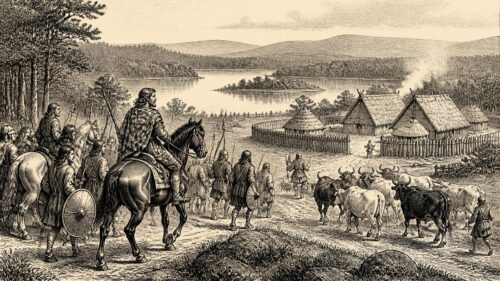
The decisive intervention came from Pilib Mag Uidhir, king of Fir Manach, Pilib Ó Raghallaigh’s son-in-law. He led ships onto Lough Oughter, took the castle and restored Pilib to his kingship. The episode is particularly revealing because the lake was not merely scenery. Boats could move warriors and provisions around difficult country, isolate an island fortification, and turn command of water into political power. Marriage also mattered as strategy. Maguire’s familial tie to the captive king gave him a compelling reason to act, while the rescue advertised his capacity to influence affairs beyond Fermanagh. The restoration did not settle every Ó Raghallaigh rivalry, but it prevented Maghnus’s coup from becoming permanent.
Royal Government Returns to Dublin
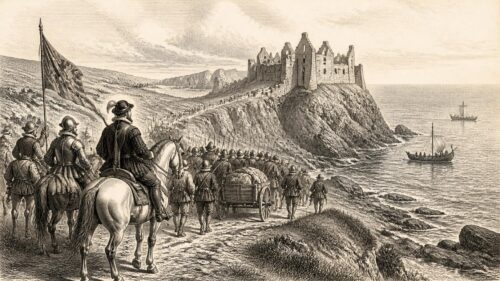
Events in Breifne unfolded while the English crown renewed its senior presence in Ireland. William Windsor was appointed lieutenant in March 1369 and arrived on 20 June. He replaced Gerald fitz Maurice FitzGerald, third earl of Desmond, whose term as justiciar ended that month. Windsor’s arrival was a reminder that the lordship’s government still possessed administrative machinery, legal claims and military resources, even though its effective reach varied greatly from region to region.
A writ issued at Dublin on 18 June summoned a parliament to meet there on 30 July, an unusually precise marker of official business in the year. Parliament was an institution of the English lordship, bringing together prelates, magnates and representatives of the colonist communities rather than an assembly for all Ireland’s peoples or lordships. Nevertheless, the summons mattered. It sought advice, consent and resources from the political community over which the crown claimed authority. Windsor’s subsequent career became closely associated with efforts to increase governmental revenue, a recurring source of friction with both lay and ecclesiastical interests.
His first months also brought a harsh intervention in Leinster. Windsor captured Diarmait Láimhdhearg Mac Murchadha, described in contemporary political language as king of Leinster, together with Diarmait’s tánaiste, or designated successor, Gerald Mac Murchadha. Both were executed later in 1369. The surviving narratives use emphatic language about treachery and cruelty, but their chronologies are not perfectly aligned. What can be stated with confidence is that Windsor’s new administration removed two leading figures of the Mac Murchadha kindred in the same calendar year. It was an assertion of force, not evidence that Leinster had become securely governed from Dublin.
Succession in Thomond
Another major succession occurred in the west. Mathghamhain Maonmhaighe Ó Briain, lord of Thomond, died in 1369 and was succeeded by his son Brian Sreamhach Ó Briain. The annalistic notice praises Mathghamhain as an outstanding Gael and says that he died after a ‘victory of repentance’, a conventional Christian expression for a good death following penitence. Such wording should not be treated as a detailed report of his final days, but it does show how political rank and religious reputation were expected to reinforce one another.
Brian’s succession was important because Thomond, centred broadly on present-day Clare and north Munster, was a substantial regional power facing Anglo-Irish lordships, towns and rival Gaelic interests. He had already been positioned as his father’s successor and was supported by a marriage alliance with the Mac Conmara family. His accession therefore represented continuity as well as change. It would be wrong, however, to bring later drama back into this year. Brian’s celebrated victory over the earl of Desmond and the burning of Limerick belong to July 1370 in modern historical reconstruction, not to 1369, even though the sequence of notices in one annalistic tradition can make the events appear adjacent.
Bishops, Learning and Political Memory
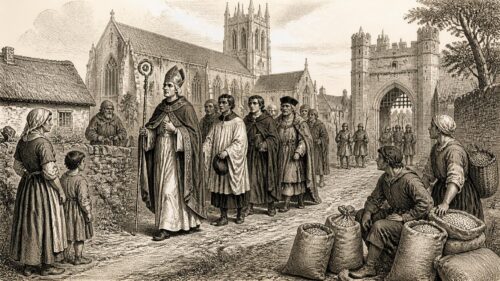
Church leadership also changed. Odo Ó Néill, bishop of Oriel, and Riocard Ó Raghallaigh, bishop of Breifne, died during the year. Their deaths mattered beyond devotional life. Bishops held land and jurisdiction, participated in diplomacy, and connected regional communities to archiepiscopal and papal structures. The Ó Raghallaigh bishopric had recently been entangled with the dynasty’s own disputes, illustrating that church office and secular politics could not be neatly separated.
The annals themselves preserve another dimension of Irish society. Their notices concentrate on rulers, clerics, raids and deaths because those were events considered worthy of permanent record. Yet their language values more than fighting. They praise generosity, hospitality, learning and penance; they identify a tánaiste as well as a king; and they record the losses sustained by named followers in a coalition army. The death of a ruler or bishop thus affected dependants, tenants, clerics, professional learned families and military retainers whose lives are usually less visible in the sources.
What the Year Shows
There is no responsible basis for attaching a single harvest, weather event, building campaign or commercial statistic to Ireland in 1369. The evidence is instead political and institutional. It shows castles still functioning as instruments of detention and dynastic legitimacy; lakes serving as military corridors; alliances crossing regional boundaries; and the Dublin administration trying to reassert royal authority through parliament, taxation and armed action.
It also requires care with dates. Irish annals preserve invaluable near-contemporary traditions, but different compilations sometimes place the same event under different year headings, and later editors have had to reconcile their chronologies with documentary evidence. For 1369, the capture and lake rescue of Pilib Ó Raghallaigh, Windsor’s arrival and Leinster campaign, and Mathghamhain Ó Briain’s death and succession can be placed in the year with confidence. Together they make 1369 a year of contested lordship: a captive king recovered by boats on a Cavan lake, a new royal lieutenant arriving in Dublin, and an Ó Briain heir taking power in Thomond.
Primary Sources
- Annála Connacht: Annal 1369 (English translation)
- Annála Connacht: Annal 1369 (Irish text)
- The Annals of Ulster: Year U1369
- The Annals of Ulster: Year U1366
- Annála Connacht
- The Annals of Ulster
- Annals of the Kingdom of Ireland by the Four Masters
- Annals of Loch Cé, Volume II
- O'Reilly (Ó Raghallaigh), Pilib | Dictionary of Irish Biography
- O'Reilly (Ó Raghallaigh), Cú Chonnacht | Dictionary of Irish Biography
- Maguire (Mág Uidhir), Pilib (Philip) | Dictionary of Irish Biography
- MacMahon (Mac Mathghamhna), Brian Mór | Dictionary of Irish Biography
- O'Brien (Ó Briain), Brian Sreamach | Dictionary of Irish Biography
- Windsor, William | Dictionary of Irish Biography
- FitzGerald, Gerald fitz Maurice (‘Gearóid Iarla’) | Dictionary of Irish Biography
- Close Roll 43 Edward III (1369–1370), Item 38
- The Windsor Crisis, 1369–1376
- ‘Ireland Corporate of Itself’
- Irish Lords and English Rulers: The Materials of Diplomacy Between England and Gaelic Ireland in the Later Middle Ages
- Exploring the Irish Annals
- Table of Contents: Annals of the Kingdom of Ireland
- Blencup, County Cavan: Historical References