Fishamble Messiah1742 CE
In 1742, Ireland remained weakened by the Great Frost famine, with hunger, disease and poverty continuing despite improving conditions. Recovery efforts included the Cope’s voyage carrying Tyrone coal to Dublin via the new Newry navigation, demonstrating improved transport and trade potential. Dublin’s cultural life produced Handel’s Messiah, first performed in Fishamble Street on 13 April for hospitals and imprisoned debtors. Government operated without a parliamentary session through Dublin Castle proclamations, while religious inequalities persisted. Jonathan Swift’s incapacity and Archbishop Hugh Boulter’s death marked losses within the established order. The year combined charitable action, infrastructure, cultural achievement and lingering social crisis.
Dateline
In 1742 Ireland was emerging, unevenly and painfully, from the catastrophe remembered as the Great Frost famine. The immediate emergency of 1740–41 had passed, but recovery was not a simple return to normality. Crop failure, inflated food prices, hunger and epidemic disease had weakened households across the island; demographic evidence is fragmentary, yet scholarship cautions that exceptionally high mortality in some places extended into 1742. Against that background, two precisely dated developments offer an unusually vivid view of the year: a coal vessel reaching Dublin through the newly opened Newry navigation, and the first performance of Handel’s Messiah in Fishamble Street. Both belonged to a society seeking means of repair—through transport, commerce, charity and public culture.
After the Great Frost
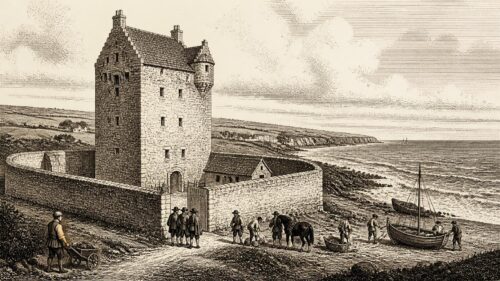
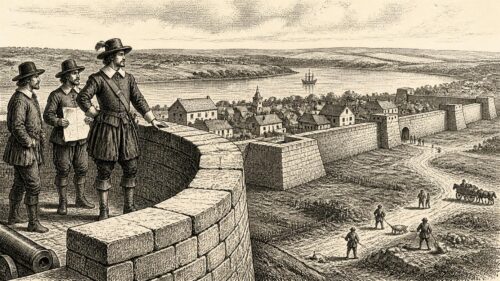
The famine that framed the beginning of the decade had resulted from more than one bad harvest. The fierce winter of 1739–40, followed by drought and continuing adverse weather, ruined or damaged potatoes and grain, disrupted milling and transport, and exposed a population already vulnerable to scarcity. Disease magnified hunger’s effects. It is therefore misleading to describe 1742 as a year of plenty merely because the worst famine phase lay behind it. Families who had lost relatives, livestock, savings or a tenancy entered the year with diminished reserves; a better harvest could not immediately undo debt, bereavement or physical debility.
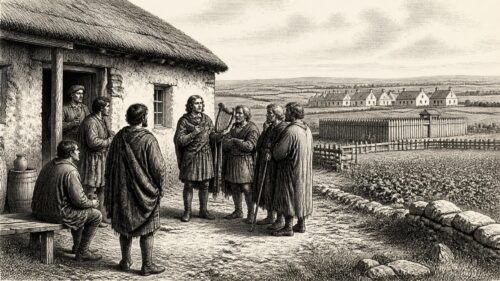
The scale of the disaster is debated because eighteenth-century Ireland had no national civil registration or census capable of recording deaths comprehensively. Nonetheless, historians regard the crisis of 1740–41 as one of the gravest demographic shocks in pre-Famine Ireland. Its uneven geography matters. Conditions varied between town and countryside, coastal and inland districts, and households with different access to land, wages, credit or relief. In 1742, then, Ireland’s daily life still included the work of restoration: finding seed, rebuilding stocks of food, seeking employment, paying rent and caring for the sick. The conspicuous charitable initiatives of Dublin should be read in that broader climate of need, not simply as fashionable benevolence.
The Cope’s Inland Passage
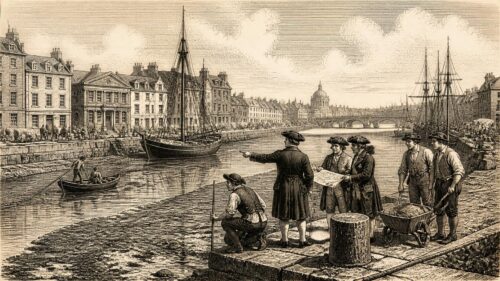
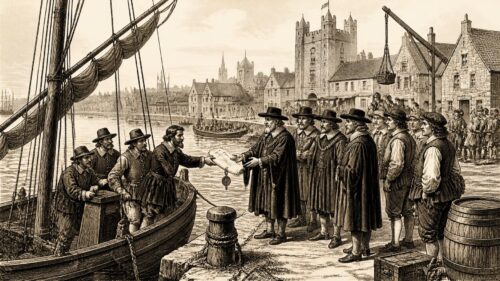
On 28 March 1742 the Cope, carrying Tyrone coal, reached Dublin by way of the newly opened navigation between Lough Neagh and Newry. This was a landmark in Irish internal transport. The route joined the Upper Bann system to Newry and, through Carlingford Lough, the sea. Its construction had been long delayed by finance, engineering difficulties and legal disputes; opening it did not mean that every link of the projected coal network was complete. In particular, coal still had to be carried overland to Lough Neagh before beginning its water journey. Yet the Cope demonstrated that bulky fuel could now travel from the Tyrone coal district towards the capital by a combined inland and coastal route.
The cargo was small in relation to the island’s later industrial economy, but its significance was considerable. Coal was essential for urban households, breweries, workshops, smithies and other heat-intensive trades. Water carriage could move heavy goods more cheaply than rough roads, where carts faced weather, gradients and high costs. The navigation also promised a two-way traffic: coal and other imported goods inland, agricultural produce and linen-related commodities towards ports. Newry’s position as an outlet for the north-east and west Ulster was strengthened, while Dublin’s demand drew the project into a wider Irish market.
There is no reason to turn the canal’s opening into a claim that Ireland had suddenly industrialised. Most people still lived in a predominantly rural economy of small holdings, grazing, tillage and household production. Nor did the new route solve poverty or regional isolation. It did, however, represent patient investment in locks, embankments, reservoirs and water management—physical infrastructure which altered the practical geography of movement. In a year when recent scarcity had shown the dangers of disrupted provisioning, a dependable transport corridor carried a political as well as commercial meaning.
A New Oratorio for Dublin Charities
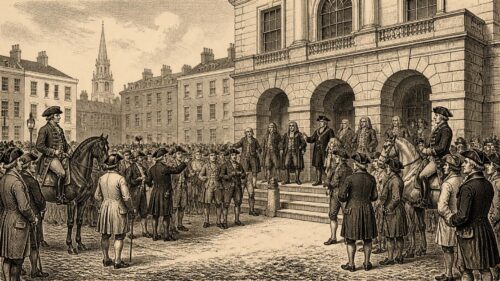
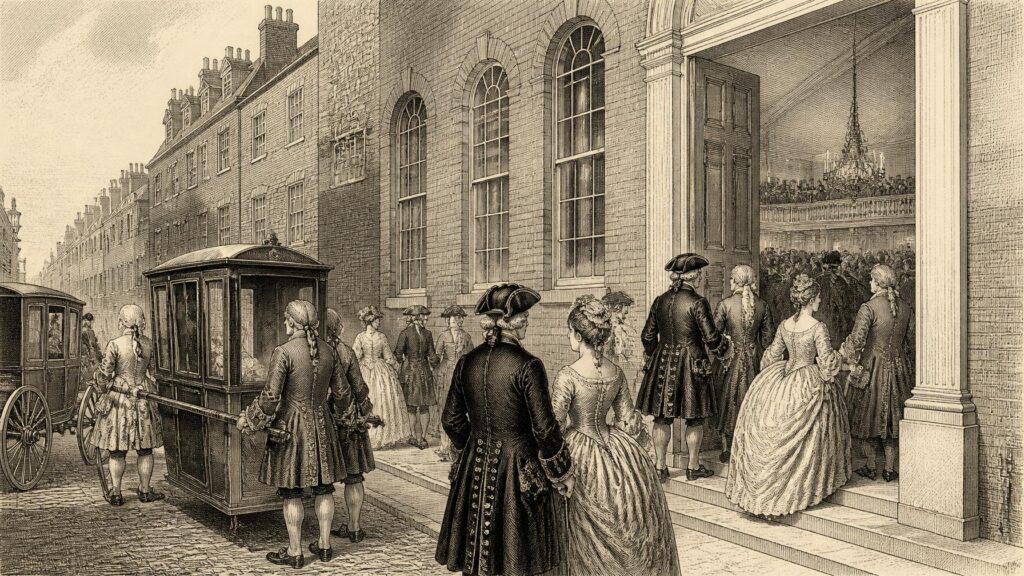
Just over two weeks after the Cope’s arrival, Dublin staged an event that would make 1742 permanently famous. On Tuesday, 13 April, George Frideric Handel’s new English-language oratorio Messiah received its first performance at the New Musick Hall in Fishamble Street, close to Christ Church Cathedral. Handel had arrived in Dublin late in 1741 for a concert season encouraged by the lord lieutenant, William Cavendish, third duke of Devonshire. The city possessed a substantial musical public: cathedral choirs, professional instrumentalists, theatre audiences, subscription concerts and charitable musical societies. Handel’s appearance exploited, rather than created from nothing, that cultural world.
The premiere was explicitly a charitable undertaking. Newspaper advertising announced that the proceeds would aid prisoners in several gaols and support Mercer’s Hospital in Stephen Street and the Charitable Infirmary on Inns Quay. These beneficiaries reveal the practical limits of social provision. Debt could result in imprisonment, while voluntary hospitals depended on subscriptions and donations to care for people unable to purchase private treatment. A public concert, attended by people able to pay, translated elite and middling sociability into funds for institutions dealing with illness and confinement.
The advertised participation of the gentlemen of both cathedral choirs was central. Handel’s principal soloists included the celebrated contralto Susanna Cibber and the soprano Christina Maria Avolio, while Dublin’s cathedral singers supplied trained local voices. Matthew Dubourg, the lord lieutenant’s musical director and an outstanding violinist, led the orchestra. Handel himself played organ concertos as part of the programme. Thus the work’s first hearing was neither a purely foreign import nor a modern-style mass choral spectacle. It was a collaboration between a visiting composer, international soloists, Dublin instrumentalists, Anglican cathedral resources and a paying audience.
Demand was intense enough that advertisements asked ladies to attend without hoops and gentlemen without swords, making more room in the hall and thereby increasing charitable receipts. Such notices offer a rare glimpse of bodily presence in an eighteenth-century public interior: fashionable dress, status-bearing weapons and restricted space all shaped the audience’s experience. They also show how strongly charity, commerce and entertainment overlapped. Admission was sold, the hall was crowded, and the request for altered dress was a practical device to admit more people—not a democratic opening of culture to everyone.
The first performance followed a public rehearsal on 9 April. A second performance of Messiah was given on 3 June, at Handel’s final Dublin concert. The later global reputation of the work can obscure what made the Dublin occasion distinctive. It was mounted in Easter season, not as a Christmas custom; it was performed for local relief; and its score was adapted to the particular performers available in the city. The premiere therefore belongs to Irish history not simply because a famous composition happened to be heard in Dublin, but because local institutions and local charitable priorities made the occasion possible.
Government Without a Sitting Parliament
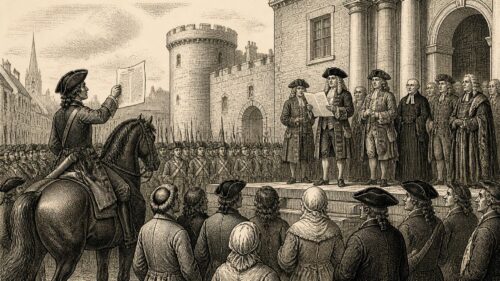
Political life in 1742 was quieter in parliamentary terms than the music hall might suggest. George II remained king, and Ireland was governed within the Hanoverian state by the lord lieutenant and Dublin Castle administration. Devonshire held the lord lieutenancy from 1737 to 1745, although government was frequently conducted by lords justices during viceregal absence. The Irish parliament was repeatedly prorogued: a February declaration postponed it to 23 March, a March proclamation deferred it again to 17 August, and a July order carried the next meeting to 15 February 1743. There was therefore no sustained parliamentary session in Dublin during the calendar year.
This mattered because the Irish political nation was narrow. The established Church of Ireland and a Protestant landowning elite dominated Parliament and many offices, while the Catholic majority was excluded from political power and faced a restrictive legal order; Presbyterian Dissenters also encountered disabilities. The absence of a sitting Parliament did not mean the absence of rule. Proclamations regulated matters from exports to public security, and in October a general fast was ordered for 10 November. Such acts show government working through executive and ecclesiastical channels rather than open legislative debate.
Religion in 1742 was therefore lived under contrasting conditions. The Church of Ireland supplied the cathedral musicians heard at Fishamble Street and retained institutional privilege. Catholic worship and clerical life persisted among the majority population but under legal constraint and with limited resources. In the same year, the Roman Congregation of Propaganda Fide imposed a limit—nominally twelve ordinations in a bishop’s lifetime—on Irish bishops, a decision poorly fitted to diocesan population or local need. It illustrates that Irish Catholicism was shaped not only by the Protestant state but also by decisions made in Rome.
Losses in Church and Letters
Two notable figures of the established cultural and ecclesiastical order were near the ends of their lives. Jonathan Swift, dean of St Patrick’s Cathedral and Ireland’s most formidable satirist, was declared incapable of managing his affairs in 1742 as his long illness worsened. He did not die until 1745, but his effective withdrawal was felt in Dublin’s intellectual life. His 1730s writings on poverty, colonial dependence and municipal failure had acquired a harsh new resonance during the recent famine.
On 27 September Hugh Boulter, Church of Ireland archbishop of Armagh and primate of all Ireland, died in London. Boulter had been one of the most influential churchmen and political figures of the previous eighteen years, closely involved in the administration of the kingdom and in projects of Protestant institutional improvement. His death removed a powerful advocate of the established order at a moment when the famine’s consequences, the condition of the poor and the long-term place of Catholics remained unresolved.
For Ireland, 1742 was not defined by a single national political rupture. Its importance lies in the conjunction of recovery and remembrance. A canal boat demonstrated new possibilities for provisioning and trade; a charitable concert gathered Dublin’s musical resources to fund hospitals and debt relief; and the shadow of famine remained over both. Fishamble Street’s crowded hall and the Cope’s coal-laden passage were different kinds of public event, but each captured an island trying to connect people, goods and institutions after a devastating crisis.

Primary Sources
- Music in 18th-century Dublin
- Oireachtas L&RS display case: Mercer’s Hospital
- Maturin, Gabriel James
- HWV 56: Messiah or “A Sacred Oratorio”
- Handel chronology: 1742 — Messiah is born
- Messiah (HWV 56)
- Add MS 46122: tenor parts of Handel’s Messiah
- The Dublin premiere of Handel’s Messiah and its later performance history
- The Irish famine of 1740–1741: famine vulnerability and ‘climate migration’
- Processes Prior and during the Early 18th Century Irish Famines—Weather Extremes and Migration
- Problems in the Interpretation and Revision of Eighteenth-Century Irish Economic History
- Newry Navigation
- Lough Neagh: The Canals
- Pre-Union British Statutes
- Statute Law Revision Act 2015
- The Statutes at Large: 25 June 1742
- Cavendish, William
- Boulter, Hugh
- Swift, Jonathan
- Catholic Ireland, 1740–2016
- Premiums and Progress—How the Dublin Society Shaped Eighteenth-Century Ireland
- The Penal Laws: Origins, Purpose, Enforcement and Impact