Drapier’s Letters1724 CE
In 1724, opposition to William Wood’s London-authorised copper coinage transformed a dispute over halfpence into a national argument about economic trust, political consent and Irish interests. Jonathan Swift’s anonymous Drapier’s Letters, printed by John Harding, encouraged householders, merchants and bankers to refuse the coins, despite official assurances of their quality. Dublin declarations, grand jury support and Harding’s prosecution threats demonstrated print’s political power, while Lord Lieutenant Carteret confronted mounting resistance. The patent remained valid until 1725, but could not circulate effectively. The year also saw Hugh Boulter’s primacy, the Neal brothers’ landmark Irish tune collection, and a total solar eclipse.
Dateline
In 1724 Ireland’s most important public argument concerned a thing small enough to disappear in a purse: a copper halfpenny. Yet the dispute over William Wood’s proposed coinage became a test of who could decide Irish economic affairs, whose judgement counted in public life, and whether organised refusal could constrain policy made across the Irish Sea. Jonathan Swift’s Drapier’s Letters, printed in Dublin under the name “M. B. Drapier”, gave the conflict its lasting language. They also made 1724 an unusually vivid year for the Irish press.
A Coinage Dispute Becomes a National Cause
The immediate issue was a patent granted in 1722 to the English manufacturer William Wood to mint copper halfpence and farthings for Ireland. Ireland genuinely needed small change: modest daily transactions in towns, markets, workshops and fairs depended upon coin of low value, while gold and silver were scarce in ordinary exchange. The difficulty was not therefore that copper currency was inherently unwelcome. It was the scale, control and trustworthiness of Wood’s proposed supply, and the fact that it had been authorised in London without consultation that satisfied Irish political opinion.
Critics feared that an excessive quantity of low-value copper would displace better money, undermine prices and wages, and injure trade. Those fears mixed practical uncertainty with political grievance. The Irish parliament, dominated by an Anglican Protestant elite and constrained by the constitutional subordination of Irish legislation to Westminster, had already objected to the patent. Dublin merchants, civic bodies and office-holders had also registered opposition. By 1724 the argument was no longer a narrow technical quarrel among officials. It was being carried into shops, coffee houses, taverns, market places and private households.
Swift entered this dispute in March with A Letter to the Shop-Keepers, Tradesmen, Farmers, and Common-People of Ireland. His pseudonymous narrator was a Dublin draper: a plausible commercial voice rather than a dean of St Patrick’s Cathedral. Addressing people who might receive a halfpenny in payment, the pamphlet converted an abstruse question of patent and assay into a matter of household prudence. It insisted that no one was obliged to accept the coins merely because they existed. The point was both economic and moral: a population alert to its own interests could refuse a damaging imposition.
Swift’s numerical claims about the coin’s worth were polemical, and should not be treated as neutral financial calculation. Official examination of samples had found Wood’s copper better than opponents alleged. But the official answer could not dissolve the deeper objection: Irish people were being asked to trust a private English patentee and a London decision-making process that many regarded as inattentive to Ireland. The pamphlet’s force lay less in metallurgy than in its invitation to readers of varied rank to make a common choice.
Print, Credit and Collective Refusal
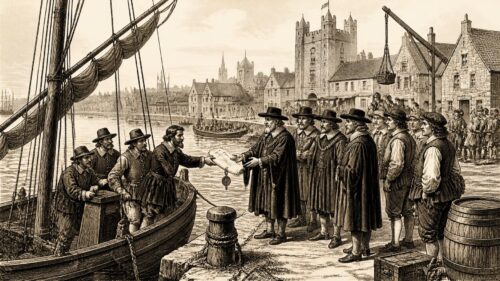
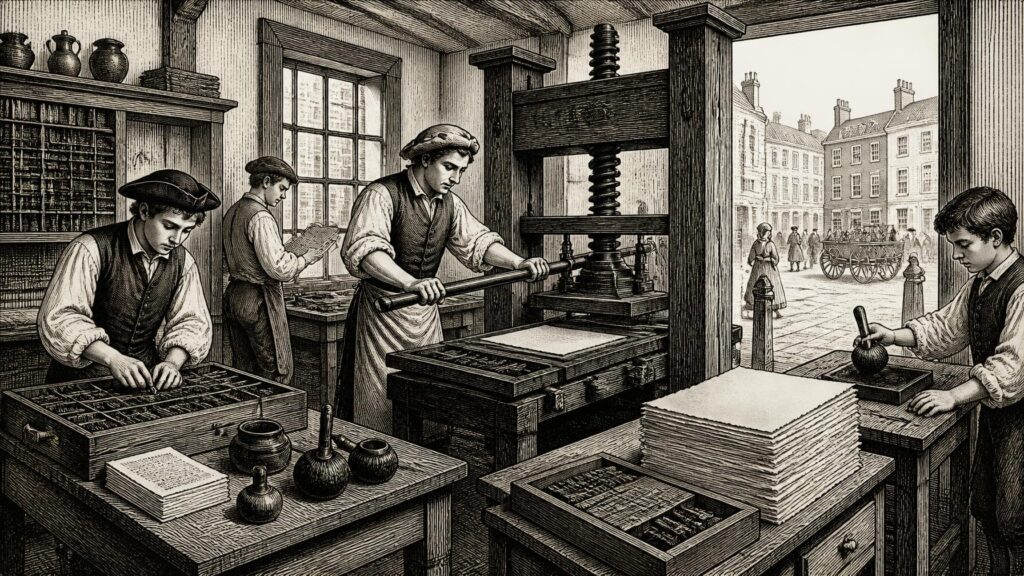
The controversy unfolded through print at remarkable speed. Swift’s second Drapier letter, addressed to John Harding, the Dublin printer, was dated 4 August. It responded to public arguments made for the patent and restated the danger as Swift saw it. Harding’s premises in Molesworth’s Court, off Fishamble Street, became a consequential address in Irish political history. There, cheap pamphlets could turn discussion into circulation: read aloud, passed between acquaintances, copied in substance by newspapers and answered by fresh broadsides.
In August, opposition acquired a practical financial form. Dublin bankers agreed not to accept Wood’s coin, and merchants and tradesmen followed with declarations of refusal. This was significant because coinage only functions through confidence and habitual acceptance. The protest did not require barricades or armed conflict. It used credit, custom and the everyday discretion of those handling payments. A shopkeeper declining a coin, a banker refusing deposits, or a landlord declining rent in it could make the patent ineffective even before the entire quantity envisaged had entered circulation.
The British privy council’s report of 1724 defended the legality of the patent and the quality of the coin examined. Swift replied in his third letter, printed on 25 August, addressed to Ireland’s nobility and gentry. His language broadened the dispute from bad money to political right. At the same time, he carefully professed loyalty to George I. That combination mattered. The Drapier did not openly call for separation from Britain; rather, he argued that the king could not reasonably intend harm to his Irish subjects, and that the patent therefore ought not to be forced upon them.
Such rhetoric helped make a wide coalition possible. The public movement drew on the influence of Protestant political managers, urban corporations and commercial interests, but it was not confined in sentiment to one denomination or social stratum. Catholics and Protestant Dissenters remained excluded or disadvantaged within the political and legal order, and the established Church of Ireland still held institutional privilege. The coinage agitation did not erase those inequalities. Its importance was that a campaign ostensibly about trade found a language of common national interest that could travel beyond the narrow parliamentary electorate.
Carteret Arrives in a Charged Dublin
High politics shifted in the same year. John Carteret, appointed lord lieutenant in May, reached Dublin on 22 October. He inherited a difficult assignment. The British ministry could not readily abandon a royal patent without appearing to yield to pressure; yet the patent was becoming impossible to implement without provoking wider resentment. Carteret had reason to understand the strength of Irish opposition, but he also had to preserve royal authority and manage the powerful interests surrounding the Dublin administration.
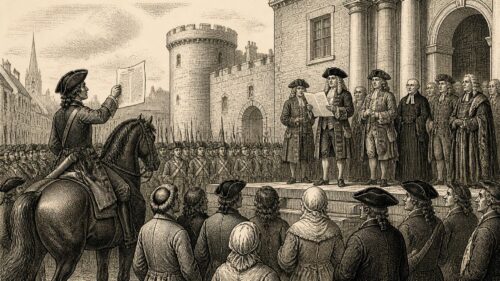
On the day of Carteret’s arrival, Harding published Swift’s fourth letter, A Letter to the Whole People of Ireland. It was the boldest of the series published that year. The Drapier asserted that Irish people were entitled to the liberties of subjects and should refuse the copper money. Its tone alarmed the administration, which regarded it as seditious. A £300 reward was offered for information leading to identification of the author. Harding was taken into custody, though the surviving evidence does not establish that he was successfully prosecuted for printing the letter.
The pressure on Harding illustrates the unequal risks behind the celebrated anonymous voice of the Drapier. Swift was well known in Dublin, and many contemporaries suspected his authorship, but the printer was exposed directly to the machinery of government. The episode also shows that Dublin’s print trade was politically important, not merely literary. A printer’s choice of type, paper, premises and distribution connected churchmen, lawyers, merchants and readers who might never meet in person.
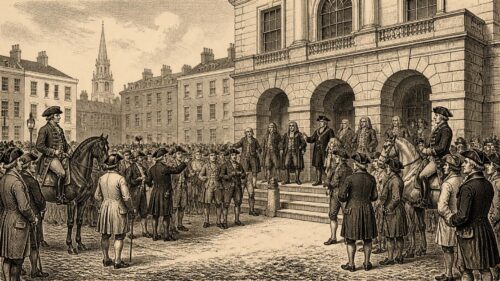
The campaign survived the proclamation. In Michaelmas term the Dublin city grand jury declared that those attempting to impose the halfpence against the kingdom’s expressed will were enemies to its welfare. On 28 November a further declaration praised those who had resisted the coin while affirming loyalty to the king and opposition to the Jacobite pretender. This formula captured the campaign’s political discipline: resistance to a policy was framed not as disloyalty but as the best defence of king, trade and country.
Church, Government and the Limits of Change
1724 also marked the appointment of Hugh Boulter, an English-born cleric, as Church of Ireland archbishop of Armagh and primate of all Ireland. His promotion was politically meaningful. The primacy was not simply a religious office: the Church of Ireland was woven into the governing establishment, and archbishops could exercise substantial influence in patronage and administration. Boulter’s arrival belongs to the same wider story as the coin controversy, in which London ministers sought dependable authority in Ireland while Irish office-holders guarded their own influence.
For most inhabitants, however, the year’s great dispute did not transform the basic social order. Land, agriculture and local obligation still shaped daily life more deeply than pamphlet controversy. Catholics formed the large majority of the population but lived under the penal-law system; Presbyterians, especially in Ulster, also encountered legal disabilities despite their economic importance in many districts. The established church received tithes, while access to office and political power remained tightly restricted. The rhetoric of “the whole people” was therefore politically potent precisely because the reality was far less inclusive.
Nor should 1724 be imagined as uniformly prosperous or uniformly desperate. Ireland’s economy was regionally varied: pastoral production, tillage, linen-related work, brewing, provisioning, coastal shipping and overseas commerce connected different communities to markets of unequal reach. Cash was scarce in much ordinary life, which helps explain why the question of a halfpenny could command attention. Money was not an abstraction when it affected what a labourer, cottier, small trader or servant could safely accept in a day’s dealings.
A Dublin Music Book
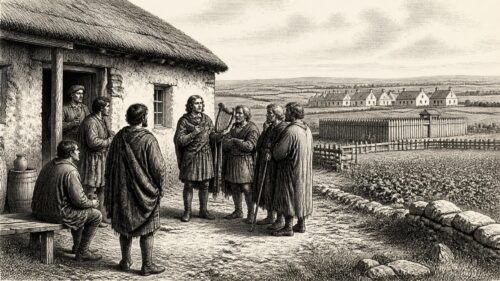
Amid political noise, a quieter publication recorded another Ireland. John and William Neal, instrument makers and music publishers in Christ Church Yard, issued A Collection of the Most Celebrated Irish Tunes, proper for violin, German flute or hautboy. The book contains forty-nine airs and is the earliest known printed collection of Irish music. It preserves tunes associated with the harp tradition, including early printed appearances of music connected with Turlough O’Carolan.
The Neals’ collection is especially revealing because it did not freeze music in an imagined rural past. It adapted Irish airs for instruments fashionable in eighteenth-century urban and polite musical life. The violin, transverse flute and hautboy suggest domestic performance, teaching, sociability and a market for printed notation. The collection shows tradition moving through Dublin’s commercial world: repertory associated with harpers and oral transmission entered copperplate print, where it could circulate in new forms and reach players who did not belong to hereditary musical families.
Only one copy of the 1724 collection is known to survive, a reminder that survival is not the same as original circulation. Still, its publication securely belongs to this year and gives 1724 a cultural significance beyond the Drapier controversy. A city that produced urgent political pamphlets also produced a durable printed record of Irish melody.
An Eclipse Over Ireland
On 22 May a total solar eclipse crossed Ireland on its north-west to south-east course. Modern astronomical reconstruction confirms the event, although it cannot tell us exactly how particular Irish communities interpreted it. In an age attentive to providence, almanacs and celestial signs, the sudden darkening of the sun would have been memorable to those within or near the path of totality. It is safer to see it as a shared natural spectacle than to assign it a political meaning that the evidence does not sustain.
By the end of 1724 Wood’s patent had not yet formally been cancelled; that outcome came in the following year. The year nevertheless established the decisive fact that the coin could not be made to circulate by authority alone. The Drapier’s campaign made refusal respectable, organised and loudly public. Harding’s press, the bankers’ stand, the grand jury’s declarations and the arrival of a new viceroy together made 1724 a formative episode in Irish political communication: a year when a brass halfpenny exposed the value placed on consent.

Primary Sources
- A letter to the shop-keepers, tradesmen, farmers, and common-people of Ireland, concerning the brass half-pence coined by Mr. Whoods
- The Prose Works of Jonathan Swift, D.D. — Volume 06: The Drapier’s Letters
- A Swift’s Chronology
- An Introduction to: Letter to the Shopkeepers, Tradesmen, Farmers, and Common People of Ireland, Concerning the Brass Half-Pence Coined by Mr. Woods [Drapier’s Letters, I]
- An Introduction to: A Letter to the Whole People of Ireland [Drapier’s Letter, IV]
- The report of the Committee of the Lords of his Majesty's most Honourable Privy-Council, in relation to Mr. Wood's half-pence and farthings, &c
- Detailed report on the trial at London of Wood's copper coinage for Ireland, which was found satisfactory, with an account of the amount of Wood's coinage up to 28 March 1724
- Wood’s Halfpence, Carteret, and the government of Ireland, 1723–6
- Carteret, John
- Boulter, Hugh
- Neal (Neale), John
- Neal: Celebrated Irish Tunes
- A Collection of the Most Celebrated Irish Tunes: Proper for the Violin, German Flute or Hautboy
- Irish Song Project — Types & Histories
- Neal, John
- Coinage of William Wood
- An answer to Mr. Wood's proposal, relating to his copper — Half — Pence
- Copies of two Orders of Council relating to William Wood's Irish coinage
- The harp that once on Ireland’s coins
- Using Other People’s Money: Farewell to the Irish Pound
- ‘Reasonable Inconveniences’: The Theory and Practice of the Penal Laws
- The Penal Laws: Origins, Purpose, Enforcement and Impact
- NASA — Solar Eclipses of History
- Path of Total Solar Eclipse of 1724 May 22