Madden’s Improvement1738 CE
In 1738, Ireland experienced a wet, delayed farming season, documented in Cathal Ó Conchubhair’s Irish-language diary through delayed harvests and turf work, exposing rural dependence on weather, fuel and mixed crops. Samuel Madden urged Protestant landlords to promote estate management, agriculture, flax, education and manufacture, though his improvement scheme preserved inequalities. Parliament remained prorogued while government addressed robbery through proclamations and rewards. The deaths of harper Turlough O’Carolan and Dublin educator Thomas Sheridan marked losses. Roxborough Castle’s construction and Richard Montgomery’s birth reflected investment and Protestant Atlantic opportunities. The year revealed social division, economic ambition and environmental vulnerability without famine.
Dateline
In 1738 Ireland was not yet in the grip of the catastrophe later remembered as the Great Frost and famine. Yet the year exposed vulnerabilities that would matter greatly in an overwhelmingly rural society: difficult weather, delayed fieldwork, insecure supplies of fuel and grain, and a political order in which the great majority of inhabitants had little formal power. Its most revealing evidence comes not from a dramatic battle or parliamentary statute, but from a farmer’s Irish-language diary, a Dublin clergyman’s programme of “improvement”, official proclamations, and the deaths of two very different cultural figures.
A Wet and Delayed Farming Year
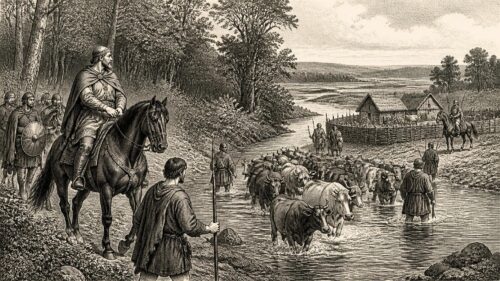
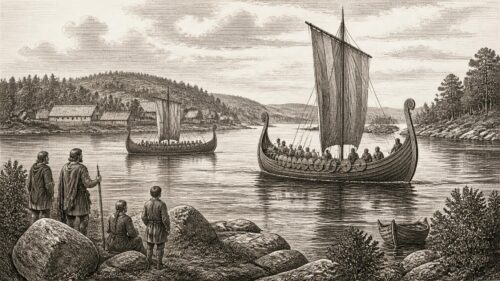
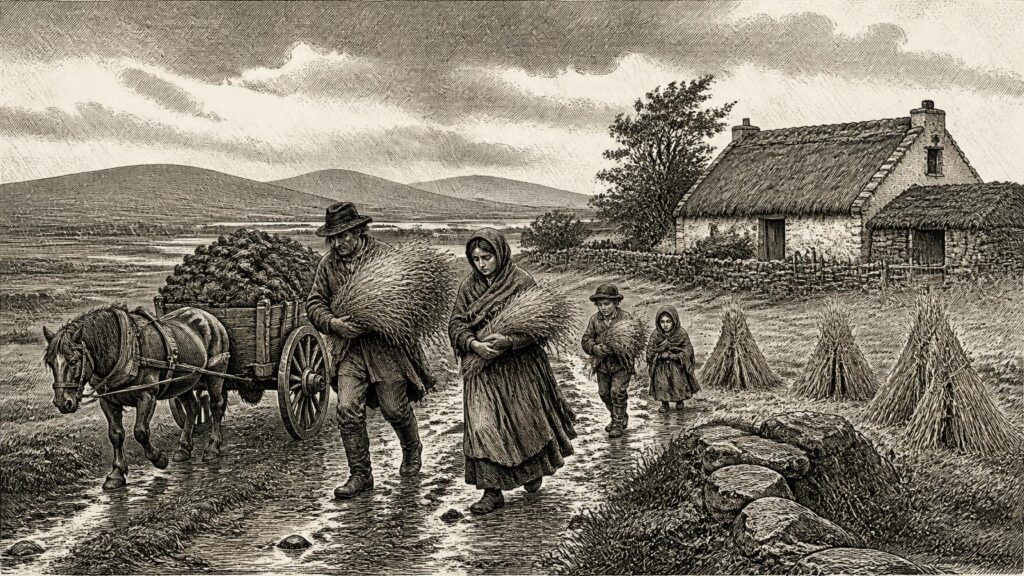
Cathal Ó Conchubhair’s surviving account book and diary offers an unusually close view of 1738. Written in Irish, it records work, weather, crops, animals, rents and household concerns in the practical language of a working farm. It cannot stand for every district of Ireland, but it gives firm dates and a vivid sense of how weather shaped daily decisions. In April he noted the preparation of old potato ground and recorded that all his potatoes had been planted by 18 April. Potatoes were already an important crop in many households, but they were part of a mixed economy of oats, barley, wheat, livestock and turf rather than a sole source of food.
The season soon became troublesome. Ó Conchubhair wrote on 30 June that persistent wet weather since Bealtaine had prevented him from beginning the dry-weather work of cutting hay until that day. He leased the tithe of his barley to Patrick Mac Giolla Ghlais for thirteen shillings: a small but telling reminder that the farm’s produce was divided by obligations as well as consumed or sold by the cultivator. By 26 July he began cutting barley, seventeen days later than the previous year and twelve days later than the year before that. Two days afterwards he judged the weather very wet and the growth of both grass and barley very poor.
Wet weather did not stop the agricultural calendar; it compressed and complicated it. The diarist was still bringing home turf on 22 August, with rain continuing, began wheat harvest on 26 August, and did not start cutting oats until 28 August—nineteen days later than in 1736. His harvest ended on 13 September, but he was still recording continual rain in October. Turf was not a minor concern. It was the principal domestic fuel for many rural households, and getting it dry, stacked and brought home was essential preparation for winter. A delayed hay or grain harvest therefore affected not one task but labour, fodder, fuel and the timing of autumn sowing.
Modern climate research supports caution rather than a simple national verdict on this one diarist’s experience. A reconstructed all-Ireland rainfall series identifies notably wet winters during the 1730s, while a historical overview places a marked deterioration in weather in the autumn of 1738. These broader findings make Ó Conchubhair’s reports of sodden work and late harvesting historically plausible, but they do not prove that every Irish county endured identical conditions or that 1738 itself was a famine year. The responsible conclusion is narrower: a difficult farming season was already visible in contemporary testimony.
Madden’s Programme for Improvement
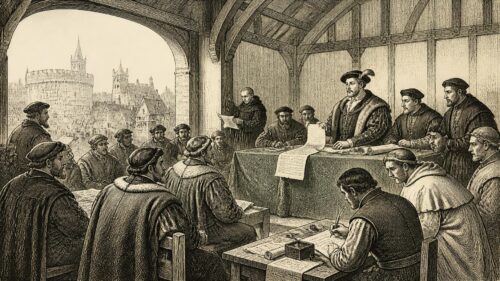
In Dublin, the Church of Ireland clergyman and philanthropist Samuel Madden published Reflections and Resolutions Proper for the Gentlemen of Ireland. Its long subtitle addressed landlords, householders, Protestants, country gentlemen and farmers, justices of the peace, merchants and members of parliament. Printed in Dublin by R. Reilly for the bookseller George Ewing, it was unmistakably aimed at the propertied Protestant elite whom Madden believed should assume a more active responsibility for the kingdom’s prosperity.
Madden’s argument was both patriotic and paternalistic. He deplored absenteeism, waste, idleness and conspicuous expenditure, and urged resident landlords to treat estates as places requiring investment and stewardship. His practical remedies included the encouragement of hemp and flax manufactures, schools, and professorships of agriculture. He also advocated incentives for flax cultivation, connecting agricultural output to linen production and export trade. Such proposals were not a programme of political equality. They assumed the leadership of a Protestant landed class, while Roman Catholics remained constrained by the penal system and excluded from the parliamentary nation. But the book recognised that estate management, employment, education, manufacture and public welfare were linked questions.
The pamphlet also belongs to the institutional world of the Dublin Society, founded in 1731, with which Madden co-operated. That body promoted agricultural and manufacturing “improvement” through premiums, information and practical encouragement. Madden had already helped establish prizes at Trinity College Dublin for learning. His 1738 book extended that belief in prizes, instruction and managed enterprise from the university into the countryside. The ideas were aspirational: publication did not itself create schools, improve tenancies or redistribute wealth. Still, it shows that, in this precise year, influential people were openly debating how Ireland might produce more, employ more people and retain more of its resources.
Government by Proclamation
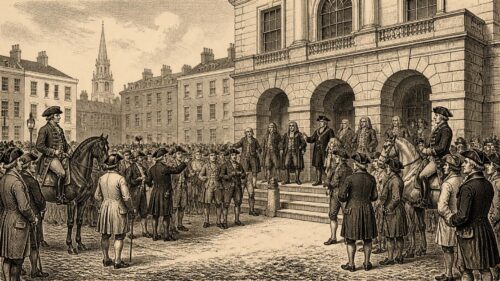
Political life in 1738 was quiet in the narrow parliamentary sense, but not inactive. The Irish parliament was repeatedly prorogued: orders moved its meeting first to 25 April, then to 21 December, and finally to 3 May 1739. This was a reminder that the legislature at College Green operated within a constitutional structure ultimately dependent on crown and British authority, and that much administration proceeded through Dublin Castle, local magistrates and proclamation rather than sustained public debate in parliament.
The surviving proclamation record reveals official anxieties about disorder and insecurity. On 3 February a reward was offered for robbers who had attacked a post-boy in County Armagh. In May rewards concerned the robbers of Theodore Van Sevenhaven and accomplices in an armed robbery of a Dublin cellar. On 7 July, authorities ordered named “tories, robbers and rapparees” in Clare, Kilkenny, Kerry, Tipperary, Westmeath, Meath, Antrim and Monaghan to surrender. The language was that of state security, not a neutral social survey, and it must not be read as proof that the island was generally lawless. It does, however, show the geographical breadth of official concern and the limited, coercive instruments upon which government relied.
Two Cultural Departures
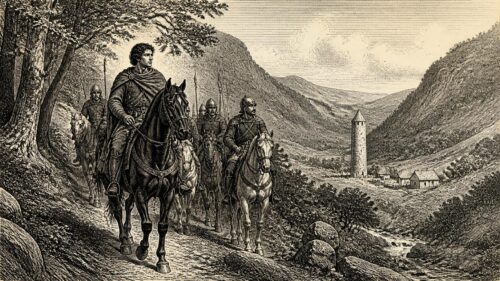
On 25 March Turlough Ó Cearbhalláin, usually known in English as Turlough O’Carolan, died at the home of his first patron, Mrs MacDermott Roe, near Ballyfarnon in County Roscommon. Blinded by smallpox when young, Carolan had travelled for decades as a harper, composer and poet, supported by networks of patronage across the country. His compositions were often occasional works attached to named patrons, and many had Irish verses. His career therefore illuminates a living system of travel, hospitality, memory and exchange rather than a vanished relic of an earlier Gaelic world.
Carolan’s music also resists easy labels. It retained Irish melodic and dance forms while absorbing elements associated with the Italian baroque: sequence, imitation, ornamentation and formal dance rhythms. Later writers often cast him as the “last bard”, a phrase that can obscure the continuing presence of Irish-speaking culture and itinerant musicians after his death. In 1738, however, his passing was genuinely significant: a composer whose work had connected Catholic and Protestant patrons, rural houses and wider European musical fashions was no longer travelling Ireland’s roads.
Another death linked the year to urban literary and educational life. Thomas Sheridan, schoolmaster, clergyman, poet, essayist and close associate of Jonathan Swift, died at Rathfarnham on 10 October. His Dublin school had been renowned for performances of Greek and Latin plays, and he had been a prominent member of Swift’s circle of writers and conversational wits. His career demonstrates that eighteenth-century Dublin’s cultural life was not confined to parliament or commerce: schools, sermons, translations, manuscript circulation, theatres and newspapers made up a vigorous, if socially restricted, public world.
Building, Birth and Perspective
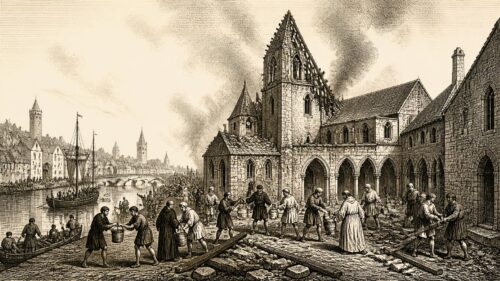
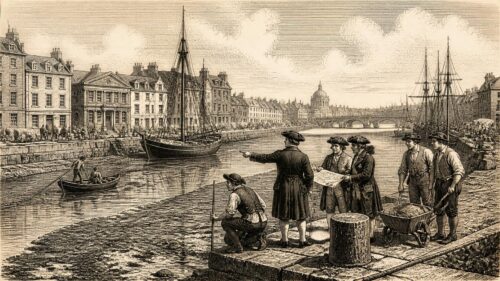
At Moy in County Tyrone, Roxborough Castle was built in 1738 as a house associated with the Charlemont estate. Later alterations erased much of its original appearance, and the building itself is gone, but its construction is still a useful sign of landed investment and display in Ulster. Grand houses expressed family authority over land, tenancy and local society; they also required craftsmen, materials, transport and continuing household labour. Madden’s approval of substantial, well-managed country seats was thus not merely aesthetic but part of his broader vision of resident elite stewardship.
On 2 December, Richard Montgomery was born at Feltrim near Swords, County Dublin, into a Protestant landowning and parliamentary family. His later career in the British army and the American Revolutionary War lay far beyond 1738, so it should not be used to inflate the year’s importance. Nevertheless, his birth neatly indicates the Atlantic reach available to some Irish Protestant families: education at Trinity, military service in imperial forces, and careers extending to North America were already imaginable within their social world.
Thus 1738 was a year of uneven evidence but clear significance. The wet, delayed work recorded by Cathal Ó Conchubhair brought environmental pressure into the household economy. Madden’s book argued that landlords and gentlemen must answer such structural weaknesses through agriculture, manufacture and education. Government answered insecurity with proclamations; Carolan and Sheridan’s deaths marked changes in Irish-language musical patronage and Dublin letters. Ireland ended the year neither at peace with all its problems nor in the later famine emergency. It stood, rather, with its social divisions, economic ambitions and dependence on the seasons plainly exposed.

Primary Sources
- Dialann Uí Chonchúir
- Reflections and Resolutions Proper for the Gentlemen of Ireland
- Reflections and Resolutions Proper for the Gentlemen of Ireland, as to Their Conduct for the Service of Their Country
- Madden, Samuel Molyneux (‘Premium Madden’)
- Carolan, Turlough (Ó Cearbhalláin), Toirdhealbhach
- Sheridan, Thomas
- Montgomery, Richard
- Climate
- A 305-year Continuous Monthly Rainfall Series for the Island of Ireland (1711–2016)
- A 305-year Continuous Monthly Rainfall Series for the Island of Ireland (1711–2016)
- Processes Prior and during the Early 18th Century Irish Famines—Weather Extremes and Migration
- Irish Political Writings after 1725
- Statute Law Revision Act 2015
- Roxborough Castle, Moy, County Tyrone
- Tyrone, Roxborough Castle
- The Dublin Daily Post and General Advertiser: Holdings
- Newspapers
- Dublin City Library and Archive Newspapers
- Daily Weather in Dublin 1716–1734: The Diary of Isaac Butler
- Searching for Historical Meteorological Observations on the Island of Ireland