
St Sepulchre’s Library Grant1701 CE
On 9 July 1701, St Patrick’s Cathedral granted Archbishop Narcissus Marsh ground to build a library beside St Sepulchre’s Palace, initiating Ireland’s first purpose-built public library, later known as Marsh’s Library. Its learned but socially restricted vision joined Protestant ecclesiastical power with Huguenot scholar Élie Bouhéreau. Meanwhile, Lord Lieutenant Rochester’s arrival reinforced English control over Irish administration, military recruitment and post-Williamite security. Catholic clergy faced uneven enforcement of banishment laws, while dissenters remained disadvantaged. Woollen export restrictions and Irish Sea trade shaped economic pressures. The Act of Settlement and James II’s death heightened Protestant fears of Jacobite and French threats.
Dateline
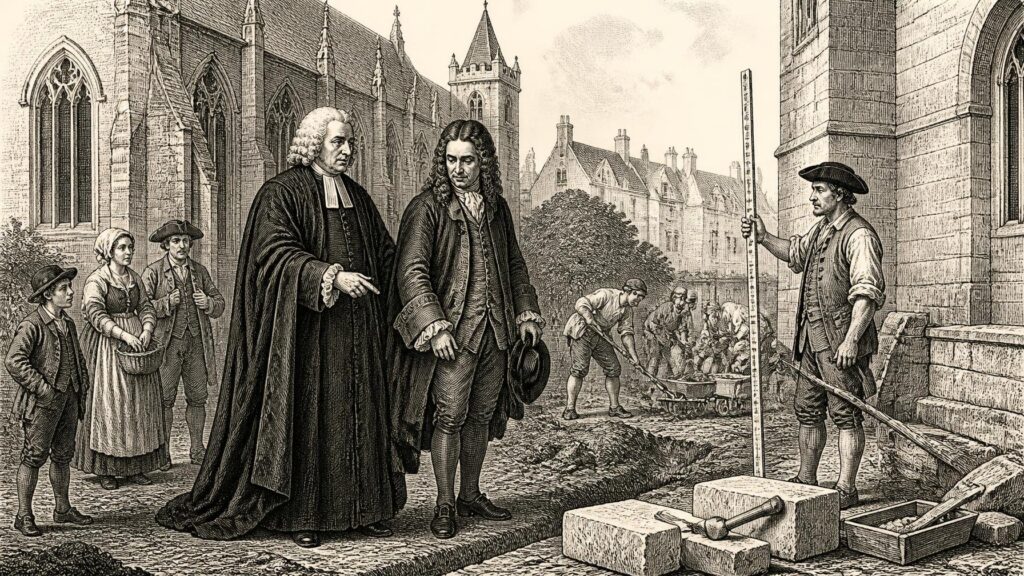
On 9 July 1701 the dean and chapter of St Patrick’s Cathedral in Dublin granted Archbishop Narcissus Marsh permission to erect pillars in the cathedral churchyard and to alter a wall for a library beside the archiepiscopal palace of St Sepulchre. It was a modest-looking act of institutional business, recorded in cathedral papers rather than announced with ceremony. Yet it marked the practical beginning of what became Marsh’s Library: Ireland’s first purpose-built public library. The building itself was not begun until 1703, and its legal incorporation came only in 1707. The securely dated event of 1701 was the grant of ground and permission to build. That distinction matters, but so does the significance of the decision. In a country recently devastated by war and governed through a narrow Protestant establishment, it announced an unusually durable investment in learned culture.
A Library Before Its Building
Marsh was well placed to make such a project happen. A former provost of Trinity College Dublin and then Church of Ireland archbishop of Dublin, he was a scholar, collector and administrator who regarded books as a public resource rather than simply private property. The projected library stood beside St Patrick’s, near the archbishop’s residence, instead of within Trinity. This location made a point: Dublin learning need not be confined to the university. Its public was nevertheless socially limited. Marsh envisaged access for graduates and gentlemen, not a universal reading room in the modern sense; women and poorer townspeople were not the intended beneficiaries. Even so, the scheme enlarged the city’s intellectual infrastructure beyond the libraries of college, cathedral and great house.
The library’s proposed holdings also gave the enterprise an international character. Marsh had collected theological and scholarly books, including works in Hebrew and other eastern languages. Its first keeper was the Huguenot refugee Dr Élie Bouhéreau, a physician and learned Protestant from La Rochelle who had fled France after Louis XIV revoked toleration for French Protestants in 1685. Bouhéreau had settled in Dublin in 1697 and brought both a substantial personal library and a transnational world of correspondence and scholarship. His appointment in 1701 joined an Irish ecclesiastical patron, a refugee intellectual and a collection built across several European languages and confessions. The books were not yet housed in the famous oak-fitted rooms visitors know today, but the grant made that future possible.
This was not a cultural renaissance shared evenly across Ireland. Literacy, bookselling and formal education were concentrated in towns and among the propertied and clerical classes. Much of the population lived in rural communities, speaking Irish, English or both according to region and circumstance, and transmitted knowledge through households, work, worship and oral culture as well as print. Nevertheless, the planned library is revealing precisely because of its limits. It belonged to the institutions which governed Protestant Dublin, while its Huguenot keeper embodied the movement of persecuted continental Protestants into Irish urban life. In 1701, learned cosmopolitanism and confessional exclusion were not opposites: they could occupy the same city and even the same institution.
Rochester Comes to Dublin
Political authority in Ireland during 1701 remained firmly tied to the crown and ministers across the Irish Sea. The Irish parliament did not sit between 1699 and 1703, so no new Irish parliamentary statute defined the year. Administration continued through Dublin Castle, the privy council, courts, revenue offices, local magistrates and the established church. On 18 September Laurence Hyde, earl of Rochester, arrived to be sworn in as lord lieutenant. He had formally received the appointment in late 1700, but spent much of his short tenure in England; his residence in Ireland lasted from 18 September 1701 until 4 January 1702. His arrival nonetheless mattered. Rochester was a powerful English Tory with extensive Irish connections through the Boyle and Butler families, and his governorship gave the Dublin executive unusually direct access to influence at court.
His administration illustrates how government operated in the absence of parliament. The lord lieutenant could shape appointments, supervise revenue, issue proclamations and direct military administration. A proclamation of 30 September offered a pardon to soldiers who had deserted if they returned to their regiments, or enlisted in newly raised units by the stated deadline. Later that autumn, a declaration on army recruiting specified that regiments in Ireland were to recruit English-born subjects known to be Protestant, whether brought from England or enlisted within Ireland. Such measures were practical responses to manpower and discipline, but they also show how military service was being made a confessional and political safeguard after the Williamite wars.
Rochester’s arrival came amid a wider effort to consolidate the post-war Protestant order. The decisive fighting of 1689–91 was a decade past, but its settlements continued to shape landholding, officeholding, military service and public trust. The governing class remembered the Jacobite war not as distant history but as a warning of what a restored Catholic monarchy, French intervention or renewed Irish rebellion might entail. That outlook helps explain why apparently administrative decisions—who could carry arms, hold office, staff a regiment or exercise church authority—had such political force.
Religion, Enforcement and Evasion
For the Catholic majority, 1701 was a year of constraint rather than a single new statute. The 1697 Banishment Act had ordered Catholic bishops, regular clergy and those exercising ecclesiastical jurisdiction to leave Ireland. Parish priests were treated differently, but the hierarchy and religious orders were particular targets. The law had not eliminated Catholic practice, nor had it made enforcement straightforward. Clergy moved, returned, disguised their status or relied on sympathetic local networks; magistrates and customs officers varied greatly in diligence. The gap between statute and everyday practice was therefore central to the religious history of the year.
Rochester’s government publicly complained in 1701 that magistrates, ministers of justice and port officers had neglected their duty, thereby allowing prohibited Catholic ecclesiastics to remain in, enter or return to the kingdom. Its proclamation offered rewards of £100 for the discovery of an archbishop or bishop, £30 for a clergyman exercising ecclesiastical jurisdiction, and £10 for a Jesuit, friar or monk. Those sums were designed to recruit informers and convert religious surveillance into local self-interest. Yet the need to repeat the policy is evidence of difficulty, not proof of total control. The later, harsher legislation of 1703–04 should not be projected backwards: in 1701 the older banishment regime, contested and unevenly applied, was the relevant framework.
The Church of Ireland possessed establishment, endowments and political privilege, but it was not synonymous with all Protestants. Ulster Presbyterians and other dissenters remained outside the established episcopal church and lacked the secure legal toleration enjoyed by many dissenters in England. Thus Ireland’s religious hierarchy was layered rather than simply binary. Catholic worship and leadership faced the greatest official suspicion; Presbyterian communities could be important locally, particularly in Ulster, yet were also excluded from the full political and ecclesiastical standing reserved for conforming members of the established church. Marsh’s library was an achievement of that church’s leadership, while Bouhéreau’s presence signalled the value it could place upon foreign Reformed Protestant learning.
Trade Across Narrow Seas
Economic life was equally shaped by regulation beyond Ireland. The restrictions imposed on Irish woollen exports in 1698–99 were already part of the working environment in 1701. They did not instantaneously destroy all manufacture, and it is misleading to portray the year as a sudden collapse. But they narrowed legal outlets for a trade that had mattered to urban producers and merchants, encouraging an economy in which livestock, provisions, hides, fish and other raw or lightly processed goods remained important. The consequences would unfold over decades, including shifts towards linen and other employments; they should be understood in 1701 as an established pressure rather than a development born that year.
A contemporaneous order from Scotland gives a sharper glimpse of the Irish Sea economy. On 14 March the Scottish privy council authorised Captain John McCulloch and his agents to seize, stave and sink illegally imported Irish grain and victuals along part of Scotland’s western coast. The order was Scottish, not Irish, and should not be mistaken for an Irish famine measure. Its relevance lies elsewhere: grain was moving from Ireland across the North Channel, and governments sought to control that movement through prohibitions, coastal watches, seizures and forfeitures. Sea routes connected Irish producers and merchants to neighbouring markets even where law attempted to close them.
A Succession Made More Fraught
Events outside Ireland intensified these domestic anxieties. In June, the English Act of Settlement fixed the future succession, after William III and Princess Anne, upon Sophia of Hanover and her Protestant heirs. The statute explicitly concerned the crowns of England, France and Ireland, and its exclusion of Catholics from the succession had obvious resonance in a kingdom where the recent war had been fought over monarchy, religion and land. It did not itself enact a fresh Irish penal code or alter ordinary life overnight. Its immediate importance was constitutional and symbolic: the Protestant character of the monarchy was declared to be permanent policy.
Then, in September, the exiled James II died in France. Louis XIV recognised James’s son, James Francis Edward Stuart, as king. For Irish Protestants, this revived the spectre of a Franco-Jacobite challenge; for Catholics and surviving Jacobite networks, the Stuart claim had not vanished with the defeat at Limerick. No rising occurred in Ireland in 1701, and it would be wrong to manufacture one from the atmosphere of alarm. But the succession crisis gave Rochester’s recruitment rules, religious proclamations and official vigilance a larger European meaning. Ireland was quiet in the narrow sense that it saw no new war, yet it remained strategically exposed in the imagination of its rulers.
An Uneven Beginning
The year is best remembered not for a battle or parliamentary turning point, but for several connected acts of consolidation. At St Patrick’s, a plot was granted for a library that would preserve and circulate European learning in Dublin. At Dublin Castle, Rochester’s arrival tightened the link between Irish administration and English high politics. In proclamations, recruitment rules and religious surveillance, the state worked to secure a Protestant post-war order whose authority was real but unevenly enforced. Across the sea, law and diplomacy made succession, trade and security matters in which Ireland had little independent control. The library grant of 9 July offers the most hopeful image of 1701: an institution conceived amid exclusion and anxiety, yet built to outlast both and still bearing witness to the intellectual world of early eighteenth-century Ireland.
Primary Sources
- Representative Church Body Library: Catalogue of Archives of St Patrick’s Cathedral, Dublin
- Marsh’s Library: Background, Purpose & Vision
- Medieval Manuscripts at Marsh’s Library, Dublin
- The Diary (1689–1719) and Accounts (1704–1717) of Élie Bouhéreau
- Explore the Correspondence of Our First Librarian
- Élie Bouhéreau (1643–1719): A Scholar at Work in his Libraries
- Élie Bouhéreau and the World of the Huguenots
- Hyde, Laurence
- HYDE, Laurence (Lawrence) (1642–1711)
- By the Lord Lieutenant General and General Governour of Ireland, a Proclamation
- Religion: Irish Parliament Background to Statutes
- The Penal Laws: Origins, Purpose, Enforcement and Impact
- The Irish Popery Laws: A Study of Eighteenth-Century Legislation and Behavior
- Irish Legislation Database: Browse Regnal Years
- Peers, Parliament and Power under the Revolution Constitution
- History of the Commercial and Financial Relations between England and Ireland from the Period of the Restoration
- Wool Exportation (Prohibition) Act: Account of the Commission for Trade relating to the Woollen Manufacture in Ireland
- Procedure, 14 March 1701, Edinburgh
- Act of Settlement (1700)
- The Act of Settlement
- Succession to the Crown: King William III and Queen Mary II
- Prince James Francis Edward
- Securing the Hanoverian Succession in Ireland: Jacobites, Money and Men, 1714–16
- State Papers Ireland 1509–1782: Government Papers on Irish Affairs