

Kilmainham’s Soldier Hospital1684 CE
In 1684, Restoration Ireland combined outward peace with unresolved political, military and property tensions. King Charles II chartered the Royal Hospital at Kilmainham for aged and disabled soldiers, linking welfare to the permanent army. A fire damaged Dublin Castle, threatening records and prompting later rebuilding. The Duke of Ormond returned as lord lieutenant but received notice of dismissal, reflecting shifting court influence. The Commission and Court of Grace sought to regularise defective land titles without overturning Protestant dominance. Granard’s regiment improved military organisation. Dublin’s scientific society and Ruaidhrí Ó Flaithbheartaigh’s regional study fostered inquiry, while winter damage exposed material vulnerability.
Dateline
Ireland in 1684 was governed in the name of Charles II, but its political life was shaped as much by unsettled inheritances from the wars and confiscations of the previous four decades as by any single dramatic crisis. There was no Irish parliament sitting, no national campaign under way, and no decisive change of sovereign. Yet several securely dated developments reveal a kingdom in which royal administration, military organisation, property law and urban building were being strengthened together. Dublin supplied the clearest stage: a veterans’ hospital was formally established at Kilmainham, a destructive fire damaged Dublin Castle, and the long-serving Duke of Ormond returned to office only to learn that his dismissal had been decided in London.
A Year of Careful Dating
The calendar of 1684 needs to be handled with some care. Older chronologies give 25 March as the completion date of the Royal Hospital at Kilmainham. Other institutional and architectural evidence shows a longer process: the hospital was chartered on 19 February 1684, its governors first met on 21 March, pensioners were admitted during the year, and work on parts of the complex, including its chapel, continued afterwards. The firm conclusion is therefore not that every element of the great building was finished on one spring day, but that 1684 marked its formal establishment and the beginning of its active life as an institution for old and disabled soldiers.
That distinction matters beyond architectural pedantry. Restoration Ireland was governed through charters, commissions, patents, military establishments and offices as much as through spectacular public events. A document could make a corporate body, recognise a land title, regulate a force of soldiers or alter the balance of influence between Dublin and the royal court. The year’s evidence is unusually rich in such administrative acts. It shows an Irish kingdom that was at peace, but not politically uncomplicated; materially improving in some places, but built upon a land settlement that still generated grievances and uncertainty.
The Hospital at Kilmainham
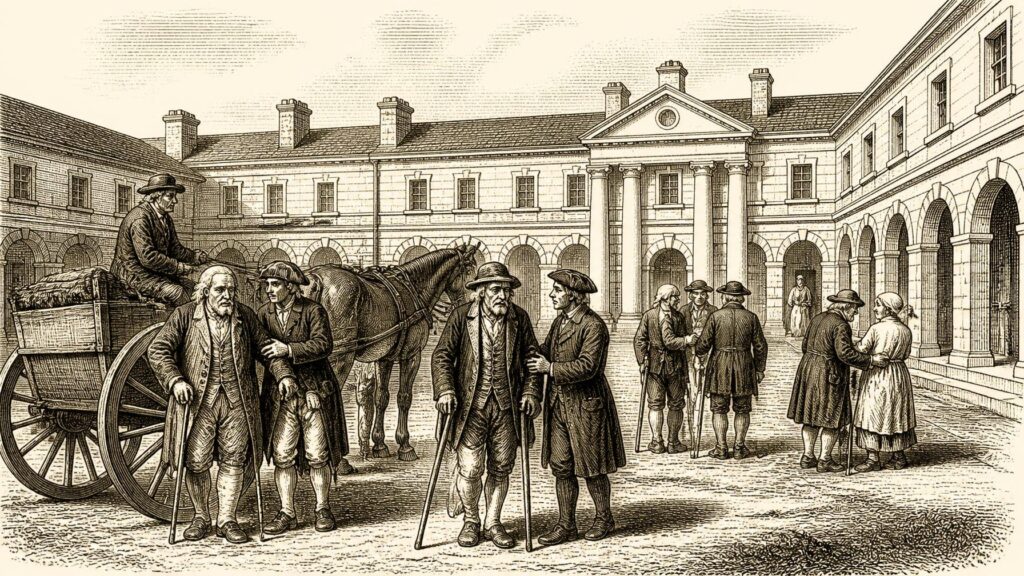
The Hospital of King Charles II at Kilmainham was incorporated by royal charter on 19 February. Its purpose was explicit: to provide for ancient, maimed and infirm officers and soldiers of the army in Ireland. The project was closely associated with James Butler, first Duke of Ormond, lord lieutenant, and was designed by Sir William Robinson, surveyor general of Ireland. Robinson and Ormond drew inspiration from the great soldiers’ hospital of Les Invalides in Paris, but the Kilmainham institution belonged to Irish conditions: it was intended for men who had served in, and were maintained by, the army establishment in Ireland.
The building stood west of Dublin on the former lands of the medieval hospital of the Knights of St John. Its regular classical ranges and large court announced royal order and permanence. The care offered was not charitable in a modern universal sense. Admission depended upon service and status; the hospital was part of the state’s obligation to soldiers who had become unable to support themselves. Nevertheless, its opening was a notable development in welfare provision. It acknowledged that military service created enduring responsibilities, and it gave those responsibilities a conspicuous institutional home outside the crowded city centre.
For Dubliners, Kilmainham also represented construction work, supply contracts and the movement of craftsmen and materials at the edge of the capital. Its architecture projected the confidence of the Restoration regime, while its purpose conveyed a harder reality: the kingdom’s apparent peace rested on a permanent armed presence, whose veterans might carry the marks of earlier fighting for the rest of their lives. The hospital’s foundation is thus inseparable from the army, not an isolated act of benevolence.
Fire at the Seat of Government
On 7 April a serious fire broke out at Dublin Castle, the administrative and ceremonial centre of English royal government in Ireland. Richard Butler, earl of Arran and Ormond’s son, was resident there as lord deputy during his father’s absence in England. Contemporary civic gratitude focused on Arran’s conduct amid the emergency. The flames approached the powder magazine, while the Castle also held records of national importance. The danger was not merely to a royal residence: an explosion might have devastated a densely inhabited part of Dublin, and the destruction of official records would have damaged the working memory of government and property.
The immediate catastrophe was averted, but much of the old Castle was badly damaged. The fire became a turning point in the physical history of the site. Rebuilding over subsequent decades helped transform what had long been a medieval fortress into a more modern vice-regal complex. In 1684, however, the central significance was immediate. A government already dependent on written warrants, revenue records and legal instruments saw how vulnerable its headquarters could be. The rescue of the records had special resonance in a society where titles to land, inherited claims and the documentation of past settlements remained intensely contested.
Ormond’s Brief Return
Ormond’s own position reflected the dependence of Irish government upon court politics across the Irish Sea. He had been away from Ireland since 1682, with Arran acting in Dublin. Ordered back to his post on 17 June 1684, Ormond was delayed by the illness and death of his wife, Elizabeth Preston. He left England on 5 August and arrived in Dublin on 19 August. His return restored one of the most experienced figures in Stuart administration to the government of Ireland, a man with immense estates, Protestant credentials and a political career reaching back to the wars of the 1640s.
But the restoration did not last. A letter dated 19 October informed him of his dismissal. The decision had been shaped by faction at Charles II’s court, where the influence of the king’s Catholic brother, James, duke of York, and of Richard Talbot was growing. Ormond was allowed to remain through the winter rather than undertake an immediate return journey, but the news mattered in 1684. It signalled that a durable Irish political arrangement, associated with Ormond’s authority and the Protestant interest, was no longer beyond revision. It would be misleading to treat this as a settled change of regime: Ormond remained in office into early 1685. Yet the dismissal notice was a clear warning that the balance of royal favour had shifted.
Titles, Grace and the Army
Land remained the deepest structural question. In March a Commission of Grace was issued to deal with defective titles and claims arising from the post-war settlement; the Court of Grace began sitting in June. It was not a general reversal of Cromwellian and Restoration land transfers, nor should it be confused with a tithe inquiry. Its intended work was narrower: to regularise insecure holdings through grants and fines, while offering the crown revenue and a possible means of addressing some unresolved claims. Its proceedings soon became entangled in disputes over fees, and its eventual practical effect was limited. Still, the commission is important because it demonstrates how incomplete the settlement felt to many proprietors more than twenty years after the Restoration.
The social stakes were considerable. The confiscations of the Cromwellian period had reduced Catholic landholding drastically; Restoration legislation restored some property, but left a predominantly Protestant landed interest with the political advantage. The Court of Grace did not erase that order. Instead, it offered a legal route through particular defects and claims, preserving the premise that property, royal favour and official documentation were interdependent. Letters concerning Irish titles later in 1684 show that prospective patentees and their advisers followed its operation closely.
Military reorganisation ran alongside this legal work. On 1 April, Arthur Forbes, Viscount Granard, was appointed colonel of an infantry regiment assembled from independent companies in Ireland. The unit would later be known as the Royal Irish Regiment. Its formation was part of a wider effort to organise the Irish military establishment more systematically. Granard, a Protestant soldier and politician with interests in Ulster and the midlands, was created Earl of Granard on 30 December. In the same year he had testified, with Richard Talbot, to inefficiency and corruption in the army. The reorganisation therefore represented not only a search for military order, but an attempt to make the crown’s Irish force more dependable and manageable.
Knowledge from Dublin and Iar Connacht
1684 also belongs to the history of Irish learning. In January, William Molyneux helped reorganise a small circle of investigators as the Dublin Society for the Improving of Natural Knowledge, Mathematics and Mechanics, later called the Dublin Philosophical Society. Sir William Petty was its first president and Molyneux its secretary. The membership brought together clerics, physicians and landowners interested in observation, mathematics, natural history and practical improvement. It was a modest institution, but its creation connected Dublin intellectual life to the experimental culture of the Royal Society in London.
In the west, Ruaidhrí Ó Flaithbheartaigh prepared his Chorographical Description of West or H-Iar Connacht for Molyneux. The work, preserved in manuscript and published much later, recorded the topography, people, customs, plants and animals of the region. Its significance lies partly in the collaboration itself. Ó Flaithbheartaigh was a Catholic Gaelic scholar whose family had suffered severely in the land changes of the seventeenth century; Molyneux was a Dublin Protestant lawyer, scientist and surveyor. Their exchange did not dissolve confessional or social divisions, but it enabled local Irish knowledge to enter a wider project of description and enquiry.
Everyday life cannot be reconstructed in equal detail for every district in this particular year. Dublin evidence does, however, preserve a reminder of environmental pressure. During the severe winter of 1684–85, a wall in Oxmantown was destroyed by hard frost. Urban households depended on fuel in a city where nearby woodland had been greatly depleted and coal was brought from outside Dublin, including from Kilkenny. Such evidence should not be inflated into a nationwide climate narrative, but it shows the material vulnerability behind the formal structures of government: masonry, fuel, transport and winter weather could all affect ordinary security.
An Unfinished Settlement
The importance of 1684 lies in accumulation rather than revolution. Kilmainham institutionalised care for soldiers; the Castle fire exposed the fragility of the administrative centre; the Court of Grace acknowledged unresolved property problems; Granard’s regiment strengthened the military machine; and scholars in Dublin and Connacht recorded a country whose landscapes and pasts mattered to emerging scientific enquiry. Ormond’s recall, followed by the notice of his dismissal, placed all these developments under a shadow of political change. Ireland ended the year still under Charles II and still outwardly quiet, but with the assumptions of the Restoration settlement becoming less secure.
Primary Sources
- Royal Hospital Kilmainham Act, 1962
- Copy of the charter of the Royal Hospital, Kilmainham, granted by King Charles II, 19 February 1684
- Minister Kieran O’Donnell welcomes the completion of works and re-opening of the North Range of Royal Hospital Kilmainham
- The Royal Hospital Kilmainham
- History: Dublin Castle
- The 16th Annual Sir John T. Gilbert Lecture – transcript
- Butler, James
- Arran to Ormond, Dublin: 3 February 1684
- Forbes, Sir Arthur
- Raising of Granard's Regiment
- Abstracts of the Establishment for Ireland to begin respectively from 25 March 1676, 1 April 1684, 1 January 1688, and 25 December 1698
- A Guide to the Records Deposited in the Public Record Office of Ireland
- Abstract of grants of lands and other hereditaments under the Commission of Grace, 36-37 Charles II, and 1-4 James II, 1684-1688
- Land titles — Ireland
- An Essay Concerning the Settlement of Ireland
- Ireland Under the Stuarts, Volume III
- Molyneux (Molyneaux), William
- O'Flaherty, Roderick (Ó Flaithbheartaigh, Ruaidhrí)
- Chorographical Description of West or H-Iar Connaught, Written A.D. 1684
- Chorographical description of west or h-Iar Connaught, written A.D. 1684, by Roderic O'Flaherty, esq. [excerpt]
- State formation in seventeenth-century Ireland: the Restoration financial settlement, 1660-62
- Dublin in the 1680s
- Restoration Dublin in the Ireland of its time c. 1660-1700
- Religion, Law and Power: The Making of Protestant Ireland 1660-1760