
O’Reilly’s Dublin Synod1666 CE
In 1666, Ormond’s Restoration administration sought to consolidate authority in Ireland through land settlement, military discipline, taxation and regulation. Proclamations advanced implementation of the Acts of Settlement and Explanation, while the dissolution of parliament ended legislative sessions until 1689. A pay mutiny at Carrickfergus was suppressed, with nine leaders executed. Dublin’s Catholic synod debated Peter Walsh’s loyalist Remonstrance but failed to secure agreement, exposing clerical organisation and state dependence. War, naval concerns and London’s fire prompted official fasts and thanksgiving. Hearth money, fisheries policy and impending English cattle restrictions affected livelihoods. Sir James Ware’s death marked a loss to scholarship.
Dateline
For Ireland, 1666 was not a year of one spectacular national turning-point. It was a year in which restoration government pressed its authority into disputed places: on the titles of landowners, in the pay and discipline of a northern garrison, in Catholic clerical politics, at the hearths of householders and along the coasts. James Butler, duke of Ormond, governed as lord lieutenant for Charles II. His administration sought to make the post-Cromwellian settlement durable while the wider wars and commercial decisions of the Stuart kingdoms exposed Ireland’s dependence on English policy and sea-borne trade.
The surviving record is unusually governmental. Proclamations, correspondence and legal instruments show what Dublin Castle attempted to regulate; they do not provide a complete diary of ordinary people’s lives. Yet their repeated concern with land, taxation, soldiers, arms, fisheries and religious allegiance makes plain how closely everyday security and livelihood were tied to the Restoration state.
Land Titles and the Closing Parliament
The central domestic business remained the restoration land settlement. The Act of Settlement of 1662 and the Act of Explanation of 1665 had tried to reconcile claims produced by more than two decades of rebellion, Confederate government, Cromwellian conquest and royal restoration. In broad terms, Cromwellian soldiers and Adventurers were confirmed in much of the land assigned to them, while limited classes of former proprietors, including some Catholics judged ‘innocent’ of rebellion, could seek restoration. The arrangement did not undo confiscation. It set rules for distributing its consequences.
In 1666 the work was still painfully active. A proclamation of 9 April addressed difficulties arising in implementing the two settlement acts; another, on 27 April, concerned a levy upon Roman Catholic land. Time to obtain decrees was extended in May, and a June proclamation dealt with the claims of royalist officers of the ‘Forty-Nine’—men whose service before 1649 entitled them to compensation. Such measures translated grand statutes into surveys, deadlines, certificates, fees, negotiations and local anxieties. A family’s future might depend on whether an estate was adjudged, allotted, reprised or charged.
That process also reshaped the social geography of Ireland. Protestant purchasers, soldiers and officials had acquired estates across the country, while many Catholic proprietors faced reduced or lost inheritances. Tenants, labourers and estate workers were not merely spectators: whoever held a title determined rents, employment, leases and the management of woods, pasture and tillage. It would be wrong, however, to treat every Catholic as a landowner marked for transplantation, or every new proprietor as an absentee. The settlement was uneven, local and contested; 1666 was one of the years in which its machinery was still sorting winners from losers.
The Irish parliament summoned in 1661 was dissolved on 7 August 1666. Its importance lay less in representative debate than in the statutes it had enacted for the Restoration order, above all the land settlement. The end of this parliament was consequential: no further Irish parliament would sit before James II called one in 1689. For more than two decades, executive government in Dublin consequently carried an especially heavy practical weight.
Mutiny at Carrickfergus
In May, disorder broke into the open at Carrickfergus, the fortified port town on Belfast Lough. The garrison mutinied over pay. Ormond moved rapidly against it, and the rising was suppressed; nine ringleaders were executed. The episode was a sharp reminder that peace after civil war relied upon soldiers being provisioned, paid and controlled, not simply upon proclamations and titles.
William Penn, then a young man managing interests connected with his father, Admiral Sir William Penn, was present with Ormond’s force and served under Ormond’s son, the earl of Arran. A letter sent from Carrickfergus on 29 May records the crisis at close range. Penn’s later fame belongs to Quakerism and Pennsylvania, but in 1666 he was participating in a Restoration military operation in Ireland. The event also reveals the strategic importance of Ulster’s garrison towns: they were not remote outposts but essential nodes linking local authority, the Irish Sea and the crown’s armed power.
A Synod Under Watch
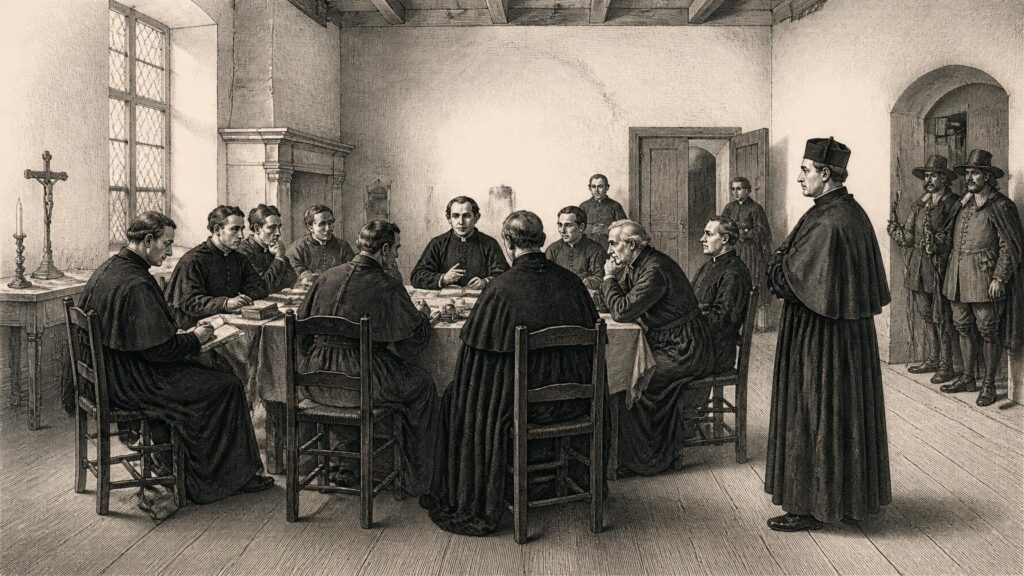
The year’s most revealing religious event took place in Dublin. On 11 June, with Ormond’s permission, Catholic clergy assembled in a national synod to discuss the Remonstrance promoted by the Franciscan Peter Walsh. Walsh sought a declaration of Catholic loyalty to Charles II which emphatically denied that the pope possessed authority to depose the king or release subjects from their allegiance. He and his allies hoped that this would demonstrate that Catholics could be politically trustworthy and might therefore receive protection and a better hearing in the land settlement.
The formula was deeply divisive. For opponents, it conceded too much in a state anxious to police Catholic loyalty and appeared to compromise the position of the Holy See. Edmund O’Reilly, Catholic archbishop of Armagh, attended the synod; he and other clergy accepted a less objectionable statement, but the meeting did not secure general acceptance of Walsh’s Remonstrance. The disagreement cannot be reduced to a simple choice between loyalty and disloyalty. Irish Catholics could profess fidelity to the crown while rejecting a text they believed trespassed on ecclesiastical authority.
Nevertheless, the assembly itself mattered. A hundred or so clerics were able to meet in the capital with official tolerance, illustrating the Catholic Church’s capacity for organisation after the upheavals of the 1640s and 1650s. At the same time, the need for Ormond’s consent exposed its vulnerability. The synod ended without the settlement Walsh wanted, and the Remonstrance controversy would continue. In 1666, Catholic religious life was neither extinguished nor free: it was active, intellectually contested and subject to close political calculation.
War, Fire and the Sea
Ireland was drawn into the Second Anglo-Dutch War through the composite Stuart monarchy. On 28 February a proclamation published the declaration of war against France, which had joined the Dutch side. Dublin government ordered a public fast on 8 June for the king’s armies and fleets, then appointed 6 September as a day of thanksgiving for the English naval victory of 25 July. These officially prescribed days joined parish worship to conflicts fought far from Irish fields, but with direct implications for shipping, ports and coastal defence.
Other proclamations show the maritime pressures more concretely. In March, authorities prohibited theft from prize ships in Irish ports. In July they set fees for purchasing privately held arms for the militia; in August they acted against soldiers leaving service without licence and called for concealed firearms to be located and returned to their owners. These were measures of a government concerned with discipline and defence, rather than evidence of a general Irish rebellion.
News of the Great Fire of London reached Ireland quickly. On 22 September, the lord lieutenant and council appointed 10 October as a day of fasting to mark the disaster. London was Ireland’s dominant political and commercial connection; a calamity that destroyed much of the English capital could not be treated as distant misfortune. The official response gave Irish congregations a ritual means of acknowledging the catastrophe, while underlining the hierarchy binding Dublin to the restored crown.
Hearths, Fisheries and Constrained Trade
The fiscal reach of government was visible within the household. Receivers of hearth money were appointed in August. The tax, levied on fireplaces, was a burden calculated from the domestic spaces in which people cooked and kept warm; surviving hearth-money material for the 1660s remains an important, if imperfect, guide to settlement and household distribution. Its existence should not be mistaken for a census, but it reminds us that the Restoration state sought revenue door by door as well as from customs and land.
On 15 August the government also addressed landowners who obstructed coastal fishing and encouraged the fishing venture of Thomas Walker and Company. The proclamation does not prove that the enterprise prospered. It does demonstrate official belief that fisheries merited encouragement and that access to shores and waters could provoke conflict between private claims and wider economic ambitions.
Livestock trade was another source of tension. Ireland had long supplied cattle and animal produce to England, but English protectionist restrictions already limited the trade. During 1666, parliamentary agitation in England moved towards the comprehensive import prohibition conventionally called the Cattle Act of 1666, although the statute received royal assent in early 1667. It should therefore not be represented as an Irish law enacted during this calendar year. Its approach nevertheless darkened the economic horizon for Irish graziers and merchants whose market depended heavily on England.
Sir James Ware’s Last Year
On 1 December Sir James Ware died at his Dublin home in Castle Street and was buried at St Werburgh’s. Auditor general, commissioner in the land settlement, parliamentarian and antiquary, Ware embodied the overlap between administration and learning in Restoration Dublin. His scholarship on Irish bishops, writers and medieval records was built through manuscripts and through collaboration with Irish-language scholars, notably Dubhaltach Mac Firbhisigh.
Ware’s death was not merely the passing of a civil servant. His collections and published work preserved material that later generations would use to reconstruct Ireland’s medieval past. That intellectual labour crossed confessional and linguistic boundaries even while political and religious divisions were being hardened elsewhere. In a year defined by disputed loyalties, land titles and military discipline, Ware’s final months offer a quieter but enduring Irish story: the survival of historical knowledge depended on collectors, scribes, translators and networks of trust.
Thus 1666 brought no single settlement of Ireland’s problems. Instead it made the character of Restoration rule clearer. Ormond’s government could crush a mutiny, supervise claims, tax hearths, regulate coasts and permit a watched Catholic synod. It could not make land confiscation uncontentious, resolve Catholic political theology, or shield Irish producers from decisions made across the Irish Sea. The year’s significance lies in that contrast between administrative reach and unresolved consent.
Primary Sources
- Act of Settlement [1662] and Act of Explanation [1665]
- Butler, James
- Penn, William
- These manuscript materials relating to William Penn and Ireland have been located and calendared
- Walsh, Peter
- O'Reilly, Edmund
- Phelan (O'Phelan), James
- Ware, Sir James
- Statute Law Revision Act 2015
- Hearth Money Rolls, etc., 1662-70, 1685, 1770, 1772
- The Irish Court of Claims of 1663
- Economic Trends, 1660-91
- The Constitutional and Parliamentary History of Ireland till the Union
- The Study of Irish Economic History
- A History of the Commercial and Financial Relations between England and Ireland from the Period of the Restoration
- Report on the Catholic Bishoprics of Ireland prepared for the Sacred Congregation de Propaganda Fide, entitled 'De Episcopi Hiberniae Anno 1666'
- Catholic Education in Restoration Ireland, 1660-1685
- Alexander, Sir Jerome
- The Great Fire of London: Food Shortage Caused by Fire
- The Great Fire of London: Call for a Public Fast to Remember the Fire
- Restoration Dublin in the Ireland of its Time, c. 1660-1700
- The Proclamations of Ireland 1660-1820