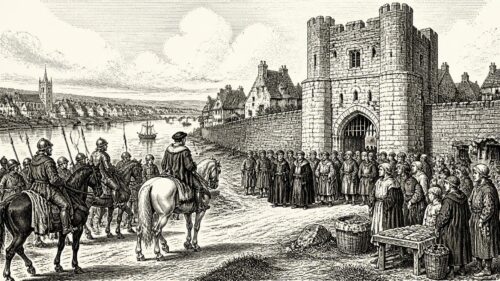
Mac Áeda’s Tuam Translation1312 CE
In 1312, ecclesiastical and governmental transitions highlighted tensions within Ireland’s lordship. William de Bermingham’s death created a vacancy at Tuam, where Máel Sechlain Mac Áeda, formerly bishop of Elphin, was formally translated on 19 December, strengthening Gaelic representation in a major metropolitan see. Religious life continued through developments at Boyle and episcopal deaths in Connacht. In Louth, a de Verdon rising defeated royal forces near Ardee, exposing fragile crown authority. Edmund Butler replaced John Wogan as keeper in August and administered Dublin while campaigning in Wicklow. These institutional changes preceded, but did not initiate, the crises of 1315 and afterwards.

Dateline
In 1312, Ireland did not experience a single island-wide turning point. Instead, the year is best understood through several closely dated changes in church leadership and government, set against a background of regional violence and an increasingly strained English lordship. The most important firmly dated Irish development came in Connacht: the death of William de Bermingham, archbishop of Tuam, opened the way for Máel Sechlain Mac Áeda, bishop of Elphin, to become archbishop. His elevation, completed formally on 19 December, joined a Gaelic churchman to one of the largest and most politically complicated ecclesiastical provinces in Ireland.
Elsewhere, the Dublin administration changed hands amid trouble in Louth and continuing pressure in Leinster. John Wogan, long-serving justiciar, was replaced as acting head of government by Edmund Butler on 7 August. These events did not yet amount to the Scottish invasion of 1315, the famine of the following years, or the great battles later remembered in Irish history. They nevertheless reveal the administrative, ecclesiastical and local tensions already present before those crises broke.
A Vacancy at Tuam
William de Bermingham died in January 1312 after more than two decades as archbishop of Tuam. His death was significant not simply because Tuam was a metropolitan see, with bishops of western and northern Connacht among its suffragans, but because Bermingham stood at an intersection of ecclesiastical office, Anglo-Irish lordship and the changing society of Connacht. He belonged to the powerful de Bermingham family associated with Athenry, Dunmore and other lordships. The archbishopric was thus not detached from secular politics: its lands, revenues, courts and buildings made it an important regional power.
The physical condition of Tuam illustrates the limitations as well as the ambitions of that power. Bermingham had promoted a substantial new cathedral, but the surviving evidence indicates that only its choir had been completed by his death. The projected church was grand in scale, while the resources available to finish it were plainly inadequate. A new archbishop inherited not an abstract spiritual dignity, but a working institution with clergy to support, estates to administer and an unfinished architectural statement at its centre.
The Annals of Connacht record both Bermingham’s death and the death of Benidecht Ó Bragáin, bishop of Leyney, during 1312. Episcopal vacancies mattered in a society where bishops were major landholders, judges and patrons as well as pastors. They also show that ecclesiastical change reached beyond the largest towns. Leyney, in the north-west of modern County Sligo, was a small diocese, but its bishop formed part of the wider provincial church governed from Tuam.
Máel Sechlain Mac Áeda was chosen for Tuam during the year, apparently after the chapter’s initial preferred candidate declined consideration. Mac Áeda himself hesitated and appealed to the papacy. It is therefore misleading to treat his election as though it instantly made him archbishop in every practical sense. The decisive, firmly dated stage was his translation from Elphin to Tuam on 19 December 1312. He did not receive the temporalities—the lands and secular revenues attached to the see—until 1 April 1313. The distinction is important: medieval ecclesiastical office was established through chapter election, papal decision, consecration or translation, and possession of property, often at different times.
Mac Áeda’s accession also had a marked local meaning. A native of Iar Connacht with links to the ruling Ó Flaithbheartaigh world, he was a Gaelic churchman succeeding an archbishop from an Anglo-Irish magnate family. That did not represent a simple transfer from one ‘nation’ to another: Tuam’s clergy, tenants, patrons and neighbours lived across Gaelic and settler political networks. But it did demonstrate that a Gaelic bishop could secure one of Ireland’s senior church offices through the recognised channels of chapter, crown and papacy. His long tenure, lasting until 1348, would make this transition one of the durable consequences of 1312.
Boyle and Connacht’s Religious Landscape
Connacht’s annals preserve a smaller but revealing religious notice: a Holy Cross was erected at the monastery of Boyle in 1312. The wording does not securely identify the form of the cross, its benefactor or the ceremony surrounding it, so none should be invented. Yet the entry is evidence of purposeful devotional and commemorative activity at Boyle, a Cistercian house on Lough Key’s eastern approaches. Monasteries were places of prayer, burial, hospitality, lordly patronage and record-keeping; an erected cross could make religious observance visible in the landscape while also expressing the standing of those associated with it.
The same annal notes that Easter fell in March that year. At first sight this is a slight detail, but it reminds us that the liturgical calendar organised the rhythms of fasts, feasts, markets, legal business and travel. Easter’s date determined Lent and many movable observances. For religious communities and lay households alike, the church year was a practical calendar as well as a sequence of sacred commemorations.
The annals also record the death of Derbail, daughter of Magnus Ó Conchobair. Such brief notices can seem private, but they point to the political importance of kinship among Connacht’s ruling families. Women of leading dynasties connected households through marriage, inheritance, fosterage and alliance, even when the surviving record gives little more than a name and parentage. The restraint of the evidence should be respected: 1312 supplies no basis for attaching Derbail’s death to a particular succession dispute or conflict.
Louth Disorder and a New Keeper
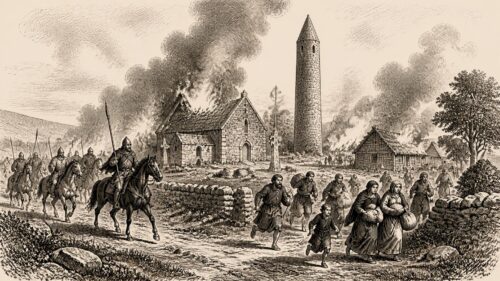
In the lordship of Ireland, the most serious political disturbance securely connected with 1312 occurred in County Louth. John Wogan’s administration faced a rising involving the de Verdons, a great Marcher and Irish landholding family. A royal force sent towards Ardee was defeated. The later Anglo-Irish chronicle known as Annales Hiberniae places the defeat on 10 July and names Nicholas Avenel and Patrick Roche among those killed; other evidence confirms the rebellion and the setback, even if the detail and sequence of the chronicler’s narrative should be treated cautiously.
This was not a conflict between neatly separate ethnic blocs. The dispute involved members and retainers of a leading Anglo-Irish family, royal officers, local communities and armed supporters drawn from the region. It shows how far the crown’s authority in Ireland depended on cooperation from magnates whose own affinities, grievances and armed followings could unsettle a strategically important frontier county. Louth lay on the routes between Dublin, Drogheda, Ardee, Dundalk and Ulster; disorder there was a direct problem for government rather than a remote local quarrel.
On 7 August, Edmund Butler became keeper of the land of Ireland, acting in place of Wogan. Modern accounts often call him acting justiciar, which accurately conveys his leading role, although contemporary administrative language could distinguish a ‘keeper’ from a fully appointed justiciar. Records from later in the year show the machinery of government still functioning at Dublin under Butler. A writ of 15 September concerning William Douz’s land at Tassagard, County Dublin, led to an inquisition held before Butler on 25 November. Jurors assessed the tenure and value of the holding: a modest example of how royal administration relied on local sworn knowledge to protect rents and rights.
Butler’s government also used force. Later annalistic testimony credits him with a campaign in Glenmalure against the Ó Broin or O’Byrne population of Wicklow, ending in their submission. The broad point is secure: Leinster’s uplands remained difficult territory for the Dublin regime, and expeditions into them required expense, mounted troops and negotiation as well as military pressure. Claims that Ireland had been ‘pacified’ should therefore be read as official aspiration rather than a literal description of the whole island.
An Irish Lordship in a Wider Crisis
The execution of Piers Gaveston in England on 19 June 1312 also mattered to Ireland, though it was not an Irish event. Gaveston had served as Edward II’s lieutenant in Ireland from 1308 to 1309 and had been connected with Irish military and financial affairs. His violent removal by the king’s baronial opponents exposed the political weakness of Edward II’s government. For Ireland, where royal authority already depended upon limited revenue, official appointments and the loyalty of powerful lords, instability at the centre was consequential.
It would be wrong, however, to write the later Bruce war backwards into 1312. Edward Bruce did not land in Ireland until May 1315. Scotland’s war with Edward II was already reshaping the political world around the Irish Sea, but there is no responsible basis for presenting 1312 as the opening of the Scottish invasion of Ireland. The year’s evidence instead shows a lordship managing its own immediate problems: a Louth rebellion, insecurity around Dublin’s hinterland, routine land administration and a change in executive leadership.
A Year of Institutions
For ordinary people, the year’s most tangible realities were likely the familiar demands of land, rent, service, harvest, religious observance and local protection. The records chiefly preserve the concerns of bishops, magnates, officials and monasteries, but they reveal institutions that touched many lives. Tuam’s cathedral project employed labour and drew resources; Boyle’s monastic cross marked a devotional landscape; a Dublin inquisition depended on jurors from local society; and campaigns in Louth and Wicklow brought danger, requisition and disruption to people far below the rank of those named in chronicles.
Thus 1312 is not chiefly memorable for a famous battle or a national settlement. Its importance lies in transitions. Máel Sechlain Mac Áeda’s formal move to Tuam gave Connacht a new metropolitan archbishop. Edmund Butler’s appointment signalled a new phase in the Dublin administration. The Louth revolt demonstrated the fragility of lordship authority, while records from Boyle and Tassagard show that religious patronage and governmental routine continued beside conflict. These developments formed part of the political and institutional landscape that would be tested far more severely after 1315.
Primary Sources
- Annála Connacht
- The Annals of Ulster: Year U1312
- The Annals of Ulster
- Annals of the Four Masters
- Annals of Loch Cé
- Annals of Inisfallen
- Annales Hiberniae
- Mac Áeda, Máel Sechlainn (Malachy, Malachias) | Dictionary of Irish Biography
- Wogan, John | Dictionary of Irish Biography
- Butler (le Botiller), Edmund | Dictionary of Irish Biography
- Gaveston, Piers de | Dictionary of Irish Biography
- Bicknor, Alexander | Dictionary of Irish Biography
- Burgh, William de | Dictionary of Irish Biography
- Irish Historic Towns Atlas: Tuam
- Inquisitions and Extents of Medieval Ireland
- Edward II and Ireland (in fact and in fiction)
- The Bruces in Ireland, 1315–18
- Calendar of the Patent Rolls Preserved in the Public Record Office: Edward II
- A Calendar of Irish Chancery Letters c.1244–1509
- The Mediaeval Irish Chancery