

Cloyne’s Medical Lecture1459 CE
In 1459, Ireland remained divided among lordships, churches, towns and learned families. Thomas FitzGerald, earl of Kildare, defeated and captured Conn O’Connor Faly in Offaly, strengthening Geraldine influence. Raids, burnings and killings in Breifne, Fermanagh and neighbouring territories reflected rivalry, while Toirdelbach Ó Briain’s death opened a transition in Thomond. Richard, duke of York, arrived after his defeat, making Ireland a Yorkist refuge, although Drogheda’s affirmation followed in 1460. Learned culture endured: scholars died, and Cormac Mac Duinnshléibhe completed an Irish medical translation at Cloyne. Ecclesiastical deaths marked the year, whose sources reveal conflict and patronage but little about conditions.
Dateline
The surviving record for 1459 does not yield a single, island-wide turning point. It instead shows Ireland as a patchwork of lordships, churches, towns and learned households, linked by travel and patronage but governed through many competing centres of power. The year brought a major defeat in Offaly, raids and burnings in the north-west and north-east, changes among regional rulers, and a notable act of medical translation at Cloyne. It also ended with the arrival in Ireland of Richard, duke of York, whose flight from English politics would give the lordship a new importance in the Wars of the Roses.
A Yorkist Refuge, Not Yet a Separate Parliament
In late 1459 Richard, duke of York, returned to Ireland after the collapse of his armed challenge to Henry VI’s Lancastrian government in England. York was no stranger to the island. As earl of Ulster and a great landholder through the Mortimer inheritance, he had been king’s lieutenant from 1447 and had personally governed in 1449–50. His earlier visit had won him useful support among the English-speaking political community of the Pale and among some powerful Gaelic lords. Thomas FitzGerald, seventh earl of Kildare, had served as York’s deputy and remained a natural ally.
York’s return in 1459 was therefore not a routine viceregal progress. It followed the Yorkist defeat at Ludford Bridge in October and made Ireland a refuge, a political base and a possible route back into English affairs. The Lancastrian regime soon attempted to counter him: James Butler, fifth earl of Ormond and earl of Wiltshire, was appointed lieutenant of Ireland in December. But appointment on paper did not equal possession on the ground. York’s established connections, and the weakness of direct royal control, meant that the contest between York and the Lancastrian court immediately had Irish consequences.
One important chronological distinction matters. The celebrated parliament at Drogheda which affirmed York’s authority, protected his person and asserted that Ireland was bound only by laws made or accepted in an Irish parliament belongs to 1460, not 1459. Its background lay in York’s late-1459 return, but it should not be used to manufacture a parliamentary event for this year. In 1459, the central development was the duke’s physical presence and the restoration of a Yorkist focus within the lordship.
Kildare’s Victory in Offaly
The year’s most consequential recorded Irish battle was fought by the earl of Kildare against Conn Ó Conchobair Fhailghe, or O’Connor Faly, lord of a powerful Gaelic dynasty in what is now County Offaly. The Annals of Ulster and the Annals of the Four Masters agree on the essentials: Kildare inflicted a major defeat; Conn himself was captured; and William Ó Ceallaigh, together with many of Conn’s followers, was killed. Neither source supplies a precise day or securely identifies the battlefield, so the encounter should not be given a spurious location or date.
Its importance is clearer than its topography. Offaly stood immediately west of the core colonial counties of the Pale and was a zone in which the reach of Dublin government, Geraldine lordship and Gaelic power overlapped. Kildare’s victory did not erase O’Connor Faly authority, but it gave the earl leverage over a formidable neighbour and began a process by which that dynasty became increasingly dependent on the Kildares. It also demonstrates that the office of deputy lieutenant was not merely ceremonial. Kildare could mobilise a substantial force, take a lord prisoner and convert military success into political influence.
The human cost was not confined to named leaders. The annals’ formula that many of Conn’s people died points to the wider retinues involved: fighting men, household followers and tenants called into service. Capture, death and the seizure of movable wealth could alter a district’s balance of power well beyond the battlefield. For communities living along this frontier, the security of cattle, grazing and seasonal movement depended on the outcome of conflicts between neighbouring lordships.
Raiding Routes Through Breifne and Fermanagh
In the north-west, the annals record the routines and violence of regional competition. Brian, son of Philip Maguire, carried off spoils from Cenél Duacháin or Cenél Luacháin. Thomas Óg Maguire raided Magh Slécht and burned the settlement of the Mag Samradháin family during the same expedition. These were not casual acts of disorder. Raiding was an established instrument of lordship: it removed livestock and other portable resources, damaged an opponent’s standing, rewarded a warband and announced the capacity of a ruling family to impose itself beyond its own territory.
Magh Slécht, in modern County Cavan, lay in the contested world of east Breifne. The burning of a town associated with the Mag Samradháins shows how quickly a raid could reach inhabited and politically meaningful places. Yet the annals do not say how many buildings were destroyed, whether a church was involved, or how long local recovery took. It is responsible to see disruption to households and production in such a report; it is not responsible to turn one terse notice into a detailed picture of devastation for which the evidence is absent.
Nearby, Glaisne, son of Conchobur Ó Raghallaigh, was killed by the sons of Ruaidhrí Mac Mathghamhna. This was a killing at the intersection of the O’Reilly and MacMahon political worlds, rather than proof of a single united northern war. The same caution applies to the record that Henry Ó Néill marched with a host described by the annalist as “Foreigners” to Oghma, seeking to take its castle from the sons of Art Ó Néill. Peace was made during the expedition. The notice confirms both military co-operation across political boundaries and a negotiated settlement; its wording does not safely tell us exactly who all the “Foreigners” were or the terms on which peace was reached.
Thomond After Toirdelbach
Further south, Toirdelbach Ó Briain, king of Thomond, died in 1459. Both the Ulster annalist and the Four Masters record the death, a reminder that the political map of Ireland depended not only on battles but on succession within ruling kindreds. Thomond, extending across much of present-day County Clare and adjoining districts, was one of the major Gaelic lordships of Munster. A ruler’s death raised immediate questions of succession, alliances and control of client families, though the annals give no date or narrative of the transition in this instance.
Later regnal lists place Tadhg an Chomhaid Ó Briain at the head of Thomond from 1459. That association makes the year a useful dividing line in the dynasty’s history, but it should not conceal the limits of the evidence. We can firmly date Toirdelbach’s death to the annalistic year; we cannot reconstruct a coronation scene, a precise accession day or the negotiations that brought the next ruler to power.
Learning, Poetry and Medicine
1459 is unusually revealing about learned life. The Annals of Ulster mark the deaths of Maghnus Ó Cuirnín, ollam or professor of history to the O’Rourkes; John the Stooped Mac an Bhaird, described as an eminent poet; and Máel Muire Ó Cianáin, expected to become a professor of history and poetry. Such notices show that professional learning was embedded in hereditary and patronage-based institutions. Historians, poets and legal or literary specialists served leading families, preserved genealogies and precedents, composed praise and satire, and trained successors. Their deaths mattered sufficiently to be recorded beside kings, chiefs and raids.
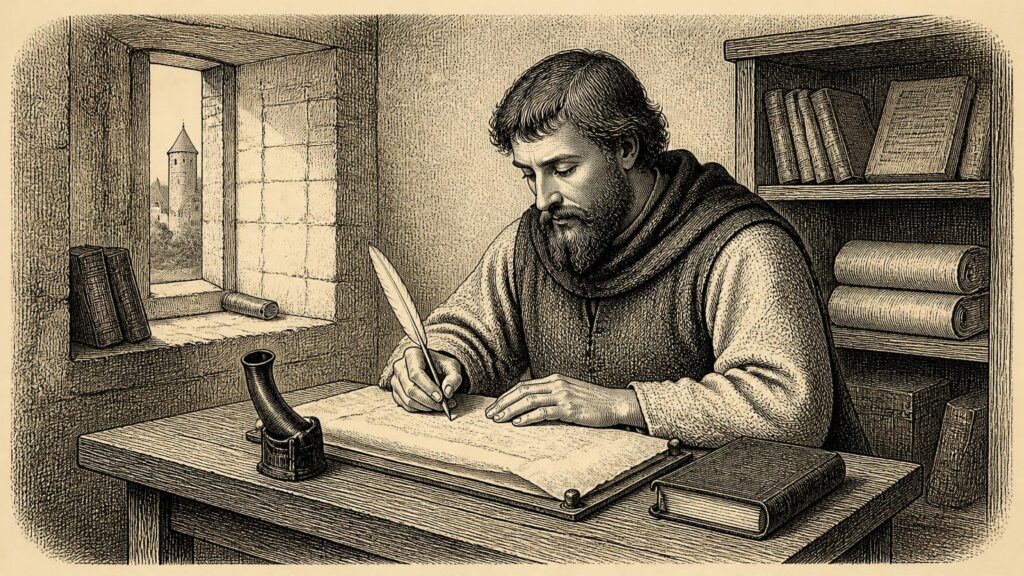
A surviving colophon gives the year an exceptionally precise cultural landmark. On the fourth day before the Kalends of April — 29 March — Cormac Mac Duinnshléibhe completed at Cloyne an Irish rendering of a medical summary on the doses of medicines, for Dermot Mac Donall Ó Laighin and his sons. Cormac identified himself elsewhere as a bachelor of medicine and belonged to the Mac Duinnshléibhe learned medical tradition. The text brought Latin medical material into Irish, making specialised knowledge usable within the language of Irish-trained physicians and their patrons.
This was not modern clinical science, nor should it be romanticised as such. The inherited medicine of the period combined classical authorities, Arabic-influenced learning, practical observation and older remedies. Nevertheless, the Cloyne colophon is hard evidence of intellectual work being commissioned, translated, copied and completed in Ireland in 1459. It also locates scholarly activity in Munster at precisely the moment when Thomond was undergoing a change of ruler. Political instability did not prevent the circulation of books, expertise and patronage.
Church, Communities and the Limits of the Record
Ecclesiastical life appears in quieter ways. Margaret Ó Breislen, mother of Pierce “the Abbot”, died on 1 February, one of the few entries with an exact day. Edmund Oldhall, Carmelite bishop of Meath, died at Ardbraccan on 9 August after a career entwined with Yorkist administration. His death mattered in the densely settled diocesan landscape of Meath, where bishops were landholders and political actors as well as spiritual office-holders. Yet 1459’s annals contain no general account of harvests, disease, prices, shipping or weather.
That silence is itself a warning. Ireland’s people continued to farm, herd, trade through ports and markets, worship in parish churches and religious houses, and travel along land and water routes. But the evidence consulted for this calendar year does not justify attaching a specific famine, epidemic, climatic event or commercial boom to 1459. What it does show is a society whose local life could be sharply affected by raiding and lordly rivalry, while its scholarly networks remained capable of preserving history, poetry and medicine. By year’s end, York’s arrival added a new external conflict to that already crowded political landscape.
Primary Sources
- The Annals of Ulster: Year U1459
- Annals of the Four Masters: Annal M1459
- Annála Connacht: Annal 1459
- Annales Breves Hiberniae
- Rosa Anglica: Introduction
- Rosa Anglica: Text
- Rosa Anglica: TEI Header
- Richard of York
- FitzGerald, Thomas ‘fitz Maurice’
- Butler, James, fifth earl of Ormond
- Butler, James, fourth earl of Ormond
- Nugent, Richard
- O'Neill (Ó Néill), Eóghan
- Statute Law Revision Act 2007
- English Lordship of Ireland and the Irish Sea World: Re-assessing the Origins of the Kildare Ascendancy, c.1390–c.1513
- A Collection of Medical Tracts in Irish, Compiled or Translated from Latin c.1459
- The Gaelic Learned Tradition
- Irish Script on Screen: MS 23 P 6, The Annals of the Four Masters
- CELT Project: The Annals of Ulster
- CELT Project: Annála Connacht
- CELT Project: Annals of the Four Masters
- Richard, Duke of York, as King’s Lieutenant in Ireland: The White Rose A-Blooming
- Ireland under the Tudors, Volume I
- The Church and Diocese of Meath in the 15th Century